
1. Learning objectives
Vocabulary is the collection of words and expressions that a person understands or uses. For BSN students, it supports lectures, reading, academic writing and clear professional interaction. This lesson focuses on English language learning, with fictional nursing-context examples. By the end, you should be able to infer a possible meaning from context, use word families and collocations, check meanings with a dictionary and build an effective review routine. You should also recognize when a precise technical meaning requires reliable clarification.
2. Receptive and productive vocabulary
Receptive vocabulary consists of words you recognize while reading or listening. Productive vocabulary consists of words you can retrieve and use appropriately in speech or writing. A learner may understand a word in a textbook but struggle to use it in a sentence. This difference is normal and suggests that recognition and active use need different practice.
To move a word toward productive use, say it, write an original sentence and use it in a meaningful task. Do not measure progress only by the number of translations memorized. The practical question is whether you can understand and communicate the intended meaning in context.
3. What knowing a word involves
Knowing a word involves more than its basic meaning. You need its pronunciation, spelling, grammatical role, common combinations, level of formality and relevant meanings. The word record can function as a noun or a verb. Its role affects how it fits into a sentence, and pronunciation can also vary by use.
A word may have several meanings. Critical can describe careful analysis, an important condition or a negative judgment, depending on context. Learning only one translation can therefore mislead you. Read the complete sentence, identify the situation and check the meaning that fits. Avoid assuming that every familiar everyday meaning is also its professional meaning.
4. Context clues
Context can suggest an unfamiliar word's meaning through a definition, example, contrast or cause-and-effect relationship. First read the whole sentence and nearby sentences. Identify the word's grammatical role and locate clues. Propose a meaning, then see whether that meaning makes the passage coherent.
Consider this original example: The library was crowded, so Sana looked for a vacant seat in the quieter room. The contrast between crowded and vacant suggests an unoccupied seat. However, context does not always reveal a precise meaning. A reasonable inference is a starting point, not a guarantee. For safety-critical instructions, unfamiliar technical terms must be checked rather than guessed.
5. Roots, prefixes and suffixes
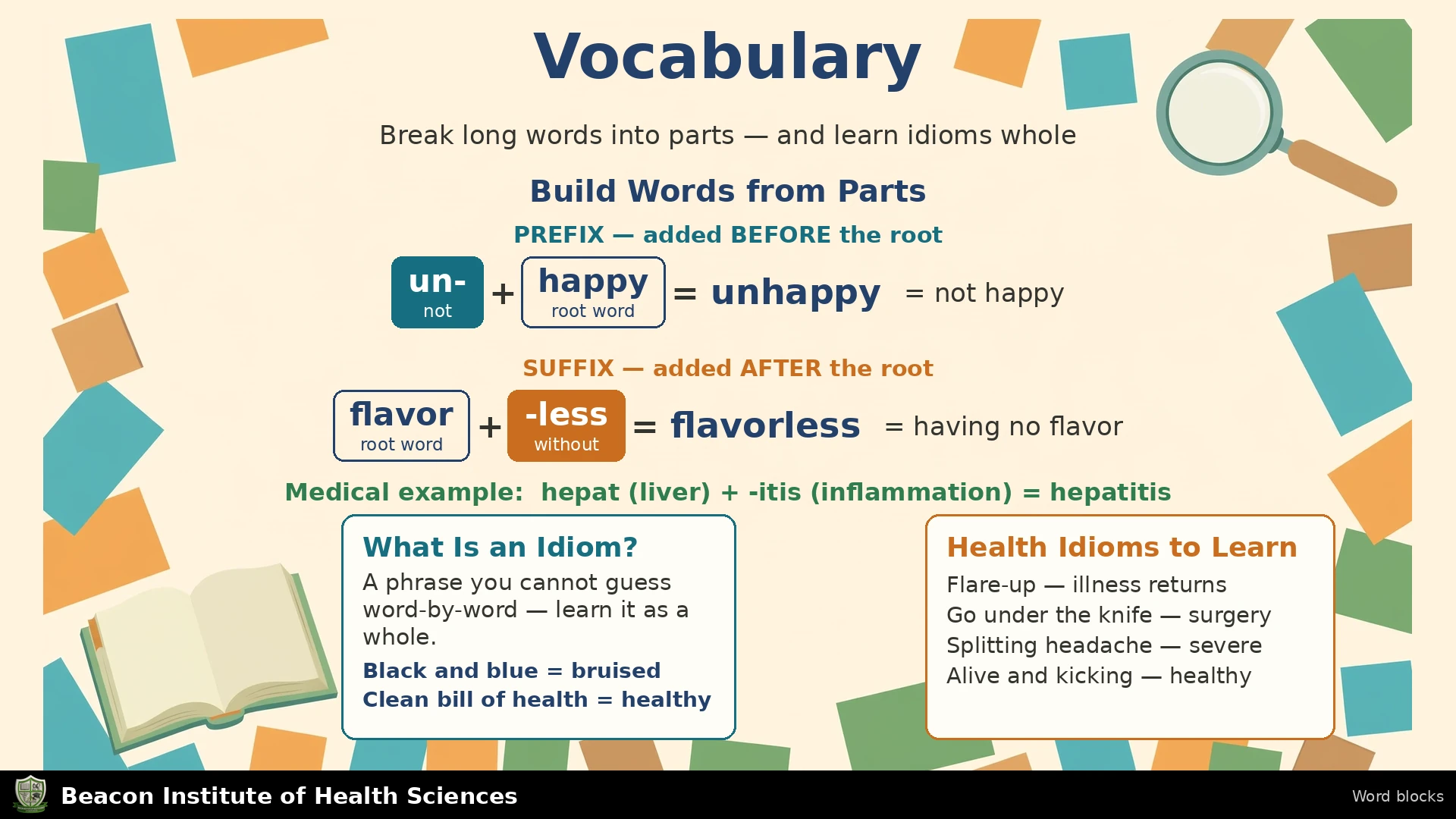
A prefix appears before a base, while a suffix appears after it. They can change meaning or grammatical function. Un- often contributes a negative meaning, as in unclear. Re- can indicate repetition, as in reread. Pre- can indicate before, as in preview. The suffix -ness forms nouns in words such as kindness; -ful and -less form adjectives in careful and careless.
Word formation is useful but not completely mechanical. Not every prefix or suffix combines with every base, and some words have meanings that cannot be predicted from their parts alone. Check unfamiliar formations in a dictionary. In professional terminology, a recognizable word part may offer a clue but does not establish a diagnosis or replace an exact definition.
6. Word families and grammatical roles
A word family contains related forms. Care, careful and carefully are related, but they cannot occupy the same position in every sentence. Compare: The student shows care; the student is careful; the student works carefully. The noun names a quality, the adjective describes the student and the adverb describes how the student works.
Assess and assessment offer another example: The team will assess the situation; the assessment is complete. Learn the form together with a sentence pattern. A notebook that lists only related words without their uses can leave the learner uncertain about grammar. Practise selecting the form that fits the actual sentence.
7. Relationships between words
Synonyms have related meanings, but their usage may differ. Small and minor overlap in some contexts but are not always interchangeable. Antonyms express contrasting meanings, such as clear and unclear. Homophones sound alike but differ in spelling or meaning, such as hear and here. Polysemy means that one word has several related uses.
Compound words combine elements, as in classroom and teamwork. Some compounds are written as one word, some as separate words and some with a hyphen. Check established spelling instead of assuming one pattern for all compounds. Learning relationships between words helps build connections, but sentence context remains essential.
8. Collocations and expressions
Collocations are combinations that occur naturally together. English commonly uses make a decision, take notes, attend a class and carry out an assessment. A sentence can be understandable yet sound unnatural if its word combination is unusual. Learn useful pairs or phrases rather than always studying words in isolation.
Phrasal verbs combine a verb with another element: look up a word, hand in an assignment and fill in a form. Their meanings are not always predictable from the individual parts. Formality also matters. Investigate may suit a formal report where look into suits ordinary conversation. Neither expression is automatically wrong; choose the one that fits the purpose and reader.
9. Dictionary use and vocabulary notebooks
A learner's dictionary can show pronunciation, part of speech, meanings, examples, common combinations and usage labels. Start with your sentence and identify the relevant meaning. Do not select the first definition simply because it appears first. Read example sentences to check grammar and use.
A useful notebook entry includes the word, an easy explanation in your own words, its role, an original sentence, a common combination and a related form. For clarify, you might record: make a meaning clearer; verb; Please clarify the meeting time; clarify a point; clarification. Add a review date and a question that makes you retrieve the word rather than merely reread it.
10. A mini glossary for study and communication
- Assess: examine information to make a judgment. The group assessed its progress.
- Observe: notice or watch carefully. The students observed the demonstration.
- Explain: make an idea understandable. Amina explained the task.
- Clarify: remove uncertainty in meaning. Please clarify the deadline.
- Confirm: check or establish that information is correct. Bilal confirmed the room number.
- Evidence: information that supports a conclusion. The report needs supporting evidence.
- Accurate: correct and precise. Check that the figures are accurate.
- Concise: using few words while keeping the necessary meaning. Write a concise summary.
- Consent: agreement or permission for a specified action. Seek appropriate consent before recording a practice interaction.
- Referral: directing someone or something to another appropriate service or person. The example describes a referral to a support service.
- Monitor: check something over time. Monitor your study progress each week.
- Revise: reconsider and improve work, or review learning. Revise the paragraph for clarity.
- Summarize: state the main points briefly. Summarize the passage in two sentences.
- Interpret: explain the meaning of information. Interpret the chart carefully.
- Collaborate: work jointly toward a purpose. The students collaborated on the outline.
These are general learning explanations, not full legal or clinical definitions. A professional term may carry more specific requirements in its actual setting.
11. Commonly confused words
Advice is usually an uncountable noun; advise is a verb. Compare: She offered useful advice; the tutor advised us to revise. Affect is commonly a verb meaning influence, while effect is commonly a noun meaning result. Specialized uses exist, so check the sentence rather than treating this as an exception-free rule.
Accept means receive or agree to; except means excluding. Patient can name a person receiving care or describe someone who tolerates waiting; patience names that quality. Compare: The patient waited patiently; her patience was appreciated. Their, there and they're also differ: possession, location and the contraction of they are. Proofread these words because spell-checking may not detect the wrong valid word.
12. Original context passage and model rewrite
Fictional passage: Sana prepared an outline before writing her report. Her first draft was lengthy and repeated several ideas. A partner suggested a more concise introduction. Sana removed the repetition, checked the evidence and clarified an ambiguous sentence about the meeting time. She then reviewed the final version against the task instructions.
Concise is suggested by removing repetition; ambiguous is suggested by the need to clarify the time. The passage describes revision, not evidence that every shortened report is better. Compare the vague sentence She made the thing better with the precise version Sana revised the introduction and clarified the meeting time. The improved version identifies both the work and the actions.
13. Practice questions and explained answers
- Which type of vocabulary is recognizing a word in reading? Receptive vocabulary, because the learner understands an incoming message.
- Complete: The student works _. Use carefully because an adverb describes works.
- Complete: Please _ notes. Use take, the usual collocation.
- What does vacant suggest in the library example? Unoccupied, supported by the contrast with crowded.
- Choose advice or advise: The tutor gave useful _. Advice is the noun required after useful.
- Choose affect or effect: Noise can _ concentration. Affect is the verb meaning influence.
- Choose accept or except: Everyone attended ___ Sana. Except indicates exclusion.
- Give the noun related to clarify. Clarification names the act or result.
- Why may a synonym be unsuitable? Its meaning, register or usual combinations may not fit the sentence.
- When should contextual inference be checked? When clues are inadequate or exact meaning matters, especially in technical instructions.
14. Review routine and checklist
Choose a small set of useful words, create meaningful sentences and test recall after intervals. For example, review them the next day, later in the week and again afterward, adjusting the schedule to difficulty. This is a sample routine, not a guaranteed memory formula. Mix recognition tasks with speaking and writing so that learning moves beyond familiarity.
Check meaning, pronunciation, spelling, role, collocation and register. Use new words in an original paragraph, then explain that paragraph aloud. Keep reading and listening to suitable material, and revisit errors without simply memorizing an isolated correction. Vocabulary becomes useful when it helps you understand and express precise ideas.