
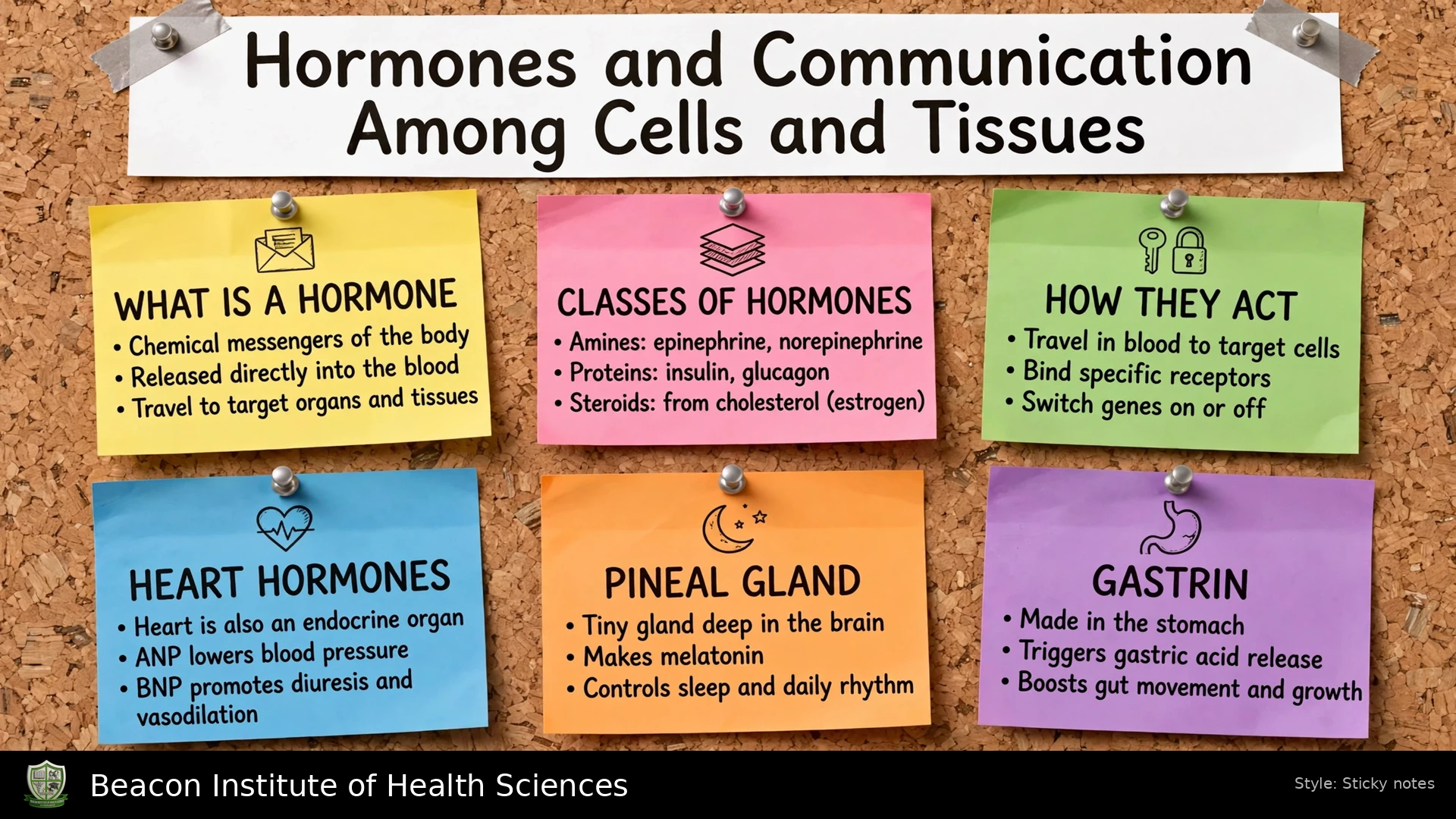
1. Learning objectives and the purpose of hormonal communication
Cells must coordinate their activities so that the body can maintain a stable internal environment while responding to meals, exercise, stress, growth and reproduction. Hormones provide chemical communication between tissues. A hormone is a messenger released by a cell that changes the activity of a responsive target cell. The message becomes useful only when the target can receive and interpret it.
- Distinguish endocrine, paracrine, autocrine and neural communication.
- Classify hormones and compare membrane receptor signaling with intracellular receptor action.
- Explain feedback regulation and the functions of cardiac, pineal and gastrointestinal hormones.
- Apply these mechanisms to nursing assessment, laboratory interpretation and patient education.
2. How cells communicate across different distances
Endocrine cells release hormones into tissue fluid and then the circulation. Blood carries the messenger widely, but only cells with appropriate receptors respond. Exocrine glands instead deliver their products through ducts, for example digestive enzymes into the intestinal lumen. A gland such as the pancreas has both endocrine and exocrine functions.
- Endocrine signaling: insulin travels from pancreatic islets to distant tissues.
- Paracrine signaling: a local messenger acts on neighboring cells, as occurs with somatostatin within pancreatic islets.
- Autocrine signaling: a secreted messenger influences the cell that released it.
- Synaptic signaling: a neuron releases a neurotransmitter across a short synaptic gap to a selected receiving cell.
- Neuroendocrine signaling: a neuron releases a hormone into blood, linking nervous and endocrine control.
- Direct communication: gap junctions allow small molecules and ions to pass between adjacent cells.
Distance alone does not determine the response. The receiving cell's receptors and internal machinery matter. The same messenger can produce different effects in different tissues, while several messengers can cooperate to regulate one physiological process.
3. Chemical classification of hormones
Chemical structure helps explain how a hormone is transported and where its receptor is located. Classification should therefore be connected to mechanism rather than learned as an isolated list.
- Peptide and protein hormones contain amino acid chains. Examples include insulin, glucagon, growth hormone, ADH and oxytocin. TSH, FSH and LH are glycoproteins with attached carbohydrate groups.
- Steroid hormones are derived from cholesterol. Cortisol, aldosterone, estrogen, progesterone and testosterone belong to this class.
- Amino acid derivatives include catecholamines and thyroid hormones derived from tyrosine, and melatonin derived from tryptophan.
Do not assume that every amino acid derivative behaves identically. Catecholamines act through membrane receptors, whereas thyroid hormones principally act through nuclear receptors. Likewise, chemical solubility is a useful guide, not a substitute for knowing the actual receptor and signaling pathway.
4. Hormone secretion, transport and duration of action
A hormone concentration reflects both entry into blood and removal from blood. Secretion can vary with meals, sleep, stress and other signals; a single measurement is therefore only a sample of a changing system. Transport proteins bind much of the circulating steroid and thyroid hormone, whereas many water-soluble hormones circulate without requiring such carriers. Bound and free hormone should not be treated as interchangeable measurements.
Half-life describes the time required for an amount or concentration to fall by half under specified conditions. It is not the same as the complete duration of a physiological response. Continued secretion, binding and downstream changes can alter what happens in the body.
Worked example: In a simplified model with no new secretion and a constant half-life of 10 minutes, an initial 80 arbitrary units becomes 40 units after 10 minutes and 20 units after 20 minutes. The relationship is A(t) = A(0) × (1/2)^(t/t½). This calculation illustrates exponential decline; it does not prescribe a medication dose or predict an individual patient's hormone concentration.
5. Receptors, target cells and sensitivity
Receptors are proteins that recognize particular signaling molecules. Cell-surface receptors receive signals outside the cell and transmit them inward; intracellular receptors bind suitable messengers inside the cell. Receptor presence explains why a circulating hormone affects selected targets rather than every cell it passes.
Receptor number, receptor affinity and events after binding influence responsiveness. Increased receptor expression can increase sensitivity, while receptor loss or impaired signaling can reduce it. A hormone can therefore be present in blood without producing its expected effect. Insulin resistance is an important clinical example of reduced responsiveness to a hormonal signal.
Think of communication as a sequence: messenger delivery → receptor recognition → intracellular interpretation → response. Failure at any stage may disturb the overall function. This is more useful than assuming that every endocrine disorder is simply too much or too little hormone.
6. Membrane receptors and second messengers
A water-soluble messenger generally cannot cross the lipid membrane freely. It binds a membrane receptor, which activates internal signaling proteins. The hormone outside the cell is the first messenger; small intracellular signaling molecules are called second messengers. A cascade can amplify the original signal because one activated component can influence several downstream components.
- cAMP pathway: receptor activation can stimulate a G protein, adenylyl cyclase and cAMP formation; cAMP can activate protein kinase A.
- IP3 and DAG pathway: phospholipase C generates these messengers; IP3 can release calcium from intracellular stores and DAG helps activate protein kinase C.
- Calcium: changes in intracellular calcium can regulate secretion, contraction and enzyme activity.
- Kinase-linked pathways: some receptors activate phosphorylation cascades rather than using cAMP as their principal messenger.
The insulin receptor has tyrosine kinase activity, so it should not be described as a standard cAMP receptor. Signaling must also stop: messengers are broken down, proteins are dephosphorylated and receptors can be internalized. Termination prevents a brief message from becoming an uncontrolled persistent response.
7. Intracellular action of steroid and thyroid hormones
Steroid hormones can enter cells and bind receptors in the cytoplasm or nucleus. The activated receptor influences gene transcription, leading to changes in RNA and protein production. Thyroid hormones also regulate gene expression through nuclear receptors, despite belonging chemically to the amino acid derivative group.
Gene regulation helps explain why many effects develop more slowly and last longer than a rapid enzyme response. However, avoid the absolute rule that every steroid effect is slow: additional rapid signaling mechanisms exist. The practical distinction is the principal mechanism being studied, not a fixed stopwatch for every hormone.
Compare the routes: A membrane receptor can rapidly alter an existing enzyme or transporter through a signaling cascade. A nuclear receptor can change the amount of a protein the cell makes. Both routes ultimately change cell behavior and may interact.
8. Stimuli for secretion and feedback control
Endocrine secretion responds to three useful categories of stimulus: a change in blood chemistry, a neural signal, or another hormone. These categories can operate together rather than being mutually exclusive.
- Humoral stimulus: a change in blood glucose influences insulin release; reduced blood calcium stimulates PTH secretion.
- Neural stimulus: sympathetic activity stimulates catecholamine release from the adrenal medulla.
- Hormonal stimulus: pituitary TSH stimulates thyroid hormone production.
Negative feedback reduces the original drive as the regulated variable or downstream hormone rises. For example, thyroid hormones suppress upstream stimulation in the hypothalamic-pituitary-thyroid axis. Positive feedback reinforces a process for a limited purpose; cervical stretch and oxytocin help strengthen contractions during childbirth until delivery removes the initiating stimulus.
Worked feedback sequence: If thyroid hormone production falls because the thyroid itself is failing, reduced feedback allows TSH to rise. The pituitary is sending a stronger signal, but the target gland cannot respond adequately. This explains why high stimulating hormone does not necessarily mean high target hormone.
9. The hypothalamus and pituitary as coordinating centers
The hypothalamus links information from the nervous system with endocrine control. Its releasing and inhibiting hormones reach the anterior pituitary through a specialized portal circulation. Anterior pituitary hormones then regulate other glands or act directly on tissues.
- TRH → TSH → thyroid hormones.
- CRH → ACTH → adrenal cortisol.
- GnRH → FSH and LH → gonadal function.
- Growth hormone supports tissue growth, partly through IGF-1; prolactin supports milk production.
The posterior pituitary stores and releases ADH and oxytocin made by hypothalamic neurons. ADH supports water conservation by the kidneys; oxytocin supports uterine contractions and milk ejection. Milk production and milk ejection are different functions, involving prolactin and oxytocin respectively.
10. Major gland functions in everyday physiology
- Thyroid hormones influence energy use, growth and development. Changes in thyroid function can affect temperature tolerance, bowel activity and heart rate.
- Parathyroid hormone helps maintain blood calcium through coordinated effects involving bone, kidneys and vitamin D activation.
- Adrenal cortex: cortisol contributes to stress adaptation and metabolism; aldosterone promotes renal sodium retention and potassium excretion.
- Adrenal medulla: epinephrine and norepinephrine support the sympathetic response, including changes in cardiovascular function and fuel availability.
- Endocrine pancreas: beta cells produce insulin, which supports glucose use and storage; alpha cells produce glucagon, which promotes hepatic glucose release when needed.
These functions operate as a network. After a meal, insulin favors storage; during fasting, glucagon supports available glucose. During stress, several hormones contribute simultaneously. A patient's signs should therefore be interpreted with the clinical situation, medication history and appropriate laboratory results.
11. Cardiac hormones: ANP and BNP
The heart is also an endocrine organ. Stretch associated with increased filling stimulates natriuretic peptide release. Atrial natriuretic peptide, or ANP, is associated mainly with the atria; B-type natriuretic peptide, or BNP, is released prominently by the ventricles under increased wall stress. Their actions help promote sodium and water excretion and reduce the circulatory workload.
BNP and NT-proBNP blood tests help clinicians assess possible heart failure. NT-proBNP is the inactive fragment released when the BNP precursor is processed; it is a marker, not the active hormone itself. Elevated values must be interpreted with symptoms and other findings, because age and conditions such as kidney disease can influence results.
Nursing scenario: A patient has breathlessness, ankle edema and an elevated natriuretic peptide result. Assess respiratory status, oxygen saturation, vital signs, fluid balance and weight trends; report deterioration promptly and follow prescribed care. The laboratory result supports assessment but does not replace clinical evaluation or independently establish a treatment plan.
12. Pineal hormone and the body's timing signals
The pineal gland secretes melatonin, a messenger involved in circadian timing. Light information reaching the brain helps coordinate daily rhythms; melatonin secretion normally rises during the biological night. It is better understood as a signal of darkness and timing than as a switch that automatically causes sleep in every situation.
Illness, shift work and nighttime environmental disturbance can disrupt sleep routines. Nursing measures include supporting a regular sleep-wake pattern when feasible, reducing avoidable nighttime light and noise, and coordinating care to limit unnecessary sleep interruption. Daytime light and activity can help reinforce appropriate timing where the patient's condition permits.
Melatonin supplements are a separate medication decision, not an automatic consequence of understanding the physiology. Assess prescribed medicines and patient-reported supplements and communicate relevant concerns to the care team.
13. Gastrointestinal hormones coordinate digestion
Endocrine cells in the digestive tract connect the arrival of food with secretion and movement. The stomach, pancreas, gallbladder and intestine must respond in a coordinated sequence rather than working independently.
- Gastrin: released by gastric G cells; supports gastric acid secretion and digestive activity.
- Secretin: released from the small intestine when acidic contents arrive; promotes pancreatic bicarbonate secretion to help neutralize acid.
- Cholecystokinin, or CCK: released in response to nutrients, especially fats and proteins; stimulates pancreatic enzyme secretion and gallbladder contraction.
- GIP and GLP-1: intestinal incretin hormones that enhance glucose-dependent insulin secretion, linking nutrient intake to pancreatic response.
Meal sequence: Food stimulates gastric responses; acidic chyme entering the duodenum favors secretin release; nutrients favor CCK and incretin responses. Bicarbonate creates a more suitable environment for intestinal digestion, enzymes break down nutrients, and insulin helps manage absorbed glucose. This illustrates communication among tissues during one ordinary meal.
14. Nursing assessment and interpretation of endocrine problems
Combine symptoms, examination, trends and laboratory results. Record the timing of samples when relevant and identify medicines that may influence hormone secretion, binding or measurement. Reference intervals depend on the laboratory and the test, so avoid applying a single memorized range to every patient.
- Thyroid scenario: fatigue and cold intolerance with high TSH and low free T4 suggest a primary hypothyroid pattern. Report findings for clinical interpretation; pituitary disease and other circumstances require different reasoning.
- Glucose scenario: a patient receiving insulin becomes sweaty and confused. Check glucose promptly where feasible and activate the institution's hypoglycemia assessment and treatment protocol; do not delay urgent care while discussing receptor mechanisms.
- Water balance scenario: unexpected thirst, altered urine output or changing sodium requires assessment of intake, losses, medications and renal function. ADH is one contributor, not the only possible explanation.
- Patient education: explain the purpose and schedule of prescribed hormone medicines, reinforce monitoring and ask patients to discuss changes with their clinician rather than adjusting treatment themselves.
Mechanism supports safer observation: a hormone may be deficient, excessive, ineffective at its receptor, or altered by another organ's dysfunction. Nursing care connects those possibilities with the patient's actual condition and the agreed care plan.
15. Summary and self-assessment
Hormonal communication depends on messenger release, transport, receptor recognition, intracellular signaling and feedback. Classify the hormone, identify its receptor route, name its target and explain the regulated variable. Remember that the heart, pineal gland and digestive tract also contribute important endocrine messages.
- Why does a hormone in blood affect only selected cells? Appropriate receptors and signaling machinery are required.
- How do endocrine and paracrine signals differ? Endocrine signals travel through blood; paracrine signals act locally.
- Which class includes cortisol? Steroid hormones derived from cholesterol.
- What is a second messenger? An intracellular molecule relaying a signal received at a membrane receptor.
- Why can TSH rise when thyroid hormone is low? Reduced negative feedback increases upstream stimulation.
- Which hormones support sodium and water loss from the circulation? Cardiac natriuretic peptides.
- What does melatonin communicate? Information about circadian timing and biological night.
- How do secretin and CCK differ? Secretin promotes bicarbonate secretion; CCK promotes enzyme release and gallbladder contraction.