Introduction to Communication
Communication skills are fundamental for both daily human experience and professional clinical practice. In healthcare, effective communication is an absolute necessity for a successful nursing career. It serves as the primary mechanism through which nurses establish therapeutic relationships, conduct clinical assessments, and deliver safe, patient-centred care.
Definition of Communication: Communication is defined as the interchange of information between two or more people. It is the exchange of ideas or thoughts among individuals, which can occur through various mediums, including speaking, writing, or bodily movements. Whenever information or thoughts are shared between individuals, communication is actively taking place.
Elements of the Communication Process
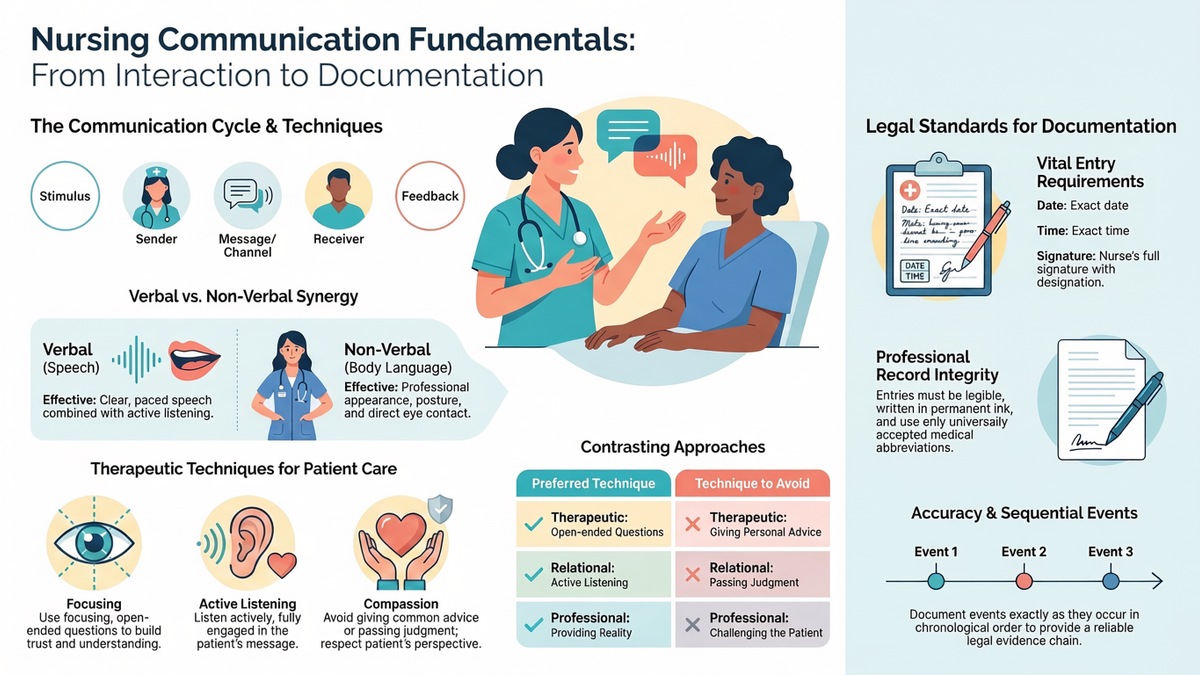
The communication process is a dynamic, continuous cycle consisting of six essential elements that must function together for message transmission to be successful:
Stimulus
A stimulus is any factor or sensory prompt that initiates or triggers an action. In communication, it is the motivating force that induces an individual to communicate. Without a stimulus, the communication process does not begin.
Clinical Example: A patient's disease, pain, or symptoms serve as a stimulus that prompts a nurse to initiate communication. Similarly, academic needs stimulate an instructor to teach or a student to ask questions.
Sender (Source / Encoder)
The sender is the individual or group who wishes to convey a message. The sender acts as the source of communication and is responsible for encoding the message.
Encoding: This is the selection of specific signs, symbols, or codes (such as language, words, gestures, or tone of voice) to transmit the message. The sender arranges thoughts into a structured format for the receiver to understand, considering cultural and linguistic factors.
Message
The message is the actual substance or content of what is said, written, or conveyed. It is the third component of the communication process and represents the information itself.
Body Language Accompaniment: Verbal messages must always be accompanied by appropriate body language to convey correct meaning. For example, expressing happiness verbally must be paired with a smile. If expressing sadness or concern, facial expressions must match the emotional gravity of the situation.
Channel (Medium)
The channel is the medium or pathway used to transmit the message from the sender to the receiver. An effective channel must target and stimulate the receiver's physical senses to ensure the message is perceived.
Examples: Face-to-face spoken communication targets the receiver's auditory sense (hearing the voice) and visual sense (observing facial expressions). The channel must be appropriate for the message type; if a proper channel is missing or blocked, communication fails.
Receiver (Decoder)
The receiver is the listener, reader, or observer who receives the transmitted message. In the communication process, the receiver is responsible for decoding.
Decoding: The receiver must listen closely, observe carefully, and understand (interpret) the message in their brain. While the sender encodes, the receiver decodes by unpacking and interpreting the signs and symbols to understand the original meaning.
Feedback
Feedback is the response that the receiver returns to the sender after interpreting the message. It is the final component of the communication cycle and confirms whether the message was successfully understood.
Clinical Example: When a nurse explains a procedure, the patient may nod, say 'yes', or say 'hmm'. This feedback reassures the sender (nurse) that the receiver (patient) has properly received, decoded, and understood the information.
Modes of Communication
Communication primarily occurs through two major modes: Verbal Communication and Non-Verbal Communication. Nurses must master both to practice effectively.
Verbal Communication
Verbal communication involves the transmission of messages using spoken or written words. The effectiveness of verbal communication depends on several critical characteristics:
- Pace and Intonation: Pace refers to the rhythm and speed of speech, while intonation refers to the tone of voice. The rate, rhythm, and tone used directly affect how the message is received. An impolite, overly rapid, or aggressive tone will hinder effective communication and damage the therapeutic relationship.
- Simplicity: Using simple and clear language that can be easily understood and processed by the receiver is crucial. Nurses must select words matching the client's IQ level, understanding, educational background, and culture, strictly avoiding complex medical terminology or professional jargon.
- Clarity and Brevity: Clarity means being precise, clear, and direct. Brevity means keeping the message as concise and short as possible, utilizing only necessary words without unnecessary or confusing elaboration.
- Timing and Relevance: Timing is critical in healthcare communication. A nurse must not bombard a client with multiple questions consecutively without allowing adequate time for processing information and feedback. The message must also be highly relevant to the patient's immediate concerns and clinical situation.
- Adaptability: The nurse's ability to modify their mood, behavior, and tone of voice based on the client's emotional state and situational cues. For instance, with an anxious patient, the nurse must adapt by maintaining a supportive, empathetic tone and asking about their concerns, rather than an inappropriately cheerful or indifferent behavior.
- Credibility: Establishing trust and belief in the nurse's professional capabilities and information. A client will only communicate openly if they perceive the nurse as credible and trustworthy. Credibility is built by being consistent, showing genuine empathy, being highly responsible, and delivering dependable care.
- Humor: Humor can relieve tension, promote comfort, and support the patient's journey toward health. However, humor must be used with extreme caution and must fit clinical circumstances. Inappropriate use during serious situations will damage professional standing.
Non-Verbal Communication
Non-verbal communication is the transmission of messages without spoken or written words. It relies entirely on body language, physical expressions, and sensory cues:
- Personal Appearance: A person's appearance offers a strong initial indicator of their personality, emotional state, grooming, and hygiene. A well-groomed person often suggests a stable emotional state. Conversely, a severely depressed client may neglect personal grooming and hygiene. As patients recover, they often show renewed interest in their appearance.
- Posture and Gait: How a person carries themselves (posture) and walks (gait) communicates significant emotional data. An erect posture typically signals confidence. A rapid, erratic, or disorganized gait can reflect high levels of anxiety, stress, or depression.
- Postural Cues: Tightly crossed arms and legs signal a closed posture, indicating defensiveness, discomfort, or reluctance to share information. Relaxed arms, uncrossed legs, and a gentle smile represent an open posture, signaling comfort and receptiveness. Nurses must consciously maintain open postures and monitor client cues.
- Facial Expressions: The human face is the most expressive part of the body, rapidly transmitting emotions. A simple smile conveys warmth and positive energy. Facial expressions reveal feelings of surprise, fear, anger, disgust, happiness, and sadness. Nurses must keep their facial expressions congruent with their clinical messages.
- Eye Contact: Eye contact is a vital component of face-to-face non-verbal communication. In many cultures, maintaining steady eye contact is viewed as a sign of respect, sincerity, and interest. Patients observe nurse's eye contact closely, especially when asking serious questions. Breaking eye contact may be interpreted as hesitation, dishonesty, or a lack of care.
- Gestures: Hand and body movements emphasize verbal communication and add clarity. Common gestures include nodding for agreement, shaking hands, waving, or tapping fingers. Gestures make communication highly expressive.
- Special Applications: Gestures form the basis of sign language. In ICU settings, semi-conscious or comatose patients may rely on subtle gestures (e.g., moving a single finger) to indicate agreement, disagreement, pain, or distress.
Factors Influencing Communication
An individual's communication is influenced by several intrinsic and extrinsic factors that can either facilitate or interfere with the exchange of information:
- Developmental Stage: Communication and perception skills change dramatically across a person's lifespan. Nurses must understand the patient's developmental stage to choose appropriate communication strategies.
- Clinical Application: When explaining medical procedures to an 8-to-9-year-old child, using play, toys, and simplified language is effective. Adolescents and adults, in contrast, require detailed, mature, and logically structured explanations regarding their disease process, diagnostic tests, and treatment plans.
- Gender: Men and women often exhibit distinct communication patterns. Females frequently build friendly, collaborative relationships more rapidly and may express greater comfort seeking supportive care. Males often emphasize independence, may minimize or deny physical symptoms, and are less likely to verbalize health problems quickly. Nurses must adapt their approach to respect these gender-based tendencies.
- Values and Perceptions: Values represent personal standards, and perceptions are how an individual interprets their environment. Aligning communication with a patient's values is crucial.
- Clinical Example: If a patient starts crying in their hospital bed and the nurse immediately draws the bedside curtains to provide physical privacy, the patient perceives this as an act of genuine caring and respect. This action shows the nurse respects their emotional boundaries, building clinical trust.
- Personal Space: Personal space is the physical distance maintained during human interactions. Four distinct zones of personal space exist:
| Space Zone | Source Description & Context | Nurse-Client Clinical Application |
|---|---|---|
| Intimate Zone | The closest physical proximity. Typically reserved for highly loved ones, family, parent-child, or spouse relationships. | Rarely entered by the nurse except during close, hands-on clinical procedures and physical care, which must be done with utmost respect and professional consent. |
| Personal Zone | A moderate distance that is less intimate than the intimate zone. Voice tone is kept moderate, and facial expressions are easily read. | The standard zone for therapeutic nurse-client interactions. Examples include sitting on a chair next to the patient's bed, administering medications, or conducting a physical assessment. |
| Social Zone | A formal, structured distance used primarily for group interactions and formal instructional settings. | Examples include teaching a group of students in a classroom or conducting administrative meetings. |
| Public Zone | The greatest distance utilized in communication, typically when addressing a larger crowd or public audience. | Examples include public speakers, community leaders, or health educators addressing a large public gathering. |
- Territoriality: Territoriality is the instinct to claim and defend a physical territory or space. In a hospital, patients treat their assigned bed, private room, bedside locker, and furniture as personal territory. If a nurse or other healthcare worker rearranges, handles, or moves these personal items without the patient's permission, the patient may feel their territory has been invaded and become defensive. Respecting the client's territory by asking for permission before moving items builds trust and respect.
- Roles and Relationships: The defined roles and the history of the relationship between the nurse and patient significantly affect communication. A first-time interaction will be more formal and cautious. A second interaction, with an already established bond of trust, will be more open, comfortable, and effective. Nurses must focus on building supportive relationships from initial contact.
- Environment: The environmental conditions where communication occurs play a huge role. A quiet, comfortable, relaxed, well-ventilated, and well-lit environment greatly facilitates effective communication. Conversely, environmental barriers such as extreme temperatures, loud background noises, or poor lighting interfere with communication, making it difficult to concentrate.
- Congruence: Congruence is the alignment between verbal words spoken and non-verbal body language. To communicate effectively, a nurse must always maintain congruence. For example, if a nurse verbally expresses happiness or care, their facial expressions, tone of voice, and eye contact must actively reflect that warmth. If the nurse says they are happy but has a cold, unsmiling expression, the communication is incongruent, and the patient will perceive non-verbal cues as the true message, leading to loss of trust.
- Interpersonal Attitude: The attitude and emotional stance a nurse displays toward a client. Displaying warmth, genuine caring, respect, and non-judgmental acceptance of the client's feelings facilitates open dialogue, makes the patient feel safe, and enhances the overall therapeutic communication process.
Therapeutic Communication Techniques
Therapeutic communication techniques are specialized, goal-oriented methods used by nurses to build trust, facilitate the open expression of feelings, and support the patient's coping and health. To help students recall these essential techniques, the mnemonic FROST PUBG is used. The techniques are detailed below:
| Technique | Definition and Clinical Purpose | Real-World Clinical Example |
|---|---|---|
| Focusing | Helping the client narrow their attention to a specific health concern or immediate problem, preventing their thoughts from wandering into unrelated issues. | Client: 'My wife says she will look after me, but the kids always follow her for homework, so she has to manage that too, and I'm worried...' Nurse (Focusing): 'But how will you manage your care and meals if she is busy with the children?' |
| Restating | Actively listening to the patient's message and repeating the core thoughts or feelings back to them using similar words, confirming they are heard. | Client: 'I have trouble talking to strangers.' Nurse (Restating): 'You find it difficult talking to people?' |
| Reflecting | Mirroring the client's expressed feelings, thoughts, and ideas back to them to encourage deeper self-exploration and validation. | Reflecting the client's emotional state or concerns back to them so they can process their feelings and gain self-awareness. |
| Open-Ended Questions | Asking broad, non-directive questions that cannot be answered with a simple 'yes' or 'no', encouraging detailed explanation. | Nurse: 'Tell me about how you managed your symptoms at home' or 'What is your opinion on this treatment?' |
| Seeking Clarification | Asking the client to explain, rephrase, or provide more detail about a vague or broad message to ensure mutual understanding. | Nurse: 'Please tell me that again' or 'Could you explain what you mean by that?' |
| Touch Therapy | Using appropriate, professional physical touch (such as holding a hand or patting a shoulder) to convey deep warmth, caring, and reassurance. | Placing a supportive hand on the client's shoulder. This must always align with professional boundaries, clinical guidelines, and the client's cultural norms. |
| Presenting Reality | Gently helping the client remain grounded in what is real when they are experiencing confusion, hallucinations, or misinterpreting their environment. | Calmly presenting the actual facts of the environment to correct a patient's confusion or distorted perception without arguing. |
| Using Silence | Allowing deliberate pauses and quiet moments in the conversation. This gives the client time to organize thoughts and process emotions. | Sitting quietly with a distressed patient, allowing them the time and space to think and speak without being rushed or interrupted. |
| Being Specific & General | Making specific, clear statements tailored to the client's needs rather than vague generalizations, and using broad openings. | Providing clear, specific guidance on care procedures rather than vague, generalized statements that lead to confusion. |
| Active Listening | Being fully present in the moment—listening closely, observing non-verbal behaviors, and validating the patient's messages. | Maintaining attentive posture, nodding, and utilizing verbal/non-verbal cues to show total engagement with the patient's story. |
Non-Therapeutic Techniques (Communication Barriers)
Non-therapeutic communication techniques are behaviors and responses that block, disrupt, or interfere with the therapeutic relationship. These barriers discourage the client from expressing their true feelings and can diminish their sense of personal worth, autonomy, and trust in the healthcare team. Nurses must recognize and strictly avoid these responses:
| Barrier Technique | Description & Therapeutic Interference | Real-World Clinical Example |
|---|---|---|
| Giving Common / Personal Advice | Telling the patient what they should do based on the nurse's personal opinions or values. This takes away the client's autonomy and implies they are incompetent. | Client: 'Should I move to a nursing home for better care?' Nurse (Non-Therapeutic): 'If I were you, I would go to a nursing home where I will get cooked meals.' (This is personal advice, which is inappropriate. Nurses may provide expert, objective advice on care options, but not personal advice). |
| Rejecting | Refusing to discuss or explore certain topics brought up by the client. This makes the patient feel rejected, unheard, and unvalued. | Client tries to talk about a difficult topic, and the Nurse says: 'I don't want to talk about this, let's change the topic.' |
| Agreeing or Disagreeing (Specifically Disagreeing) | Opposing or arguing with the client's thoughts or perceptions. Disagreeing makes the client defensive and reinforces their negative beliefs. | Client: 'I think the doctor is not interested in her patients.' Nurse (Non-Therapeutic Disagreeing): 'No, I know her, she is an excellent doctor.' (This defensive response invalidates the patient's feelings and makes them defensive, strengthening their negative belief). |
| Stereotyping | Offering generalized, oversimplified, and baseless beliefs about individuals or groups. It ignores the patient's unique individual feelings. | Telling a crying male patient: 'Men don't cry, why are you crying?' or telling a female patient: 'Women are always complaining about these kinds of issues.' |
| Probing | Asking highly personal, intrusive, or sensitive questions out of mere curiosity rather than clinical or therapeutic necessity. | Client was involved in a car crash while driving at 120 km/h. Nurse asks: 'Why were you speeding so fast?' (This is intrusive, judgmental probing that violates personal space). |
| Challenging | Demanding that the patient prove their assertions or perceptions, which forces them to defend themselves and damages trust. | Arguing against a patient's description of their experiences or demanding logical proof for their subjective feelings. |
| Unwarranted Reassurance | Providing empty, baseless reassurance (false hope) without any clinical grounding, which minimizes the patient's real worries. | Telling a seriously ill patient: 'Don't worry, everything will be perfectly fine,' when there is no clinical basis for such a claim. |
| Interrupting | Cutting off the patient while they are speaking, which prevents them from fully expressing their thoughts, concerns, and feelings. | Stopping a client mid-sentence to input the nurse's own thoughts, showing a lack of respect for the client's voice. |
Legal Aspects of Clinical Documentation
Definition of Documentation: Clinical documentation is the formal process of writing, recording, and maintaining a complete record of the client's health data and history. It encompasses all stages of the nursing process: Assessment, Diagnosis, Planning, Implementation, and Evaluation (ADPIE).
Legal Significance: Clinical charts and nursing records are legal documents. They can be subpoenaed and utilized in a court of law as primary evidence. Therefore, documentation must be written with extreme precision, absolute honesty, and professional care. Falsifying or neglecting records carries severe legal liabilities. The instructor details ten non-negotiable guidelines for legally sound clinical documentation:
Date and Time
Every single entry in the medical record must explicitly state the exact date and time it was written. It must be documented in a conventional manner, clearly specifying AM or PM, to establish a precise timeline of care.
Legibility
All handwriting must be clear, clean, and legible. If other healthcare providers or legal authorities cannot easily read and understand the writing, the quality of care is compromised, and the document loses its clinical and legal utility.
Permanence (Dark Ink)
All entries must be written using dark ink (not pencil or light, erasable ink). This ensures that the records are permanent and cannot be erased, altered, or tampered with over time.
Accepted Terminology and Abbreviations
Nurses must strictly use universally accepted medical terminology and standard abbreviations (e.g., OD for once daily, BD/BID for twice daily). Nurses must never invent custom, personal, or non-standard abbreviations, as they lead to dangerous medical errors and are legally indefensible.
Correct Spelling
Ensuring correct spelling is essential. It prevents clinical misunderstandings, maintains professional standards, and projects a highly credible and competent image of the nurse and the healthcare institution to higher authorities and courts of law.
Signatures and Designation
Every single recording must be signed by the person who wrote it and must include their professional designation (e.g., RN for Registered Nurse, Student Nurse). This verifies that the entry was made by an authorized, accountable professional.
Accuracy and Truthfulness
All documented data must be highly accurate, factual, and strictly truthful. Nurses have a profound ethical and legal responsibility never to fabricate, copy, or fake data.
Severe Legal Violation Example: If a patient's condition is deteriorating and a nurse is too busy to measure vital signs, but instead writes down fabricated 'normal' values, this is a major legal and ethical offense. If the patient has a sudden cardiorespiratory arrest and dies, the nurse will be held legally and criminally liable for falsifying records during the subsequent investigation.
Chronological Sequence
Events must be documented in the exact chronological sequence in which they occurred. When documenting complex events, such as a patient's death, the record must tell a clear, sequential story: the patient's initial condition, the sudden drop in respiration, ECG/cardiac monitor fluctuations, the occurrence of cardiorespiratory arrest, the resuscitation efforts, and the final outcome.
Completeness
Records must be completely filled out, leaving no blank lines or empty spaces where unauthorized additions could be written. If a line is partially empty, it should be crossed out. Additionally, every single page of the record must clearly contain the client's name, ID number, and other identifying information to prevent page-mixing.
Conciseness (Brevity)
While documentation must be thoroughly complete and sequential, it should be kept as concise and short as possible. Unnecessary filler words should be omitted so that other healthcare professionals can quickly read, understand, and act upon the recorded information.