
Learning Objectives
- Explain the surveillance cycle and distinguish surveillance from notification.
- Compare common surveillance approaches.
- Apply case definitions, reporting procedures and confidentiality principles.
- Calculate and interpret selected health and reporting indicators.
- Describe nursing action from early recognition to feedback.
Surveillance: Information for Action
Public-health surveillance is a continuing process of collecting, checking, analysing and interpreting health information, sharing findings and using them to guide action. It can identify unusual events, monitor disease trends, assess service needs and support evaluation. Collecting reports without interpreting or acting on them is not a complete surveillance system.
Notification is the formal reporting of a specified disease, condition or event to the responsible health authority. It supplies information for surveillance and may be required by law or programme rules. Surveillance is broader than notification: it may also use laboratory information, surveys, death registration, sentinel facilities and event alerts.
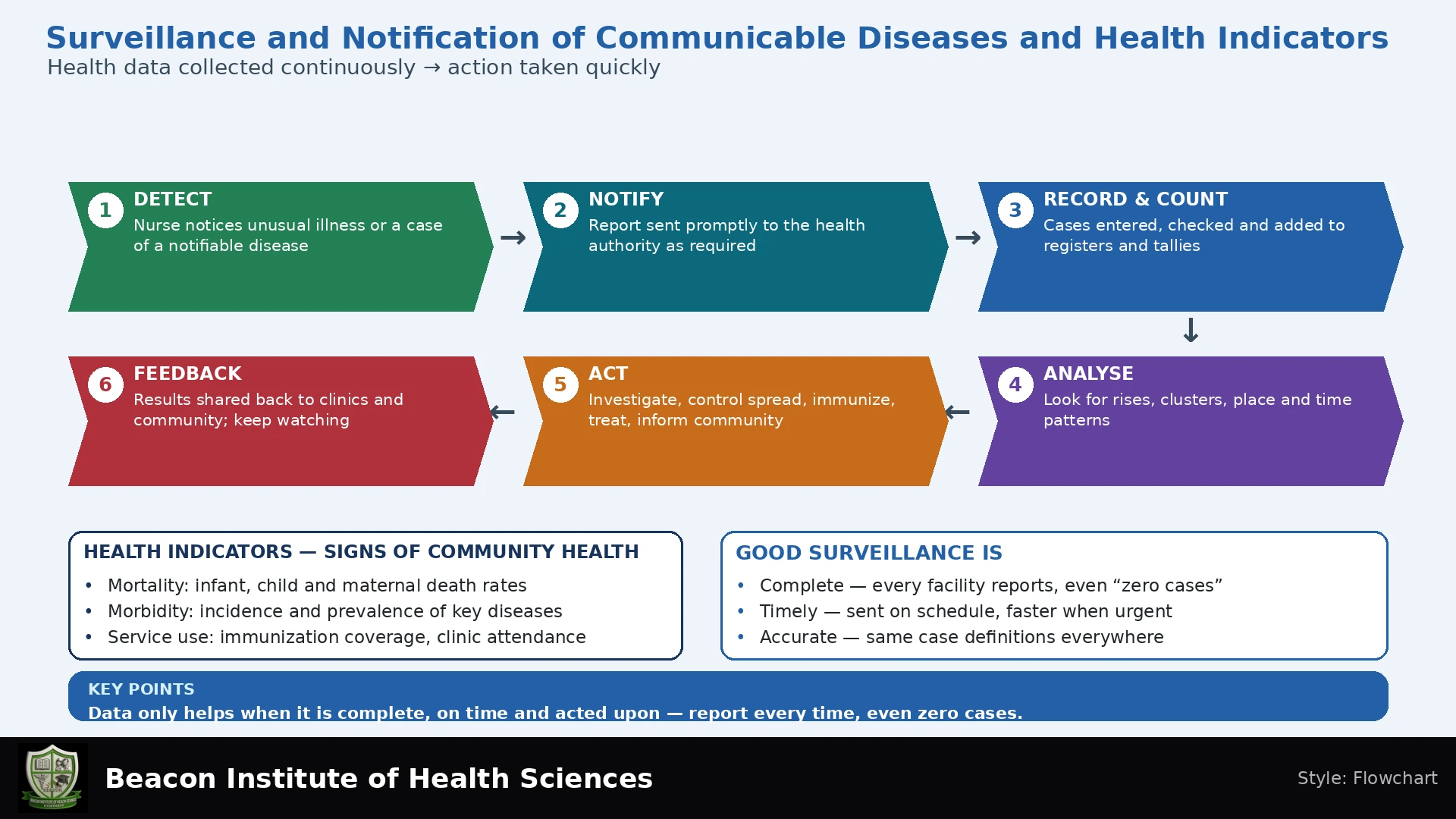
The Surveillance Cycle
- Define the purpose: identify the decisions the system needs to support and the population covered.
- Detect and record: apply current case definitions and obtain required clinical, laboratory and epidemiological information.
- Report: use the approved channel, required format and applicable reporting timeframe.
- Validate: check eligibility, duplicates, missing values, dates and classification.
- Analyse: examine time, place, person, denominators and expected patterns.
- Interpret and act: investigate signals and coordinate proportionate prevention or response.
- Provide feedback: tell reporting teams what was found and how it informed action; evaluate and improve the system.
These activities often overlap during an urgent event. Do not wait for a polished statistical report before escalating an unusual cluster or a serious suspected public-health threat through the current local protocol. Clinical care and appropriate infection prevention must continue while classification and investigation proceed.
Approaches to Surveillance
| Approach | How it works | Strength and limitation |
|---|---|---|
| Passive | Facilities or professionals submit routine reports | Broad and relatively economical, but underreporting and delays may occur |
| Active | Public-health staff seek cases or contact reporting sites | Can improve completeness, but requires more staff and resources |
| Sentinel | Selected sites monitor defined conditions | Useful for trends and detailed information; may not represent the entire population |
| Syndromic | Tracks symptom patterns before or without final diagnosis | May provide early signals, but signals can be nonspecific |
| Laboratory-based | Uses test results, pathogen identification or resistance data | Improves specificity for tested cases; depends on access, sampling and test performance |
| Event-based | Collects and assesses reports of unusual events from varied sources | May detect new threats; information needs verification before conclusions |
These categories overlap. A sentinel network may collect syndromic and laboratory data. Indicator-based surveillance uses structured, predefined measures; event-based surveillance complements it with signals that may arise outside routine reporting.
Case Definitions and Data Quality
A surveillance case definition provides standardized criteria so reports can be counted consistently. Depending on the programme, classifications may include suspected, probable and confirmed cases. Use the current official definition rather than inventing criteria. A clinician may need to treat a patient before a surveillance classification is finalized.
Record symptom onset, presentation, specimen collection, result and notification dates separately when required. They answer different questions. A line list usually has one row per case and one column per variable, with an appropriate unique identifier. Record the classification and update it when new evidence arrives, while keeping an audit trail.
Zero reporting means a site submitted a report stating that no eligible cases occurred during the period. A missing report means the status is unknown. Neither should be silently substituted for the other. Before interpreting an apparent fall in cases, check the reporting coverage and diagnostic activity.
Notification and Nursing Responsibilities
At the start of placement or work, identify the facility focal person, district reporting pathway, forms, escalation contacts and current reporting schedule. The list of notifiable diseases, who must report them and the required deadlines depend on the jurisdiction and programme. This lecture does not substitute for current official instructions.
Pakistan's National Institute of Health publishes Integrated Disease Surveillance and Response bulletins covering priority detection, notification, reporting, analysis and response. Nurses should use the current provincial, district and facility instructions that apply to their setting. Do not infer local legal requirements from another country's reporting list.
- Recognize relevant symptoms, exposure histories or unusual clusters and notify the designated team.
- Provide urgent clinical assessment and disease-appropriate precautions within professional scope.
- Collect and transport specimens only under the applicable clinical, laboratory and biosafety procedures.
- Report known facts accurately, identify uncertainty and avoid unverified accusations about sources.
- Record when and to whom notification was made, then follow up on required updates.
- Support patients with clear explanations and respectful communication.
Confidentiality and Ethical Communication
Collect and disclose only information needed for the authorized purpose. Identifiable reports may be necessary for legitimate case investigation, but must use approved secure channels and role-based access. Public summaries should avoid names and combinations of details that identify people. Small-cell tables and precise household maps can reveal identity even without names.
Explain the purpose and applicable reporting duties without promising absolute secrecy where notification is required. Follow the relevant legal basis, consent requirements and institutional procedures. Do not circulate patient line lists in public social-media groups.
Health Indicators
| Indicator | Meaning or calculation | Interpretation caution |
|---|---|---|
| Incidence proportion | New cases during a defined period ÷ initially disease-free people at risk | Requires suitable follow-up and a clear period |
| Point prevalence | Existing cases ÷ population at the same specified time | Reflects both disease occurrence and duration |
| Mortality rate | Deaths ÷ population time | Crude comparisons may be influenced by age structure |
| Case-fatality proportion | Disease-attributable deaths among cases ÷ those cases during a defined outcome period | Missed mild cases and delayed outcomes can distort estimates |
| Immunization coverage | Eligible people receiving the specified dose or schedule ÷ eligible target population | Define age, dose, period and denominator source |
| Reporting completeness | Reports received ÷ reports expected | Does not itself measure whether every case was detected |
| Reporting timeliness | Reports received by deadline ÷ defined expected reports | Some systems use received reports as denominator; state the definition |
The maternal mortality ratio is maternal deaths per 100,000 live births, using the specified maternal-death definition. It is a ratio, not the proportion of pregnant women who die. A maternal death generally concerns death during pregnancy or within 42 days of its end from a cause related to or aggravated by pregnancy or its management, excluding accidental or incidental causes; confirm the programme definition.
Infant mortality is conventionally expressed per 1000 live births and concerns death before the first birthday. Estimation methods may use birth cohorts, registration or life tables. Do not divide infant deaths by the number of all residents and label that the infant mortality rate. Indicators require reliable numerator and denominator data.
Fictional Worked Reporting Example
A district expects one weekly report from each of 25 facilities. Twenty reports arrive, and 18 arrive before the local programme deadline. Completeness = 20/25 × 100 = 80%. Timeliness using expected reports = 18/25 × 100 = 72%. Timeliness among received reports would be 18/20 = 90%; that is a different definition and must be labelled clearly.
Eight of the 20 submitted reports explicitly record zero cases. Five sites have not reported. The district cannot treat the five missing reports as zero. The nurse contacts the focal persons, checks transmission problems and updates the dataset transparently. A sudden rise in one site's cases also needs assessment for a real cluster, better testing, delayed batch reporting or a case-definition change.
In a separate fictional vaccination activity, 180 of 200 eligible children received a specified dose. Coverage is 90%. This describes service reach; it does not prove that disease incidence fell because of the activity. Twenty children remain outside documented coverage and need respectful follow-up for access barriers or incomplete records.
Evaluating a Surveillance System
Useful systems balance simplicity, acceptability, flexibility, data quality, timeliness, sensitivity, predictive value, representativeness and stability. Surveillance sensitivity concerns detecting eligible events, which differs from the sensitivity of an individual diagnostic test. A system can receive every expected form and still miss cases among people who cannot reach care.
Review whether the information leads to appropriate action and whether reporting workload is proportionate. Give feedback to frontline staff, investigate gaps and document changes so trends remain interpretable.
Practice Questions with Explained Answers
- Are notification and surveillance the same?
No. Notification is a reporting step; surveillance includes continued analysis, interpretation, communication and action.
- Does no report mean no cases?
No. Missing information is unknown; a submitted zero report is an explicit observation.
- Should unusual clusters wait for the next routine summary?
Escalate according to current urgent-alert procedures while providing care and appropriate precautions.
- Why can more reported cases follow better surveillance?
Improved detection and reporting can reveal previously missed cases without a true rise in incidence.
- In the reporting example, why are 72% and 90% both possible?
They use different denominators. Define the indicator before comparing performance.
Conclusion
Surveillance turns consistent observations into public-health action. Nurses support it through early recognition, accurate reporting, secure information handling and feedback. Clear case definitions, meaningful denominators and honest treatment of missing information are essential for useful notification and health indicators.