
Learning Objectives
- Differentiate between health, disease, illness, and sickness.
- Discuss various perspectives on health and disease, including biomedical, ecological, and biopsychosocial models.
- Identify the key determinants of health and the role of risk factors.
- Explain the epidemiological triad and the natural history of disease.
- Categorize diseases based on their characteristics (acute/chronic, communicable/non-communicable).
- Understand the health-illness continuum and the levels of disease prevention.
- Apply these concepts to nursing practice through fictional case studies.
- Recognize essential nursing considerations in promoting health and managing disease.
Understanding Health
Defining Health Beyond Absence of Disease
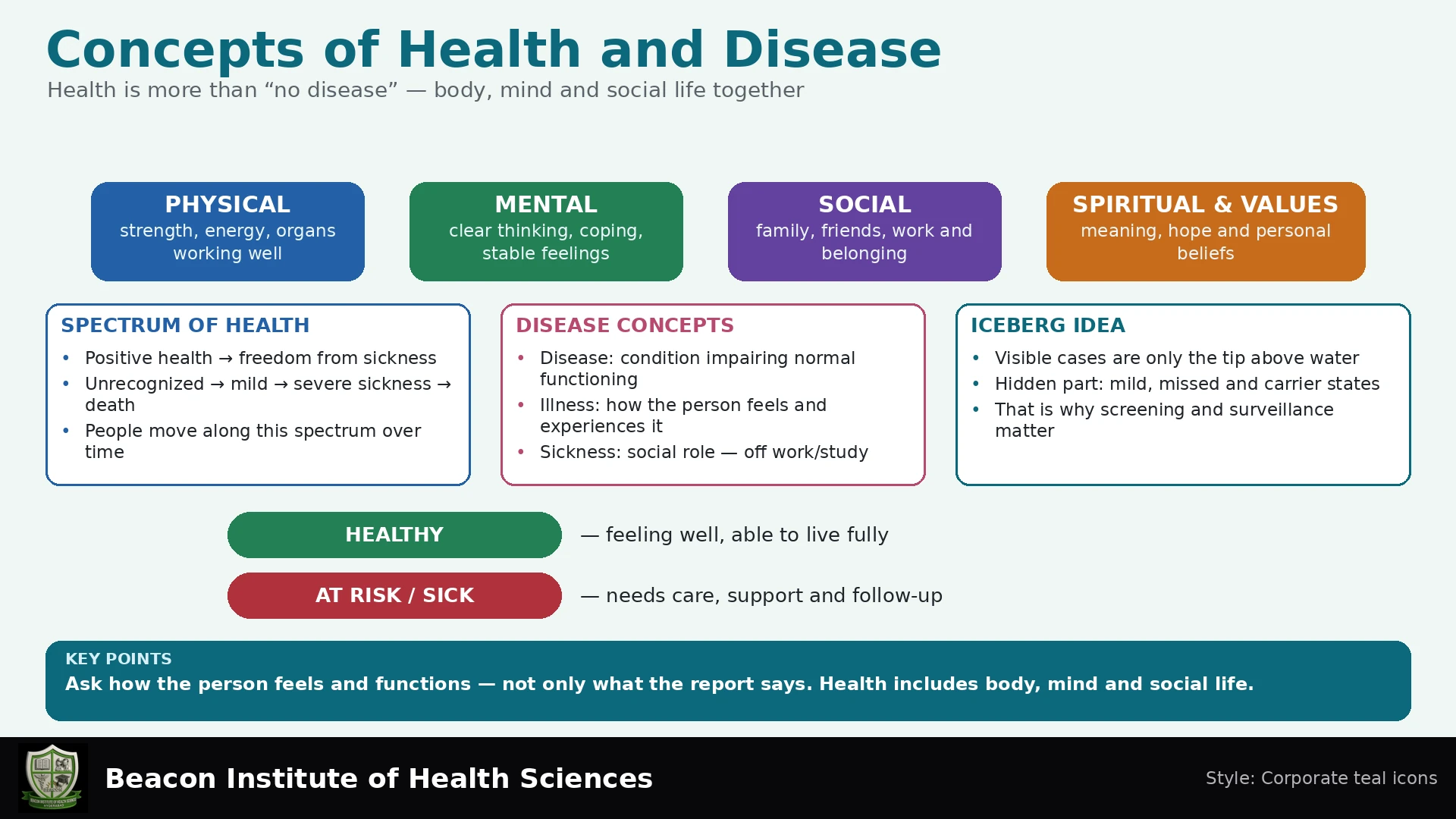
Health is often perceived merely as the absence of disease. However, a more comprehensive understanding reveals that health encompasses a state of complete physical, mental, and social well-being. It is important to note that this definition from the WHO constitution describes an aspirational ideal, rather than a rigid criterion for classifying everyone with any limitation as unhealthy.
Dimensions of Health (WHO Perspective)
The World Health Organization (WHO) broadly defines health across three key dimensions:
- Physical Health: Refers to the optimal functioning of the body's systems, free from disease or infirmity.
- Mental Health: Involves a state of psychological well-being where an individual can cope with the normal stresses of life, work productively, and contribute to their community.
- Social Health: Encompasses the ability to form meaningful relationships with others and adapt to social situations, contributing to community well-being.
Moreover, health is understood to include the capacity for well-being and effective functioning even in the presence of a chronic condition or disability.
Health as Dynamic and Context-Dependent
Health is not a static state but a dynamic process that continuously changes throughout an individual's lifespan. It is also highly context-dependent, influenced by various personal, environmental, and societal factors.
Differentiating Disease, Illness, and Sickness
While often used interchangeably, the terms disease, illness, and sickness have distinct meanings in healthcare contexts, though terminology can vary.
Disease: Pathological Process
Disease refers to an objective, pathological process involving a deviation from the biological norm. It is characterized by specific signs and symptoms and involves a disturbance of structure or function in a living organism. Disease can be identified through diagnostic tests and objective observations (signs).
Illness: Subjective Experience
Illness is the subjective experience of feeling unwell. It is an individual's perception of their health state and how they cope with discomfort or symptoms. A person can experience illness even without a confirmed disease diagnosis, and their subjective experience still requires respectful assessment and care.
Sickness: Social Role
Sickness represents the social role assumed by an individual who is unwell. This role is culturally and socially defined, often carrying certain expectations and permissions, such as temporary exemption from work or social duties. However, the