
Understanding Key Concepts in Vector-Borne Diseases
As nursing students, comprehending the fundamental terminology associated with disease transmission is crucial for effective patient care and public health interventions. This lesson will define key terms and explore common diseases spread by insects and animal vectors, highlighting critical nursing considerations.
Vector
A vector is an organism, often an arthropod like a mosquito or tick, that transmits a pathogen from a reservoir to a susceptible human or animal host. Vectors play a pivotal role in the epidemiology of many infectious diseases.
Reservoir
A reservoir refers to the primary habitat where a pathogen naturally lives, multiplies, and from which it can be transmitted to a susceptible host. This can be an animal, a human, or even the environment, providing a continuous source of infection.
Zoonosis
A zoonosis is any disease or infection that is naturally transmissible from vertebrate animals to humans. Understanding zoonoses is vital for public health, as many emerging infectious diseases have zoonotic origins.
Common Vector-Borne Diseases for Nurses
Nurses must be familiar with the various diseases transmitted by vectors, their causative agents, and specific nursing interventions.
Malaria
Malaria is a serious disease transmitted by the Anopheles mosquito, which carries a parasitic pathogen. Symptoms typically include high fevers, chills, and flu-like illness. Early diagnosis and treatment are essential.
Dengue Fever
Dengue fever is a viral infection spread by the Aedes mosquito. For nursing students, understanding the importance of prompt fever assessment is critical. Nurses must recognize dengue red flags, such as severe abdominal pain, persistent vomiting, or any bleeding manifestations. It is crucial to avoid administering NSAIDs (Non-Steroidal Anti-inflammatory Drugs) like ibuprofen or aspirin to patients with suspected or confirmed dengue, as these medications can increase the risk of bleeding complications.
Leishmaniasis
Leishmaniasis is caused by parasitic pathogens transmitted through the bite of infected sandflies. This disease can manifest in various forms, including cutaneous, mucocutaneous, and visceral leishmaniasis.
Plague
Plague, a historically significant disease, is primarily transmitted to humans by fleas carrying bacterial pathogens, typically from rodents. Prompt recognition and treatment are vital to prevent severe outcomes.
Crimean-Congo Hemorrhagic Fever (CCHF)
CCHF is a viral disease transmitted to humans by ticks or through contact with infected animal blood or tissues. It is characterized by fever, muscle pain, dizziness, and bleeding manifestations, requiring careful nursing management.
Rabies: A Critical Zoonosis
Rabies is a highly fatal viral zoonosis transmitted through the saliva of infected mammals, most commonly via a bite. It is important to note that rabies is classified as a zoonosis but is not an arthropod vector-borne disease.
Immediate nursing actions for suspected rabies exposure are paramount:
- Immediate wound washing: The bite wound must be thoroughly washed with soap and water for at least 15 minutes.
- Urgent Post-Exposure Prophylaxis (PEP) assessment: Rapid assessment by a healthcare provider for the need for rabies PEP, which may include rabies vaccine and, when indicated, rabies immunoglobulin or an approved alternative, is crucial to prevent the disease's progression.
Nursing Interventions: Prevention and Management
Nurses play a vital role in both preventing vector-borne diseases and managing affected patients.
Bite Prevention Strategies
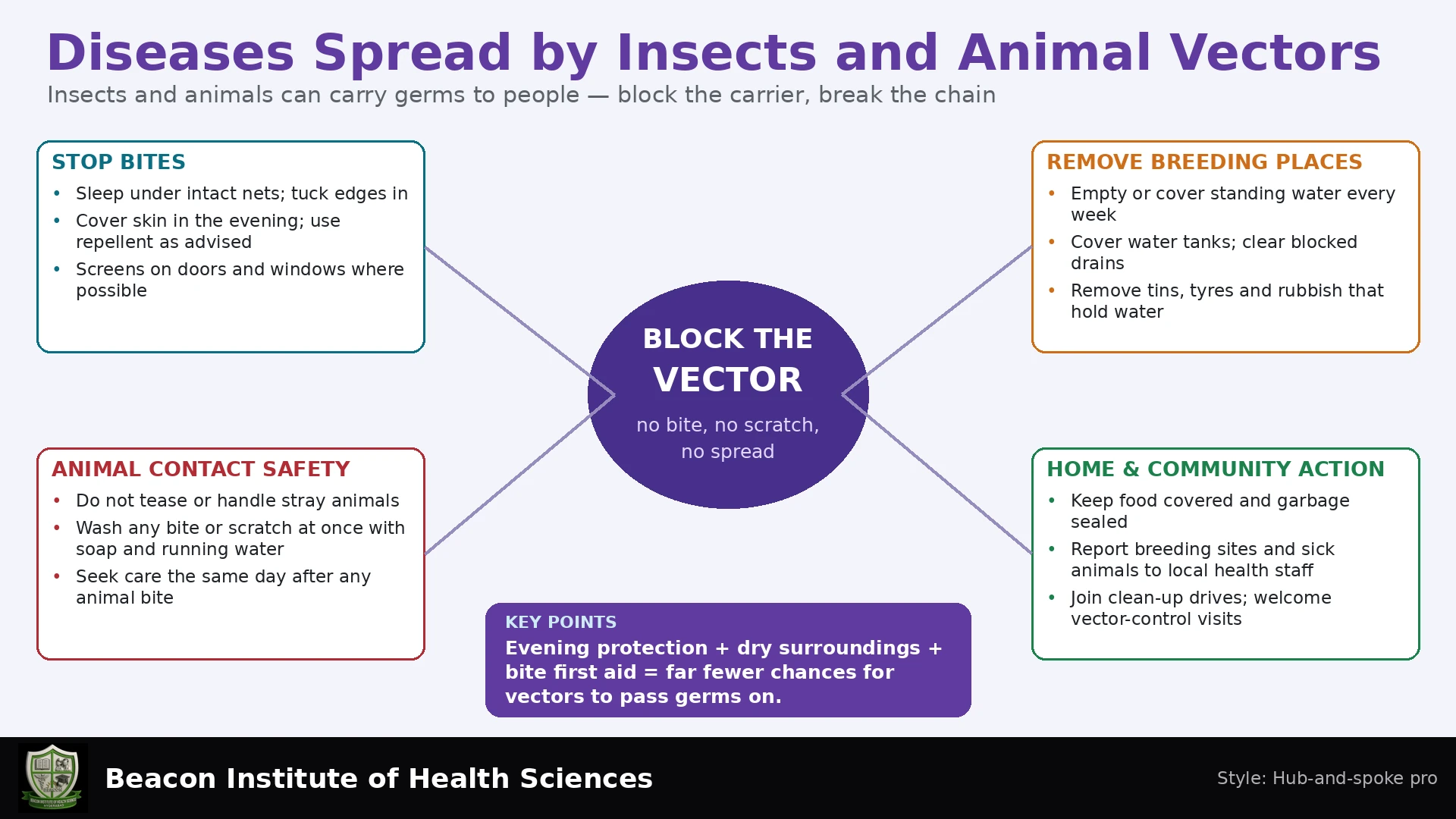
- Educating patients on the use of insect repellents containing DEET or picaridin.
- Advising on wearing long-sleeved clothing and trousers, with protection appropriate to the vector: Aedes mosquitoes commonly bite during the day, while malaria-vector protection is particularly important at night.
- Promoting the use of bed nets in endemic areas.
Environmental Control Measures
- Encouraging the elimination of vector breeding sites, such as standing water for mosquitoes.
- Coordinate flea and rodent control with trained public-health or pest-control teams.
- Promoting the use of window and door screens to prevent insect entry.
Early Recognition and Assessment
- Conducting a prompt and thorough fever assessment, including a detailed travel history.
- Assessing for exposure to insect bites or animal contact.
- Recognize deterioration and arrange urgent clinical assessment.
Nursing Assessment and Care
Ask where the patient has lived or travelled, when symptoms began, and whether there were mosquito bites, tick exposure, animal bites or contact with livestock blood. Record the history without assuming that one remembered bite establishes the diagnosis. Many illnesses cause fever and several infections may circulate in the same area.
Assess vital signs, mental state, breathing, hydration, urine output and bleeding. Escalate altered consciousness, shock, severe pain, persistent vomiting or respiratory difficulty promptly. Diagnostic testing and treatment should follow the clinician’s assessment and the applicable protocol. Maintain prescribed monitoring and document changes over time.
Preventing Further Exposure
Explain bite prevention in practical terms: cover water storage, remove unnecessary water-holding containers, use suitable screens, and follow repellent instructions. Bed nets are useful when the relevant vector bites during sleep, but daytime mosquito protection is also needed. Adapt advice to age, living conditions and the local control programme.
Important Safety Distinctions
Dengue warning signs can appear as fever settles; improvement in temperature alone does not establish recovery. Avoid aspirin and ibuprofen in suspected dengue and seek clinician-directed symptom care. Suspected CCHF requires immediate infection-control consultation because exposure to infected blood or body fluids can also transmit infection. Do not handle such exposures as ordinary mosquito-borne illness.
Fictional Case: Fever After Travel
A student has fever after travel to an area with mosquitoes. A family member labels the illness dengue and suggests ibuprofen. The nurse arranges prompt clinical assessment, records travel and symptom history, checks for warning signs and explains why the cause cannot be diagnosed from mosquito exposure alone.
Reasoning: The history supports considering vector-borne infection but does not identify the pathogen. Clinicians select appropriate tests. Avoiding an unsuitable medicine and recognizing deterioration are useful immediate actions.
Fictional Case: Animal Bite
A child is bitten by an unknown dog. The caregiver plans to wait for fever. The nurse explains that rabies prevention must start before symptoms: wash the wound thoroughly with soap and water for at least 15 minutes and obtain urgent assessment for post-exposure prophylaxis. Do not wait for the animal or child to become visibly ill.
Practice With Explained Answers
- Is the malaria pathogen a mosquito? No. The mosquito is the vector; the pathogen is a parasite.
- Is a dog transmitting rabies an arthropod vector? No. Rabies is a zoonosis transmitted through infected mammal saliva.
- Are bed nets alone enough for all mosquito prevention? No. Some mosquitoes bite during the day.
- Should a falling fever exclude severe dengue? No. Warning signs and clinical reassessment remain important.
- What is the purpose of an exposure history? It guides investigation and prevention but does not replace diagnostic assessment.
Revision Checklist
Identify the pathogen, route, vector or animal source, warning signs, diagnostic needs and prevention measure. Keep surveillance reports factual and follow local reporting procedures. Teach patients to seek help early and use teach-back to check understanding.