
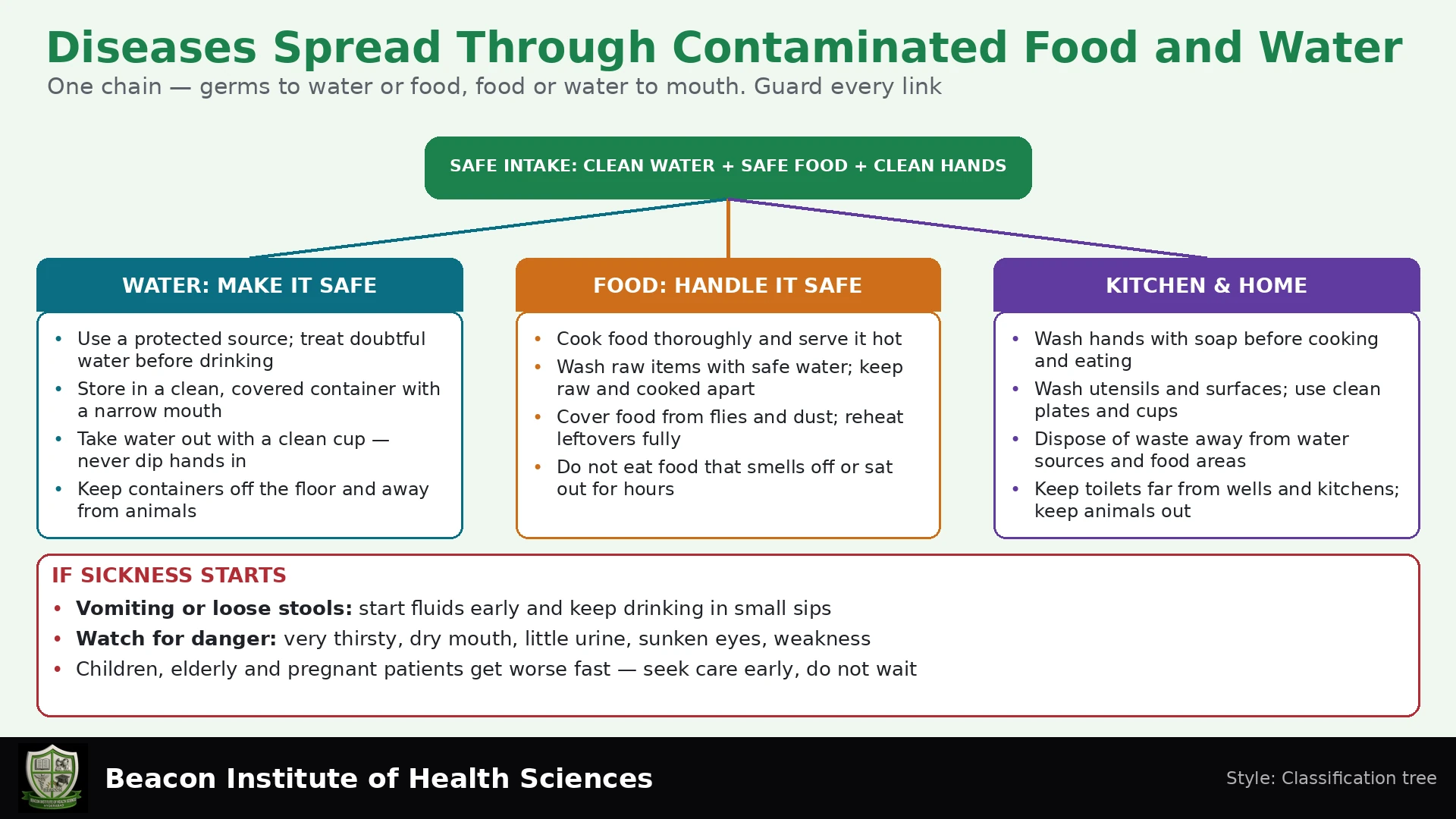
Understanding Fecal-Oral Transmission
Many infectious diseases are transmitted through the fecal-oral route, primarily via contaminated food and water. This pathway occurs when pathogens from the feces of an infected person or animal are ingested by another individual, leading to illness. As future nurses and educators, understanding this transmission route, common associated diseases, and effective prevention strategies is crucial for public health and patient care.
Key Diseases Spread Through Contaminated Food and Water
Here, we will delve into some of the most significant diseases transmitted through contaminated food and water, highlighting their causative agents, symptoms, and key considerations.
Cholera
- Causative Agent: Vibrio cholerae bacteria.
- Transmission: Ingestion of water or food contaminated with cholera bacteria, often from the feces of an infected person.
- Symptoms: Profuse, watery diarrhea (often described as "rice-water stools"), vomiting, rapid dehydration, muscle cramps.
- Complications: Severe dehydration, electrolyte imbalance, shock, and death if untreated.
Typhoid Fever
- Causative Agent: Salmonella enterica serovar Typhi bacteria.
- Transmission: Ingestion of food or water contaminated with the feces of an infected person or a chronic carrier.
- Symptoms: Sustained high fever, headache, malaise, anorexia, constipation or diarrhea, rose spots (rash on the trunk), abdominal pain.
- Complications: Intestinal hemorrhage, perforation, meningitis, myocarditis.
Shigellosis
- Causative Agent: Shigella bacteria (e.g., S. dysenteriae, S. flexneri, S. boydii, S. sonnei).
- Transmission: Direct or indirect fecal-oral transmission, often through contaminated food or water, or person-to-person contact.
- Symptoms: Abrupt onset of fever, abdominal cramps, tenesmus, and frequent, small-volume stools often containing blood and mucus (dysentery).
- Complications: Dehydration, seizures (especially in children), hemolytic uremic syndrome (HUS).
Hepatitis A and E
- Causative Agents: Hepatitis A virus (HAV) and Hepatitis E virus (HEV).
- Transmission: Both viruses are transmitted primarily through the fecal-oral route, often via contaminated food or water.
- Symptoms: Fatigue, nausea, vomiting, abdominal pain, dark urine, clay-colored stools, jaundice, low-grade fever.
- Distinction: Hepatitis A is generally milder and rarely fatal, especially in children. Hepatitis E can be more severe, particularly in pregnant women, where it carries a high mortality rate.
Giardiasis
- Causative Agent: Giardia lamblia (also known as Giardia intestinalis or Giardia duodenalis), a flagellated protozoan parasite.
- Transmission: Ingestion of Giardia cysts, typically from contaminated water (e.g., untreated surface water) or food, or through person-to-person contact.
- Symptoms: Chronic or intermittent diarrhea, abdominal cramps, bloating, excessive gas, weight loss, and foul-smelling, fatty stools.
- Chronic Effects: Malabsorption, growth retardation in children.
Viral Gastroenteritis
- Common Viruses: Rotavirus, Norovirus, Adenovirus, Astrovirus.
- Transmission: Highly contagious; fecal-oral route through contaminated food or water, or direct contact with an infected person.
- Symptoms: Nausea, vomiting, watery diarrhea, abdominal cramps, low-grade fever.
- Clinical Relevance: Often self-limiting, but can lead to severe dehydration, especially in infants, young children, and the elderly.
Comparison of Major Food and Waterborne Diseases
| Disease | Causative Agent | Key Symptoms | Transmission Route | Key Nursing Consideration |
|---|---|---|---|---|
| Cholera | Vibrio cholerae | Profuse "rice-water" diarrhea, vomiting | Contaminated water/food (fecal-oral) | Rapid rehydration, electrolyte balance |
| Typhoid Fever | Salmonella Typhi | Sustained high fever, rash, headache | Contaminated food/water (fecal-oral) | Antibiotic compliance, monitor for complications |
| Shigellosis | Shigella species | Bloody diarrhea, abdominal cramps, fever | Fecal-oral (food, water, person-to-person) | Hydration, infection control, monitor for HUS |
| Hepatitis A/E | HAV / HEV | Jaundice, fatigue, nausea, dark urine | Fecal-oral (contaminated food/water) | Rest, nutritional support, monitor liver function |
| Giardiasis | Giardia lamblia | Chronic/intermittent diarrhea, bloating, fatty stools | Contaminated water/food (cysts) | Antiparasitic treatment, nutritional status |
| Viral Gastroenteritis | Rotavirus, Norovirus, etc. | Vomiting, watery diarrhea, fever | Fecal-oral (food, water, person-to-person) | Prevent dehydration, supportive care |
Prevention Strategies: A Nursing Imperative
Nurses play a critical role in educating communities and individuals on preventing food and waterborne illnesses.
Safe Water Practices
- Boiling Water: Follow official safe-water guidance for the setting, including boiling or approved disinfection when indicated. Boiling does not remove chemical contamination.
- Using Water Purification Tablets: Follow manufacturer instructions for effective disinfection.
- Storing Water Safely: Use clean, covered containers to prevent recontamination.
Sanitation
- Proper Disposal of Human Waste: Use latrines or toilets and ensure they are well-maintained.
- Maintaining Clean Latrines: Regularly clean and disinfect sanitation facilities.
- Preventing Contamination of Water Sources: Ensure latrines are situated away from wells or other water sources.
Handwashing
- Critical Moments: Wash hands thoroughly with soap and clean water before preparing food, before eating, and after using the toilet or changing diapers.
- Proper Technique: Lather soap for at least 20 seconds, scrub all surfaces of hands, rinse well, and dry with a clean towel or air dry.
Safe Food Preparation and Storage
- Cooking Food Thoroughly: Ensure food, especially meat, poultry, and eggs, is cooked to safe internal temperatures.
- Avoiding Cross-Contamination: Use separate cutting boards and utensils for raw and cooked foods.
- Storing Food at Safe Temperatures: Refrigerate perishable foods promptly and keep hot foods hot and cold foods cold.
- Washing Fruits and Vegetables: Rinse all raw produce under running water, especially if eaten raw.
Clinical Assessment and Management
Effective nursing care for individuals with food and waterborne diseases involves prompt assessment and targeted interventions.
Assessing Dehydration and Recognizing Red Flags
Nurses must be adept at recognizing signs of dehydration and identifying red flags that require urgent medical attention:
- Assessment: Use an age-appropriate validated protocol and several signs together; a single finding does not reliably classify dehydration.
- Moderate Dehydration: Increased thirst, restless/irritable, sunken eyes, dry mucous membranes, decreased skin turgor, decreased urine output, sunken fontanelle in infants.
- Severe Dehydration: Lethargic or unconscious, unable to drink, very sunken eyes, absent tears, very dry mouth, no urine output, poor skin turgor ("tenting"), rapid weak pulse.
Red Flags for Immediate Medical Attention:
- Inability to drink or breastfeed
- Persistent vomiting
- High fever
- Bloody or very frequent stools
- Lethargy or reduced consciousness
Oral Rehydration Solution (ORS) Preparation
ORS is a life-saving intervention. Nurses must educate patients and caregivers on correct preparation:
- Exact Instructions: Dissolve the full packet in the exact volume of safe water stated on that packet. Packet sizes differ; do not assume that every packet requires one litre.
- Importance of Correct Dilution: Do not add less or more water than instructed, as incorrect dilution can worsen electrolyte imbalances.
- Administration: Give small, frequent sips, especially after each loose stool. For infants, a spoon or syringe can be used.
Continued Feeding During Diarrhea
It is crucial to continue feeding to prevent malnutrition and aid recovery:
- Infants: Continue breastfeeding frequently.
- Children and Adults: Offer small, frequent meals of easily digestible, nutritious foods such as cereals, bananas, potatoes, and cooked vegetables. Avoid fatty, sugary, or highly spiced foods.
Prescribed Treatment (General Principles)
While specific drug doses are not within the scope of this general lesson, the principles of prescribed treatment are vital:
- Supportive Care: Primarily focuses on rehydration, electrolyte balance, and symptom management.
- Antibiotics: Prescribed for specific bacterial infections like severe cholera or typhoid, only as indicated by a medical professional.
- Antiparasitics: Used for parasitic infections such as giardiasis.
- Antivirals: Rarely used for viral gastroenteritis, which is typically self-limiting; focus remains on supportive care.
Outbreak Response: The Nurse's Role
Nurses are integral to public health outbreak response:
- Early Detection and Reporting: Recognize unusual patterns of illness and promptly report suspected outbreaks to public health authorities.
- Contact Tracing: Identify individuals who may have been exposed and implement preventive measures.
- Public Health Education: Disseminate information on prevention, symptoms, and when to seek care.
- Implementing Control Measures: Assist in implementing measures such as water chlorination, food safety inspections, and vaccination campaigns where applicable.
- Collaboration: Work closely with epidemiologists, laboratory staff, and other healthcare professionals.
The Nursing Process in Food and Waterborne Illnesses
Applying the nursing process ensures comprehensive and individualized care.
Assessment
- History Taking: Inquire about recent food and water intake, travel history, recent contacts, onset and duration of symptoms, and associated complaints (fever, vomiting, abdominal pain, stool characteristics).
- Physical Examination: Assess hydration status (skin turgor, mucous membranes, fontanelle in infants, urine output, vital signs), general appearance, abdominal tenderness, and signs of complications.
Diagnosis
- Identify relevant nursing diagnoses, such as:
- Deficient Fluid Volume related to active fluid loss from diarrhea and vomiting.
- Imbalanced Nutrition: Less Than Body Requirements related to decreased intake and malabsorption.
- Risk for Infection Transmission related to contagious nature of pathogens.
- Acute Pain related to abdominal cramping.
Planning
- Collaborate with the patient (or caregivers) to set realistic, measurable, and patient-centered goals. Examples include:
- Patient will achieve and maintain adequate hydration status within 24-48 hours.
- Patient will consume adequate nutrients to prevent further weight loss.
- Patient will demonstrate understanding of infection control measures.
Implementation
- Give ORS by mouth when appropriate. For severe dehydration or shock, prepare prescribed intravenous fluids; ORS must never be given intravenously.
- Administer antiemetics or antipyretics as ordered.
- Provide comfort measures for abdominal pain.
- Educate patient/family on proper hand hygiene, safe food/water practices, and ORS preparation.
- Implement strict infection control protocols (e.g., proper waste disposal, isolation precautions if indicated).
- Monitor vital signs, intake and output, and hydration status closely.
Evaluation
- Continuously monitor the patient's response to interventions.
- Assess if established goals are met (e.g., improved hydration, decreased frequency of diarrhea, absence of fever).
- Revise the care plan as needed based on the patient's evolving condition.
Fictional Case: A Child With Diarrhoea
A three-year-old has frequent watery stools and vomiting, with reduced urine, dry mouth and unusual tiredness. A caregiver suspects food eaten earlier caused the illness.
Assessment and Reasoning
Fluid loss is the immediate concern, but do not assign a dehydration category from an incomplete description or assume the food is the confirmed source. Assess responsiveness, ability to drink, circulation, vital signs, intake and urine output using an age-appropriate protocol. Obtain clinical review promptly.
Care and Education
If oral intake is appropriate, give correctly prepared ORS in small frequent amounts and reassess. Severe dehydration or shock requires urgent clinician-led care and prescribed IV fluids. Continue age-appropriate nutrition and breastfeeding where applicable. Teach the exact packet dilution, safe water handling and signs requiring urgent return.
Practice With Explained Answers
- Should every ORS packet be mixed in one litre? No. Follow the exact packet volume.
- Can ORS be given intravenously? No. It is an oral preparation; IV fluids are separate prescribed products.
- Does diarrhoea always need antibiotics? No. Treatment depends on the cause and clinical assessment.
- Does clear-looking water guarantee safety? No. Pathogens may be invisible.
- What is a priority when a patient is lethargic and unable to drink? Urgent clinical assessment and rehydration planning.
Conclusion
The transmission of diseases through contaminated food and water represents a significant public health challenge, particularly in vulnerable populations. As BSN students and future nursing professionals, a deep understanding of the causative agents, modes of transmission, clinical presentations, and evidence-based prevention and management strategies for these illnesses is indispensable. By applying the nursing process and promoting robust public health education, nurses are at the forefront of preventing these diseases and improving patient outcomes. Take our comprehensive quiz to test your understanding: Diseases Spread Through Contaminated Food and Water Quiz