
1. Learning objectives and environmental pathways
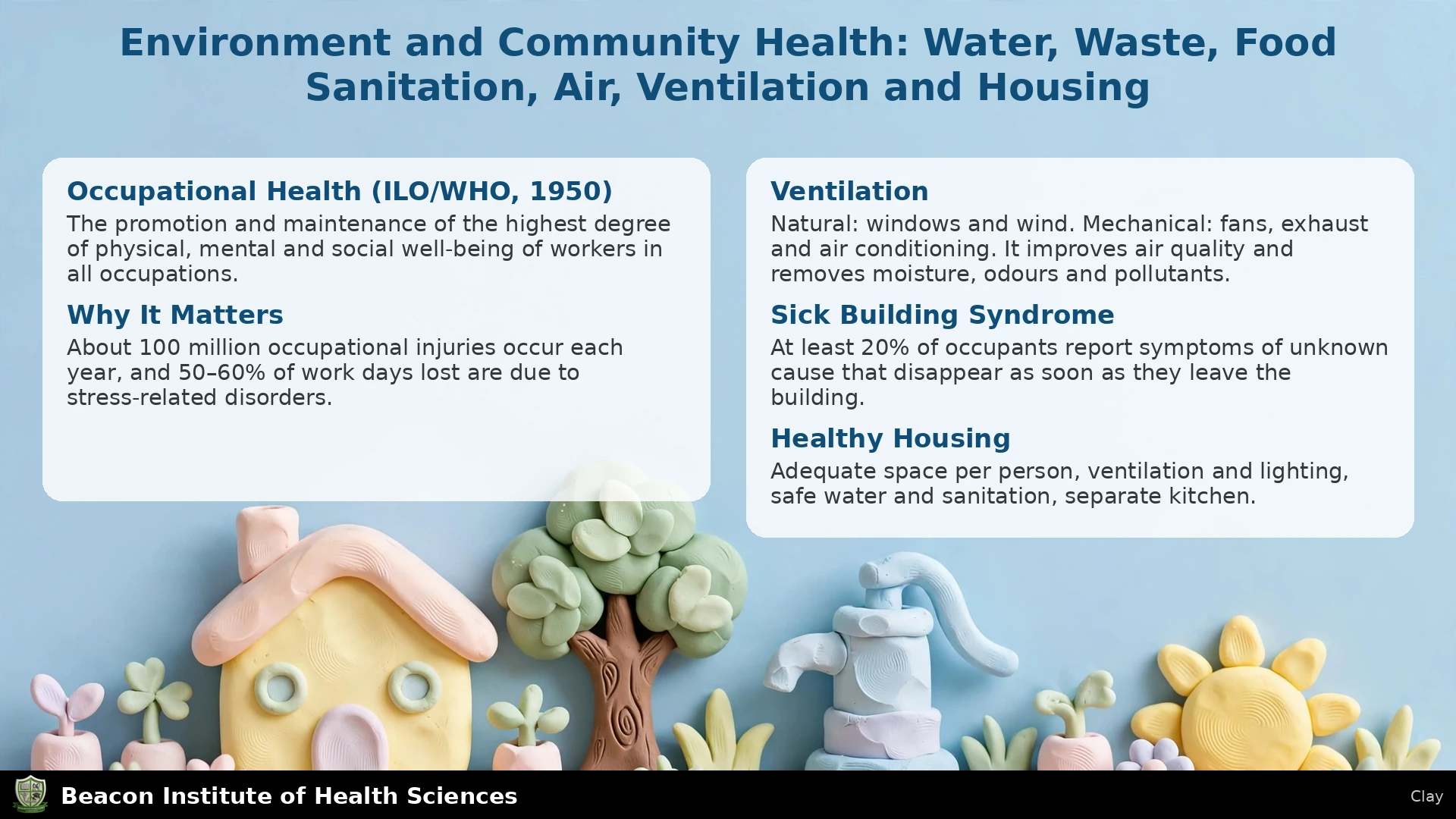
Environmental health examines how surroundings influence health. After this lesson, describe pathways linking water, waste, food, air and housing with community wellbeing, identify observations useful in a supervised assessment and propose realistic preventive actions. A hazard does not automatically prove a person has a disease. Connect the source of a hazard, route of exposure and people affected before deciding what further assessment is needed. This lesson focuses on prevention and community learning.
2. Water supply and contamination
Safe drinking water requires attention from source to consumption. Contamination can occur during collection, distribution, storage or handling. Microbial and chemical hazards are different, and clear-looking water is not proof of safety. Ask where the water comes from and how its quality is checked. Distinguish a temporary household measure from a reliable community supply. A nursing observation can identify a concern, but testing and technical assessment are needed to confirm many water-quality hazards.
3. Household handling and safe storage
Observe whether storage containers are suitable, covered and handled without contaminating the water. Ask about collection practices respectfully rather than assuming unsafe behaviour. Families may have limited access to a reliable supply or suitable containers. When treatment is advised, follow current local public-health guidance and product instructions. Do not invent chemical doses. Boiling can reduce microbial hazards but does not remove every chemical contaminant, so the type of concern must guide the appropriate response.
4. Sanitation and the faecal-oral pathway
Sanitation manages human excreta so it does not contaminate water, food or living spaces. A faecal-oral pathway can involve contaminated hands, surfaces, food and water. Toilets, handwashing arrangements and wastewater management therefore work together. A toilet alone is insufficient if it is unusable or waste leaks into the environment. In a community assessment, note access, maintenance and barriers to use. Protect dignity and avoid photographing private facilities or household members without appropriate permission.
5. Solid waste and drainage
Waste accumulation can create injury, pest and environmental concerns. Separate ordinary household waste from sharps, medicines and other hazardous material requiring authorized disposal. Community collection, safe storage and maintained drainage are systems issues as well as household responsibilities. Open burning can add air pollution rather than safely solving the problem. Students should report hazardous conditions through the responsible team and avoid handling unknown waste. Describe the specific observation and location instead of making an unsupported general accusation.
6. Health-care waste and sharps
Sharps can injure workers, residents and waste handlers. Used needles and similar material require approved containers and disposal pathways. A household should not be expected to improvise an unsafe disposal method after home treatment. The responsible service should explain the arrangement. Nursing students must follow placement policies and supervised training. Do not pick up discarded sharps during a community survey; protect the area when feasible and notify the appropriate authorized service for safe management.
7. Food contamination and safer handling
Food safety involves biological, chemical and physical hazards. Prevention includes clean handling, separation of raw and ready-to-eat food, thorough cooking, suitable temperature control and safe water and ingredients. These ideas align with the WHO Five Keys to Safer Food. A community lesson should demonstrate a practical behaviour and discuss available resources. Do not imply that food is safe because it smells normal. Food handlers and consumers need workable methods, while authorities also have responsibilities for the food system.
8. Food storage and cross-contamination
Cross-contamination occurs when hazards move from one food or surface to another. A classroom example is using a board for raw meat and then for food that will not be cooked, without suitable cleaning. Discuss utensils, hands and storage arrangements as connected factors. Temperature control depends on the food and current guidance. Avoid giving a single universal storage time for every item. Ask about electricity and refrigeration before proposing advice that the household cannot realistically follow.
9. Outdoor and household air
Air pollution can come from transport, industry, dust, smoke and household fuel use. Indoor exposure matters because people may spend long periods at home. Children, older adults and people with existing conditions may face greater vulnerability. Identify sources and exposure patterns without diagnosing illness from an environmental observation. Cleaner energy and reduced emissions address the source; ventilation is another consideration. A plan should not shift all responsibility to households when wider infrastructure or affordability barriers are involved.
10. Ventilation and practical limits
Ventilation replaces or dilutes indoor air and can influence exposure to pollutants and infectious particles. The effectiveness depends on airflow, room use and conditions outside. Opening a window is not always a complete solution, especially if outdoor air is polluted or safety concerns prevent it. A fan may move air without bringing in clean outdoor air. Observe openings and airflow arrangements, and seek appropriate technical advice for building changes. Clinical infection-prevention requirements remain separate from a general housing observation.
11. Housing and health
Housing conditions include crowding, dampness, heat or cold, structural safety, lighting and access to water and sanitation. These factors can affect comfort, injury risk and health. A respectful assessment recognizes that families may not control tenancy, repairs or household size. Describe hazards objectively and identify the responsible service or support option. Do not promise a housing improvement that the team cannot provide. Accessibility also matters for residents with limited mobility or sensory needs.
12. Community assessment and prioritization
Use a clear checklist, permission and supervised observation. Record the condition, potential exposure, affected group and information still needed. Include assets such as functioning collection points or a trusted community contact. Prioritize serious hazards and feasible actions with residents and relevant services. An environmental finding should lead to a practical next step, not merely a label. Use fictional records for class exercises and keep identifiable household information in approved systems.
13. Worked case and simple indicator
In a fictional survey of thirty consenting households, twelve report unreliable waste collection. Twelve divided by thirty times one hundred equals forty percent of surveyed households. It is not a verified estimate for the entire district. The team confirms collection arrangements, discusses storage concerns and reports the service gap to the responsible authority. A second measure could track whether agreed collection improvements occur. Counting posters would measure activity rather than the environmental change the project needs.
14. Answered review and practical task
Prepare a six-part checklist covering water, waste, food, air, ventilation and housing. Answers: clear water may still be contaminated; microbial and chemical hazards need different responses; sanitation and hygiene are connected; cross-contamination transfers hazards; fans do not necessarily supply fresh air; waste burning can worsen air quality. Explain why a household cannot solve every environmental risk alone. Recap: trace exposure pathways, assess respectfully and coordinate realistic prevention with the responsible services.