
For Bachelor of Science in Nursing (BSN) students and educators, developing robust English study skills is fundamental to academic success and effective clinical practice. This lesson explores key competencies in reading, summarizing, and precis writing, essential for comprehending complex medical texts, research articles, and patient documentation while maintaining academic integrity.
Active Reading Strategies
Active reading goes beyond passively absorbing text; it involves engaging with the material to improve comprehension and retention. It is a critical skill for BSN students to process vast amounts of information efficiently and effectively.
Skimming
Skimming is a rapid reading technique used to quickly grasp the main idea or overall gist of a text. It involves looking at headings, subheadings, topic sentences, and keywords to get a general understanding without reading every word. This is useful for previewing chapters or articles.
Scanning
Scanning is used to locate specific pieces of information within a text quickly. Unlike skimming, where the goal is a general overview, scanning aims to find particular facts, names, dates, or concepts without reading the surrounding material. It is effective for finding data in research papers or patient charts.
SQ3R Method
The SQ3R method is a systematic approach to active reading that enhances comprehension and recall:
- Survey: Preview the text by looking at headings, subheadings, introduction, conclusion, and any visuals to get an overview.
- Question: Formulate questions based on the headings and what you expect to learn from the text. This creates a purpose for reading.
- Read: Read the text actively, seeking answers to your questions and highlighting important points.
- Recite: After reading a section, recall the main points in your own words without looking at the text. This reinforces memory.
- Review: Periodically review your notes and the text to solidify understanding and retain information long-term.
Identifying Main Idea and Supporting Details
A core reading skill is the ability to distinguish the central message or main idea of a paragraph or passage from the details that support, explain, or elaborate on it. Recognizing this structure is vital for summarizing and analyzing information.
Inference
Inference involves drawing conclusions or making educated guesses based on the information provided in the text, even when it is not explicitly stated. This requires critical thinking and the ability to interpret context, implications, and underlying meanings.
Effective Note-Taking
Note-taking is an essential companion to active reading. Effective notes help consolidate information, aid memory retention, and provide a concise resource for review. Strategies include using bullet points, diagrams, abbreviations, and summarizing key concepts in your own words.
Understanding Paraphrase, Summary, and Precis
While often used interchangeably, paraphrasing, summarizing, and precis writing are distinct skills crucial for academic integrity and effective communication.
Paraphrasing
Paraphrasing involves restating someone else's ideas or words in your own words, maintaining approximately the same length as the original text. It aims for clarity and demonstrates understanding while avoiding direct quotation and plagiarism. Proper source acknowledgment is critical when paraphrasing.
Summarizing
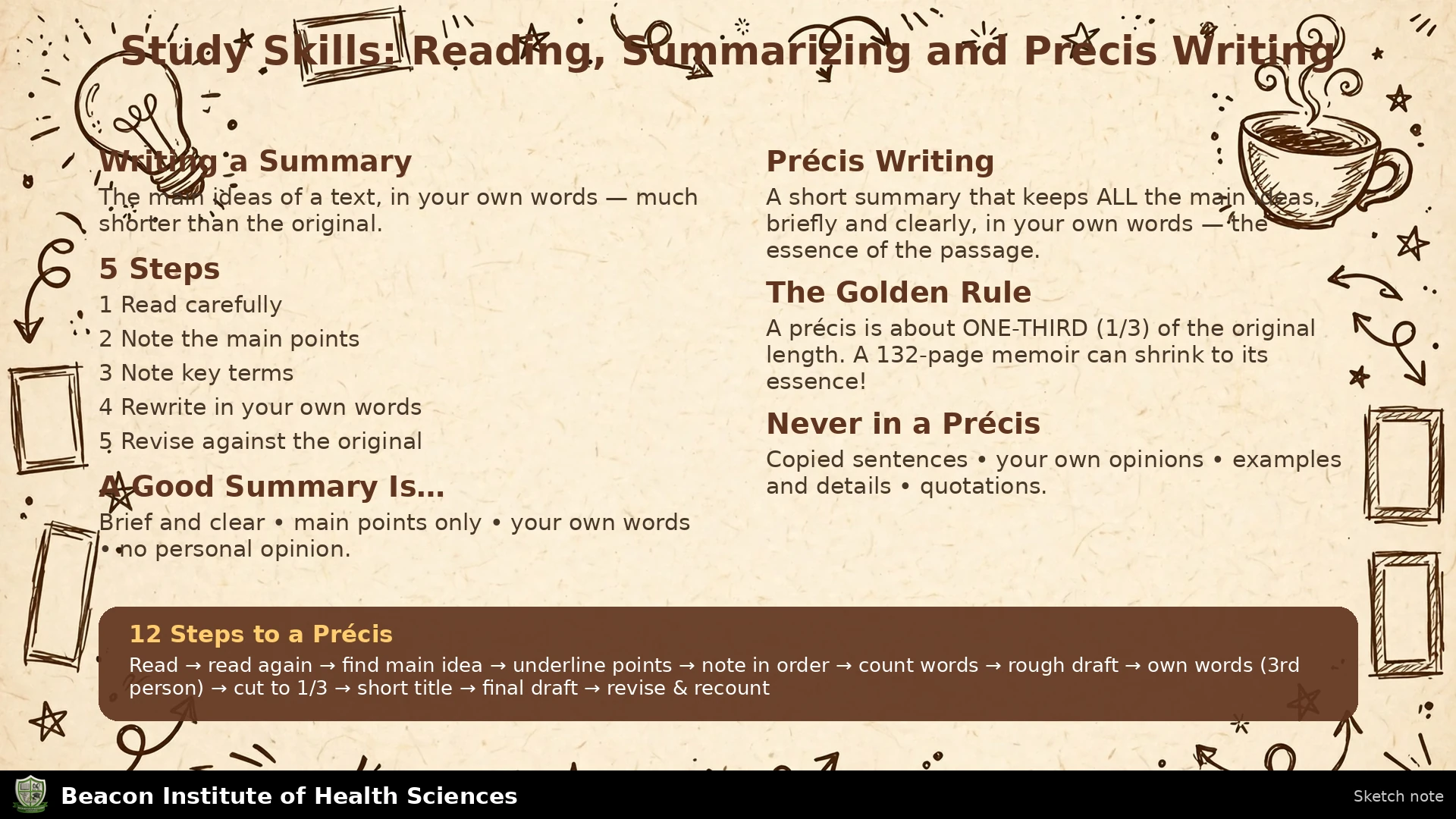
Summarizing involves condensing the main points of a text into a shorter form, using your own words. A summary focuses on the essential information, omitting minor details, examples, and repetitions. It provides a general overview and is significantly shorter than the original.
Precis Writing
Precis writing is an advanced form of summarization that provides a clear, concise, and faithful reproduction of the essential points of a text, often adhering to a strict word limit (typically one-third of the original length). A precis captures the core essence, tone, and order of ideas from the original, presenting it objectively without interpretation or added opinions. It is more formal and objective than a general summary.
Key Distinctions
| Feature | Paraphrase | Summary | Precis |
|---|---|---|---|
| Length relative to original | Similar | Significantly shorter | Very concise (e.g., 1/3) |
| Purpose | Restate ideas in own words for clarity, avoid direct quotes | Provide main points and overall understanding | Reproduce the core essence and order of ideas faithfully and concisely |
| Details included | Most details, rephrased | Only main ideas, key facts | Only essential arguments, main logic flow |
| Subjectivity | Objective restatement | Objective, focused on key information | Strictly objective, no personal interpretation |
| Use of own words | Yes, always | Yes, always | Yes, always |
Principles of Concise and Faithful Writing
Effective academic writing requires not only comprehension but also the ability to express complex information clearly, concisely, and ethically.
Source Acknowledgment and Plagiarism Avoidance
All academic work, including summaries and precis, must meticulously acknowledge the original source. Plagiarism, the act of using someone else's words or ideas without proper attribution, is a serious academic offense. Proper citation and referencing techniques are mandatory to avoid plagiarism.
Editing and Word Limits
Editing is crucial for refining written work, ensuring clarity, conciseness, grammar, and adherence to specific instructions like word limits. For precis writing, strict adherence to word limits is a key skill, requiring careful selection of words and elimination of redundancy without sacrificing core meaning.
Worked Example: Summary and Precis
Original practice passage
A nursing student prepares for a seminar by reading a chapter before class. She first surveys its headings and turns them into questions. During reading, she identifies the main argument and records brief notes in her own words. After closing the book, she explains the key ideas aloud and checks gaps in understanding. Later, she reviews her notes and acknowledges the source when using its ideas in an assignment.
Model summary
A nursing student studies actively by previewing a chapter, asking questions, taking original notes, recalling ideas and reviewing gaps. She credits the source in her assignment.
Model precis
A nursing student improves understanding through purposeful reading, original notes, recall and review, while acknowledging borrowed ideas in assignments.
The precis retains the process and academic-integrity point. It removes minor setting details and adds no new claims. Follow the word limit your teacher sets; one-third is a common convention, not a universal rule.
Practice and Explained Answers
- What is the main idea? Active reading combines preparation, understanding, recall and review.
- Which action corresponds to recite? Explaining key ideas aloud after closing the book; the student retrieves rather than simply rereads information.
- Is changing a few words enough to avoid plagiarism? No. Understand and restructure the idea in your own language and cite the source.
- What should a precis omit? Minor examples, repetition and personal opinions, while preserving the central meaning.
Revision Checklist
- Read the full passage before selecting its central idea.
- Keep relationships such as cause, contrast and sequence accurate.
- Draft from notes, then compare with the original for meaning.
- Remove repetition; check grammar, word count and required title.
- Credit borrowed ideas according to the required citation style.
Attempt Quiz: Study Skills: Reading, Summarizing and Precis Writing