
About these notes: This BSN and Post RN study guide is based on the teaching and infection-prevention references listed below. It is an original source-based summary, not an extracted YouTube lecture transcript.
A Relationship With Many Outcomes
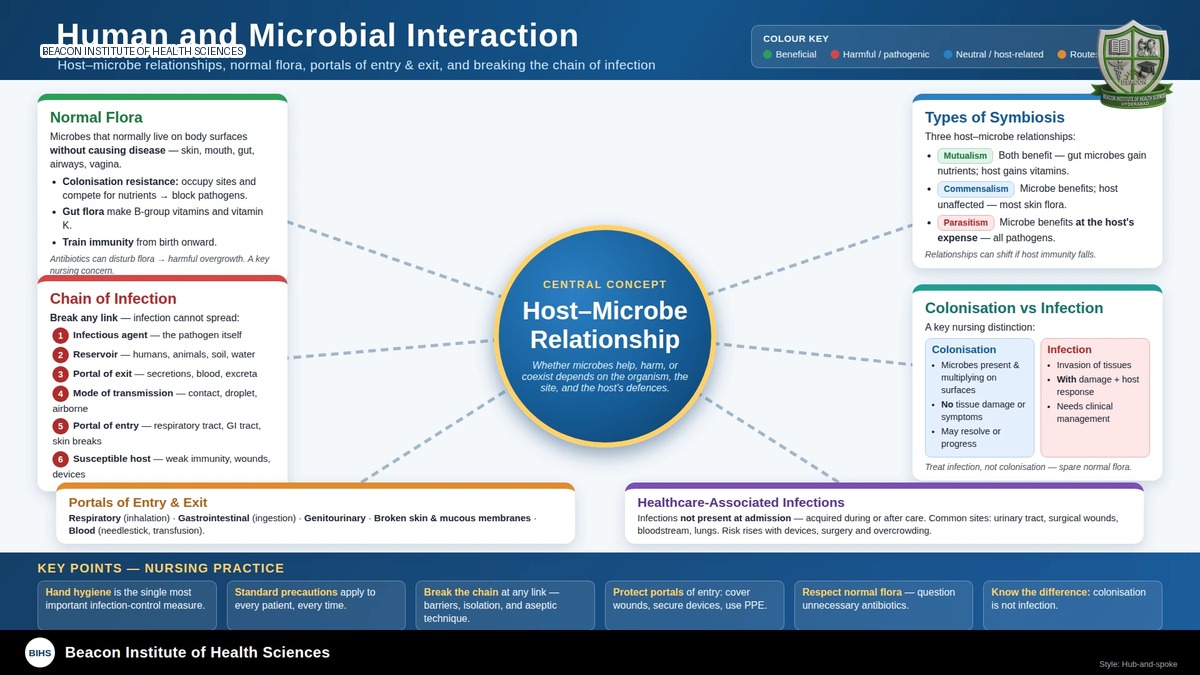
Humans constantly encounter microbes in their environment and host diverse microbial communities both on and within their bodies. The outcome of such an encounter depends on several factors, including the specific organism involved, the level of exposure, the particular body site affected, and the host's defense mechanisms. It is crucial to understand that the mere presence of a microorganism does not automatically equate to disease. Therefore, nursing assessment requires a comprehensive approach that integrates the clinical picture with laboratory results and the patient's relevant exposure history.
Helpful, Neutral, and Harmful Relationships
Microbial relationships can be broadly categorized using ecological models, though their nature can shift with circumstances:
- Mutualism: A relationship where both partners benefit from the interaction.
- Commensalism: Describes an interaction where one partner benefits without any apparent effect on the other.
- Parasitism: Involves one partner benefiting at the direct expense of the host.
It is important for nurses to recognize that microbes typically found at one body site can become harmful if introduced into a normally sterile site. The term 'normal microbiota' does not imply that these organisms are harmless in all settings or under all conditions.
Colonization and Infection
Understanding the distinction between colonization and infection is fundamental:
- Colonization: This refers to the presence and carriage of microorganisms without evident symptoms of infection. Even in the absence of symptoms, colonized individuals may still transmit the microbes to others.
- Infection: This involves entry and multiplication of microorganisms within a host with a host response. Clinical disease refers to the associated harmful disturbance of normal function; microbial carriage alone does not establish clinical disease.
A laboratory result, such as a positive culture, requires careful interpretation considering the specimen site, the patient's symptoms, physical examination findings, the quality of specimen collection, and the patient's treatment history. Not every positive culture warrants antimicrobial treatment; the clinician must apply relevant diagnostic and treatment criteria.
Pathogenicity and Host Factors
Pathogenicity refers to an organism's inherent ability to cause disease, while virulence describes the degree or specific characteristics of that ability. Several factors contribute to an infection developing:
- Microbial Factors: Entry into the host, adherence to host cells, multiplication, and the production of harmful products.
- Host Factors: Host barriers and immune responses significantly influence the outcome after exposure. Factors such as wounds, the presence of invasive medical devices, and immunosuppressive treatments can increase a patient's vulnerability to infection. Consequently, the same microbial exposure may lead to different outcomes in different patients based on their individual host factors.
Transmission and the Chain of Infection
To effectively prevent infection, it is essential to identify and target specific links in the chain of infection. This chain includes:
- The infectious agent
- The reservoir (where the agent lives and multiplies)
- The exit route from the reservoir
- The mode of transmission
- The entry route into a new host
- The susceptible host
People, medical equipment, and the environment can all contribute to this chain. For example, a healthcare worker's contaminated hands can transfer an organism from equipment to a patient. Respiratory secretions can spread through relevant respiratory pathways, and a contaminated sharp object creates a direct exposure route. Effective prevention strategies should target the actual links involved rather than relying on a single, isolated measure.
Biofilms and Devices
A biofilm is a community of microorganisms attached to a surface, often thriving in a moist environment. Medical devices and wet infrastructure within healthcare settings can provide persistent sites for microbial colonization and growth. Safe patient care practices include:
- Correct insertion and maintenance procedures for devices.
- Appropriate reprocessing of reusable medical equipment according to manufacturer instructions and facility policy.
- Regular assessment of the necessity of continuing to use certain devices.
It is important not to assume that a visibly clean surface guarantees the absence of microorganisms, nor that a single routine antibiotic will resolve every device-associated problem.
Antimicrobial Resistance
Antimicrobial resistance occurs when microorganisms develop the ability to withstand drugs designed to kill or inhibit them. It is the microorganism, not the person, that becomes resistant. Resistant organisms can spread among individuals or be carried asymptomatically. Effective infection prevention and responsible antimicrobial use are interconnected strategies. Nurses play a critical role by:
- Supporting prescribed antimicrobial administration.
- Reviewing communication related to medication orders.
- Ensuring proper specimen handling.
- Verifying patient allergies.
- Monitoring patient responses to treatment.
- Educating patients not to share leftover medicines or use antibiotics without authorized medical advice.
Bedside Reasoning
Effective bedside reasoning in nursing involves a systematic approach to patient assessment and care:
- Assessment: Evaluate symptoms and their trends, relevant exposure history, barrier integrity, the presence of devices, and immune risks.
- Intervention: Apply Standard Precautions and additional infection control measures as indicated.
- Specimen Management: Label and transport specimens correctly to ensure accurate results.
- Communication: Promptly communicate relevant findings and avoid stigmatizing a patient who is colonized.
- Treatment and Isolation: Base decisions on current clinical and infection-prevention guidance.
- Patient Education: Use good communication to explain uncertainties, avoiding promises that one test will definitively resolve every question.
Learning Example
Consider a scenario where a wound swab reports the presence of an organism. The nurse's assessment must also include a review of the patient's wound appearance and overall clinical condition. The nurse documents this assessment, verifies the context of specimen collection, and reports all findings through the established care pathway. Infection prevention measures continue while the healthcare team collectively determines whether the organism represents colonization, contamination, or a true clinical infection requiring treatment.
Revision Prompts
To deepen your understanding, consider these points:
- Compare and contrast mutualism, commensalism, and parasitism, providing examples where possible.
- Explain why the specific body site where microorganisms are found is critical in determining their significance.
- Clearly distinguish between microbial colonization and infection, outlining their implications for patient care.
- Identify at least two links in the chain of infection that can be effectively interrupted by nursing care.
- Explain the interconnectedness between antimicrobial resistance and safe medical device practice.