
About these notes: This BSN and Post RN study guide is based on the teaching and infection-prevention references listed below. It is an original source-based summary, not an extracted YouTube lecture transcript.
Meaning and Scope of Microbiology
Microbiology is the study of organisms and infectious agents too small to be adequately examined without magnification. It connects laboratory science directly with bedside infection prevention, public health, food safety, and biotechnology. Medical microbiology seeks to answer critical questions such as which agents cause disease, how they spread, how the host responds, and how laboratory findings guide patient care. For BSN and Post RN learners, a central question is how knowledge of microbes influences nursing decisions.
Major Groups of Microorganisms
Microbes are categorized into several major groups, each with distinct characteristics:
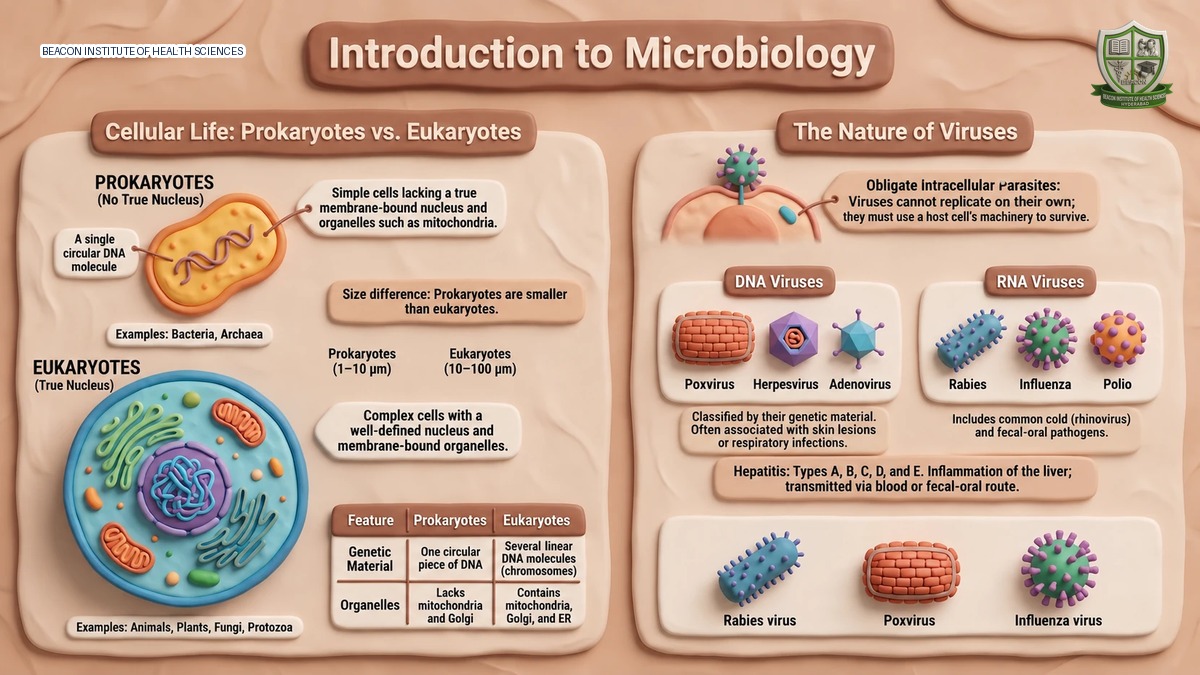
- Bacteria: These are single-celled prokaryotes.
- Fungi: This group includes yeasts and moulds, which are eukaryotic cells.
- Protozoa: These are single-celled eukaryotes.
- Parasitic Worms: Though adult forms may be visible, these are studied within medical parasitology.
- Algae: Important environmental organisms.
- Viruses: Acellular infectious agents that require a host cell to replicate.
- Archaea: These are prokaryotes that are distinct from bacteria.
It is crucial to understand that these categories are not interchangeable; for example, antibacterial medicines are ineffective against viral infections.
Key Terminology and Identification in Microbiology
Understanding specific terminology is fundamental to microbiology:
- Pathogen: An agent capable of causing disease.
- Opportunistic Pathogen: A pathogen that causes disease particularly when host defenses are impaired or when it reaches an unusual body site.
- Colonization: The carriage of microorganisms without symptoms of infection, which can still permit transmission.
- Infection: Involves the entry of a microorganism, its multiplication within the host, and a subsequent host response.
When interpreting a positive laboratory result, it must be considered in conjunction with the specimen site, the patient's clinical condition, and the quality of the specimen collection. In scientific nomenclature, the genus name begins with a capital letter, and the species name begins with a lower-case letter, such as Escherichia coli.
A Brief Historical Perspective on Microbiology
The microbial world became observable through the invention of microscopy. Hooke described microscopic structures, and Leeuwenhoek observed tiny living organisms. Pasteur's work connected microbes with fermentation and helped disprove the theory of spontaneous generation. Koch established links between specific microorganisms and particular diseases. These discoveries contributed to the Germ Theory, which supported safer sanitation and clinical practice. While modern molecular methods now supplement microscopy and culture, these advancements do not diminish the importance of careful specimen collection.
Microbial Growth and Its Relevance to Nursing Care
Microorganisms exhibit diverse requirements for growth, including nutrients, moisture, temperature, pH, and oxygen:
- Aerobes: Require oxygen for growth.
- Obligate Anaerobes: Grow without oxygen and may be harmed by its presence.
- Facultative Anaerobes: Can grow with or without oxygen.
Conditions that are optimal for one organism's growth may inhibit another. Refrigeration is a method used to slow the growth of many food-associated microbes, but it does not achieve sterilization. Biofilms, which are microbial communities attached to surfaces, can complicate infection control, especially with device-associated infections.
Understanding the Chain of Infection
The chain of infection consists of six interconnected links, all of which must be present for an infection to occur:
- Infectious Agent
- Reservoir
- Portal of Exit
- Transmission
- Portal of Entry
- Susceptible Host
A reservoir can be a person, a contaminated device, a wet environment, or a surface. Transmission can occur through various routes, including contact, droplets, inhalation, or a contaminated sharp object. A catheter, for instance, can provide a portal of entry. Factors such as illness, immunosuppressive treatment, and invasive procedures can increase a host's susceptibility. Nursing interventions can effectively interrupt multiple links in this chain simultaneously.
Nursing Application in Microbiology and Infection Control
Nurses play a critical role in infection prevention and control. Key applications include:
- Performing consistent hand hygiene and adhering to Standard Precautions for every patient, selecting protective equipment based on anticipated exposure.
- Utilizing additional Transmission-Based Precautions when indicated.
- Maintaining the cleanliness of equipment.
- Protecting wounds and device sites.
- Collecting specimens using the correct container, site, label, and transport protocols.
- Promptly communicating relevant symptoms and laboratory findings.
It is important for nurses to avoid diagnosing an infection solely based on a laboratory name or assuming that the absence of fever automatically excludes an infection.
Worked Learning Example: Urinary Catheter Case
Consider a patient with a urinary catheter who has a positive urine culture. The nurse's role involves reviewing the patient's symptoms and observations, assessing the ongoing need for the catheter, and evaluating the specimen collection method. These findings are then reported through the clinical pathway. A positive culture result alone does not confirm a symptomatic infection or automatically necessitate antibiotics. Regardless of whether the patient is infected or merely colonized, hand hygiene and safe catheter care remain crucial for preventing complications and transmission.