
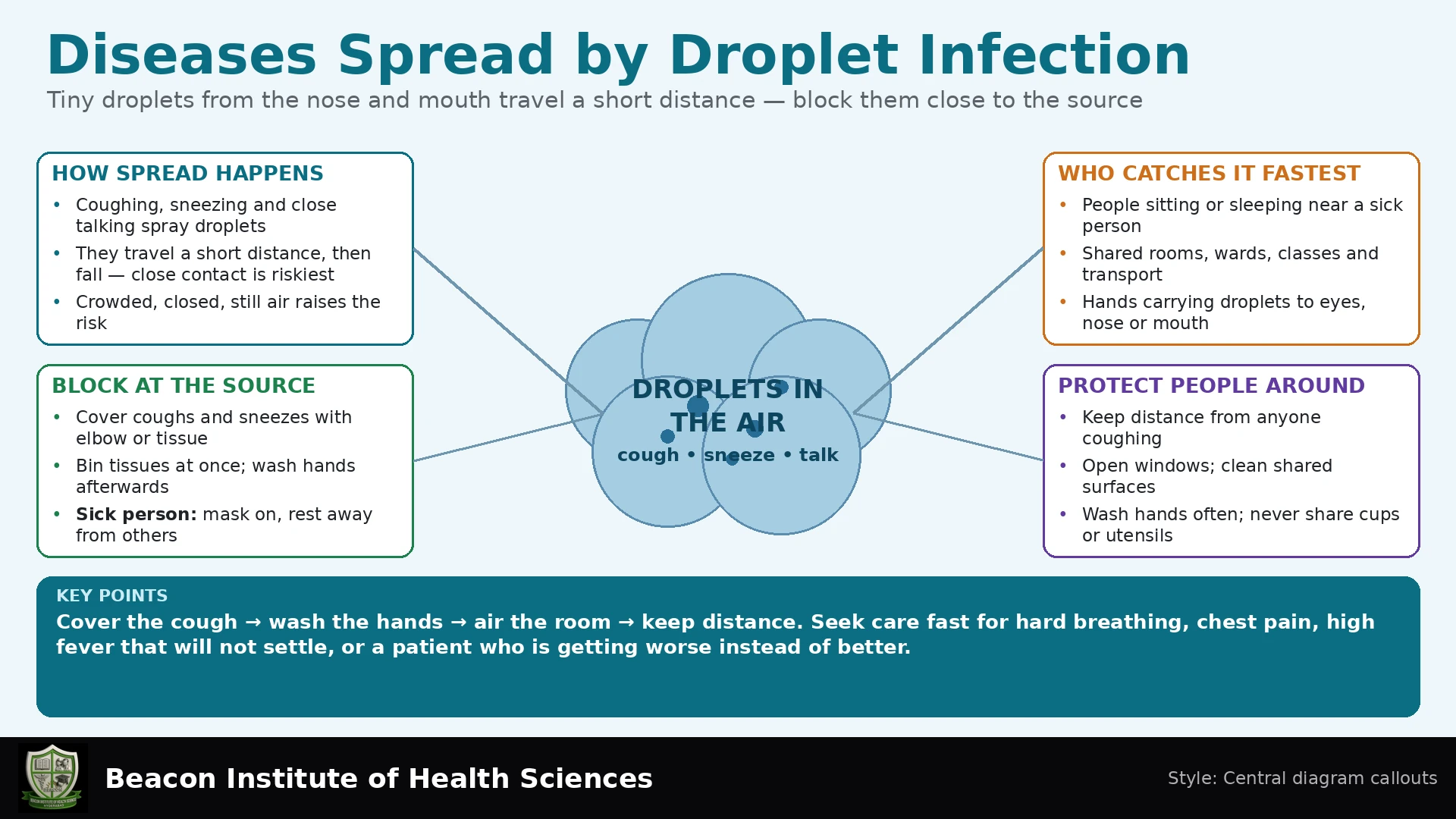
This BSN lesson explains respiratory transmission, recognition of selected communicable diseases and practical nursing responsibilities. The syllabus heading is retained, but infection-control decisions must follow the actual disease: respiratory infections do not all require the same precautions.
Learning Objectives
- Distinguish droplet precautions from airborne precautions.
- Recognize important features of mumps, pertussis, respiratory diphtheria and measles.
- Organize assessment, prevention, education and escalation without diagnosing from symptoms alone.
- Apply a safe, respectful response to a suspected communicable infection.
Transmission and Precautions
Respiratory secretions can expose another person during close interaction. Standard Precautions apply to every patient. Add the disease-specific transmission precautions required by the facility’s infection-control policy. Do not decide that a surgical mask is sufficient merely because an illness appears under a “droplet infection” syllabus heading.
| Condition | Healthcare Precaution Category | Learning Point |
|---|---|---|
| Mumps | Standard plus Droplet | Protect against respiratory-secretions exposure. |
| Pertussis | Standard plus Droplet | Protect vulnerable contacts, particularly infants. |
| Respiratory diphtheria | Standard plus Droplet | Recognize airway danger and obtain urgent care. |
| Measles | Standard plus Airborne | Airborne isolation and appropriate respiratory protection are required. |
Important correction: Measles is included for syllabus comparison, not as an example managed with Droplet Precautions alone. Follow current institutional instructions for placement, protective equipment, transport and discontinuation of precautions.
Mumps
Mumps is a viral infection often associated with swollen salivary glands, particularly the parotid glands. Swelling may affect one or both sides. Some infections have only nonspecific symptoms or no obvious symptoms. Complications can include inflammation of the testes, meninges or brain, and hearing loss. Vaccination reduces disease risk and complications, although illness can still occur in vaccinated people.
In a nursing assessment, record the onset of swelling, associated symptoms, exposure history and vaccination history. Ask about difficulty eating or drinking and assess the patient’s comfort. Severe headache, neurological changes or significant new pain require prompt clinical assessment. Do not assume that every swelling near the jaw is mumps.
Pertussis: Whooping Cough
Pertussis is caused by Bordetella pertussis. Early illness may resemble a common cold. Later, repeated coughing attacks may occur, sometimes followed by an inspiratory whoop or vomiting. Babies may have breathing pauses with little or no cough. The absence of a whoop therefore does not exclude the disease.
The nurse records the pattern and duration of coughing, breathing effort, feeding tolerance and possible contact with vulnerable people. Apnoea, cyanosis or respiratory distress requires urgent escalation. A clinician determines testing, treatment and contact management. Early antibiotic treatment may reduce illness severity; nurses administer prescribed therapy and monitor the response rather than select a regimen independently.
Respiratory Diphtheria
Diphtheria is a bacterial infection that can cause sore throat, fever, weakness and neck swelling. A thick grey coating in the respiratory tract may interfere with breathing or swallowing. This is an urgent clinical concern. Toxin-mediated disease may also affect organs beyond the throat.
Assess airway and breathing promptly, activate the appropriate clinical response and follow infection-control instructions. Do not attempt to remove a suspected adherent throat membrane. Diagnostic sampling and treatment are managed by the clinical team. Check the patient’s vaccination history and arrange the education and follow-up requested by the treating team.
Measles: The Airborne Comparison
Measles commonly presents with fever, cough, runny nose and red watery eyes, followed by a rash. A suspected case should be identified early to reduce exposure in shared waiting areas. Healthcare management requires Airborne Precautions, not Droplet Precautions alone.
Alert the responsible clinician and infection-control team, follow the facility’s airborne placement and respiratory-protection procedures, and communicate the concern before any transfer. Record relevant exposure and vaccination history. Do not postpone appropriate precautions while waiting for a final laboratory result when the clinical team suspects measles.
Nursing Process: A Practical Framework
- Assessment: Collect symptoms, onset, contacts, immunization history, vital signs and the patient’s concerns. Prioritize airway, breathing and hydration.
- Problem identification: Describe observed needs such as breathing difficulty, poor oral intake, discomfort, knowledge gaps or anxiety. Avoid labelling an unconfirmed disease as a confirmed diagnosis.
- Planning: Set observable goals, such as timely clinical review, appropriate precautions, adequate intake when safe and accurate understanding of instructions.
- Implementation: Provide prescribed care, communicate changes, use required precautions and explain each action in plain language.
- Evaluation: Reassess symptoms and understanding. Document response, escalation and any unresolved concern.
Prevention and Patient Education
Review vaccination according to the applicable local programme. Explain respiratory hygiene, hand hygiene and the reason for precautions. Give the patient the specific instructions agreed by the clinical and public-health teams. Use teach-back: ask the patient to describe what they will do if symptoms worsen and whom they should contact. Avoid blame; clear information encourages early reporting.
Fictional Learning Case
An infant arrives with episodes of stopped breathing after a household member has had a prolonged cough. A student says pertussis is unlikely because the infant does not whoop. The supervising nurse identifies the breathing episodes as urgent, obtains immediate clinical support and communicates the exposure history. Appropriate precautions are started under the facility’s protocol.
Reasoning: The immediate priority is breathing. Infants may have pertussis without a characteristic cough or whoop. Exposure history supports assessment but does not establish the final diagnosis. Record observations and actions accurately.
Practice With Explained Answers
- Does every respiratory infection need only droplet precautions? No. Measles requires airborne precautions.
- Can a vaccinated person develop mumps? Yes; vaccination reduces risk but does not exclude disease.
- Should a nurse remove a suspected diphtheria membrane? No. Obtain urgent clinical support and protect the airway.
- Why ask about contacts? It supports assessment and helps the clinical team identify people who may need advice or preventive action.