
About these notes: This BSN and Post RN study guide is based on the teaching and infection-prevention references listed below. It is an original source-based summary, not an extracted YouTube lecture transcript.
Purpose and Key Distinctions in Microbial Control
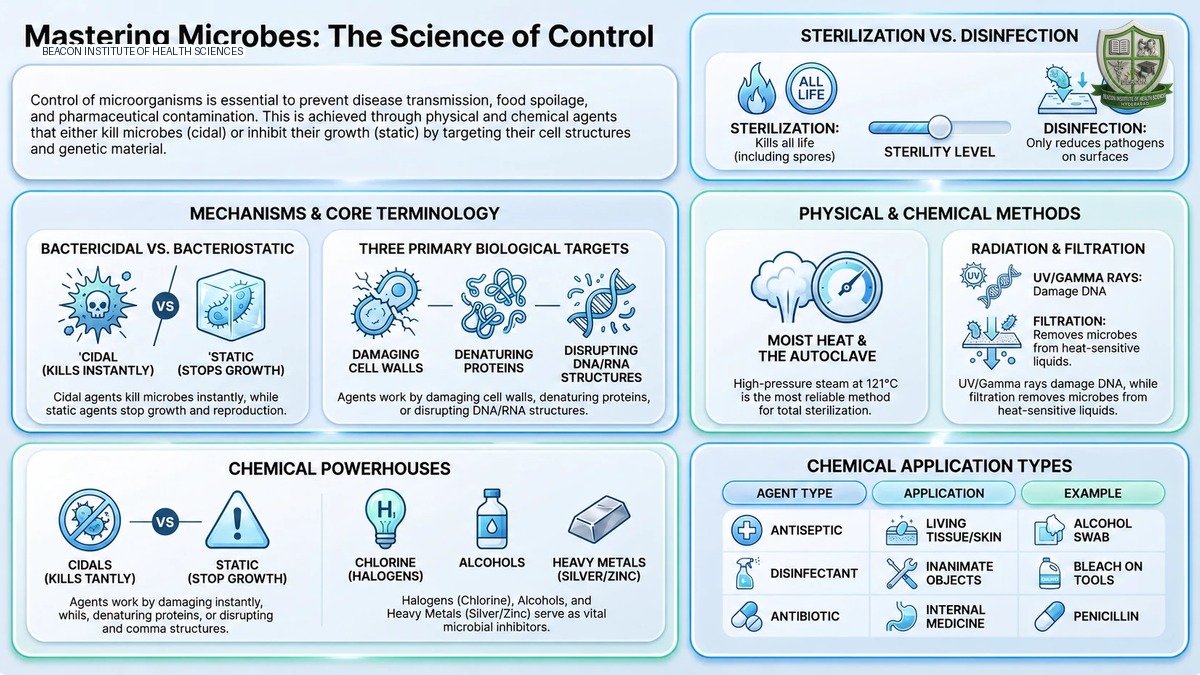
Microbial control is fundamental in healthcare, aiming to reduce the risk of transmission by actively removing, reducing, or destroying microorganisms. Understanding the precise distinctions between various methods is crucial for safe nursing practice:
- Cleaning: This process focuses on removing soil and organic material. It is a vital first step, as blood, tissue, and other soil can interfere with subsequent disinfection or sterilization.
- Disinfection: This method inactivates many pathogens on inanimate objects. Its effectiveness varies depending on the level of disinfection and the specific product used.
- Sterilization: This is a validated process that eliminates all viable microorganisms, including bacterial spores.
- Antisepsis: This involves using suitable products specifically on living tissue.
It is important to remember that a surface appearing clean does not guarantee it is disinfected, and a disinfected instrument is not necessarily sterile.
Cleaning Comes First
Effective reprocessing of medical devices always begins with thorough cleaning. This initial step is critical because organic material, such as blood and tissue, can significantly impede the efficacy of subsequent disinfection or sterilization. Nurses must adhere to device manufacturer instructions and facility reprocessing procedures.
Key considerations for cleaning include:
- Maintaining separate workflows for dirty and clean items.
- Containing contaminated items properly during transport.
- Using appropriate personal protective equipment (PPE).
The complete reprocessing sequence encompasses cleaning, inspection, the required microbial treatment, drying, safe storage, and meticulous documentation. Shortcuts at any early stage can compromise the effectiveness of later treatments.
Risk-Based Device Classification
Medical devices are classified based on their intended use and the potential risk of infection they pose. This classification dictates the level of microbial treatment required:
- Critical items: These devices enter sterile tissue or the vascular system. They absolutely require sterilization. Examples include surgical instruments.
- Semicritical items: These items contact mucous membranes or nonintact skin. They generally necessitate at least high-level disinfection, though device-specific guidance might require sterilization. An example is selected endoscopes.
- Noncritical items: These devices contact intact skin. They typically require appropriate low-level disinfection. Blood pressure cuffs are an example.
The classification is determined by the item's intended use, rather than its cost or appearance. Actual reprocessing must always follow specific device instructions.
Physical Approaches to Microbial Control
Several physical methods are employed for microbial control:
- Steam sterilization: This is suitable for heat- and moisture-resistant items and requires validated cycles. Other approved methods are available for heat-sensitive devices.
- Filtration: This removes organisms from certain liquids or air. It is important to note that filtration does not imply that every filtered material is sterile.
- Heat for food processing: While heat can reduce pathogens in food, it does not necessarily sterilize it.
It is crucial not to confuse everyday practices like boiling, refrigeration, or sunlight exposure with validated clinical sterilization processes.
Chemical Approaches to Microbial Control
Disinfectants and antiseptics are chemical agents with specific indications for use. Their efficacy is influenced by several factors:
- Concentration of the chemical.
- Contact time.
- Coverage of the surface.
- Temperature.
- Organic load present.
- Material compatibility.
When using these agents, always keep the surface wet for the required product contact time and use the stated dilution. Never create a universal concentration or timing rule, as each product has specific instructions. Mixing cleaning chemicals is unsafe, and surface disinfectants should never be applied to skin. Always follow the label, safety data, and local infection-prevention policies.
Ensuring Efficacy and Preventing Resistance
Monitoring and Storage
Sterilization quality assurance involves a comprehensive monitoring process that includes mechanical records and chemical and biological indicators. It's important to understand that a mere color change on a chemical indicator does not, by itself, confirm sterility.
Proper procedures for release, storage, and traceability must be followed, and packaging should be meticulously inspected. Any damaged or compromised packs require assessment and reprocessing according to policy. Failed monitoring results must be reported, and affected items removed from use until the responsible team resolves the issue.
Antimicrobials and Resistance
Antimicrobials, which act within or on the patient, are distinct from environmental disinfectants and are not interchangeable. Antimicrobial resistance develops in microorganisms, not in the patient as a person, and resistant organisms can spread between individuals and settings.
Nurses play a critical role in antimicrobial stewardship by:
- Ensuring accurate allergy information is documented.
- Administering prescribed antimicrobials precisely.
- Handling specimens for culture in a timely manner.
- Monitoring for and responding to adverse effects.
- Communicating effectively with the treating team.
Nurses should never recommend antibiotics for every fever or for viral illnesses, as this contributes to resistance.
Nursing Application Example
Consider a reusable blood pressure cuff: after use on one patient, it must be cleaned and disinfected according to its intended use and product instructions before being used on another patient. In contrast, a surgical instrument intended for sterile-tissue use cannot be rendered sterile simply by wiping it with the same product. The method of microbial control must always align with the item's risk category and a validated procedure.
Key Study Points for BSN Students
To reinforce your understanding of microbial control, consider these essential study points:
- Clearly differentiate between cleaning, antisepsis, disinfection, and sterilization.
- Explain why the thorough removal of soil and organic material is paramount before disinfection or sterilization.
- Classify medical devices into critical, semicritical, and noncritical categories based on their patient contact.
- Discuss why precise contact time and manufacturer compatibility are crucial factors for the efficacy of chemical disinfectants and antiseptics.
- Describe the appropriate actions to take when a sterilization monitoring result fails.