
1. Learning objectives
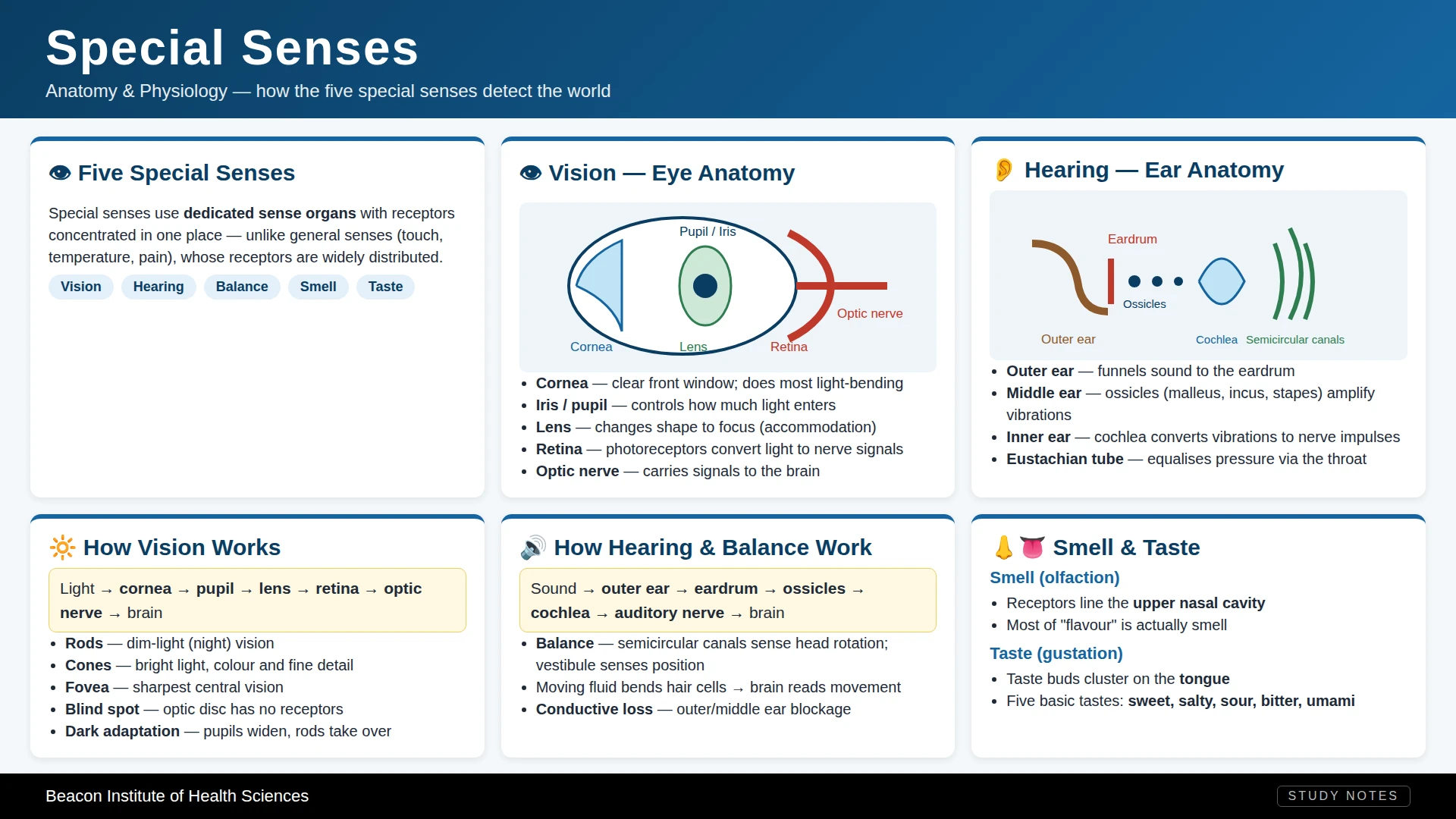
Special senses involve specialized organs for vision, hearing, equilibrium, smell and taste. BSN students should identify their key structures, explain how a stimulus becomes a neural signal and connect sensory information with safe communication. General sensations such as touch and temperature are distributed more widely. This lesson focuses on normal anatomy and physiology. Practical activities are for learning and do not replace professional eye, ear or neurological assessment.
2. Receptors and sensory transduction
Transduction converts a stimulus into a signal that the nervous system can process. Photoreceptors respond to light, mechanoreceptors to mechanical changes and chemoreceptors to chemicals. Perception requires central processing as well as receptor activity. Receptor adaptation can reduce responses to a constant stimulus, although different systems adapt differently. Detecting a signal is not the same as correctly identifying its meaning. Attention and context influence the experience of a sensation.
3. Protective and supporting eye structures
Eyelids, eyelashes, conjunctiva and the lacrimal apparatus help protect the eye. Tears support the ocular surface and drain through the lacrimal pathway. Extraocular muscles move the eyeball and help align gaze. The eyeball has an outer fibrous layer, a vascular layer and an inner retinal layer. The transparent cornea permits light entry, while the sclera provides a firm outer covering. Keep anatomical protection distinct from permission to manipulate an eye during a classroom exercise.
4. Optics and focusing
Light passes through the cornea, aqueous humor, pupil, lens and vitreous body before reaching the retina. The cornea provides substantial refraction, while changes in lens shape contribute to accommodation. The iris regulates pupil size and therefore light entry; it is not itself the focusing lens. Near viewing involves coordinated adjustments. Refractive errors concern how light focuses relative to the retina. A classroom diagram can illustrate focusing without diagnosing a person from difficulty reading text.
5. Retina, rods and cones
The retina contains photoreceptors and processing cells. Rods support vision in dim conditions and do not provide color discrimination. Cones support color and high-detail vision, especially in the foveal region. Signals pass through retinal circuits toward ganglion cells, whose axons form the optic nerve. The optic disc has no photoreceptors and creates a physiological blind spot. An image can reach the retina while perception is still affected by problems elsewhere in the pathway.
6. Visual pathways and interpretation
Optic nerves carry retinal information to the optic chiasm, where some fibers cross. Subsequent pathways convey information toward relay centers and visual cortical areas. Each hemisphere processes information from the opposite visual field through organized pathways. Visual field is not identical to one whole eye. Trace left and right field information using a careful diagram rather than assuming that all signals from one eye remain on the same side. Reading and recognition involve additional networks.
7. Outer and middle ear
The outer ear includes the auricle and external canal, directing sound toward the tympanic membrane. The middle ear contains malleus, incus and stapes, which transmit mechanical vibration. The auditory tube helps pressure equalization between the middle ear and nasopharynx. This tube is not the cochlea. Sound transmission depends on several structures, so reduced hearing can arise at different points. Students should not insert objects into the ear canal to explore anatomy.
8. Inner ear and hearing
The cochlea contains sensory structures that respond to mechanical movement generated by sound transmission. Hair-cell activity contributes to signals carried through the cochlear nerve. Different regions of the cochlea respond preferentially to different frequencies. Central pathways then process auditory information. Hearing involves more than detecting sound volume; understanding speech also depends on processing and context. Conductive and sensorineural hearing difficulties describe broad mechanisms and require professional assessment to establish their cause.
9. Equilibrium and the vestibular apparatus
The utricle and saccule help detect linear acceleration and head position relative to gravity. Semicircular ducts detect rotational acceleration through movement affecting sensory hair cells. Vestibular information combines with vision and proprioception to support balance and gaze stability. Equilibrium is therefore not controlled by the ear alone. A mismatch among sensory inputs can produce discomfort, but dizziness has many possible causes. Do not use spinning or risky balance challenges as unsupervised student demonstrations.
10. Olfaction
Olfactory receptor neurons in the nasal region respond to odor-related chemical signals. Information reaches the olfactory bulb and associated pathways. Smell contributes to flavor, environmental awareness and memory-related experiences. Nasal conditions and other factors can affect odor detection. Loss of smell should not be inferred simply because a person fails one informal test. Avoid strong chemicals, allergens or unknown substances in teaching activities. A safe diagram or fictional example is sufficient to explain the pathway.
11. Gustation and flavor
Taste receptor cells are organized within taste buds. Common taste qualities include sweet, sour, salty, bitter and umami. These qualities are not confined to rigid separate zones on the tongue; the old tongue map is misleading. Flavor combines taste with smell, texture, temperature and other inputs. Cranial pathways convey taste information for processing. Changes in appetite or food experience may involve several systems, so a nursing assessment should avoid assuming that taste alone explains the problem.
12. Sensory communication and safe care
Ask about a person's preferred communication needs, usual glasses or hearing devices and any change from baseline. Face the person, reduce unnecessary background noise and confirm understanding rather than shouting automatically. Vision and hearing differences do not establish cognitive impairment. Make written information readable and provide appropriate assistance. Sudden sensory loss or severe acute eye symptoms require timely professional assessment through local procedures. This article does not provide a treatment algorithm or instructions for adjusting clinical devices.
13. Worked comparison activities
Compare three fictional examples: a camera lens focuses an image, a microphone converts vibration and a person perceives a familiar voice. The first two analogies explain limited functions but do not reproduce human perception. Next trace a sound from the canal through the membrane and ossicles to cochlear signaling. Finally explain why a blocked nose can change flavor even when taste buds remain active. Each exercise should state the structures involved and the limits of the analogy.
14. Answered review and practical task
Label an eye, an ear and the principal vestibular structures. Answers: the iris changes pupil size; the lens contributes to accommodation; rods support dim-light vision; the cochlea participates in hearing; semicircular ducts detect rotation; smell and taste are chemical senses. Why is the tongue map inaccurate? Taste qualities are not limited to its separate labeled zones. Why does perception require the brain? Receptors provide signals that must be processed. Recap: trace stimulus, receptor, pathway and interpretation.