
Learning Objectives
- Recognize common situations requiring careful transcultural nursing care.
- Balance individual preferences, consent, clinical safety and professional responsibilities.
- Use respectful communication in sensitive, urgent and family-related situations.
- Plan, document and evaluate a feasible response to fictional care dilemmas.
What Makes an Issue Transcultural?
Transcultural issues arise when meanings, communication needs or expectations differ between patients, families and health services. They may involve food, privacy, prayer, pain, childbirth, serious illness or decisions about treatment. Differences can occur within the same language or religious community. The aim is safe care that responds to this individual rather than a presumed group profile.
A missed appointment or disagreement is not automatically a cultural problem. Cost, transport, inaccessible buildings, unclear explanations and poor previous experiences may be more important. Begin with clinical assessment and the patient's account, then explore the social and organizational context.
A Consistent Decision Process
- Identify the clinical issue, urgency and relevant risks.
- Ask what the practice or preference means to the person.
- Check communication, consent, capacity for the particular decision and desired family involvement.
- Explain evidence, uncertainty and available options.
- Accommodate safe preferences or negotiate safer alternatives with the appropriate team.
- Document the agreement, unresolved concerns and review arrangements.
Culture does not excuse discrimination, abuse or unsafe practice. Respect does require listening and an understandable explanation. Nurses should work within their competence and follow current clinical, safeguarding and consent procedures. International resources cited here inform practice; they do not replace Pakistani law or the institution's responsibilities.
Language, Health Literacy and Interpretation
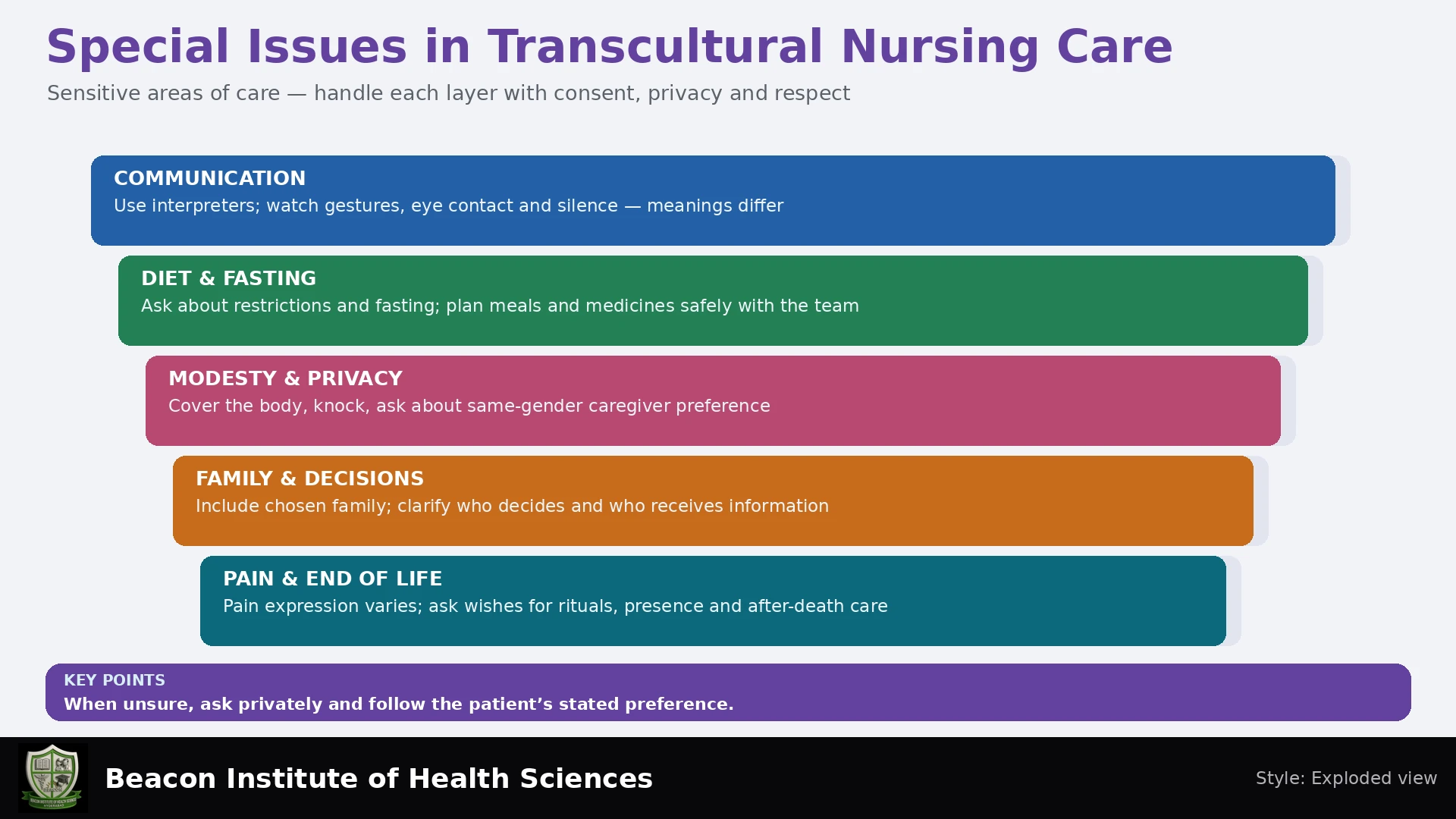
Ask which language and format the patient understands best for clinical decisions. Everyday conversational fluency does not guarantee understanding of complex treatment. Use trained interpreters where available, short explanations and teach-back. Speak to the patient directly. A translated leaflet supplements rather than replaces a conversation.
A relative may provide valued support but may also omit information or have conflicting interests. Clarify permission and interpretation arrangements. Avoid relying on children for sensitive or complex interpretation. If assistance is unavailable during urgent care, follow emergency communication procedures, document limitations and arrange a fuller discussion as soon as possible.
Religious Practices, Fasting and Food
| Issue | Individual question | Safe response |
|---|---|---|
| Prayer or spiritual support | Would you like time, privacy or a support person for spiritual needs? | Coordinate routines where feasible and explain urgent care needs. |
| Fasting | What does the practice involve for you? | Arrange individualized clinical review of illness, hydration, nutrition and medicines. |
| Dietary preferences | Which foods or ingredients do you avoid or prefer? | Coordinate suitable meals with clinical nutritional needs. |
| Medicine ingredients | Do you have concerns about any ingredient or preparation? | Ask pharmacy or the prescriber about appropriate alternatives. |
| Personal rituals | What would make care more acceptable or comfortable? | Assess safety and accommodate harmless practices. |
Never infer observance from a patient's name or appearance. Do not independently change doses, omit medicines or guarantee fasting is safe. A spiritual adviser may help if the patient wants this, while clinical assessment remains the responsibility of qualified clinicians. Include people of minority faiths and people with no religious preference equitably.
Modesty, Gender and Intimate Care
Ask before touching, explain what an examination requires and expose only the necessary area. Discuss preferences for a clinician's gender, a chaperone or a chosen supporter without assuming them. Follow chaperone and consent procedures. If a request cannot immediately be met, explain options and urgency honestly, seeking senior support when needed.
Gender, age, marital status or disability does not establish incapacity. Address the person directly, provide appropriate communication support and assess the particular decision. A patient may choose family involvement, but relatives should not automatically replace the patient's voice or receive confidential information.
Pain, Distress and Mental Health
People express pain and distress in different ways. Quietness does not prove comfort, and visible emotion does not establish exaggeration. Use appropriate pain assessment, clinical findings and reassessment after interventions. Explore meanings while avoiding stereotypes about a community's pain tolerance.
Distress may be expressed through bodily symptoms, social concerns or spiritual language. Take symptoms seriously and assess possible medical causes. A spiritual belief alone does not establish mental illness. Evaluate distress, functioning, context and safety with appropriate clinical support. Do not label an unfamiliar experience as psychosis solely because it differs from the nurse's beliefs.
Traditional Practices and Treatment Decisions
Ask about home remedies, herbs, supplements and other healing practices without ridicule. Record available product details and seek pharmacy or clinical advice about interactions and adverse effects. Natural does not mean risk-free, and spacing doses does not necessarily prevent an interaction. A safe comforting practice may be supported alongside treatment.
When a practice could cause harm or delay necessary care, explain the concern and explore alternatives. If a patient declines treatment, check understanding, communication needs, decision-making capacity and possible pressure or practical barriers. Involve the responsible clinician and follow applicable procedures. An informed disagreement is not automatically evidence of incapacity.
Pregnancy, Birth and Family Care
Ask about desired support people, food, privacy, feeding and postpartum practices. Assess each preference for benefit, risk and feasibility rather than accepting or rejecting it because it is called traditional. Explain recommended care and clinical warning signs through the appropriate maternity team. Avoid inventing a uniform birth practice for any religion or ethnic group.
Children need developmentally appropriate explanations and involvement, alongside applicable guardian consent and safeguarding requirements. Adolescents may have sensitive concerns that require careful privacy arrangements. Explain confidentiality and its limits accurately according to local rules; do not promise absolute secrecy.
Serious Illness, Dying and Bereavement
Ask how much information the patient wants, who should join discussions and what gives comfort or meaning. If relatives ask staff to conceal a diagnosis, explore their concerns and clarify the patient's information preferences with the responsible team. Do not automatically assume that family wishes override the patient.
Palliative care addresses physical, psychological, social and spiritual suffering and can accompany disease-directed treatment. Discuss symptom relief and desired rituals without promising a specific outcome. After death, follow policy and legal requirements while accommodating requested practices where possible. Grief varies; there is no compulsory sequence or timetable every person must follow.
Migration, Displacement and Access
Migrants and displaced people have diverse histories and strengths. Assess current needs such as interrupted treatment, missing records, language assistance, transport or housing. Do not presume infection, trauma or legal status from nationality. Explain available services and coordinate continuity without collecting unnecessary personal details.
A trauma-informed approach offers choices, explains procedures, avoids unnecessary repeated accounts and asks permission. This does not require pressing the person to disclose trauma. Focus on immediate needs and refer to suitable services with appropriate consent.
Violence, Coercion and Safeguarding
Violence is not a harmless cultural preference. Where concern arises, provide a safe private opportunity to speak, listen without blame and assess immediate clinical and safety needs. Explain confidentiality limits and follow safeguarding and reporting requirements. Do not confront a suspected perpetrator or disclose concerns to relatives in ways that could increase danger.
WHO's first-line support approach for women experiencing violence emphasizes listening, asking about needs, validating the experience, enhancing safety and supporting access to help. Apply relevant training and local referral arrangements. Avoid pressuring the person into an unsafe disclosure or a decision they are not ready to make.
Fictional Worked Care Dilemma
A fictional patient, Farah, wishes to fast while receiving treatment and asks for privacy during prayer. A relative insists on answering for her. The nurse arranges a private, understandable conversation, asks Farah's preferences and seeks clinical review of fasting and medicines. Desired prayer is accommodated safely. The team explains options and risks, documents Farah's informed choices and agrees on review and escalation arrangements.
This plan separates an easily accommodated preference from a clinical question needing individualized review. It does not assume that all patients of Farah's faith fast, or that her relative has decision-making authority. Evaluation asks whether the plan is understood, feasible and clinically safe.
Fictional Service Review
A fictional ward records 20 requests for privacy adjustments. Sixteen were met and four were not: 16 ÷ 20 × 100 = 80% of recorded requests. The team examines why four requests were unmet and asks patients about their experience. Some needs may never have been expressed, and a recorded adjustment may still have been inadequate. The percentage alone cannot establish cultural safety or improved health outcomes.
Practice Questions with Explained Answers
- Should all members of a faith receive the same fasting plan?
No. Ask individual wishes and arrange clinical review based on illness and treatment.
- Does quiet behaviour show that pain is mild?
No. Use appropriate assessment and reassessment rather than presumed cultural rules.
- Can a family request automatically justify withholding information?
No. Clarify the patient's wishes and consult the responsible team and applicable procedures.
- What is the first response to a disclosed unsafe situation?
Listen without blame, assess immediate needs and safety, and follow appropriate confidential support and safeguarding procedures.
- Does 80% of privacy requests met establish that all needs were known?
No. Unexpressed needs and the quality of adjustments require separate assessment.
Conclusion
Special transcultural issues call for careful questions, clear explanations and shared decisions. Nurses protect dignity by accommodating safe preferences, assessing risk individually and addressing barriers and discrimination. Good care is judged through clinical outcomes and the patient's experience, not assumptions about identity.