
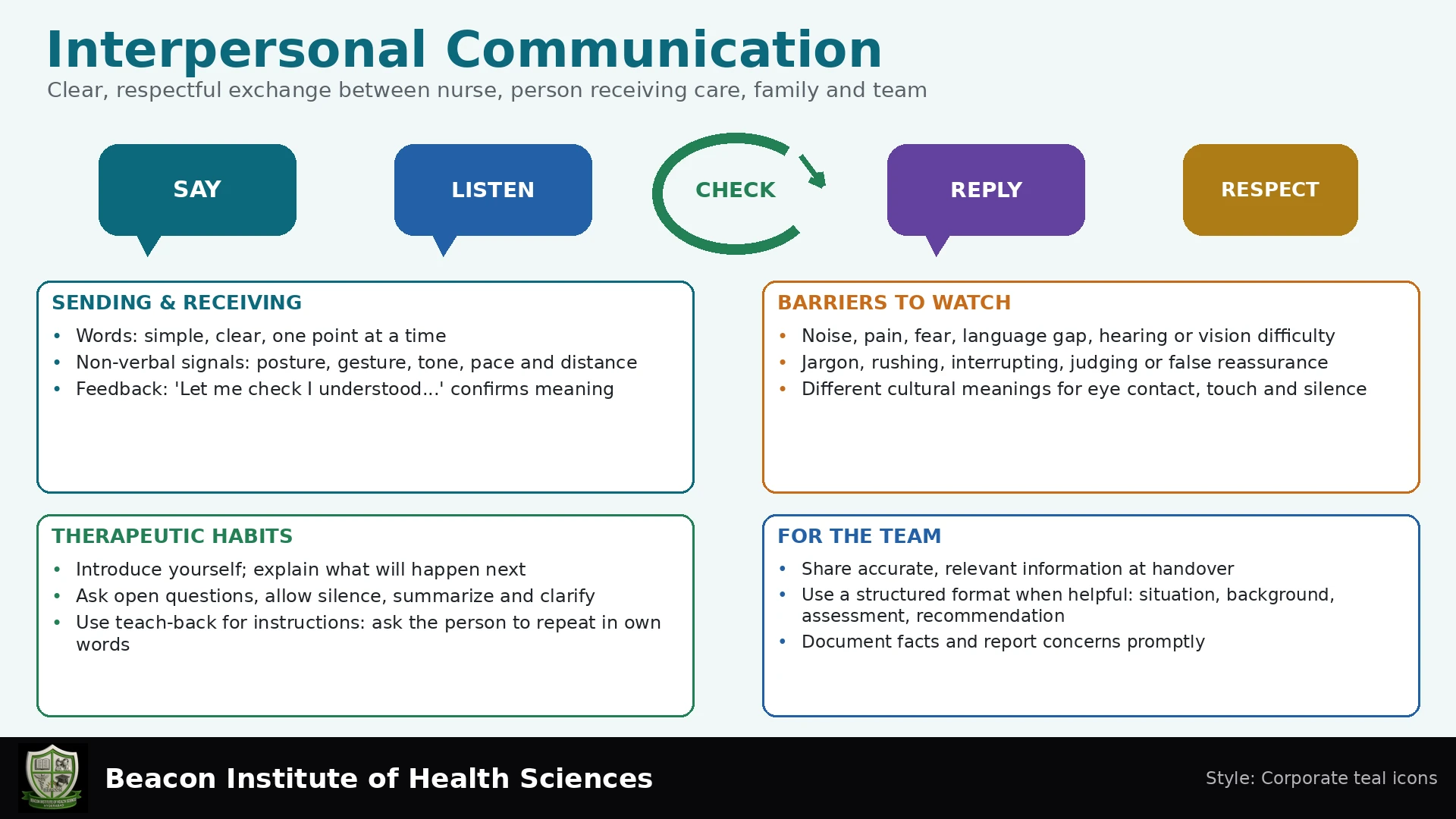
Introduction to Interpersonal Communication
Effective interpersonal communication is a cornerstone of professional nursing practice, essential for delivering patient-centered care, fostering therapeutic relationships, and ensuring team collaboration. This lesson defines key communication concepts, explores various communication types, identifies common barriers, and outlines strategies for enhancing communication in diverse clinical settings. The goal is to establish shared meaning between people, facilitating mutual understanding and trust through transactional exchanges.
Learning Objectives
Upon completion of this lesson, BSN students and nursing educators will be able to:
- Define the core components of the communication process.
- Distinguish between verbal, nonverbal, and written/digital communication.
- Identify key therapeutic communication techniques and their applications.
- Recognize common pitfalls to avoid in nursing communication.
- Explain the importance of assertiveness in professional interactions.
- Identify barriers to effective communication in healthcare settings.
- Implement strategies to overcome communication barriers and enhance patient safety.
- Understand the principles of interprofessional communication structures like SBAR.
- Apply communication techniques in a practice scenario to improve patient understanding and adherence.
The Communication Process
Interpersonal communication is a dynamic process involving several interdependent components:
- Sender: The individual who initiates the message.
- Encoding: The process by which the sender converts thoughts or feelings into a message using words, gestures, or other symbols.
- Message: The information being conveyed, which can be verbal, nonverbal, or written.
- Channel: The medium through which the message is sent (e.g., face-to-face conversation, phone call, written note).
- Receiver: The individual to whom the message is directed.
- Decoding: The process by which the receiver interprets the message and assigns meaning to it.
- Feedback: The response the receiver provides to the sender, indicating whether the message was understood and how it was received. This completes the communication loop and allows for clarification.
- Context/Noise: Environmental or internal factors that can influence the clarity and interpretation of the message. Noise can be physical (e.g., loud environment) or psychological (e.g., anxiety, distractions).
Effective communication is a transactional exchange, meaning both parties are simultaneously sending and receiving messages and influencing each other.
Types of Communication
Communication can manifest in various forms, each contributing to the overall message conveyed.
Verbal Communication
In this lesson, verbal communication refers primarily to spoken words; more broadly, language-based communication also includes writing. Its effectiveness depends on clarity, tone, pace, and appropriate language for the receiver's comprehension level.
Nonverbal Communication
Nonverbal communication conveys information without the words themselves. This includes body language (posture, gestures, facial expressions, eye contact), touch, appearance, and proxemics (personal space). In nursing, congruence between verbal and nonverbal cues is crucial for building trust. Nurses must carefully check for ambiguous nonverbal cues and clarify their meaning. It is important to note that there are no universal body-language percentages that apply to all interactions or cultures, as interpretation can vary significantly.
Written/Digital Communication
Written communication includes documentation, care plans, reports, and digital messages. It requires precision, accuracy, and adherence to professional standards to ensure clarity and avoid misinterpretation. Digital communication, in particular, requires secure and authorized channels to maintain patient privacy and confidentiality.
Therapeutic Communication Techniques
Therapeutic communication techniques are purposeful, conscious uses of communication to facilitate healing and positive patient outcomes.
- Active Listening: Fully concentrating on what the patient is saying, both verbally and nonverbally, demonstrating attentiveness.
- Open Questions: Encourage the patient to elaborate and provide more detailed information, fostering a deeper understanding.
- Clarification: Seeking to understand ambiguous or unclear statements from the patient to ensure accurate comprehension.
- Paraphrase: Restating the patient's message in one's own words to confirm understanding and show the patient that they have been heard.
- Reflection: Directing feelings, ideas, or questions back to the patient to enable them to explore their own thoughts and feelings more deeply.
- Therapeutic Silence: Allowing periods of quiet for the patient to organize thoughts, express emotions, or initiate further conversation.
- Empathy: The ability to understand and share the feelings of another, communicating this understanding to the patient.
- Summarizing: Condensing the main points of the conversation to review key information, provide closure, and ensure mutual understanding.
Table of Therapeutic Communication Techniques
| Technique | Purpose | Sample Phrase |
|---|---|---|
| Open Questions | Encourages elaboration, exploration of feelings/thoughts. | "What concerns do you have about your recovery?" |
| Clarification | Ensures accurate understanding, addresses ambiguity. | "Can you explain what you mean by 'feeling off'?" |
| Paraphrase | Confirms understanding, shows active listening. | "So, if I understand correctly, you're saying your pain is worse in the mornings?" |
| Reflection | Helps patient explore feelings, gain insight. | Patient: "I just feel so hopeless." Nurse: "You're feeling hopeless." |
| Empathy | Communicates understanding and validation of feelings. | "It sounds like you're going through a very difficult time right now." |
| Summarizing | Reviews key points, ensures mutual understanding, provides closure. | "So, we've discussed your medication schedule and the importance of hydration." |
Communication Pitfalls to Avoid
Certain communication behaviors can hinder therapeutic relationships and compromise patient care:
- False Reassurance: Offering comforting but untrue or unrealistic statements (e.g., "Don't worry, everything will be fine").
- Judgement: Expressing approval or disapproval of the patient's thoughts, feelings, or actions.
- Jargon: Using medical terminology that the patient may not understand.
- Unsolicited Personal Advice: Offering personal opinions or solutions without the patient requesting them or based on one's own experiences, rather than patient-centered evidence.
Assertiveness in Nursing Communication
Assertiveness is a crucial communication skill for nurses. It involves expressing one's needs, opinions, and feelings in a direct, honest, and appropriate manner, while respecting the rights and feelings of others. This stands in contrast to passivity (failing to express one's needs) or aggression (expressing needs in a demanding or disrespectful way).
Using respectful "I" statements (e.g., "I feel concerned when... because... I would appreciate if...") can facilitate constructive dialogue and conflict resolution without assigning blame.
Barriers to Effective Communication
Various factors can impede effective communication in healthcare settings:
- Patient Factors: Pain, anxiety, fear, hearing impairment, vision impairment, language barriers, low health literacy.
- Nurse Factors: Power imbalance (perceived or real), inadequate communication skills, stress, fatigue.
- Environmental Factors: Noise (e.g., alarms, conversations), lack of privacy, uncomfortable setting.
- Systemic Factors: Time pressure, heavy workload, inadequate resources, cultural differences.
Strategies to Enhance Communication and Overcome Barriers
Nurses can employ several strategies to improve communication and mitigate barriers:
- Quiet Environment: Find a calm, private space to communicate whenever possible.
- Aids: Ensure patients have and use their hearing aids, glasses, or other assistive devices.
- Short Information Chunks: Break down complex information into smaller, digestible segments.
- Qualified Interpreter: Utilize professional, qualified interpreters for language barriers. Avoid relying routinely on children to interpret sensitive care information due to ethical concerns and potential for misinterpretation or distress.
- Teach-Back Method: Ask patients to explain in their own words what they have understood about their condition or treatment. This checks clarity of explanation without shaming the patient.
- Patient Autonomy and Consent: Respect the patient's right to make decisions about their care, ensuring informed consent through clear and comprehensive communication.
- Privacy and Professional Boundaries: Maintain patient privacy and adhere to professional boundaries in all interactions.
- Secure Authorized Digital Channels: For written and digital communication, always use secure and authorized platforms to protect patient confidentiality.
Interprofessional Communication
Effective communication among healthcare team members is vital for patient safety and coordinated care.
- SBAR Structure: A widely used communication framework for sharing critical information in a structured manner:
- Situation: Briefly state the problem.
- Background: Provide relevant context and history.
- Assessment: Share your assessment of the situation.
- Recommendation: Propose an action or solution.
It is important to note that not all conversations or brief updates require the full SBAR structure; its application depends on the complexity and criticality of the information being conveyed.
- Closed-Loop Confirmation: The sender gives a message, the receiver repeats the message back, and the sender confirms the accuracy of the repeated message. This ensures mutual understanding and reduces errors, especially in critical situations.
Fictional dialogue: discussing an unfamiliar test
Nurse: “What have you been told about the scan, and what concerns you most?” This open question explores the patient’s understanding.
Patient: “I know it is an MRI, but I am worried about the noise and enclosed space.”
Nurse: “The noise and enclosed space are worrying you. Is that right?” Reflection invites confirmation or correction.
Patient: “Yes. I do not know how to tell someone if I need help.”
Nurse: “Let us ask the scanning team to explain the equipment and how you can contact them. MRI uses magnetic fields and radio waves to make images. The team will check safety information, explain whether contrast or other preparation is planned and discuss support for your concerns. What else would you like to ask?” The nurse gives limited relevant information and arranges clarification rather than promising that every scan is identical.
Nurse: “To check that I explained our plan clearly, could you tell me what we will ask the scanning team before the scan?” This explicitly requests teach-back.
Patient: “We will ask how to contact the staff, what preparation is needed and what support is available.”
Nurse: “Yes. I will help arrange that discussion. We have identified your concerns and the information you need before deciding about the next steps.” The summary closes the conversation without false reassurance.
Practical Evaluation Checklist for Nursing Communication
As you engage in patient and interprofessional communication, consider the following:
- Did I establish shared meaning?
- Was my verbal communication clear, appropriate, and jargon-free?
- Was my nonverbal communication congruent with my verbal message?
- Did I actively listen to the other person?
- Did I use open questions to encourage elaboration?
- Did I clarify any ambiguous statements?
- Did I paraphrase or reflect to confirm understanding?
- Did I demonstrate empathy?
- Did I avoid false reassurance, judgment, and unsolicited advice?
- Did I use "I" statements when expressing concerns?
- Did I address potential barriers to communication (e.g., noise, language)?
- Did I use the teach-back method to confirm understanding?
- For team communication, was SBAR appropriate and utilized effectively?
- Was closed-loop confirmation used for critical information?
- Did I respect patient autonomy, privacy, and professional boundaries?
- Were secure channels used for digital communication?
Self-Check Questions
- Question: A nurse tells a patient, "Don't worry, your surgery is routine, you'll be fine." Which communication pitfall is the nurse demonstrating?
- Explanation: This is an example of false reassurance. While well-intentioned, it dismisses the patient's valid concerns and may not be accurate. Therapeutic communication requires acknowledging the patient's feelings and providing realistic information.
- Question: To ensure a patient understands their new medication schedule, the nurse says, "Can you tell me in your own words when and how you'll take this medication?" This is an example of which communication strategy?
- Explanation: This is the teach-back method. It's an effective way to assess a patient's understanding without making them feel inadequate, empowering them to verify their comprehension.
- Question: When a nurse states, "I feel concerned when the care plan is not updated daily because it impacts patient safety," they are employing which assertive communication technique?
- Explanation: This is a respectful "I" statement. It allows the nurse to express their feelings and concerns clearly and professionally, focusing on the impact of the behavior rather than blaming the other party.
Glossary
- Active Listening: Fully concentrating on and understanding a speaker's message.
- Assertiveness: Expressing one's rights and feelings in a direct, honest, and appropriate way.
- Closed-Loop Confirmation: A communication technique to ensure accuracy where the receiver repeats a message and the sender confirms it.
- Congruence: Agreement between verbal and nonverbal communication.
- Decoding: The process of interpreting a message.
- Empathy: Understanding and sharing the feelings of another.
- Encoding: The process of converting thoughts into a message.
- False Reassurance: Offering comforting but untrue or unrealistic statements.
- Jargon: Technical language specific to a profession, often not understood by outsiders.
- Open Questions: Questions that encourage detailed, elaborate answers.
- Paraphrase: Restating a message in one's own words to confirm understanding.
- Reflection: Directing thoughts, feelings, or questions back to the speaker.
- SBAR: A structured communication method (Situation, Background, Assessment, Recommendation).
- Shared Meaning: Mutual understanding of a message between sender and receiver.
- Summarizing: Condensing main points to review and confirm understanding.
- Teach-Back Method: A technique to confirm patient understanding by asking them to explain information in their own words.
- Therapeutic Silence: Intentional pauses in conversation to allow for reflection or emotional processing.
- Transactional Exchange: A communication model where both parties are simultaneously sending and receiving messages.
Conclusion
Interpersonal communication is a foundational competency for all nursing students and practicing nurses. By mastering the principles of therapeutic communication, recognizing and overcoming barriers, and engaging in respectful interprofessional dialogue, nurses can significantly enhance patient safety, foster trusting relationships, and contribute to positive healthcare outcomes. Continuous practice and self-reflection on communication techniques are vital for ongoing professional development. Nurses must always follow institutional policy regarding communication practices.
Ready to test your knowledge? Take the quiz here: Interpersonal Communication Quiz