
1. Learning objectives
Oral communication helps people exchange ideas through spoken language. For a BSN student, it supports classroom participation, teamwork and clear explanations. This lesson develops English language skills; clinical communication must also follow the institution's procedures. By the end, you should be able to explain the communication process, adapt your words to a listener, ask useful questions, listen actively and repair misunderstandings. You should also be able to practise a short conversation and judge whether its purpose was achieved.
2. Communication as a two-way process
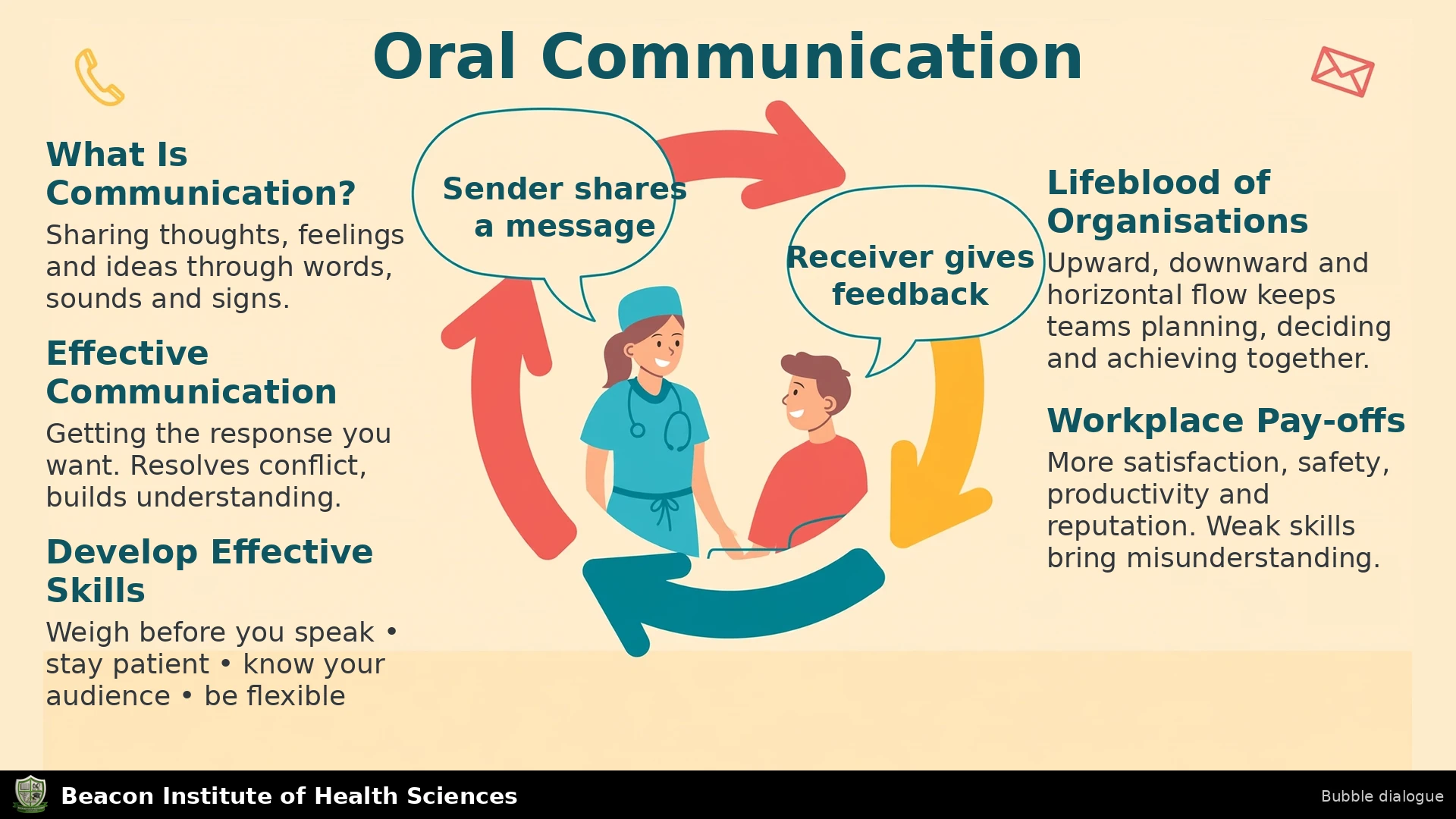
A speaker sends a message through a channel, such as a face-to-face conversation or telephone call. A listener interprets it in a particular context and gives feedback. The speaker then checks the response and adjusts the message. Meaning is therefore negotiated rather than simply delivered. Interference may come from noise, unfamiliar words, anxiety or assumptions. A sentence can be grammatically correct while still being misunderstood.
For example, a student says that a meeting will be held after class. The listener may not know which class or where to meet. A complete message identifies the event, time and place, and invites confirmation. Feedback reveals missing information before it becomes a practical problem.
3. Forms of oral interaction
- Conversation is an exchange in which speaking and listening roles change naturally.
- A discussion explores a shared question and compares ideas or reasons.
- An interview uses planned questions to obtain relevant information.
- A telephone call depends heavily on clear wording because visual clues are absent.
- A structured handover organizes professional information according to an agreed format.
An oral presentation usually involves a more sustained, planned message to an audience. Ordinary interaction gives listeners more frequent chances to interrupt, clarify and respond. In all forms, the purpose should guide the language and level of detail. A casual greeting and a formal team update need different organization.
4. Purpose, audience and register
Before speaking, identify what the listener needs to understand or do. Consider their knowledge, preferred language, available time and circumstances. Register means the style of language suitable for a situation. A discussion with a friend may be informal; an academic explanation needs more precise terms. Respectful language can remain simple.
Compare a technical expression with a plain version: You are finding it difficult to move around is easier for many listeners than Your mobility is compromised. Explain necessary professional terms rather than assuming everyone knows them. Plain English does not replace qualified language support. Where communication needs exceed your ability, follow local procedures for appropriate assistance.
5. Clarity, fluency and accuracy
Clarity means the listener can follow your meaning. Accuracy concerns correct language and information. Fluency means maintaining a reasonably smooth flow without losing the message. These qualities support one another, but speaking fast is not the same as being fluent. A short pause can help both speaker and listener.
Use manageable sentences and one main idea at a time. Put the key point early, then add necessary detail. Avoid filling every pause with unrelated words. If you make an error, correct it calmly: I said Tuesday; I meant Thursday. A clear correction is more useful than continuing with an uncertain message.
6. Pronunciation and vocal delivery
Intelligibility is the practical goal of pronunciation. Different accents are normal; students do not need to imitate a single accent to communicate effectively. Pay attention to sounds that change meaning, word stress, sentence stress, volume and pace. Speak loudly enough for the setting without shouting.
Stress can change emphasis. In I asked you to call the supervisor, stressing I contrasts the speaker with someone else; stressing call contrasts calling with another action. Intonation can signal a question, uncertainty or completion, but its interpretation depends on context. Practise short sentences aloud, record yourself with permission and check whether a partner understood the intended meaning.
7. Active listening
Hearing is receiving sound; listening involves attention and interpretation. Active listening means allowing the speaker to finish, identifying the main point, noticing relevant details and checking meaning. Do not prepare your reply so early that you stop attending to what is being said.
A useful sequence is listen, paraphrase, clarify and summarize. For example: You would like more time for the library demonstration. Is that correct? Paraphrasing uses your own words while preserving the speaker's meaning. Avoid adding an assumption that was never stated. If a listener corrects you, use the correction to improve understanding.
8. Questions and conversational functions
- Open question: What would you like me to explain? This invites a fuller response.
- Closed question: Did you attend the morning session? This checks a specific point.
- Clarification: Do you mean the session on Thursday?
- Polite request: Could you repeat the last point, please?
- Confirmation: Let me check that I understood correctly.
- Respectful disagreement: I understand your reason; could we also consider another option?
Leading questions can suggest the expected answer. You understood everything, didn't you? gives the listener less freedom than What would you like us to review? Choose the question according to the information needed, and allow sufficient time for a response.
9. Nonverbal communication and barriers
Facial expression, posture, gesture and distance can support or complicate spoken words. Avoid assuming that one gesture has the same meaning in every culture. Eye contact preferences and accessibility needs also differ. Attend to the whole interaction rather than judging understanding from one behavior.
Match barriers with practical responses. Reduce avoidable noise, pause when the listener is distracted, explain jargon and confirm details after an interruption. Anxiety may require a calmer pace and a chance to ask questions. Unfamiliar accents call for respectful clarification. Repeating the same difficult sentence more loudly may not solve the problem; rephrasing it often helps.
10. Worked student dialogue
Situation: Two fictional students arrange a study session.
Amina: Hello, Bilal. Could we review our English notes together this week?
Bilal: Yes. Would Thursday afternoon suit you?
Amina: Do you mean after the two o'clock class?
Bilal: Yes, at three o'clock in the library study room.
Amina: Let me confirm: Thursday at three in the study room. I will bring the vocabulary exercises.
Bilal: Correct. I will bring the grammar notes. See you then.
The greeting opens the interaction. The request states its purpose; the question narrows the time; clarification removes uncertainty; confirmation checks the arrangement; and the closing ends it politely. Notice how both speakers contribute rather than one person giving an uninterrupted instruction.
11. Explaining and checking understanding
An explanation should connect a familiar idea with new information. Introduce the purpose, divide the message into small parts and invite questions. In patient-facing interactions, use approved information within your role and protect privacy. The following fictional example demonstrates language rather than clinical advice.
Student: I have explained how to find the patient information desk. To check that I explained it clearly, could you tell me in your own words where you will go?
Visitor: To the desk beside the main entrance.
Student: Yes. If you need help finding it, please ask the reception staff.
This approach checks the quality of the explanation without presenting the listener as the problem. A vague question such as Do you understand? can miss uncertainty. When the answer reveals a misunderstanding, explain again using a different approach and check once more.
12. Group discussion and professional messages
In a discussion, stay on the question, give reasons, listen to other views and invite quieter members without pressuring them. Disagree with an idea respectfully. For example: Your suggestion could save time, but we also need to consider access for students who arrive later. This combines acknowledgment with a reasoned concern.
A brief team message should distinguish facts, a request and confirmation. For a fictional classroom example: The room has changed to Room B. The session starts at ten. Please confirm that your group received the update. The listener can repeat the room and time. Use the required professional format when communicating real clinical information; never disclose identifiable patient details in public conversations or practice recordings.
13. Practice and self-assessment
- What makes communication two-way? The listener responds, and the speaker uses that feedback to check or adjust meaning.
- Why is speed not the same as fluency? Rapid speech may be difficult to follow; a smooth, understandable message can include pauses.
- Change the leading question You agree, don't you? A better open question is What is your view?
- What should you do when an important detail is unclear? Ask specifically, then confirm the corrected detail.
- Does a different accent mean poor communication? No. Judge intelligibility and meaning rather than accent similarity.
- How does paraphrasing help? It shows what the listener understood and gives the speaker a chance to correct it.
- Why can plain language still be insufficient? Some people need qualified interpretation or other communication support.
- What should a closing do? Summarize any agreement, confirm next steps where needed and end respectfully.
14. Revision and practice plan
Practise a one-minute introduction, a partner information-gap task and a short role-play. Ask your partner to state the message they received. Use a sample practice rubric covering organization, clarity, vocabulary, accuracy, listening and respectful interaction. This is a learning aid, not an official university scale.
After each attempt, identify one strength and one change to practise. Check whether you stated the purpose, used appropriate language, allowed a response, clarified uncertainty and confirmed the outcome. Repeated meaningful interaction develops more useful speaking habits than memorizing isolated sentences without a listener.