
Learning Objectives
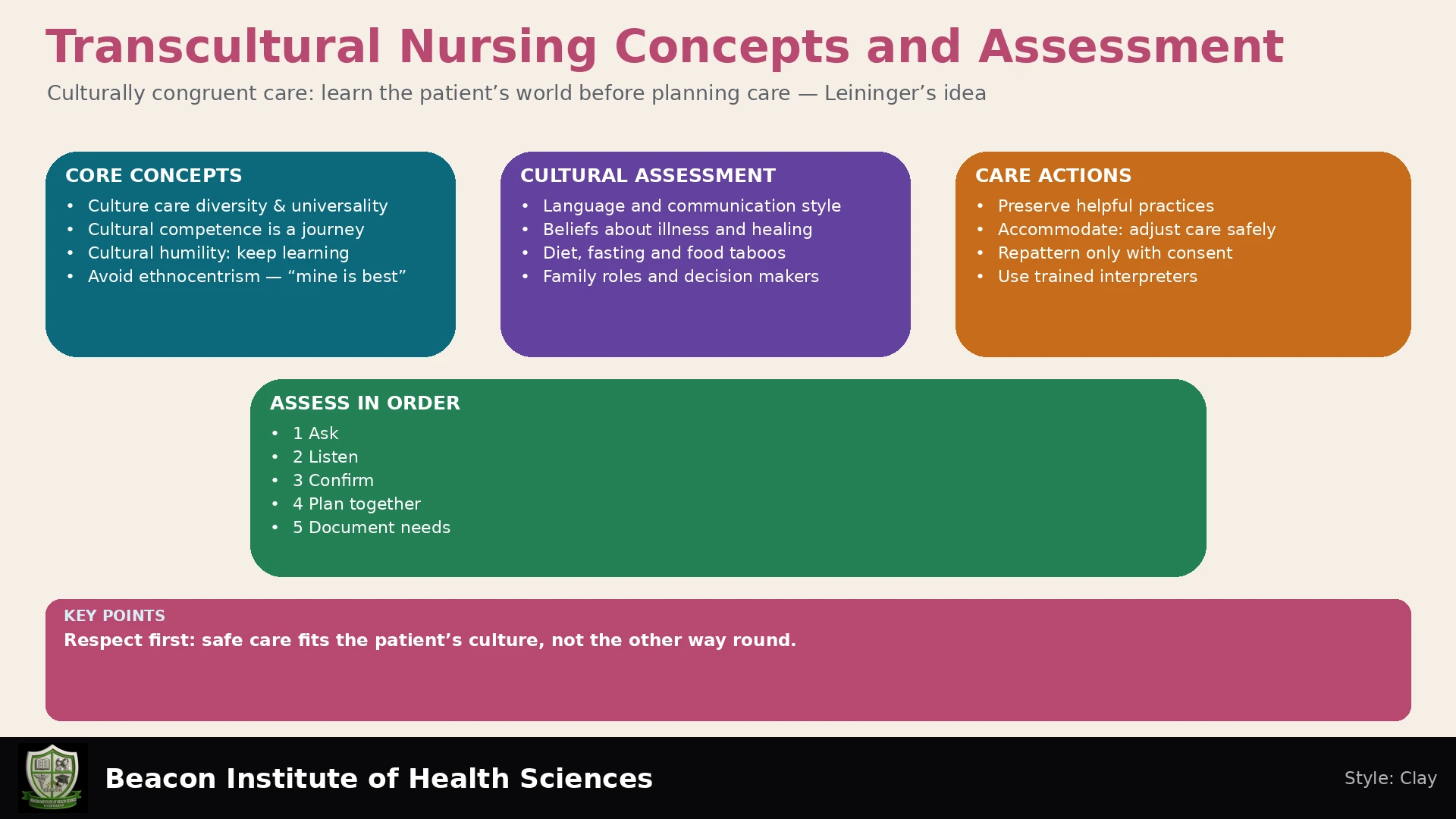
- Explain transcultural nursing, cultural humility and culturally safe care.
- Use selected nursing frameworks to guide individual assessment.
- Gather relevant information through respectful questions and language support.
- Translate findings into a shared, documented and evaluated care plan.
Purpose of Transcultural Nursing
Transcultural nursing examines how culture relates to care, health, illness and people's ways of living. Its practical purpose is care that is clinically sound and meaningful to the person receiving it. Culture includes learned meanings, values, relationships and practices, and changes over time. It is not identical to ethnicity, nationality, religion or language.
Every patient deserves assessment as an individual. People have multiple identities and experiences, including work, disability, education, family relationships and migration. Members of one community may disagree about care. Healthcare organizations also have cultures: routines, professional language and power differences can affect whether patients feel able to ask questions.
Essential Concepts
| Concept | Practical meaning | Nursing implication |
|---|---|---|
| Cultural awareness | Recognizing one's own assumptions and social position | Reflect before interpreting unfamiliar behaviour. |
| Cultural knowledge | Learning about meanings, histories and contexts | Use knowledge to ask better questions, not predict every preference. |
| Cultural competence | Developing abilities to respond appropriately across differences | Continue learning and adapt communication and services. |
| Cultural humility | Ongoing self-reflection, openness and attention to power | Invite correction and recognize the patient's expertise in their own life. |
| Cultural safety | Attention to whether care is experienced as respectful and free from harmful power practices | Seek patient feedback and address discrimination. |
| Culturally congruent care | Care fitted to individual meanings and values while remaining safe | Agree on an evidence-informed plan with the patient. |
These concepts overlap; none is achieved by memorizing a checklist about groups. Ethnocentrism judges others mainly through one's own cultural standards. Stereotyping assigns presumed group characteristics to an individual. Cultural imposition pressures the patient to adopt the provider's values without adequate consideration of choice and context.
Leininger's Culture Care Theory
Madeleine Leininger linked nursing and anthropology through Culture Care Diversity and Universality theory. It directs attention to shared and differing meanings of care and to influences such as language, worldview, family, religion, economics, education and the environment. The Sunrise framework helps organize inquiry rather than establish a diagnosis.
An emic perspective describes the person's or community's own meanings; an etic perspective offers an outside analytical or professional view. These can inform each other. The nurse should not assume that the professional explanation fully captures the patient's experience, or that a personal explanation establishes medical causation.
| Care mode | Meaning | Fictional application |
|---|---|---|
| Preservation or maintenance | Support a helpful or harmless practice the patient values. | Provide safe space for desired prayer. |
| Accommodation or negotiation | Adjust a plan collaboratively to fit important preferences. | Coordinate a routine appointment around a family commitment where feasible. |
| Repatterning or restructuring | Work together to change a practice that threatens health. | Discuss safer alternatives to an unsafe remedy after clinical review. |
Repatterning is not permission to force change. Explain the concern, explore alternatives, respect informed choices and follow professional duties and applicable policy. An accommodation must not conceal a clinical risk or promise resources the service cannot provide.
Giger and Davidhizar's Assessment Domains
This model draws attention to communication, space, social organization, time, environmental control and biological variations. Use the domains as prompts, avoiding rigid group profiles.
- Communication: preferred language, interpretation, hearing, vision and understandable information.
- Space: privacy, touch, personal boundaries and examination preferences.
- Social organization: chosen supporters, household roles and community connections.
- Time: routines, priorities and feasible appointments; investigate transport and work barriers before attributing lateness to culture.
- Environmental control: beliefs about causes and ways of influencing health, alongside actual housing and resource conditions.
- Biological variations: individual clinical findings and relevant personal and family history, rather than treating race as a precise biological diagnosis.
Models help prevent omissions but do not replace assessment, evidence or professional judgment. Ancestry, social conditions and exposure can be relevant for some health questions; group identity alone cannot determine an individual's genetics, disease or treatment response.
Preparing a Respectful Assessment
Introduce yourself, explain the purpose and ask permission to discuss relevant preferences. Attend to urgent clinical needs first. Provide privacy and ask who the person wants present. Cultural questions should serve care, not satisfy curiosity. The patient can decline a nonessential question.
Ask which language is preferred for clinical discussion and which format is easiest to understand. Use trained interpreters when available for important conversations, speaking directly to the patient in short sections. Check interpretation arrangements for confidentiality and conflicts of interest. Family support and interpretation are different roles; avoid using children for sensitive or complex discussions.
Questions That Lead to Useful Care
| Assessment area | Open question | Possible action |
|---|---|---|
| Understanding illness | What do you think is happening, and what concerns you most? | Connect clinical explanations with the person's concerns. |
| Preferences | Is there anything we should know to make care acceptable to you? | Discuss safe options for examination, food or routines. |
| Support and decisions | Whom would you like involved? | Document permission and keep the patient's voice central. |
| Medicines and practices | What treatments, home remedies or other help are you using? | Complete reconciliation and seek safety review. |
| Daily resources | What might make this plan difficult at home? | Address cost, access, caregiving and practical skills. |
| Communication | How would you explain the next steps in your own words? | Use teach-back to improve the explanation. |
Ask about spiritual needs, pain expression, nutrition, modesty and end-of-life preferences only as relevant to the situation. Do not assume that quietness means low pain, eye contact means honesty or agreement means understanding. Use appropriate clinical assessment methods and invite clarification.
From Assessment to the Nursing Process
Separate observations from interpretations. Record the patient's own words where helpful, the assistance used, agreed preferences and unresolved needs. Avoid entries such as “culture prevents cooperation” when the actual issue is unavailable transport or an unexplained procedure. Record only information needed for care and protect confidentiality.
Identify nursing needs from the complete assessment rather than from identity alone. Agree on achievable outcomes, assign team responsibilities and coordinate referrals. At evaluation, ask whether the patient understands the plan, whether it fits daily life and whether clinical goals and access needs are being met. Reassess preferences after changes in condition or circumstances.
Fictional Worked Assessment
A fictional patient, Samina, speaks conversational Urdu but prefers Punjabi for complex explanations. Her son answers questions, yet she wants him involved only in transport planning. She values prayer and is worried that an examination will expose more of her body than necessary. These are individual findings, not characteristics of all Punjabi-speaking patients.
The nurse arranges language assistance, offers a private conversation, explains the examination and seeks consent. Draping and privacy are planned; spiritual preferences are accommodated safely. Permission to share transport details with the son is recorded separately from clinical information. Teach-back checks the explanation. The plan is evaluated through Samina's feedback and clinical needs, not simply whether staff completed a form.
Fictional Quality-Improvement Example
In a fictional review, 18 of 24 patients with identified language-assistance needs received appropriate assistance. Provision is 18 ÷ 24 × 100 = 75%; six needs were unmet. The team should investigate missed assistance, urgency, availability and patient experience. A form marked complete does not establish accurate interpretation, informed understanding or cultural safety.
These small service data describe the reviewed group only. They do not prove a causal effect on health outcomes or describe every patient with an unrecognized need. Use feedback and appropriate follow-up rather than rely on a single percentage.
Practice Questions with Explained Answers
- Is cultural assessment a list of ethnic customs?
No. It is an individual inquiry into meanings, preferences, relationships and relevant conditions.
- What distinguishes humility from memorized cultural facts?
Humility includes continuing reflection, openness to correction and attention to power.
- Which care mode supports a safe valued practice?
Preservation or maintenance; negotiate any practical requirements with the patient.
- Does a relative's presence authorize disclosure?
No. Clarify the patient's wishes and applicable consent and confidentiality requirements.
- What does 75% provision establish?
That 18 of 24 identified needs received assistance in the review; it does not establish quality or identify every missed need.
Conclusion
Transcultural assessment strengthens nursing when it supports individual choice, understandable communication and safe evidence-informed care. Frameworks guide questions, while listening, reflection, documentation and patient feedback determine how those questions improve practice.