
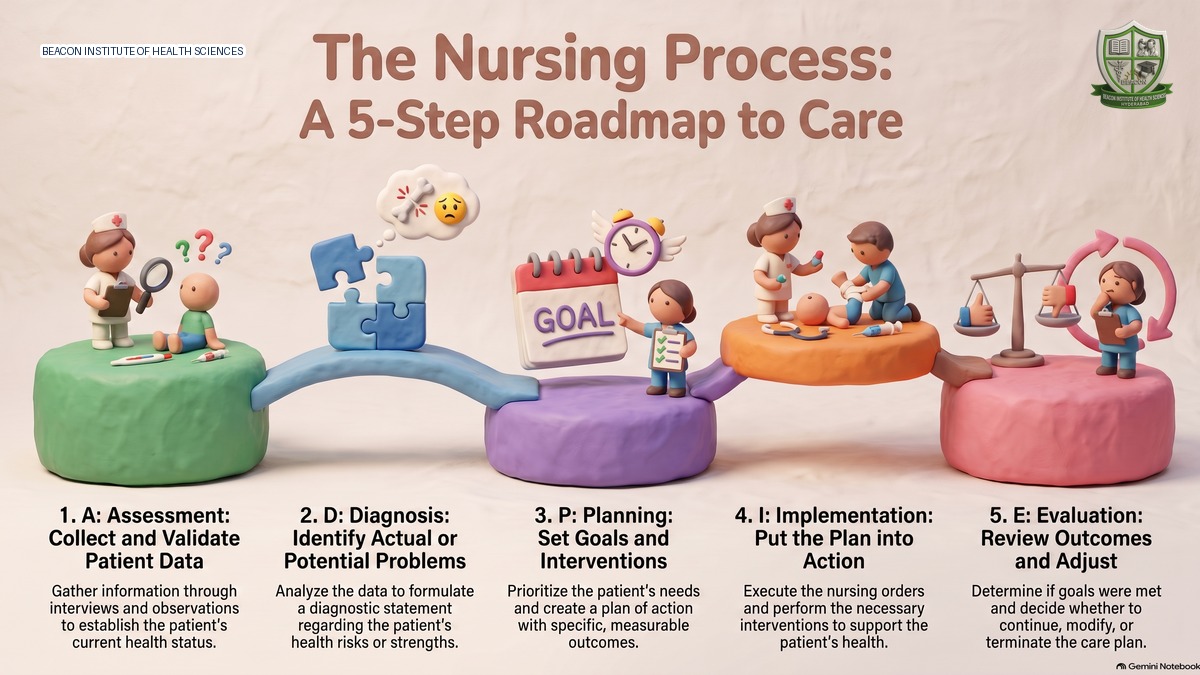
Understanding the Nursing Process: Definitions and Goals
In the nursing profession, clinical decisions are founded on a scientific method, not arbitrary or unscientific intuition. The nursing process serves as the foundational scientific method that guides all nursing actions. It represents the structured, cognitive blueprint that transforms a student from performing task-oriented duties to practicing as a critical, analytical clinical professional. It is an essential reference for students to understand how to systematically assess, diagnose, plan, implement, and evaluate individualized patient care. By mastering this cyclical framework, clinical nurses utilize critical thinking and scientific reasoning to address both actual and potential health problems.
Dual Definitions of the Nursing Process
To establish a rigorous academic foundation, the nursing curriculum provides two key definitions of the nursing process:
- Comprehensive Academic Definition: A systematic, rational method of planning and providing nursing care. Its ultimate goal is to identify a client's health care status and their actual or potential health problems, to establish structured plans to meet their identified clinical needs, and to deliver highly specific, evidence-based nursing interventions to address those needs.
- Simplified Clinical Definition: A systematic, rational method of planning and providing individualized nursing care.
Core Terminology Breakdown
The core terminology of the nursing process includes:
- Systematic: The process follows an ordered, step-by-step sequence. Each phase is dependent on the successful execution of the preceding phase (e.g., planning cannot occur without assessment and diagnosis).
- Rational: Decisions are not based on guesswork. Every nursing action has a clear 'rationale'—meaning it is backed by scientific reasoning, critical thinking, clinical evidence, and established research.
- Individualized: Care is tailored specifically to each patient's unique habits, personality, physical nature, psychological state, and specific clinical requirements. There is no one-size-fits-all plan of care; two patients with the same medical diagnosis will receive different, individualized nursing care plans.
Multi-Step Purpose of the Nursing Process
The primary purpose of the nursing process is to enable the delivery of highly effective and safe nursing care. It achieves this overarching purpose by progressing through four specific operational goals:
- Identify the Client's Health Status: Discover the patient's current baseline health, recognizing both actual problems (issues currently present) and potential problems (risks that may occur if preventive measures are not taken).
- Establish a Plan of Action: Formulate an organized, prioritized strategy of care that specifically targets and satisfies the patient's identified health needs.
- Deliver Specific Interventions: Implement and perform the planned, evidence-based nursing procedures and treatments to resolve or manage the client's problems.
- Evaluate and Modify the Care Plan: Assess the patient's physiological and psychological responses to the interventions, determining whether to continue, adjust, or completely terminate the care plan based on goal achievement.
The 5-Phase ADPIE Framework: A Systematic Approach
The nursing process is divided into five distinct, interrelated phases, represented by the widely recognized mnemonic ADPIE:
- A — Assessing (Comprehensive Data Collection)
- D — Diagnosing (Analyzing & Formulating Clinical Statements)
- P — Planning (Prioritizing, Setting Goals & Interventions)
- I — Implementing (Executing Planned Nursing Orders)
- E — Evaluating (Measuring Efficacy & Modifying Care)
Phase 1: Assessing (Comprehensive Data Collection)
Assessment is the first and most critical phase of the nursing process. It involves the systematic, continuous, and dynamic gathering of information about a patient. Without a thorough assessment, the subsequent phases of the nursing process cannot be accurate or effective. Assessment is not a one-time event; it begins at admission and continues throughout the entire period of hospitalization.
The Four Core Activities of Assessment (COVD)
- Collect Data: Gathering raw, detailed, and comprehensive clinical information about the patient from primary sources (the patient) and secondary sources (family members, medical records, diagnostic tests). This data is gathered randomly as it is spoken or observed.
- Organize Data: Taking the raw, scattered information and systematically arranging it into structured categories, tables, or charts (e.g., Gordon's Functional Health Patterns) to make sense of the clinical picture.
- Validate Data: Double-checking, verifying, and validating the collected information to ensure it is 100% accurate, factual, and free from errors. This involves confirming that subjective complaints align with objective observations and verifying that recording errors did not occur.
- Document Data: Formally, accurately, and legibly recording all validated information in the client's official medical folder or files as mandated by the healthcare facility's standards.
Phase 2: Diagnosing (Analyzing & Formulating Clinical Statements)
In the diagnosing phase, the nurse critically analyzes the validated assessment data to identify the client's actual and potential health problems, risks, and clinical strengths. The outcome of this phase is the formulation of a Diagnostic Statement (Nursing Diagnosis).
The Diagnostic Statement
Unlike a medical diagnosis (which identifies a specific disease pathology), a nursing diagnosis describes a patient's response to an illness or condition. It outlines what the patient is experiencing and why. For example, rather than simply diagnosing a fracture (medical), the nurse formulates a statement such as 'Impaired physical mobility related to pain and localized swelling as evidenced by inability to bear weight.' It includes actual problems, potential risks (e.g., risk of infection, risk of falls), and body system disturbances.
Phase 3: Planning (Prioritizing, Setting Goals & Interventions)
Planning is the phase where the nurse establishes an organized, prioritized strategy to resolve or manage the patient's nursing diagnoses. Planning involves several distinct logical steps:
- Prioritize Nursing Problems: Examine the formulated nursing diagnoses and rank them by order of clinical urgency. Problems requiring immediate, life-saving attention (such as respiratory distress or severe pain) are placed as high priority, followed by intermediate and low-priority issues.
- Set Goals and Design Desired Outcomes: Define clear, measurable, and patient-centered goals. Goals can be:
- Short-Term Goals: Outcomes that can be achieved quickly (e.g., reducing pain scale from 8 to 3 within 2 hours). Short-term achievements keep the nurse motivated, build professional satisfaction, and give the patient visible evidence of progress.
- Long-Term Goals: Broad outcomes achieved over a longer duration (e.g., fully restoring joint mobility over 3 months of physical therapy).
- Select Specific Nursing Interventions: Choose and select the most appropriate nursing procedures, actions, and therapies that will directly help the patient achieve the established goals.
- Write and Document Nursing Orders: Formally write down and document the selected interventions as specific 'nursing orders' in the patient's care plan, ensuring the entire care team can execute them consistently.
Phase 4: Implementing (Executing Planned Nursing Orders)
Implementation is the active, action-oriented phase where the planned nursing orders and interventions are put into physical practice. To implement care safely, the nurse must execute several critical clinical actions:
- Re-Assess the Patient: Before performing any intervention, the nurse must re-examine and assess the patient to confirm that the problem still exists, check if their condition has changed, or determine if new symptoms have emerged.
- Determine Need for Assistance: The nurse must critically evaluate their own capacity and determine if they require physical help or supervision from other clinical staff to execute a procedure safely (e.g., turning a heavy patient or performing complex sterile dressings).
- Implement Nursing Orders: Physically execute the planned interventions, procedures, and medication administrations with clinical precision.
- Task Delegation & Supervision: Delegation is a structured system of clinical work-sharing. For instance, a head nurse or staff nurse delegates specific duties (e.g., patient vital signs, wound hygiene, or nutrition) to qualified nursing assistants or junior staff, while maintaining supervision and ultimate accountability.
- Document Nursing Interventions: Promptly and accurately document every intervention performed and the patient's immediate response in the medical record.
Phase 5: Evaluating (Measuring Efficacy & Modifying Care)
Evaluation is the final, systematic phase where the nurse measures the effectiveness of the nursing care provided. It functions as a crucial quality-control and feedback loop to determine if the patient has progressed toward their goals.
- Collect Outdated/Relative Outcome Data: Gather up-to-date subjective and objective information from the patient regarding the targeted health problems (e.g., asking the patient about their pain level or reassessing wound healing).
- Compare Data against Desired Outcomes: Compare the patient's current health status against the pre-established goals. Determine whether the goals were fully met, partially met, or not met.
- Relate Nursing Actions to Patient Outcomes: Critically analyze if the nursing interventions were the direct cause of the patient's improvement, or if outside factors influenced the outcome.
- Draw Conclusions about Problem Status: Determine whether the identified health problems are resolved, improved, or unchanged.
- Decide to Continue, Modify, or Terminate the Care Plan: Based on the findings, the nurse decides the next logical step:
- If goals are met and the problem is resolved, the nurse terminates that part of the care plan.
- If goals are not met, or if new problems are detected, the nurse circles back to assessment, collects more data, modifies the nursing diagnoses, and develops a new plan.
Characteristics of an Effective Nursing Process
To achieve its therapeutic goals, the nursing process must possess specific operational characteristics that ensure safe, holistic, and professional care:
- Open and Flexible: The process is never rigid or static. It is a flexible framework that adapts seamlessly to the highly unique, evolving needs of individuals, families, groups, and entire communities. Just as every individual's fingerprints are unique, every patient's clinical needs are unique; the process must bend to fit those needs.
- Cyclical and Dynamic: It is a continuous, cyclic process. Each step flows naturally into the next in a circular fashion. If evaluation shows goals are unmet, the nurse immediately returns to assessment, creating an ongoing loop of care.
- Client-Centered (Client-Focused): The patient is the absolute center of the nursing universe. The nurse planning care must focus entirely on the patient's lifestyle, habits, preferences, and direct wellbeing, rather than prioritizing hospital routines or nursing convenience.
- Goal-Directed: Every clinical action is directed toward a clear, predefined outcome. Setting specific goals ensures that the entire healthcare team works toward the same purpose, providing a standard for measuring success.
- Planned and Structured: Care is never random or haphazard. It is designed with deliberate forethought, systematic planning, and meticulous scheduling to maximize efficiency and safety.
- Interpersonal and Collaborative: Nursing cannot be practiced in a vacuum. It requires deep, direct interpersonal communication and active collaboration. The nurse must communicate openly with the patient, relatives, physicians, and other allied healthcare professionals. Crucially, the patient is not a passive recipient of care but an active partner in planning and executing their recovery.
- Creative Thinking & Problem-Solving: Professional nursing demands cognitive innovation. Nurses must use creative, rational, and critical thinking to develop customized solutions to complex patient challenges and unique clinical barriers.
- Continuous Feedback Loop: The nursing process relies on a constant flow of feedback from the patient to assess whether the treatments, positioning, or procedures are producing positive health changes.
- Universally Applicable: The ADPIE framework is not restricted by setting, age, or diagnosis. It can be applied to any client, in any clinical environment (intensive care, community clinics, nursing homes, or home care), across all developmental stages from neonate to geriatric.
Marjory Gordon's 11 Functional Health Patterns: A Holistic Assessment Framework
In nursing practice, executing a comprehensive assessment requires a structured, holistic framework. Instead of utilizing a purely medical model (which focuses strictly on physical disease pathology), nursing utilizes Marjory Gordon's 11 Functional Health Patterns. This model guides the nurse in evaluating the patient as a whole person, looking at the complex interplay of physical, social, psychological, and spiritual health.
Why Use Functional Health Patterns?
By assessing these 11 structured patterns, the nurse is able to obtain a complete, multi-dimensional profile of the patient's lifestyle and health level. This holistic approach ensures that the nurse does not just treat a physical ailment, but discovers underlying behavioral, lifestyle, or environmental causes that may be contributing to the patient's illness.
The 11 Functional Patterns Explained with Clinical Assessments:
| Gordon's Health Pattern | Clinical Assessment Focus & Description |
|---|---|
| 1. Health Perception & Management | Assesses how the client perceives their health and well-being, and how they manage their health. Includes evaluating health habits, adherence to treatments, and preventive self-care behaviors. |
| 2. Nutritional-Metabolic | Evaluates food and fluid consumption relative to metabolic needs. Includes checking dietary intake, Body Mass Index (BMI), physical skin and tissue condition, and biochemical/laboratory data (e.g., blood tests). |
| 3. Elimination Pattern | Assesses excretory functions of the body, including bowel, bladder, and skin. Nurses evaluate common problems such as constipation, diarrhea, and urinary incontinence (involuntary loss of bowel/bladder control). |
| 4. Activity-Exercise Pattern | Assesses the client's patterns of exercise, physical activity, leisure, and recreation. Includes evaluating their ability to perform Activities of Daily Living (ADLs) independently or if they require assistive devices. |
| 5. Sleep-Rest Pattern | Evaluates sleep quality, rest, and relaxation patterns. Assesses for common sleep disorders like insomnia (severe sleeplessness) or hypersomnia (excessive, pathological sleeping). |
| 6. Cognitive-Perceptual | Assesses neurological functions, brain activity, sensory abilities (vision, hearing, touch), cognitive understanding, decision-making, and the patient's overall level of comprehension. |
| 7. Self-Perception & Self-Concept | Evaluates the client's self-image, feelings about their body, physical appearance, self-worth, and personal identity. Highlights how illness impacts their self-esteem. |
| 8. Role-Relationship | Assesses the client's roles, responsibilities, and relationships within their family, friend groups, workplace, and society. Identifies the strength of their social support system. |
| 9. Sexuality-Reproductive | Assesses sexual identity, reproductive history, relationship satisfaction, and the client's perception of their sexuality in the context of their illness or developmental stage. |
| 10. Coping-Stress Tolerance | Evaluates how the patient manages stress and copes with life crises. Includes asking about major past losses (e.g., death of a close relative) and assessing how they coped and adapted to understand their coping threshold. |
| 11. Value-Belief Pattern | Assesses values, goals, and spiritual or religious beliefs that guide the client's choices, health decisions, and perceptions of recovery. Understands what they value and how they wish to heal. |
Clinical Integration Note: In professional practice, these 11 patterns are used as the structural template for taking a comprehensive patient history. For instance, when a nurse asks a patient about their sleep patterns (Sleep-Rest), bowel movements (Elimination), or spiritual wishes (Value-Belief), they are directly executing Gordon's holistic assessment model.
Clinical Transition & Review Summary
As BSN students transition through their Fundamentals of Nursing course, mastering the theoretical foundation of the nursing process is the critical first step. The concepts of ADPIE, COVD (Collect, Organize, Validate, Document), and Gordon's 11 Functional Health Patterns are thoroughly understood, as they form the theoretical core of all nursing examinations and professional licensing boards.
This study manual serves as a definitive academic reference for Unit 1. The upcoming Lecture 2 will explore the practicalities of patient assessment, diagnostic interviews, and communication techniques.
The ADPIE Framework Summary Matrix:
| ADPIE Phase | Core Nursing Activities | Clinical Goal & Purpose |
|---|---|---|
| Assessing | Collect, Organize, Validate, Document (COVD) | To gather a comprehensive, 100% accurate baseline of the patient's health status and needs. |
| Diagnosing | Analyze data, identify actual/potential risks, write statement | To formulate a precise diagnostic statement describing the client's response to an illness. |
| Planning | Prioritize diagnoses, set short/long-term goals, write orders | To establish a prioritized, measurable strategy of care tailored to the patient's unique needs. |
| Implementing | Re-assess client, determine aid needs, delegate, document | To put the planned interventions into action safely, coordinating tasks across the care team. |
| Evaluating | Collect outcome data, compare to goals, draw conclusions | A quality-control loop to determine if interventions worked and whether to continue, modify, or stop. |