
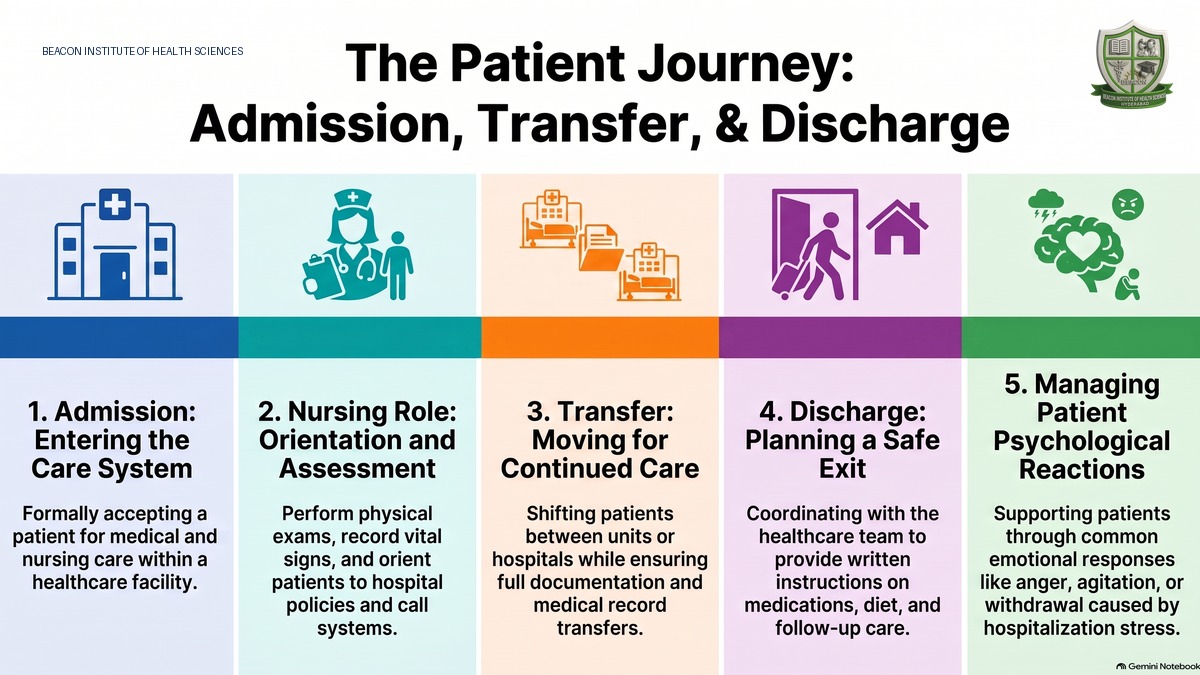
The process of hospitalization is a central component of nursing care, involving a sequence of clinical and administrative operations from the moment a patient enters a healthcare facility until their safe transition out. This comprehensive overview details the critical processes governing patient hospitalization, including admission, internal and external transfer, and discharge operations. Nurses play a pivotal role in navigating the physiological, clinical, and psychological frameworks, ensuring continuity of care, patient safety, and managing the psychological stress inherent in the clinical environment.
Hospitalization is a highly disruptive and stressful experience for patients and families. Nurses must execute their clinical duties with high precision while demonstrating empathy and therapeutic communication to ease anxiety and build trust from admission to discharge, adhering to standard, evidence-based nursing protocols.
Core Clinical Terminology
In the clinical healthcare ecosystem, transitions of care are standardized under three primary operations: Admission, Transfer, and Discharge. Each process represents a distinct legal, clinical, and administrative phase of patient care.
Patient Admission
Patient admission is defined as the process of accepting a patient into a healthcare facility. It is a structured clinical and administrative procedure in which a patient is formally accepted for medical and nursing care in a hospital or another health care institution. Hospitalization begins with this process, transitioning the individual from a community member to a patient under direct clinical supervision.
Patient Transfer
Patient transfer is the process of moving a patient from one clinical ward, unit, or location to another. This includes patients with limited functional status who may require physical assistance or the use of assistive devices, such as wheelchairs or stretchers. In clinical practice, transfer also includes moving a patient from one flat surface to another (e.g., from a hospital bed to a stretcher, bed to wheelchair, wheelchair to chair, or wheelchair to a toilet, and vice versa).
Patient Discharge
Patient discharge is the formalized process when a patient leaves the hospital after undergoing treatment, transitioning out of active inpatient care. A discharge occurs when the medical team determines that the patient no longer requires active, direct inpatient care and can safely return home or transition to another clinical facility for continued recovery or specialized treatment.
Inpatient Care vs. Outpatient Care
To fully understand discharge, nurses must distinguish between these two core models of care:
- Inpatient Care: Involves admitting a patient to a hospital bed where they reside for continuous, multi-day observation, treatment, and direct 24-hour nursing supervision.
- Outpatient Care (OPD - Outpatient Department): Involves clinical services where the patient presents to a clinic, undergoes physician examination, receives a prescription, and immediately returns home on the same day without being admitted to a ward.
The Patient Admission Process
The standard clinical sequence for admitting a patient to a hospital unit is structured as follows:
- Admission/Registration Counter: The patient or their family presents to the reception counter where they complete preliminary paperwork, undergo administrative registration, and receive an admission slip.
- Physician Evaluation: The patient is examined by the physician, who evaluates the present illness, assesses clinical urgency, and orders diagnostic medical tests.
- Diagnostic Verification: Standard diagnostic tests (laboratory, imaging, etc.) are executed. If results confirm the patient's condition requires active clinical surveillance, the physician issues a formal, written order for inpatient admission.
- Patient Registration & Demographics: Staff collect comprehensive demographic and personal information, including the patient's full name, address, contact numbers, and National Identity Card (CNIC) number. A unique hospital registration number is assigned.
- Unit and Bed Assignment: The patient is guided and escorted to their assigned clinical unit, ward, and bed, which have been prepared in advance of their arrival.
Admitting Nurse's Roles & Responsibilities
The admitting nurse is the primary coordinator of the admission process. The nurse must execute a comprehensive set of administrative and clinical duties to establish a safe environment:
- Meet and Greet: Formally receive the patient and family members upon arrival at the ward. A warm, courteous, and professional demeanor is essential to reduce immediate anxiety.
- Verify Patient Data: Cross-reference and verify the patient's demographic details by checking medical records, physician charts, and admission sheets to prevent identification errors.
- Professional Introductions: Introduce yourself and key nursing and medical personnel responsible for the patient's direct care, establishing a clear line of communication.
- Assist and Escort: Physically guide or transport the patient to the treatment area or assigned hospital bed, ensuring comfort and safety during the transition.
- Hospital Attire: Instruct the patient to change into a clean hospital gown, facilitating unhindered clinical assessment and nursing care.
- Perform Clinical Examination: Begin the nursing assessment, including a head-to-toe physical examination to inspect for bruises, open wounds, infections, or pre-existing physical markings.
- Establish Baseline Vital Signs: Check and document the patient's baseline physiological values, including blood pressure, pulse rate, respiratory rate, and body temperature.
- Complete Nursing History: Interview the patient to obtain a detailed nursing history, including past illnesses, surgical history, family history, lifestyle factors, and specific allergies.
- Coordinate Initial Orders: Coordinate with the attending physician to execute initial medical orders immediately, such as starting intravenous (IV) lines, administering injections, or preparing medications.
- Prepare Equipment: Ensure all necessary bedside equipment is fully prepared and functional prior to patient arrival (e.g., preparing oxygen cylinders, flow meters, or suction apparatus if oxygen therapy is indicated).
- Explain Bedside Technology: Orient the patient to bedside systems, including the operation of the call bell/emergency alarm and bedside telephone, instructing them on how to summon immediate nursing assistance.
- Orient to Clinical Schedule: Explain the daily clinical routine, outlining when medications are administered, when diagnostic procedures are scheduled, and what to expect during their stay.
- Communicate Visitor Policies: Inform the patient and relatives about visitor schedules, designated timings, and structural rules regarding who is permitted in the patient care area.
- Brief on Healthcare Team: Brief the patient on the roles of various healthcare team members, such as physicians, nurse practitioners, dietitians, and physical therapists.
- Explain Facility Policies: Clearly detail the rules and regulations of the unit, emphasizing standard operating procedures (e.g., prohibiting relatives from sleeping on patient beds or occupying treatment zones).
- Secure Personal Valuables: Gather and catalog the patient's valuable items (jewelry, cash, electronics). Record these items on a formal inventory sheet, sign it, and obtain the patient's signature. If valuables are handed over to a relative, obtain their signature to verify the transfer of custody and avoid legal liability.
- Complete Documentation: Complete all documentation in accordance with hospital policy, entering the exact admission date, time, medical reason, registration number, CNIC, and contact details in the ward register.
- Manage Communicable Diseases: Identify patients presenting with transmissible infections (e.g., flu, viral infections). Implement strict contact or droplet precautions, perform rigorous hand sanitization, and utilize personal protective equipment to prevent the spread of cross-infection.
- Isolation Protocol: For patients presenting with severe, highly contagious conditions (e.g., viral meningitis), execute immediate isolation protocols, placing the patient in a dedicated, negative-pressure or private isolation room.
- Maintain Empathetic Care: Maintain an actively supportive, polite, and reassuring presence. Hospital admission is highly stressful, and psychological care is as critical as physical intervention.
Special Considerations in Admission
- Emergency Admission: When a patient presents in an acute, life-threatening condition (e.g., burns, severe poisoning, road traffic accidents, cardiac or respiratory emergencies), they are immediately admitted to the treatment zone. The clinical team initiates life-saving interventions first, while accompanying relatives or support personnel complete administrative paperwork and registration formalities concurrently.
- Medico-Legal Cases (MLCs): Admissions involving legal complications—such as suicide attempts, assault, gunshot wounds, or blunt-force injuries—must be documented with extreme precision. The nurse must accurately record all physical findings and immediately notify the hospital's medico-legal department.
The Patient Transfer Process
A patient transfer is the transition of care from one clinical environment to another. To ensure patient safety, transfers must follow strict multidisciplinary protocols.
Types of Clinical Transfer
- Internal Transfer (Unit-to-Unit): The movement of a patient between wards within the same hospital facility (e.g., transferring a stabilized patient from the Intensive Care Unit (ICU) to a general medical-surgical ward, or moving a patient from a ward to a specialized coronary care unit).
- External Transfer (Hospital-to-Hospital): The movement of a patient from one hospital facility to an entirely separate healthcare institution (e.g., transferring a patient to a facility with more specialized diagnostic equipment, advanced surgical capabilities, or open beds).
Clinical Procedure for Internal and External Transfers
To execute a safe, seamless transfer, the nursing and medical teams must follow this sequence:
- Physician's Written Order: A transfer cannot occur without a formal, signed written order from the attending physician documenting the clinical necessity of the transfer.
- Patient and Family Notification: The nurse must inform the patient and family about the transfer, thoroughly explaining the clinical reasoning, destination, and goals of the transition.
- Receiving Unit Notification: The nurse must contact the receiving ward's in-charge or nurse manager in advance to communicate the patient's condition, pending clinical needs, and ensure the receiving bed and equipment are fully prepared.
- Transfer/Discharge Summary Preparation: The clinical team compiles a comprehensive, concise written transfer summary. This summary outlines the patient's primary diagnosis, treatments given, medications administered, diagnostic results, and current clinical status, ensuring seamless continuity of care.
- Physical Transportation Coordination: The nurse coordinates the physical movement, arranging for appropriate transportation equipment (e.g., a stretcher or wheelchair for internal transfers, or a fully equipped ambulance with a paramedic team for external transfers).
- Multi-Departmental Coordination: The nurse contacts the pharmacy, laboratory, and other diagnostic departments to notify them of the transfer so that pending results, medications, and records are rerouted to the new unit.
- Records Duplication: The sending ward duplicates all medical charts, lab results, and medication records. The sending unit retains a complete set of photocopies for their administrative archives, while the original records are placed in a secure folder or envelope and sent with the patient.
- Receiving and Bed Placement: Upon arrival, a designated receiving nurse meets the patient, takes over clinical custody, guides them to their bed, and immediately conducts an admission assessment.
Nurse's Roles & Responsibilities in Patient Transfer
- Clinical Continuity & Care Quality: The primary responsibility of the nurse is to maintain the continuity of care during the transition, ensuring no treatments are delayed or omitted.
- Autonomy and Consent: For external transfers, the nurse must ensure that the patient or family is fully involved in the decision-making process. The patient or family must consent to the transfer, as they ultimately control the decision based on their financial and logistical circumstances.
- Duplication of Services Avoidance: Providing a clear, written transfer summary and detailed photocopied medical records prevents the duplication of diagnostic tests and clinical services, saving time and protecting the patient from unnecessary procedures.
- Belongings Safeguarding: Gather and inventory all personal belongings (e.g., clothing, medical aids, eyeglasses, or wedding rings). Pack them securely and document the handover to the patient, relative, or receiving nurse. Carelessness during transfer can lead to the loss of precious items, causing severe distress and clinical inconvenience.
The Patient Discharge Process & Collaborative Planning
A patient discharge is not a single administrative event; it is a collaborative, multidisciplinary process designed to transition a patient safely from acute inpatient care back into the community.
The Multidisciplinary Discharge Team
Discharge planning is a highly coordinated effort that involves several key members of the healthcare team working in harmony:
- The Physician: Evaluates clinical recovery, determines that inpatient monitoring is no longer required, and writes the formal, signed written discharge order on the chart.
- The Nurse: Serves as the primary discharge coordinator, assesses home care readiness, executes discharge instructions, and conducts patient and family teaching.
- The Patient & Family: Actively participate in recovery, express concerns about home care, and prepare to assume responsibility for self-management.
- The Social Worker: Evaluates home safety, assesses financial or emotional support systems, and coordinates community-based resources or home health nursing services.
- The Dietitian: Reviews the patient's nutritional requirements, develops a post-hospital dietary plan, and educates the patient on foods to eat or avoid based on their specific condition.
Addressing Patient Anxiety
Patients and their families frequently experience significant anxiety regarding post-discharge care. Surgical patients, for instance, often worry about how to manage complex wound care, dressing changes, or cleaning surgical incisions at home without professional assistance. Nurses must recognize these concerns, offer reassurance, and conduct thorough teaching to build the patient's confidence.
Nurse's Roles & Responsibilities in Discharge
- Verify Written Orders: Confirm that a formal, written discharge order has been signed by the attending physician on the patient's chart before initiating any discharge procedures.
- Psychological Preparation: Prepare the patient psychologically for discharge. Discharge must never be sudden or unexpected. The patient should understand their recovery trajectory and anticipate their discharge day.
- Advance Notification: Notify the patient and family of the planned discharge date and time early in the morning or one to two days in advance, allowing them sufficient time to arrange transportation and home support.
- Provide Written Instructions: Review all discharge instructions with the patient and family. Always provide these instructions in written form to take home. Verbal instructions are easily forgotten or misunderstood under stress.
- Ensure Clarity and Readability: Written instructions must be specific, concise, thorough, and legible. Avoid complex medical jargon; use simple, comprehensive terminology that is easy for a layperson to understand.
- Use Accessible Language: Ensure the discharge card is written in a legible hand and in the primary language that the patient and family understand.
- Notify Family for Transport: Notify family members in advance so they can coordinate a safe, timely departure and provide appropriate transportation.
- Conduct Structured Patient Teaching: Actively engage in patient and family education, covering all critical domains of home self-care.
Comprehensive Patient Teaching (Discharge Education)
Patient teaching is the cornerstone of a safe discharge. The nurse must thoroughly educate the patient and family across several core clinical domains:
- Medication Management: Explain each prescribed drug, its specific clinical purpose, the correct dosage, the route of administration, and the frequency (e.g., morning, afternoon, evening). Clearly highlight potential side effects and what to do if they occur.
- Dietary Guidelines: Provide detailed dietary instructions, emphasizing foods that support healing (e.g., high-protein foods for tissue repair) and listing specific foods or substances that must be strictly avoided (e.g., sodium restrictions for hypertensive patients).
- Wound Care: Instruct the patient on how to care for surgical wounds, incisions, or drains, emphasizing the importance of keeping the site clean and dry.
- Dressing Changes: Demonstrate how to perform a dressing change using aseptic technique. Explain the step-by-step cleaning process (e.g., using Pyodine/antiseptic solution), applying sterile gauze, and securing bandages to prevent bacterial contamination and infection.
- Medical Equipment Operation: If the patient requires specialized medical devices at home (e.g., oxygen concentrators, nebulizers, or mobility aids), provide hands-on training and troubleshooting instructions.
- Exercises and Physical Activity: Define physical limitations and prescribe specific physical activities or range-of-motion exercises. Clearly outline the frequency, duration, and intensity of movements allowed to facilitate recovery.
- Physical Therapy: Explain the purpose of specific body movements and how they support musculoskeletal rehabilitation and joint mobility.
- Symptom Management and Injections: Teach the patient how to manage acute symptoms, including pain control. If the patient requires self-administered injections (e.g., insulin) or rescue respiratory therapies, provide thorough training on safe preparation and administration.
- Home Health Care Services: Connect the patient with available home health support services, explaining how to access clinical resources in their community.
- Follow-up Appointment Coordination: Instruct the patient on when to return to the hospital or clinic for follow-up evaluations, stitch removal, or physician consultations. Clearly write the exact date, time, and department on the discharge card.
Clinical Documentation of Discharge Operations
To maintain legal and clinical accountability, the nurse must record all discharge details in the patient's medical file, including:
- Exact Date and Time: Document the precise time the patient left the unit.
- Method of Transport: Record the patient's mobility status and transport mode upon departure (e.g., discharged via wheelchair, stretcher, or walking under self-power with assistance).
- Discharge Instructions & Teaching: Summarize the specific teaching and instructions provided to the patient and family, noting their demonstrated understanding.
- Handover of Personal Belongings: Record that all personal valuables and medications held by the ward have been gathered, verified, and returned to the patient or relative, leaving nothing behind.
Discharge Checklist: Written instructions are the patient's clinical anchor at home. Nurses must ensure that all instructions are readable, written in plain language, and contain clear emergency contact numbers.
Psychological & Physiological Reactions to Hospitalization
Hospitalization is a profound physiological and psychological stressor that disrupts an individual's normal life, routine, and identity. Nurses must recognize the common coping mechanisms, stressors, and behavioral patterns that patients exhibit.
Common Changes and Stressors in Hospitalization
- Alterations in Body Image: Severe illnesses or surgical interventions (such as the amputation of a limb) alter a patient's physical appearance and self-perception, causing profound grief and anxiety.
- Confrontation with Mortality: Facing the reality of physical pain, severe illness, frailty, and the possibility of death.
- Disrupted Relationships: Admission breaks normal social routines, and communicable diseases can lead to social isolation when family or friends avoid contact due to fear of infection.
- Forced Level of Dependency: Independent adults are forced to rely on healthcare staff and relatives for basic self-care activities (such as bathing, dressing, eating, or toileting), which can severely damage self-esteem.
- Adjusting to Physical Changes: Adapting to temporary or permanent physical limitations or sensory deficits.
- Grief over Lifestyle Loss: Patients experience deep grief over losing their independence, daily occupational or exercise routines, and personal freedom.
- Anxiety and Fear of Procedures: Intense worry about upcoming surgeries, diagnostic tests, complications, or long-term prognosis.
- Environmental Ward Stress: The clinical environment is inherently stressful. Witnessing other patients experiencing extreme pain, undergoing invasive procedures, or dying in adjacent beds creates a high level of psychological trauma.
Three Major Behavioral Categories of Patient Reactions
When coping with the stress of hospitalization, patients typically fall into one of three major behavioral categories. Recognizing these patterns allows nurses to tailor their therapeutic interventions:
| Behavioral Category | Clinical Characteristics | Underlying Psychological Cause |
|---|---|---|
| 1. Angry & Hostile | Criticizing nursing care, complaining about ward conditions (food, bed), showing open frustration, and refusing cooperation. | A defense mechanism against a perceived loss of power and control. Patients feel powerless and express this internal discomfort as external anger. |
| 2. Agitated & Hypervigilant | High levels of irritability, extreme anxiety, restlessness, and excessive concern over minor environmental changes. | A manifestation of intense helplessness. This anxiety heightens physical discomfort, creating a cycle of escalating agitation. |
| 3. Withdrawn & Isolated | Passive, quiet, non-communicative behavior. Refusing to complain or ask for help, remaining isolated. | Severe depression, feeling overwhelmed, or a naturally introverted personality style. High clinical risk of being overlooked in a busy ward. |
CRITICAL CLINICAL ALERT (Withdrawn Patients): Withdrawn patients are at the highest risk of clinical neglect. Because they do not call for assistance or show outward distress, busy nursing staff may focus attention on demanding or hostile patients, leaving the withdrawn patient isolated. Nurses must proactively check on withdrawn patients, conduct regular assessments, and offer emotional support.