Introduction and Core Concepts
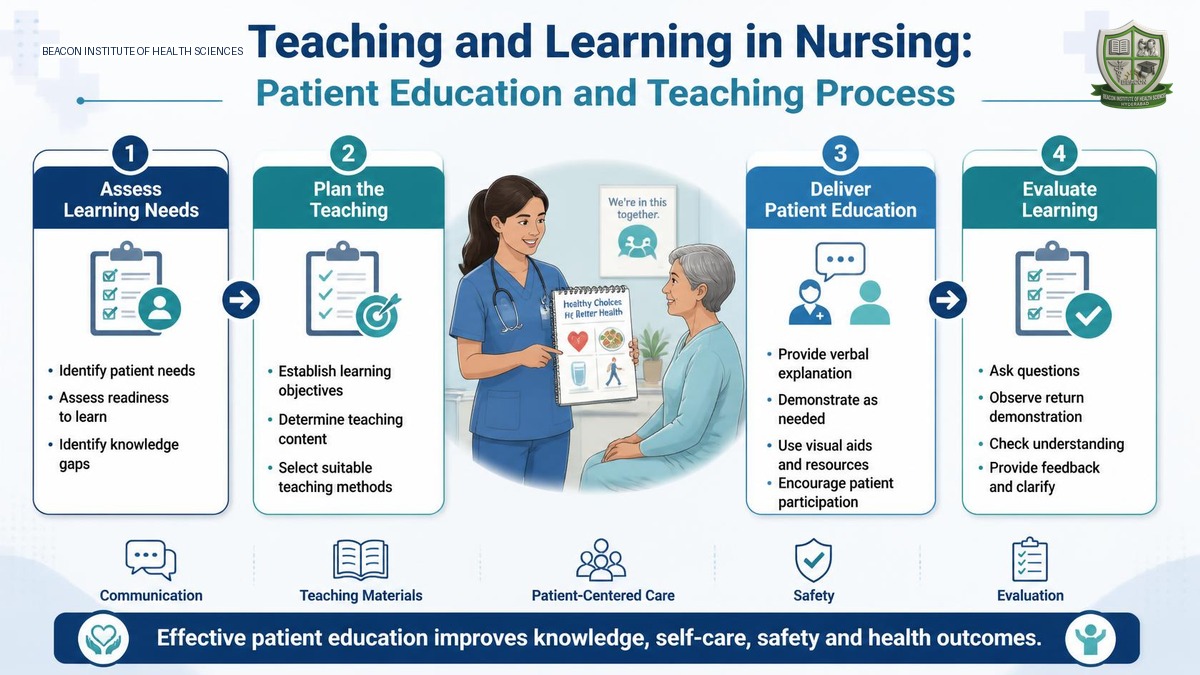
Patient education and health teaching are fundamental clinical and professional responsibilities for nursing personnel. While direct clinical interventions are vital for acute recovery, empowering patients and communities with accurate health literacy is crucial for long-term wellness and preventing disease recurrence. The BSN nursing curriculum establishes a systematic framework for identifying learning deficiencies, planning interventions, delivering health instructions, and verifying educational outcomes.
In nursing practice, patient education serves as an autonomous and essential professional role. This guide details the core concepts of teaching and learning, the methodology for assessing learning needs, the structural design of teaching-learning plans, and their clinical health teaching application, all based on the BSN curriculum.
Defining Teaching and Learning
What is Teaching?
According to standard educational nursing frameworks, teaching is defined by its primary definition:
Teaching is a deliberate intervention that involves the planning and implementation of instructional activities and experiences to meet intended learner outcomes according to a structured plan.
To facilitate memorization for nursing students, this comprehensive definition can be broken down into three core components:
- Part 1: It is a deliberate, conscious intervention involving planning and implementation.
- Part 2: It incorporates instructional activities and educational experiences.
- Part 3: Its core goal is to meet intended learner outcomes according to a predetermined plan.
An alternative, highly practical definition of teaching is: The process of attending to people's needs, experiences, and feelings, and making specific interventions to help them learn particular things.
What is Learning?
Learning is defined as a change in behavior, knowledge, skills, or attitudes that can occur at any time or at any place as a result of exposure to the environment.
A fundamental characteristic of learning is its lifelong aspect: It is a continuous, lifelong process. A human being begins to learn from infancy and continues learning throughout their entire lifespan until death.
Identifying Patient Learning Needs
Before designing or executing any educational intervention, a nurse must accurately identify the patient's learning needs at the clinical site. A learning need is defined as the gap in knowledge that exists between a desired level of performance and the actual level of performance.
Clinical Example: In a hospital setting, the desired level of performance for a patient with surgical stitches is to successfully care for their wound independently at home. The patient's actual level of performance is that they do not possess the knowledge or skill required to perform wound dressing safely. The gap between these two states represents their learning need, which must be addressed.
Nine Steps to Assess Clinical Learning Needs
To systematically identify and prepare for a patient's learning needs, nursing personnel must execute the following nine sequential assessment steps:
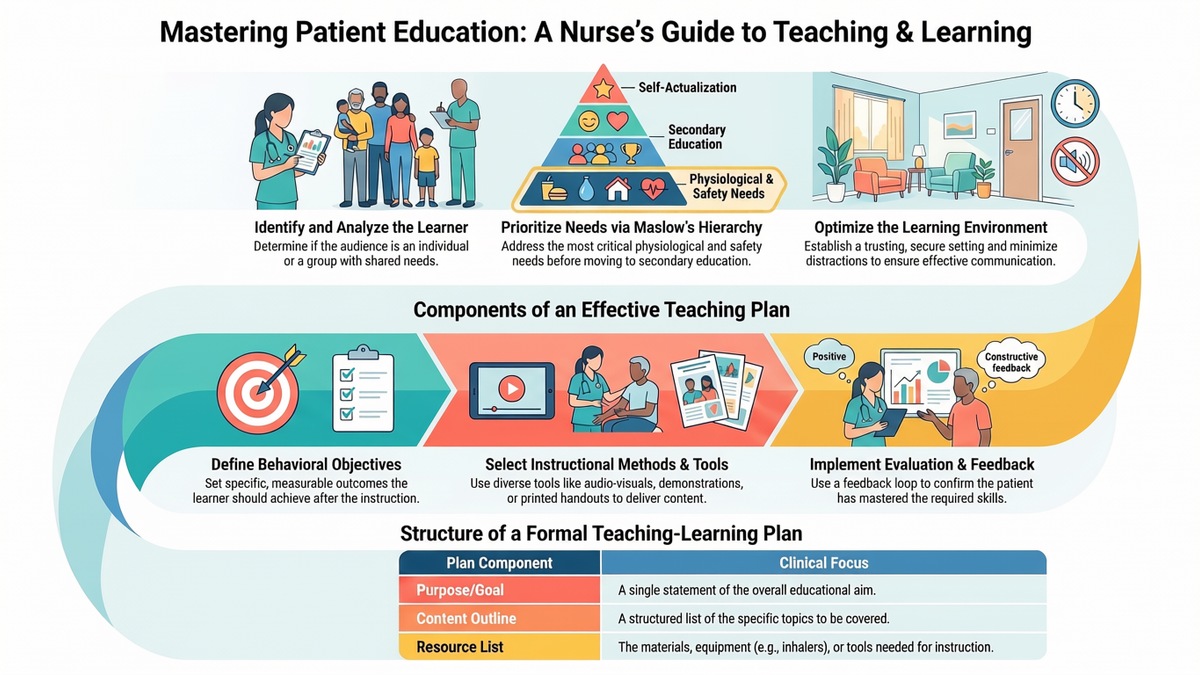
- Identify the Learner (Target Audience): Determine who requires education. Analyze if the audience is a single individual with a single need, an individual with multiple complex needs, or a larger group sharing a common deficit. For example, this could be multiple postpartum mothers in a maternity ward needing infant care education, or a group of uneducated residents in a rural village. Gathering people with similar needs is called 'anticipation of learning needs' and maximizes educational efficiency.
- Choose the Right Setting: Establish a supportive, comfortable, and therapeutic learning environment. This environment must foster a sense of security and confidentiality, building trust and showing empathy and respect. When patients feel respected and secure, they openly explore and express their needs.
- Collect Data on the Learner: Gather clinical data regarding the learner's characteristics. Explore typical health problems and issues of interest that affect their specific demographic or population. Begin with these general, typical problems and then narrow down to specific problems unique to the individual client.
- Incorporate the Learner's Perspective (Information Resources): Involve the patient and their family members directly. Allow them to identify what topics and skills are most important to them. Assess what types of social support systems (e.g., NGOs, supportive family members, or friends) are available or can be made available to assist, and determine how these social support systems can be utilized to aid the patient's care.
- Involve Members of the Healthcare Team: Nurses are not the sole educators. Nursing personnel must collaborate with other members of the healthcare team (physicians, nutritionists, physical therapists) to obtain a rich, multi-disciplinary, and comprehensive assessment of the patient's learning needs.
- Prioritize Needs: List all identified patient learning needs and prioritize them using Maslow's Hierarchy of Needs. According to Maslow's model, human needs are organized in a hierarchy. Basic survival and physiological needs must be completely addressed first. Once basic survival needs are met, the nurse can systematically address safety needs and higher-level developmental/esteem needs.
- Examine Educational Resources: Assess what teaching resources and materials are available. Identifying a learning need is ineffective if appropriate tools are unavailable. For example, if an asthma patient needs to learn to use an inhaler or a peak flow meter, those exact devices must be present during teaching so the patient can learn practically. Ensure teaching tools (such as whiteboards or audio-visual aids) are available and operational.
- Understand Organizational Demands: Familiarize yourself with the institutional policies, regulations, and guidelines of the healthcare organization you represent. All health teaching must be conducted in accordance with these rules, ensuring that standard clinical protocols are never violated.
- Apply Effective Time Management: Time is a vital factor in education. Always give the patient adequate time to process information and express their own perception of their needs. Avoid asking rapid-fire questions in quick succession. Minimize external interruptions and environmental distractions during teaching to save time, maintain focus, and show respect for the patient's dignity.
Components of a Teaching-Learning Plan
To operationalize health education, the nurse must compile a structured Teaching-Learning Plan. A standard plan contains eight essential components, organized in a sequential format:
- 1. Purpose: A single, high-level statement summarizing the overall goal or intent of the teaching plan.
- 2. Behavioral Objectives: Specific, measurable, and action-oriented statements describing what the learner will be able to do, state, or perform after the teaching session.
- 3. Content Outline: A structured outline of the topics, information, and clinical details to be taught during the lesson.
- 4. Instructional Methods: The specific educational methods used to deliver the content (e.g., lecture, discussion, practical demonstration, whiteboard utilization, or audio-visual media).
- 5. Time Allotted: The specific timeframe (measured in minutes) allocated to cover each individual behavioral objective.
- 6. Instructional Resources: The physical materials, handouts, clinical equipment, or tools required to facilitate the lesson.
- 7. Method of Evaluation: The specific technique used by the nurse to measure learning and obtain feedback (e.g., oral questioning, written tests, or practical return demonstrations).
Case Study: Health Teaching at a Clinical Site
In international healthcare settings, patient health education is recognized as an autonomous, primary professional duty of the nursing staff (especially BSN-prepared nurses), rather than the physician. Providing high-quality education enhances the nurse's professional reputation, builds community trust, and prevents hospital readmissions.
Clinical Scenario Details:
- Patient: 20-year-old male college student.
- Injury: 7 cm laceration (cut) on the left lower anterior thigh sustained from a hockey stick.
- Treatment: Wound was thoroughly cleansed and closed with sutures (stitches) in the clinical unit.
- Discharge Plan: Appointed to return to the clinic in 10 days for suture removal.
- Living Situation: Lives in a college hostel; expresses a strong willingness and capability to perform wound care himself if provided clear instructions.
- Literacy/Cognitive Status: Literate; fully capable of reading and understanding English.
Nursing Diagnoses and Goals:
- Nursing Diagnosis: Knowledge Deficit (Wound Care) related to lack of exposure to suture care instructions, as evidenced by the client's verbal request for information.
- Short-Term Goal: The client will answer short questions correctly and describe wound care protocols immediately following the teaching session.
- Long-Term Goal: The client's suture wound will heal completely with no signs of infection or complications by the time of suture removal.
Clinical Suture Wound Care Teaching-Learning Plan
The following standardized grid represents the complete, structured Teaching-Learning Plan customized for the 20-year-old college student's suture wound self-care program:
| Behavioral Objective | Content Outline | Method of Instruction | Time | Resources / Tools | Method of Evaluation |
|---|---|---|---|---|---|
| 1. Describe normal wound healing. | Normal biological process of tissue repair and wound healing. | Describe the normal healing process verbally using slides or diagrams. | 3 min | Audio-visual aids, anatomical pictures or drawings. | Patient verbally describes normal wound healing in their own words. |
| 2. Describe signs and symptoms of wound infection. | Clinical signs of infection:
|
Use audio-visual aids (photos or videos) to demonstrate infected wound appearances. | 4 min | Audio-visual aids, photographs of clinical wound infections. | Patient lists the key signs of infection and states when to report them. |
| 3. Identify needed materials for wound care. | Supplies prescribed:
|
Direct demonstration of materials and handing over a printed checklist. | 2 min | Actual wound care supplies, printed materials list. | Patient identifies and selects the correct supplies needed for wound dressing. |
| 4. Demonstrate wound cleansing and dressing. | Step-by-step cleaning (center to outward) and dressing change procedure. | Practical step-by-step demonstration of aseptic cleansing and dressing. | 5 min | Dressing tray, antiseptics, sterile gauze, tape, gloves, handouts. | Patient performs a return demonstration or explains the steps back. |
| 5. Describe actions if complications arise. | Clinical resources, emergency contacts, and when to seek urgent care. | Discuss resources, hand over list of clinic contacts and emergency numbers. | 3 min | Handout listing clinic contacts, emergency numbers, discharge card. | Patient repeats the contact details and identifies emergency criteria. |
| 6. Identify date, time, and location of suture removal. | Follow-up appointment details in 10 days for suture removal. | Verbal explanation; write specific details onto the discharge card. | 2 min | Discharge card, appointment slip, pen. | Patient states the exact date, time, and location of follow-up. |
Educational Evaluation Phase
The final, critical phase of the clinical teaching plan is the evaluation. Upon concluding the lesson, the nurse must never assume the patient has fully understood the content. Instead, the nurse must ask targeted questions and evaluate the patient's understanding based on the behavioral objectives. To verify comprehension, the patient must be able to successfully:
- Respond accurately to oral questions regarding wound care and hygiene.
- Demonstrate or explain the exact steps of wound cleansing and dressing application.
- Correctly identify and name the clinic contact numbers provided for questions or emergencies.
- Confirm and repeat the exact scheduled date, time, and location of their follow-up appointment for suture removal in 10 days.