
Learning Objectives
- Describe diversity within Pakistani society without stereotyping individuals.
- Explain how language, family, religion and living conditions can affect care.
- Apply respectful communication, consent and privacy in nursing practice.
- Interpret fictional service data and identify its limitations.
Understanding Pakistani Society
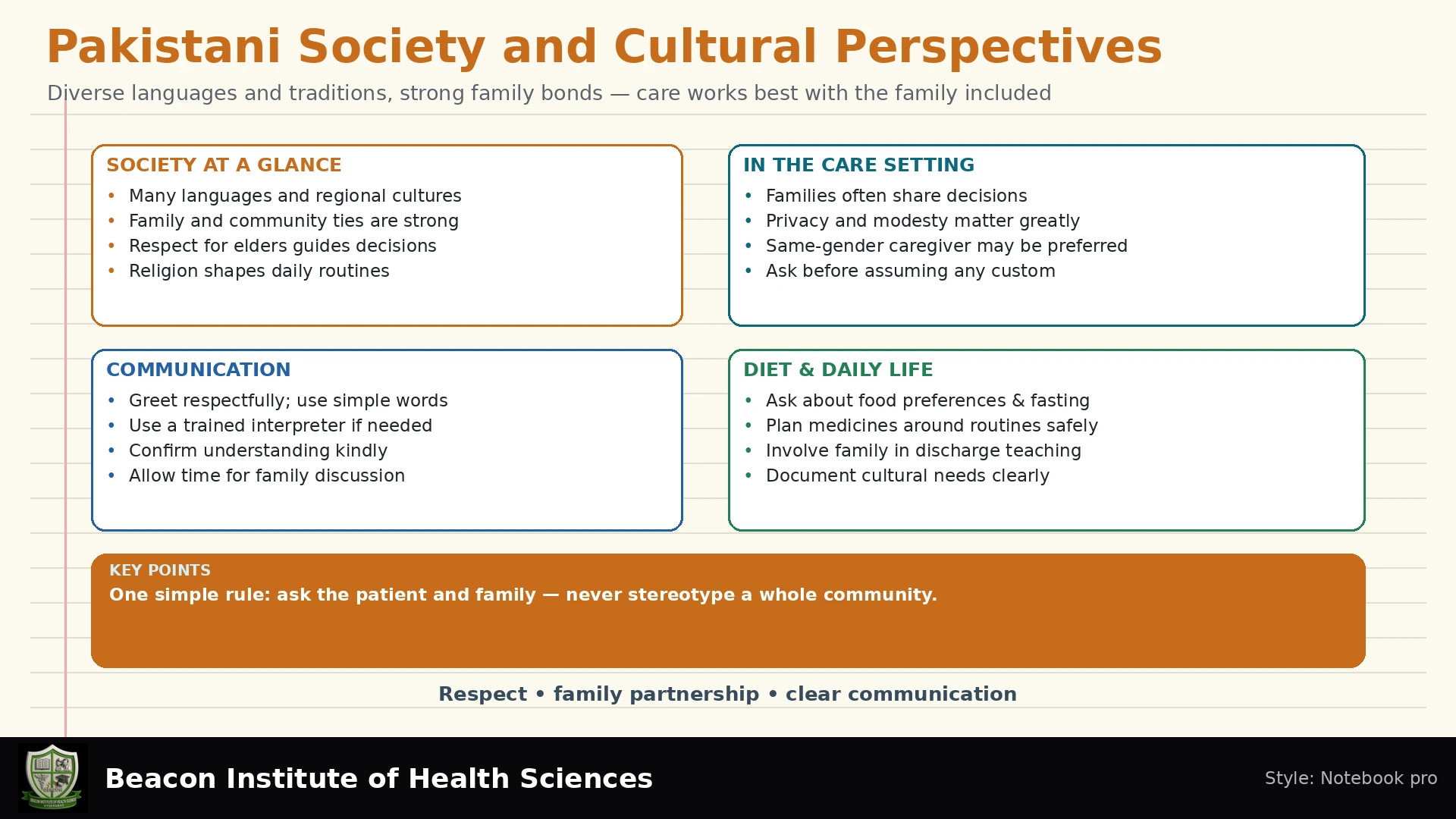
Pakistani society includes many languages, regional identities, religious traditions, occupations and ways of living. People also differ within each community. A patient's ethnicity or place of residence cannot tell a nurse what that person believes, understands or wants. Cultural knowledge should prompt thoughtful questions rather than replace individual assessment.
Sociology examines social relationships and institutions. Anthropology explores human life, meanings and practices across settings. Together they help nurses understand why illness is experienced within a family, workplace and community as well as within a body. Clinical assessment remains essential; a cultural explanation must never become a reason to overlook symptoms or delay necessary care.
Diversity, Identity and Change
A person can identify with several communities at once. Language, religion, gender, age, education, disability, occupation and migration experience interact. These influences do not operate in the same way for every person. Avoid assuming that a rural resident has little health knowledge or that a city resident can easily afford treatment.
Culture changes through education, migration, work, technology and contact between generations. Older and younger family members may share some values and disagree about others. Social media can provide support and information, but it can also spread misleading claims. Ask what information the patient has seen and discuss the evidence calmly.
Language and Communication
Urdu and English are used in many public and professional settings, while people also use Punjabi, Sindhi, Pashto, Saraiki, Balochi, Brahui and other languages. This list is illustrative, not exhaustive. A person's preferred language for everyday conversation may differ from the language they understand best for complex health decisions.
Ask about preferred spoken language, reading comfort and communication needs. Use plain words, short explanations and appropriate visual material. Where available, trained interpreters should support important conversations. Speak directly to the patient and check understanding through teach-back. Avoid relying on children to interpret sensitive information. Follow the setting's language-support procedures when trained assistance is unavailable.
Family, Kinship and Support
Households may be nuclear, extended, joint, multigenerational or organized in other ways. Some people live alone or away from relatives. Families can offer emotional support, transport, financial help and practical care, but the presence of relatives does not prove that those resources are available.
Ask who the patient wants involved and what each person can realistically do. A relative who accompanies the patient is not automatically authorized to receive private information or make decisions. Assess capacity for the particular decision and follow applicable consent requirements and institutional policy. Support the patient's voice, including when a family prefers collective discussion.
| Area | Individual assessment | Nursing response |
|---|---|---|
| Family involvement | Who should join discussions? | Seek permission and clarify roles. |
| Home care | Who can help, when and with which tasks? | Check ability, training needs and caregiver strain. |
| Communication | Which language and format are understood? | Arrange assistance and use teach-back. |
| Privacy | Which topics should be discussed alone? | Offer a safe private conversation. |
| Follow-up | What makes returning difficult? | Plan practical access and review arrangements. |
Religion, Spirituality and Care
Islam is the majority religion in Pakistan, and religious minorities also form part of society. Observance and personal interpretation vary within every faith community. Do not infer a patient's wishes from their name, dress or stated religion. Ask whether spiritual practices, dietary preferences or religious support matter to the current care plan.
Prayer, spiritual support and other safe practices may offer comfort alongside clinical treatment. Requests should be considered respectfully and equitably. If fasting could affect an illness or medicine schedule, involve the appropriate clinician for an individualized assessment. Nurses should not independently change prescribed treatment or assume that every patient wishes to fast.
Modesty, Gender and Patient Choice
Ask about preferences for examination, privacy, a chaperone or a clinician of a particular gender. Explain what the examination involves and obtain appropriate consent. Where a preference cannot immediately be met, explain available options and clinical urgency rather than make promises. Follow policy while preserving dignity.
Do not assume that a woman, an older adult or a person with a disability lacks decision-making ability. Address the patient directly and provide communication support where needed. Family relationships can be supportive, strained or unsafe. Offer private assessment when appropriate and follow safeguarding procedures without taking steps that could increase risk.
Social Conditions and Health Opportunities
Health is affected by the conditions in which people live and work. Labelling a missed appointment as a cultural problem may conceal unaffordable travel, lost wages or inaccessible services. Assess these conditions before judging motivation.
| Condition | Possible barrier | Practical nursing action |
|---|---|---|
| Income and employment | Costs and unpaid time away from work | Discuss feasible appointments and available assistance. |
| Transport and distance | Difficulty reaching services | Explore safe transport or appropriate referral options. |
| Housing and environment | Limited space, water or safe storage | Adapt advice to actual household conditions. |
| Education and communication | Unclear written instructions | Explain simply and confirm understanding. |
| Disability and accessibility | Physical or communication obstacles | Arrange reasonable support and accessible information. |
| Migration and disrupted support | Unfamiliar services or interrupted records | Explain pathways and coordinate continuity of care. |
Health Beliefs and Healing Practices
Some people combine clinical treatment, pharmacy advice, home remedies and spiritual practices. Ask what is being used, including ingredients, amounts and reasons. Neither traditional nor commercial products should be assumed safe without assessment. Seek clinical or pharmacy advice about uncertain ingredients, adverse effects and interactions.
Respectful discussion does not require agreement with an unsupported medical claim. Explain known benefits, uncertainties and risks. Accommodate harmless preferences where possible, and discuss safer alternatives when a practice could cause harm or delay necessary treatment. Avoid ridicule, threats or blanket claims about a community.
Fictional Worked Nursing Example
A fictional patient, Ayesha, prefers Sindhi for health discussions. A relative offers transport but answers every question. Ayesha requests a private conversation and asks whether a female clinician is available. These are her expressed preferences; they should not be attributed to all Sindhi-speaking patients.
The nurse asks whom Ayesha wants involved, arranges appropriate language assistance and explains examination options. The nurse checks understanding with teach-back, confirms what information may be shared and explores transport costs. The plan records Ayesha's choices and realistic follow-up support. Clinical needs are assessed alongside social needs.
In a separate fictional review, 30 patients requested language assistance and 24 received it. The documented provision proportion is 24 divided by 30, multiplied by 100, or 80%. Six requests were unmet. This measure does not include people whose need was never identified or who could not request help. It also does not establish the accuracy or quality of interpretation. Review unmet needs and patient experience as well as the percentage.
A Practical Nursing Approach
- Assess symptoms, urgency and individual communication needs.
- Ask about preferences, explanatory beliefs and desired family involvement.
- Identify practical resources, barriers and safety concerns.
- Explain evidence and options in understandable language.
- Agree on a safe, feasible plan and document consent and preferences.
- Review understanding, access and outcomes, adapting the plan when needed.
Population data, including census information, can help plan services and identify broad needs. They do not describe every individual or establish the cause of a health outcome. Check definitions, dates and coverage before comparing figures. Protect confidentiality when collecting local service information.
Practice Questions with Explained Answers
- Can ethnicity determine a patient's treatment preferences?
No. Ask the individual; group identity does not predict every belief or choice.
- Does living in a joint household guarantee a caregiver?
No. Assess willingness, availability, skills and strain rather than presume support.
- Why is language assistance important for consent?
A patient needs an understandable explanation of options and relevant consequences to participate meaningfully in decisions.
- Should a nurse independently change medication times for fasting?
No. The plan needs individualized review by the appropriate clinician, considering the illness and treatment.
- Does 80% language-assistance provision prove that all needs were met?
No. Six recorded requests were unmet, unrecognized needs are excluded, and quality still requires assessment.
Conclusion
Understanding Pakistani society helps nurses ask better questions about language, relationships, beliefs and access. Safe care combines clinical evidence with respect for individual choices and practical living conditions. The central habit is to listen, assess and review rather than assume.