
Learning Objectives
- Explain how culture interacts with health behaviour and living conditions.
- Explore a person's explanatory model without assuming their beliefs.
- Apply behaviour-change concepts to realistic nursing support.
- Evaluate a fictional intervention while recognizing uncertainty.
Culture and Health Behaviour
Health behaviour includes actions related to maintaining health, seeking care, following treatment and living with illness. Culture can influence what symptoms mean, whom people trust and which practices feel acceptable. Behaviour also depends on income, time, transport, service quality, safety and previous experience. Beliefs alone do not explain every action.
People within the same community differ. A person's language, age, occupation, religion, disability, family relationships and life history intersect in complex ways. Ask about the individual rather than use a list of presumed group characteristics. Healthcare organizations also have cultures that shape communication and access.
Beliefs, Norms and Practical Conditions
| Influence | Possible effect | Useful nursing question |
|---|---|---|
| Explanations of illness | Shape interpretation and help-seeking | What do you think is happening? |
| Family and peer expectations | Can support or discourage care | Who supports you with this decision? |
| Trust and past experience | Affect willingness to return | Has anything about previous care worried you? |
| Material resources | Limit what is feasible | What makes the plan difficult to carry out? |
| Communication | Influences understanding and consent | Which language and explanation format work best for you? |
Distinguish descriptive norms, which concern what people believe others do, from injunctive norms, which concern what others approve of. Neither necessarily reflects what everyone actually does or wants. Avoid messages that unintentionally suggest an unsafe practice is universal.
Exploring the Explanatory Model
An explanatory model is the person's understanding of the problem, its causes, likely course and suitable treatment. Ask open questions: What name do you use for this problem? Why do you think it started? What worries you most? What have you tried? What help do you hope for? These questions invite discussion without endorsing every proposed medical explanation.
Explain the clinical assessment in plain language and invite questions. Acknowledge distress and meaning while being honest about evidence. If the person's understanding differs from the clinical explanation, explore the difference respectfully and agree on safe next steps.
The Health Belief Model
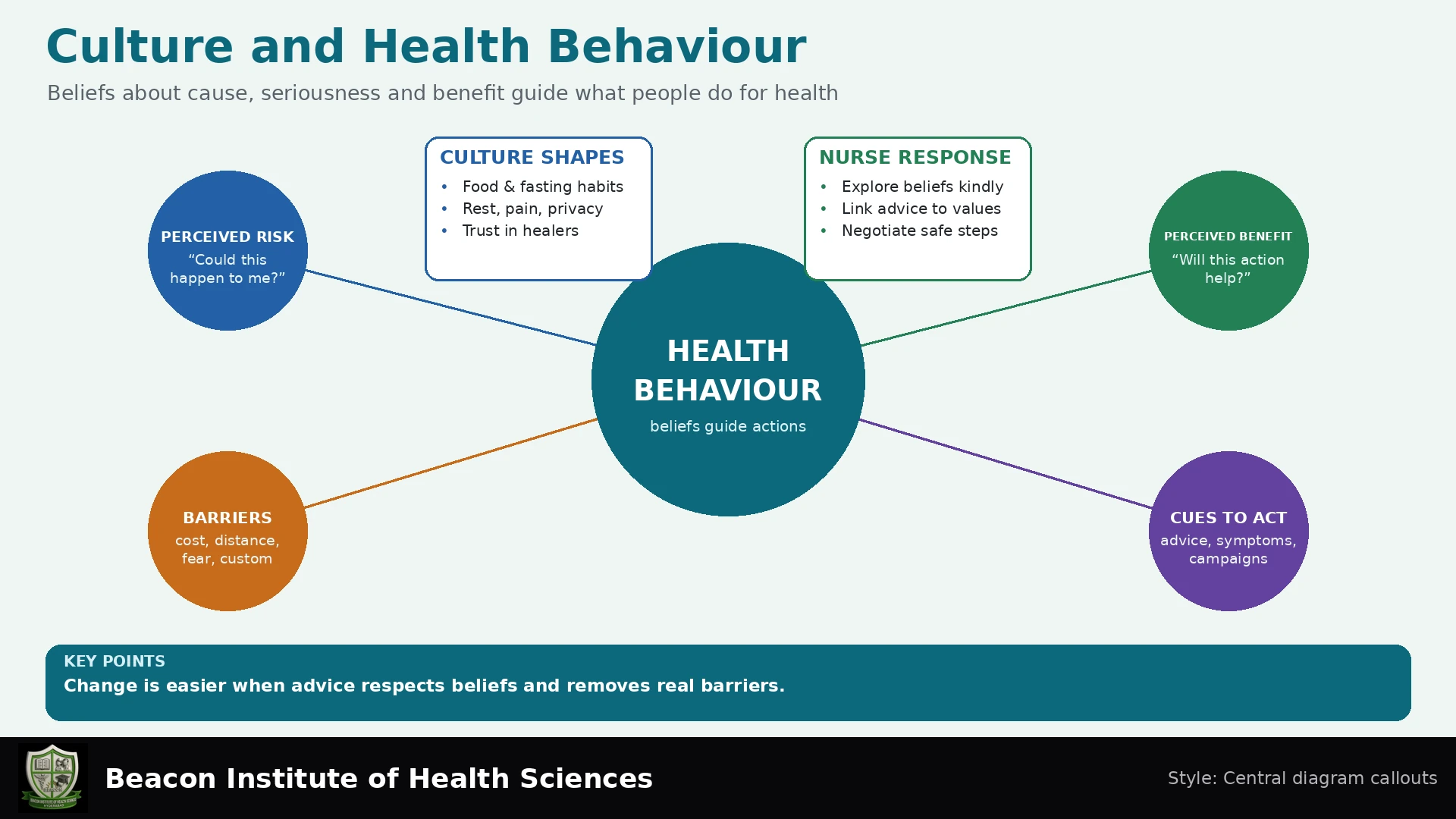
The Health Belief Model is a framework for exploring perceptions related to action. It is a guide to questions, not a diagnostic test or a guarantee of behaviour.
| Concept | Meaning | Example question |
|---|---|---|
| Perceived susceptibility | Believed chance of a health problem | How likely do you feel this problem is for you? |
| Perceived severity | Believed seriousness and consequences | How might it affect your daily life? |
| Perceived benefits | Expected value of the action | What benefit would make the plan worthwhile? |
| Perceived barriers | Expected obstacles or costs | What concerns or difficulties do you anticipate? |
| Cues to action | Prompts that trigger consideration or action | Would a reminder help, and how should it be sent? |
| Self-efficacy | Confidence in performing the action | How confident are you that you can do this step? |
Perceived barriers may correspond to real structural barriers, such as unavailable transport. Education alone cannot remove them. The model may underrepresent habit, emotion, power and social constraints if used too narrowly. Combine it with assessment of actual opportunities and resources.
From Knowledge to Feasible Action
Knowing what to do does not ensure that a person can do it. Assess capability, opportunity and motivation. Capability includes understanding and practical skills. Opportunity includes the physical and social conditions that make action possible. Motivation includes intentions, emotions and habits. These influences interact.
For example, teaching a person how to use a device addresses a skill barrier, while arranging access to the device addresses an opportunity barrier. Repeating frightening information may add little when the person already understands the risk but cannot obtain care.
Culturally Responsive Communication
- Use the preferred language and appropriate language assistance. Speak directly to the patient.
- Ask permission before discussing sensitive topics and provide privacy.
- Use familiar examples without assuming that everyone eats, lives or worships in the same way.
- Use teach-back to check the explanation, rather than test or shame the person.
- Ask whom the person wants involved and clarify confidentiality.
- Document individual preferences and review them when circumstances change.
Where trained interpreters are available, use them for important clinical conversations. Family members may provide support but can introduce errors, pressure or confidentiality concerns. Avoid relying on children to interpret sensitive or complex information; follow the setting's language-support policy.
Traditional Practices and Shared Planning
People may combine professional treatment, home remedies and spiritual practices. Ask what is used, how often and for what purpose. Do not assume either that every traditional practice is harmful or that familiar remedies are automatically safe. Medicines and herbal products may interact, and their ingredients or doses may be uncertain.
Where a harmless practice offers comfort, seek ways to accommodate it. If a practice creates risk or delays needed care, explain the concern, discuss safer alternatives and involve the appropriate clinician. Spiritual support can accompany necessary medical care. Treatment changes, including changes around fasting, require individualized clinical assessment rather than a blanket rule.
Supporting Change Without Blame
Agree on a specific, achievable next step based on the person's priorities. Ask what support is needed, anticipate obstacles and plan a review. Use reflective listening and open questions to explore ambivalence. Avoid threats, humiliation or promises of guaranteed outcomes.
A plan might specify that the patient will bring all medicine containers to the next review and that the clinic will arrange a suitable appointment time. Responsibilities belong to services as well as individuals. An informed choice to decline an intervention should not be automatically labelled noncompliance.
Fictional Worked Nursing Example
A fictional patient, Sana, understands why follow-up is recommended but attends irregularly. She fears being criticized about a home remedy, cannot leave work during clinic hours and finds the written instructions difficult to read. Assuming that her cultural beliefs explain everything would miss important barriers.
The nurse asks about Sana's goals and preferred language, reviews the remedy through the clinical team and explains concerns respectfully. Together they choose a feasible follow-up arrangement and a simple written or pictorial plan. Teach-back confirms that the explanation is understandable. Family participation is offered only if Sana wants it.
In a separate fictional service review, 12 of 20 eligible patients completed follow-up before a change, and 16 of 20 did so afterward. Completion rose from 60% to 80%, an increase of 20 percentage points. This small before-and-after comparison cannot establish that culturally adapted communication caused the change; scheduling, patient mix and other factors may also matter.
Evaluating Nursing Support
Assess understanding, access, patient experience, completion of agreed actions and relevant health outcomes. Count who was eligible and who was missed. Gather feedback from people with different language and access needs, not only those who attend regularly. Protect confidential data and avoid presenting a community as a problem to be corrected.
Practice Questions with Explained Answers
- Does sharing a cultural identity mean sharing every health belief?
No. Individual variation and life experience must be assessed.
- What is an explanatory model?
The person's understanding of the health problem and suitable responses to it.
- Can education solve an unavailable transport service?
No. Information may help planning, but the practical access barrier also needs attention.
- Is self-efficacy the same as knowledge?
No. It concerns confidence in carrying out an action; knowledge is understanding information.
- What does the rise from 60% to 80% show?
A 20-percentage-point increase in documented completion, without proof of a causal intervention effect.
Conclusion
Culture and health behaviour are linked through meanings, relationships and opportunities. Nurses support better care by listening, explaining evidence clearly, respecting choice and helping remove practical barriers. Effective plans are individualized, safe and feasible in the person's daily life.