
Learning Objectives
- Distinguish between sex, gender, gender identity, gender expression, and sexual orientation.
- Understand the multifaceted influences on gender roles and their variability across cultures and individuals.
- Recognize the impact of gender stereotypes, prejudice, discrimination, and social barriers on health behaviors.
- Apply principles of culturally competent and patient-centered care related to gender in nursing practice.
- Address common myths and misconceptions about gender and behavior.
Understanding Core Concepts: Sex, Gender, Identity, and Orientation
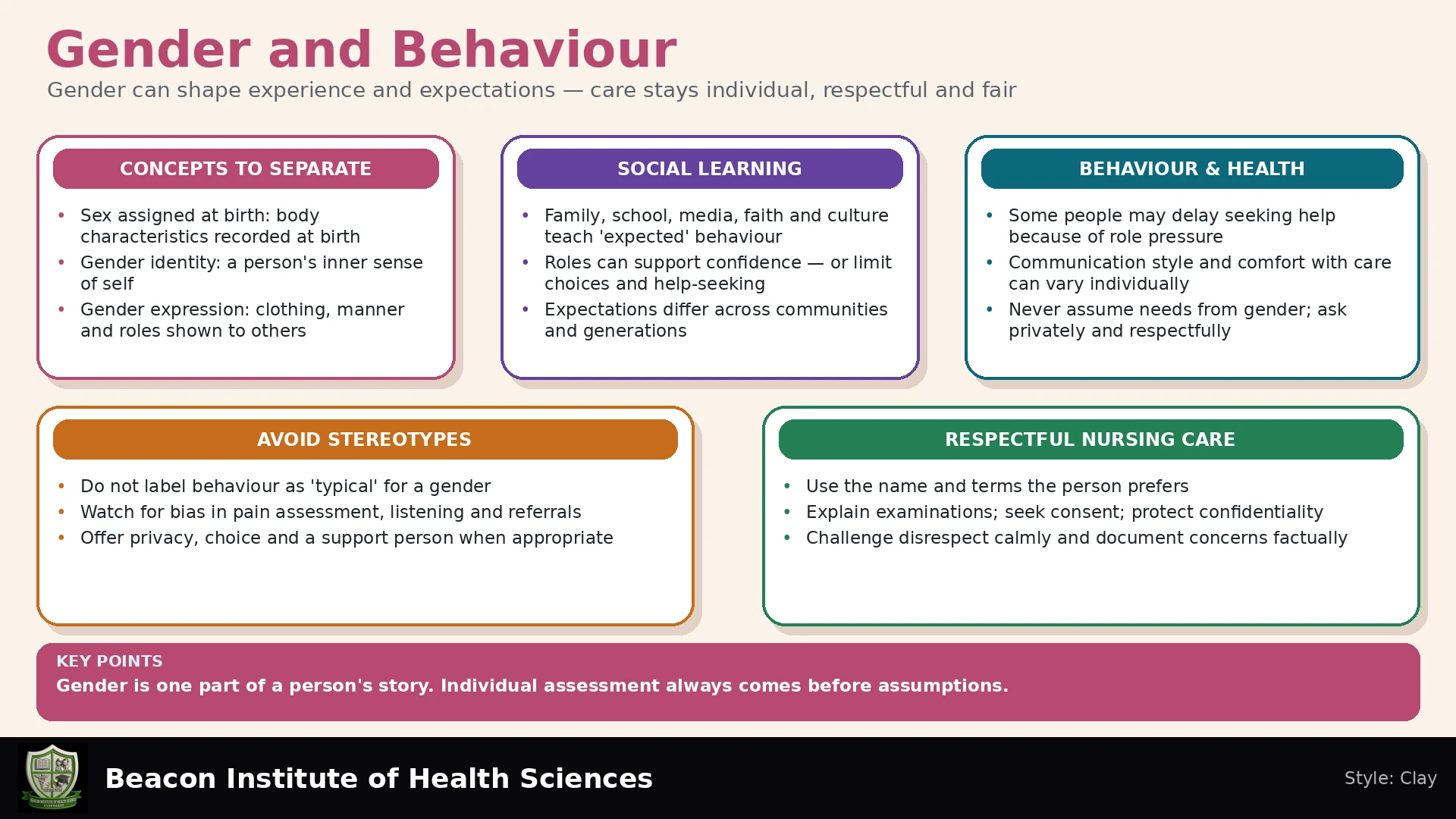
In nursing, a clear understanding of fundamental terms related to sex and gender is crucial for providing respectful, individualized care. These concepts are often conflated but represent distinct aspects of an individual's identity and characteristics.
Sex vs. Gender
Sex refers to the biological characteristics that categorize individuals, typically as male or female, based on chromosomal, anatomical, and physiological features. These are biologically determined attributes.
Gender, in contrast, refers to the socially constructed norms, roles, and relations, as well as the power dynamics associated with being male or female within a given society. These are not biologically inherent but are learned and vary across cultures and over time.
Gender Identity
Gender identity is an individual's deeply felt, internal sense of being a woman, a man, both, neither, or somewhere along the gender spectrum. It is internal and may or may not correspond to the sex assigned at birth.
Gender Expression
Gender expression refers to the external manifestation of an individual's gender identity, typically through clothing, demeanor, voice, or social behavior. It is important to note that gender expression does not inherently reveal an individual's sexual orientation.
Sexual Orientation
Sexual orientation describes an individual's enduring pattern of emotional, romantic, and/or sexual attraction to men, women, both, neither, or another gender. This is distinct from gender identity and gender expression.
Gender Roles and Their Influences
Gender roles are complex and shaped by numerous interacting factors, influencing how individuals are expected to behave, think, and feel within a society.
Variability of Gender Roles
Gender roles are not static or universal. They vary significantly across different cultures and historical periods. Furthermore, within any given group or society, there is considerable variation in how individuals enact or perceive gender roles. It is crucial to avoid rigid assumptions based on perceived gender.
Interacting Factors
Human behavior, including gender-related behaviors, results from a dynamic interaction of various factors:
- Biology: Biological predispositions can influence certain behaviors, though their interaction with other factors is complex.
- Socialization: The process through which individuals learn the norms, values, and behaviors appropriate to their society or group, heavily influencing gender roles.
- Resources: Access to education, economic opportunities, and healthcare can significantly shape gendered behaviors and expectations.
- Personal Experience: Individual life events and interactions contribute to the development of personal understandings and expressions of gender.
It is vital for nurses to understand that these factors interact in complex ways, and there are no deterministic stereotypes about intelligence, emotion, leadership, or caring ability based solely on sex or gender. Such stereotypes are inaccurate and can hinder effective, individualized care.
Role Learning
Gender roles are primarily learned through various channels:
- Family: Primary educators, modeling behaviors and values.
- Peers: Influence through social interactions and group norms.
- Media: Portrayals in television, movies, advertisements, and social media shape perceptions of gender.
- Institutions: Educational systems, religious organizations, and legal frameworks can reinforce or challenge gender norms.
- Modelling: Observing and imitating the behavior of others, especially significant figures.
- Rewards and Sanctions: Behaviors consistent with gender roles are often rewarded, while deviations may be met with sanctions.
Self-Concept and Expectations
Through role learning, individuals develop a self-concept related to their gender, which includes their expectations of themselves and what society expects of them. These internal and external expectations can profoundly influence their choices, actions, and overall well-being.
Difference Between Description and Prescribing Roles
It is important to differentiate between describing gender roles as they exist in society and prescribing or endorsing specific roles. Nurses should observe and understand societal gender roles to better comprehend patient contexts but must never impose or assume these roles dictate an individual's behavior or capabilities.
Impact of Gender Stereotypes and Social Barriers on Health
Gender stereotypes, prejudice, and discrimination can have significant negative consequences on individuals' health and their access to care.
Stereotypes, Prejudice, and Discrimination
- Gender Stereotypes: Oversimplified and often inaccurate beliefs about the characteristics, roles, and behaviors of men and women.
- Gender Prejudice: Preconceived negative judgments or attitudes towards individuals based on their gender.
- Gender Discrimination: Unfair or unequal treatment of individuals based on their gender, which can lead to disparities in opportunities and outcomes.
These societal issues can lead to unequal access to resources and opportunities, impacting health behaviors and outcomes.
Social Barriers and Health Behaviors
Various social barriers, often rooted in gender inequalities, can affect an individual's health-seeking behaviors and overall health:
- Transport: Limited access to safe or affordable transportation can prevent individuals from attending appointments or accessing health services, particularly impacting those with traditional household responsibilities.
- Resources: Unequal access to financial resources, education, or stable employment can create significant barriers to health.
- Decision-Making: Limited agency in household or community decision-making can prevent individuals from prioritizing their health needs or seeking care.
It is crucial for nurses to understand that these barriers are real and can disproportionately affect different individuals based on their gender and social context. Nurses must avoid assuming that women always behave one way or men another, as individual circumstances and experiences are highly diverse.
Nursing Considerations: Culturally Competent and Patient-Centered Care
Providing safe, effective, and ethical nursing care requires a patient-centered approach that respects individual preferences and upholds core ethical principles related to gender and behavior.
Individual Preferences
Nurses must always ask about individual preferences regarding privacy, chaperones, and family involvement in care. Assumptions based on perceived gender or cultural background are inappropriate and can lead to discomfort or mistrust. For example, some patients may prefer a chaperone of a specific gender during examinations, or may wish for family involvement in certain aspects of care while others may not.
Consent and Capacity Principles
The principles of informed consent and patient capacity are paramount. For an adult with decision-making capacity, seek the patient’s own informed consent; relatives do not replace that decision merely because of gender or cultural expectations. Where capacity is impaired or urgent care is required, follow the applicable consent and emergency-care procedures and institutional policy. Ensuring the patient understands their care options and can make an autonomous decision is a fundamental nursing responsibility.
Dignity and Confidentiality
Upholding patient dignity and confidentiality is essential. This includes respecting personal space, maintaining privacy during examinations and discussions, and ensuring that sensitive information is not disclosed without authorization. Respect for dignity extends to how nurses communicate about and interact with patients regarding their gender.
Respectful Neutral Language
Nurses should use respectful, neutral language in all interactions. Clinical questions should be based solely on their relevance to the patient's care and health status, not on assumptions or stereotypes about gender. Furthermore, a patient's gender identity or sexual orientation should never be disclosed without their explicit authorization, maintaining strict confidentiality.
Case Study: Applying Principles in Practice
Consider an adult patient who has delayed follow-up appointments for a chronic condition. During a home visit, the patient expresses difficulty attending clinic appointments due to transport challenges and significant household responsibilities, which traditionally fall to them in their family structure.
Nursing Approach:
- Ask Open Questions: Instead of making assumptions, use open-ended questions to understand the patient's specific barriers and priorities.
- Agree a practical plan: Explore suitable appointment times, transport options and support services without assuming which barrier matters most.
- Respect chosen support: Ask whether the patient wants a relative or another person involved. Discuss information privately unless sharing is authorized or another applicable duty requires it.
- Check understanding: Ask the patient to explain the agreed plan in their own words. Clarify any remaining difficulty.
- Evaluate: At follow-up, ask what was feasible and revise the plan. Do not claim success before the outcome is known.
This is a fictional teaching case. Household and transport responsibilities can affect people of any gender. The example does not imply that a particular gender is naturally responsible for domestic work or likely to miss appointments.
Concept comparison
| Term | Focus | Practical caution |
|---|---|---|
| Sex characteristics | Biological features, including reproductive anatomy, hormones and chromosomes. | Features vary; do not infer all relevant anatomy or clinical needs from appearance. |
| Gender roles | Social expectations about behaviour and responsibilities. | An expectation does not establish an individual’s preferences or abilities. |
| Gender identity | The person’s internal sense of gender. | Ask respectfully when relevant; do not diagnose from identity. |
| Gender expression | How a person presents or expresses gender. | Clothing and manner do not establish identity or orientation. |
| Sexual orientation | Patterns of romantic or sexual attraction. | It is distinct from identity and should not be guessed. |
Common myths to challenge
| Myth | More careful understanding |
|---|---|
| Women are naturally the only good caregivers. | Caring skills can be developed by people of any gender through education, experience and support. |
| Men should never express distress. | Emotional needs are individual. Expectations that discourage disclosure can hinder help-seeking. |
| Different group averages determine what one person can do. | A group pattern cannot establish an individual’s abilities, choices or needs. |
| Culture makes one fixed care preference compulsory. | Ask about the patient’s own wishes and respond within safe practice. |
Questions for respectful assessment
Useful questions include: “What makes it easier or harder to attend?” “Who, if anyone, would you like involved?” “What privacy arrangements would help you feel comfortable?” and “Are there any concerns you would prefer to discuss privately?” Ask sensitive questions only when relevant, explain their purpose and allow the person to raise concerns. Avoid turning a routine consultation into an unnecessary inquiry about identity.
Chaperone arrangements depend on the examination, patient preferences and local policy. Explain the available options and discuss any difficulty with the responsible team. Preferences deserve attention without creating avoidable delays in essential care. Never assume that one answer applies to everyone from the same background.
Self-check with explained answers
1. Can clothing tell a nurse a patient’s sexual orientation?
Answer: No. Expression and orientation are different concepts. Make no inference from clothing; ask relevant clinical questions respectfully when needed.
2. A patient has missed follow-up. What should the nurse establish before attributing this to lack of motivation?
Answer: Ask about the patient’s account, practical barriers and understanding of the plan. Transport, finances, care responsibilities and service arrangements may matter. A single behaviour does not establish a personal trait.
3. Does explaining a social gender role mean endorsing it?
Answer: No. Description explains an expectation in its context. Endorsement would prescribe that expectation as the right role for an individual. Nursing assessment should support individual needs and informed choice.
Glossary and conclusion
Socialization: learning expectations through interaction and experience. Stereotype: an oversimplified group belief. Prejudice: a preconceived attitude. Discrimination: unfair treatment. Equity: addressing relevant differences in needs and barriers to enable fair access.
Gender can shape opportunities, expectations and help-seeking, while each person’s behaviour reflects many interacting influences. Respectful nursing combines accurate concepts with individual assessment, privacy, informed choice and practical attention to barriers. It avoids stereotypes and does not treat gender diversity as an illness.