Understanding Professionalism and the Concept of a Profession
To establish a clear understanding of the nursing discipline, it is essential to first define what constitutes a Profession and who is designated as a Professional. In academic terms, these definitions differentiate routine labor or occupations from specialized vocations.
Academic Definition of a Profession
Profession: An occupation that requires extensive, specialized education and training, or a calling that demands specialized knowledge, skills, and preparation.
Academic Definition of a Professional
Professional: An individual who is engaged in, belongs to, or actively practices within a recognized profession. A professional is characterized by the application of specialized expertise, clinical experience, and an established standard of competence.
For example, in a clinical setting, a Staff Nurse who executes patient care with expert skill, clinical judgment, and comprehensive experience is practicing as a professional. This professional standing dictates that all interactions within the workplace—whether among healthcare colleagues or between the nurse and the client—are governed by formal, objective, and specialized relationships.
2. Key Characteristics of a Profession
Every recognized profession in modern society is defined by a set of non-negotiable core characteristics. An occupation must fulfill these requirements to be considered an autonomous, respected discipline:
- Specialized and Extensive Education: A profession requires rigorous, formalized, and structured academic study. Society mandates specific clinical and educational hours before licensing. For example, obtaining a Bachelor of Science in Nursing (BSN) is required to become a Registered Nurse, just as a medical doctor must complete a five-year degree, or an engineer must obtain a university engineering degree.
- On-Going and Continuous Research: A profession cannot remain static. It must constantly evolve through rigorous academic research and clinical studies. If a discipline ceases to research, its growth declines. Professionals have a responsibility to remain updated with current findings and actively integrate new evidence-based practices into their daily operations.
- Well-Defined Body of Knowledge: A profession must possess a robust, established, and distinct body of literature, theories, and concepts. This ensures that when a professional speaks or acts, their clinical decisions are backed by validated scientific evidence. Nursing has established a comprehensive body of knowledge, supported by standardized syllabi, peer-reviewed clinical research, and a unified educational framework that clarifies practice standards at all levels.
- Strict Code of Ethics: Ethics and moral values are the cornerstone of professional practice. A code of ethics governs interpersonal manners, communication guidelines, and situational decision-making. It dictates how a professional treats a patient with dignity, ensuring they are never ignored or neglected. Without a code of ethics, clinical practice collapses into structural chaos and disaster.
- Autonomy and Self-Governance: Autonomy (self-governance or mukhtari) means having the legal authority and independence to make critical, beneficial decisions within one's professional boundaries. In nursing, an expert staff nurse possesses clinical autonomy—they have the right and responsibility to assess a patient's immediate condition and make rapid care decisions based on established clinical protocols without waiting for outside instructions.
- Service Orientation: A profession is distinguished by its primary motive. While standard occupations may prioritize financial gain or profit, a true profession is primarily defined by service. In nursing, the core focus is providing empathetic care, comfort, and direct support to clients and families, prioritizing humanitarian service over financial profits.
- Professional Organization: Professionals operate under the oversight of governing bodies that establish national and international policies, rules, and codes of conduct. Examples of such bodies include the World Health Organization (WHO), the United Nations (UN), and national nursing councils, which regulate and standardize clinical standards across the globe.
3. Dimensions of Nursing as a Specialized Profession
When analyzing nursing through the lens of professional criteria, several unique clinical dimensions emerge. These dimensions define the practical and emotional boundaries of nursing care:
A. Delivery of High-Quality Care
Nurses are legally and ethically bound to deliver quality patient care. Quality care is defined as providing the exact standard of safe, attentive, and evidence-based therapeutic care that the healthcare provider would expect to receive for themselves or their family members under similar clinical circumstances.
B. The Critical Distinction: Empathy vs. Sympathy
In the nursing discipline, understanding the difference between empathy and sympathy is a fundamental requirement for maintaining professional boundaries and therapeutic efficacy:
| Concept | Clinical Definition | Nurse's Position & Action |
|---|---|---|
| Sympathy | Feeling sorrow, pity, or sadness for a patient's pain, loss, or bereavement. | The nurse remains outside the patient's experience, feeling bad for them but not understanding their internal perspective. This can lead to subjective emotional exhaustion without therapeutic utility. |
| Empathy | The cognitive and emotional capacity to place oneself entirely within the patient's position. | The nurse actively imagines: 'If I were in this exact situation, with this diagnosis or loss, what would my mental state be, and what specific clinical and emotional support would I require?' The nurse remains empathetic to deliver targeted, objective care. |
C. Adherence to Current Knowledge and Global Standards
Nursing practice must be continuously updated with current knowledge. Nurses are required to strictly follow standardized, globally accepted clinical practice guidelines. These standards govern every aspect of clinical care, ranging from routine procedures like administering an intramuscular or intravenous injection to participating in highly complex, sterile surgical procedures.
D. Critical Thinking and Rapid Decision-Making
The clinical environment is highly unpredictable. Critical thinking is an absolute necessity in nursing. When facing acute or life-threatening patient crises, a professional nurse must remain calm and avoid panicking. They must employ systematic critical thinking skills to analyze the situation, prioritize immediate patient needs, and make rapid, evidence-based decisions that protect the client's life.
4. Stages of Clinical Nursing Proficiency
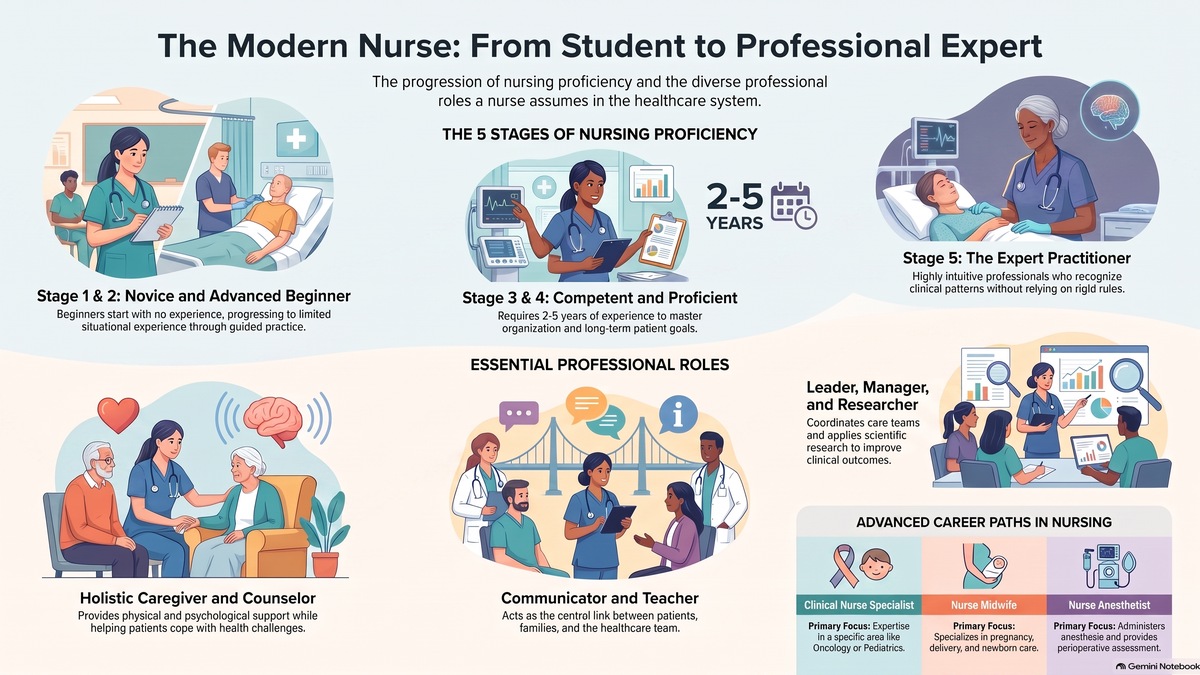
As a nurse progresses through their professional career, they advance through five distinct, highly documented levels of clinical proficiency. This developmental framework outlines the transition from a novice student to a highly intuitive clinical expert:
| Stage | Experience Level | Clinical Characteristics & Behavioral Markers |
|---|---|---|
| 1. Novice | No Prior Experience (e.g., first-year nursing students) | Clinical performance is highly limited and rule-governed. The student is dependent on step-by-step instructions and has not yet developed the experience required to adjust to real-world clinical variations. |
| 2. Advanced Beginner | New Graduates or Interns | Demonstrates improved clinical performance. They can make basic clinical judgments and recognize patterns in real-life situations. They can identify when a patient's condition is deteriorating (becoming critical) and know exactly when and how to escalate the situation by informing senior medical staff. |
| 3. Competent Practitioner | 2 to 3 Years of Active Practice | Capable of differentiating between critical and non-critical clinical factors. They organize and prioritize care based on patient-specific needs. For example, they can determine whether a patient immediately needs dietary intake, sleep, or ambulation, and they prioritize interventions accordingly. |
| 4. Proficient Practitioner | 3 to 5 Years of Active Practice | Possesses advanced decision-making skills. They view clinical situations holistically rather than as isolated tasks. They focus heavily on long-term patient-oriented goals and formulate comprehensive, highly effective clinical care interventions. |
| 5. Expert Practitioner | Highly Experienced (e.g., Head Nurses, Nursing Superintendents) | Practice is completely fluid, highly skilled, and intuitive. They require no external guidelines or rules to manage complex patient care. They are highly analytical, can rapidly assess and diagnose a patient's clinical state, predict potential future complications, and design highly individualized, proactive care plans. |
5. The Ten Core Professional Roles of a Nurse
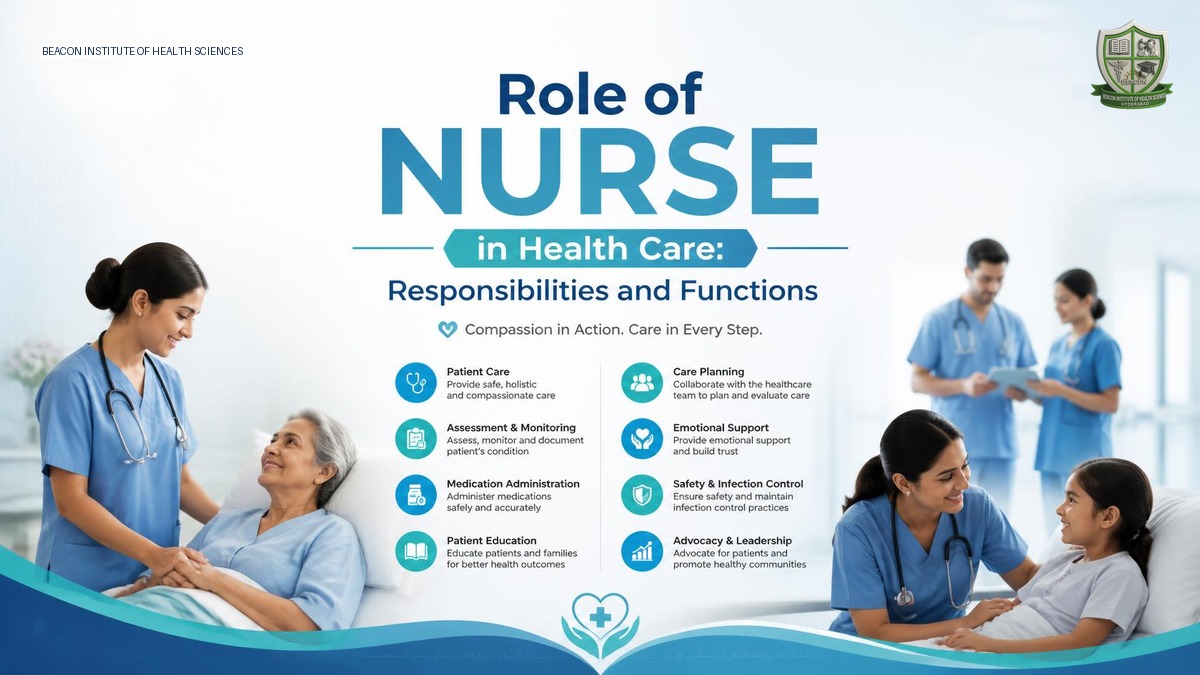
In the modern healthcare ecosystem, a professional nurse does not simply perform bedside tasks. Instead, they simultaneously execute ten distinct, highly integrated professional roles to ensure holistic patient recovery and system efficiency:
- Caregiver: The primary role of the nurse is to deliver direct, hands-on, therapeutic care. This care is divided into two equal domains:
- Physical Care: Ensuring physical comfort, helping with mobility, performing back rubs to prevent skin breakdown, managing hygiene, and executing physical treatments.
- Psychological Care: Providing structured emotional support when a patient is experiencing acute anxiety, clinical depression, or severe situational stress.
- Communicator: Communication is an integral, non-negotiable part of every single nursing role. Without effective communication, a nurse cannot accurately identify patient needs. The nurse is the primary communication bridge, interacting constantly with the patient, their support systems (family members and close friends), local communities, and the broader multi-disciplinary healthcare team. This role is essential for delivering safe, coordinated patient care.
- Teacher: A nurse acts as an active educator, explaining medical facts, treatments, and procedures to the patient, family members, and the public. They teach about health preservation, management of acute illnesses, risk factors, and public health threats (such as epidemics or global pandemics like COVID-19). This role is executed at the bedside, in community health centers, and through national public-awareness campaigns.
- Client Advocate: As an advocate, the nurse acts as a legal and protective shield for the patient. Patients are often vulnerable due to illness and may not fully understand their rights or medical procedures. If any individual, policy, or clinical action poses a risk of harm to the patient, or if the patient's consents are compromised, the nurse must step in to protect the client and represent their best interests.
- Counselor: The counselor role focuses on helping patients recognize, understand, and cope with psychological or social barriers. The nurse helps the patient improve interpersonal relationships and promotes personal growth and self-confidence. Rather than imposing decisions, the counselor provides emotional support and guides the patient to identify healthy alternatives. For example, if a patient is struggling with smoking addiction, the counselor helps them identify customized alternative behaviors (like reading, singing, or listening to music) to engage in during times of intense cravings, systematically replacing the harmful habit.
- Change Agent: As a change agent, the nurse initiates, coordinates, and manages systematic changes within the patient's micro-environment, hospital wards, clinic policies, or the overarching healthcare delivery system. This role ensures that clinical workflows continuously adapt to improve patient safety, efficiency, and comfort.
- Leader: The nurse leader understands the specific health needs and goals of their patient population, community, or ward staff. They provide direction, inspire clinical excellence, and guide the entire team to collaboratively achieve these goals within the hospital or clinic setting.
- Manager: The nurse manager is responsible for planning, organizing, directing, and evaluating the delivery of nursing care across hospital departments, community clinics, and public health settings. They supervise staff and ensure optimal clinical outcomes.
- Case Manager: The case manager coordinates the patient's care journey by organizing a multidisciplinary healthcare team. For example, when managing a surgical patient, the case manager acts as the central hub. They coordinate with the ward's head nurse, attending physicians, surgeons, anesthesiologists, and ward support staff to seamlessly manage the pre-operative assessment, intra-operative procedures, and post-operative recovery, ensuring zero communication gaps.
- Research Consumer: Nursing is an evidence-based science. As a research consumer, the nurse actively reads clinical research findings, analyzes peer-reviewed scientific studies, and directly applies these verified findings to patient care. This ensures that clinical interventions are guided by the latest scientific evidence, constantly improving patient recovery rates.
6. Advanced Career Pathways in Nursing
Modern nursing offers highly specialized, diverse career opportunities. Upon completing foundational nursing education (a diploma or a BSN degree), professionals can pursue eight advanced career pathways:
| Advanced Career Role | Academic & Training Requirements | Clinical Scope & Responsibilities |
|---|---|---|
| 1. Nurse Practitioner (NP) | Graduate of a formal, advanced Nurse Practitioner program (BSN plus specialized clinical certifications). | Operates with high autonomy in ambulatory or community-based settings. Certified in specialties such as Family, Adult, Pediatric, or School Nursing. They diagnose and manage acute, chronic, and emergency illnesses. |
| 2. Clinical Nurse Specialist (CNS) | RN (Diploma or BSN) plus a minimum of one year of formal specialization in a designated clinical domain. | Acts as an expert clinical resource, consultant, and researcher in specialized fields like Critical Care, Oncology, Pediatrics, Surgery, or Gynecology. They have the authority to provide specialized consultation and, in some settings, prescribe medications. |
| 3. Certified Nurse Midwife | RN with advanced, formalized postgraduate education and clinical licensing in Midwifery. | Delivers comprehensive prenatal, intranatal, and postnatal care to mothers and newborns, spanning from conception to 40 days post-delivery. They manage normal deliveries, perform episiotomies, conduct cervical smears, guide family planning, and perform clinical breast exams. They refer high-risk or surgical cases to specialized physicians. |
| 4. Nurse Researcher | Typically requires advanced postgraduate degrees (MSN, MPhil, or PhD). | Investigates complex clinical nursing problems, designs scientific studies, analyzes data, and authors/publishes peer-reviewed research papers. Their work updates global nursing knowledge and drives the advancement of evidence-based practice. |
| 5. Nurse Administrator | Requires a BSN, MSN, or PhD combined with specialized training in healthcare administration. | Manages the organizational and financial infrastructure of healthcare facilities. Roles range from middle management (Head Nurses, Supervisors) to executive leadership (Director of Nursing, Nursing Superintendent). They manage budgets, staff scheduling, ward setups, and institutional policy, ensuring an environment for safe care delivery. |
| 6. Nurse Educator | Postgraduate nursing degree with extensive, demonstrated clinical experience. | Employed as instructors and faculty members in nursing schools and colleges. They are responsible for classroom teaching, designing curricula, and supervising and evaluating students in clinical training areas. |
| 7. Nurse Anesthetist | RN with advanced, specialized postgraduate training and certification in clinical Anesthesiology. | Conducts thorough pre-operative physical assessments (checking for active infections, cardiac or respiratory risks, etc.), administers general anesthesia under the supervision of a physician or anesthesiologist, and monitors patient vitals during post-operative recovery. |
| 8. Nurse Entrepreneur | Advanced nursing degree combined with professional education in Business Administration (e.g., MBA). | Manages or consults for health-related commercial ventures. Their scope includes managing pharmaceutical distribution networks, distributing public medical supplies, and consulting for medical equipment and clinical resource management companies. |
7. Specialized Roles: Communicator, Teacher, and Counselor
To provide a comprehensive understanding of nursing practice, three fundamental roles—the Nurse as a Communicator, Teacher, and Counselor—are examined in detail. These roles form the clinical core of nurse-patient interactions and directly influence patient outcomes:
A. The Nurse as a Communicator
Communication is the foundation of all nursing roles. A nurse cannot identify or address patient needs without effective communication. The nurse's communication must be highly collaborative and clear across several key groups:
- The Patient: Asking targeted clinical questions to discover physical symptoms, emotional states, and individual preferences.
- Support Systems: Engaging with family members and close friends to identify patient background details and plan discharge care.
- The Healthcare Team: Collaborating with doctors, pharmacists, therapists, and administrative staff to ensure a seamless plan of care.
- The Community: Directing public health initiatives and managing community-based health promotion campaigns.
Crucial Clinical Skills for Effective Communication:
- Active and Attentive Listening: A professional nurse must be a skilled listener. This requires maintaining direct eye contact, using open and attentive physical gestures, and avoiding distractions. If a nurse fails to listen actively, the patient will not build trust and may withhold critical clinical information.
- Non-Judgmental Behavior: Professional ethics require a completely non-judgmental attitude. If a patient possesses behaviors or habits that are socially stigmatized (such as smoking or substance abuse), the nurse must never express disapproval or criticize. Expressing judgment destroys patient trust and terminates the therapeutic relationship. Instead, the nurse must accept the patient as an individual and support them to make positive changes over time.
B. The Nurse as a Teacher
In the role of an educator, the nurse provides essential, evidence-based health instruction to patients, families, and communities. This educational role covers several critical areas:
- Managing Chronic Illnesses: For example, when caring for a diabetic patient, the nurse educates both the patient and their family. They explain that diabetes is a chronic, long-term condition and provide detailed instruction on lifestyle modifications, specifically dietary habits (such as consuming fewer calories and reducing sugar intake).
- Disease Prevention and Public Awareness: Nurses play a central role during public health crises, such as epidemics or global pandemics (such as COVID-19). They educate the community on transmission risks, protective protocols, and preventive measures to control the spread of disease.
- Assessing Educational Readiness: A key teaching skill is evaluating the patient's specific learning needs and their physical or emotional readiness to learn. The nurse must identify whether the patient is prepared to receive information and adapt their teaching methods to the patient's level of understanding.
- Educating the Next Generation: As clinical instructors, nurse educators teach nursing students how to solve complex clinical problems, perform procedures safely, and identify and meet patient needs.
C. The Nurse as a Counselor
Counseling is a structured, therapeutic process where the nurse helps the patient recognize, understand, and cope with psychological or social challenges. The core objectives of the counselor role include:
- Coping with Psychological and Social Challenges: The nurse helps patients navigate the emotional stress of illness, improve their interpersonal relationships, and promote personal growth, self-confidence, and self-reliance.
- Providing Continuous Emotional Support: The counselor offers a safe, empathetic space for patients struggling with life-altering diagnoses, physical adjustments, or the process of breaking harmful habits.
- Guiding Proactive, Preventive Choices: For patients with a family history of chronic disease (such as genetic risk factors), the nurse counsels them on changing habits and diets to prevent disease onset and maintain long-term health.
- Facilitating New, Healthy Behaviours: The counselor helps the patient set realistic health goals, develop positive behaviours, and maintain the internal motivation needed to sustain these healthy habits over time.