
Learning Objectives
Upon completion of this lesson, BSN students will be able to:
- Define personality and differentiate between personality traits, temporary states, and psychological disorders.
- Summarize the core tenets, strengths, and limitations of major theories of personality and behaviour, including psychodynamic, behavioural, social cognitive, humanistic, and trait theories.
- Identify specific biological and cognitive factors that influence personality and behaviour.
- Apply principles from personality and behaviour theories to develop safe and ethically sound nursing care strategies.
- Recognize the importance of validated assessment methods and patient rights when considering personality in clinical practice.
Understanding Personality: Core Concepts
Personality refers to relatively enduring patterns of thought, emotion, and behaviour that characterize an individual. It is crucial for nursing students to understand that personality is not a fixed destiny; rather, it is influenced by a complex interplay of genetic, environmental, and developmental factors.
It is important to distinguish personality traits from temporary states and psychological disorders. Traits are relatively enduring tendencies, whereas states are transient emotional or behavioural responses. Personality disorders represent maladaptive and inflexible patterns that cause significant distress or impairment, requiring careful diagnosis by qualified professionals, not informal assessment by nurses.
Major Theories of Personality and Behaviour
Understanding the various theoretical perspectives on personality and behaviour provides nurses with a comprehensive framework for patient care.
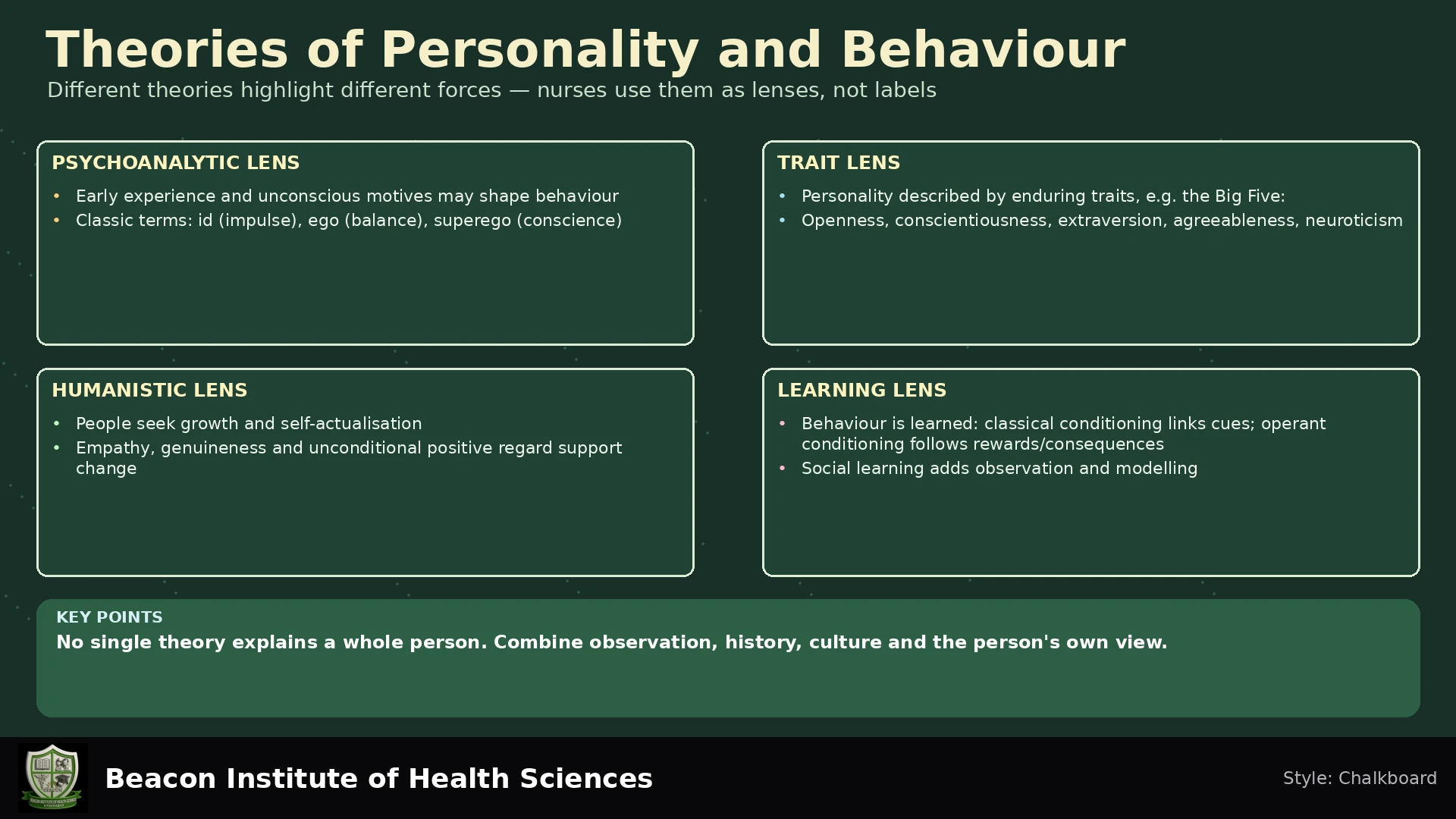
Psychodynamic Theories
Psychodynamic traditions consider internal processes and development. Freud emphasized unconscious conflict; Erikson extended the discussion to psychosocial concerns across the lifespan.
-
Freud's Psychoanalytic Theory: Freud proposed that personality is shaped by unconscious conflicts between the id (primitive desires), ego (reality principle), and superego (moral conscience). It is important to note that the id, ego, and superego are theoretical constructs for understanding psychological processes, not actual brain structures. While historically impactful, Freud's theories have empirical limitations, and nurses should never attempt to diagnose a patient's personality or psychological state based on anecdotal stories or limited observations.
-
Erikson's Psychosocial Development Theory: Erikson expanded on psychodynamic ideas by proposing that personality develops across the entire lifespan through a series of psychosocial stages, each presenting a unique crisis to resolve. This framework is flexible and highlights the ongoing potential for growth and change, making it relevant for understanding patients at various life stages.
Behavioural Theories
Behavioural theories focus on how environmental stimuli shape observable behaviours through learning processes.
-
Classical Conditioning (Pavlov): This theory explains how individuals learn to associate neutral stimuli with involuntary responses. For example, a patient might develop anxiety (an involuntary response) about a hospital setting (a neutral stimulus) if they associate it with painful medical procedures.
-
Operant Conditioning (Skinner): Skinner's work emphasizes that behaviours are learned through consequences. Reinforcement increases the likelihood of a behaviour, while punishment decreases it. Both can be positive (adding something) or negative (removing something). For instance, positive reinforcement might involve praising a patient for adhering to their medication regimen, while negative reinforcement occurs only if removal of an unpleasant stimulus increases a behaviour in future; symptom relief alone does not establish that learning occurred. It is important to remember that not all behaviourists deny the existence of private thoughts; some acknowledge their role while still focusing on observable behaviour.
Social Cognitive Theory (Bandura)
Albert Bandura's social cognitive theory posits that personality is shaped by reciprocal interaction among a person's thoughts and feelings, their behaviour, and their environment. A key concept is observational learning or modelling, where individuals learn by observing others. Self-efficacy, another central concept, refers to an individual's belief in their ability to succeed in specific situations or accomplish a task. It is crucial to understand that self-efficacy is task-specific, not a general confidence that applies to all areas of life.
Humanistic Theories
Humanistic theories emphasize the inherent goodness of people and their potential for growth and self-actualization.
-
Rogers' Person-Centered Theory: Carl Rogers highlighted the importance of empathy (understanding another's perspective), congruence (genuineness), and unconditional positive regard (acceptance without judgment) in fostering personal growth. These concepts are foundational for therapeutic communication in nursing.
-
Maslow's Hierarchy of Needs: Abraham Maslow proposed a hierarchy of human needs, suggesting that basic needs generally have priority, while people can pursue connection, meaning and other goals even when some needs remain unmet. While influential as a framework for understanding motivation, it is important to recognize that Maslow's hierarchy is a theoretical model, not a fixed universal pyramid or a set of proven biological laws. Needs can be interdependent, and individuals may prioritize them differently.
Trait Theories
Trait theories focus on identifying and measuring stable individual differences in behaviour, thoughts, and emotions.
-
The Big Five (OCEAN): This widely accepted model describes personality along five continuous descriptive dimensions:
- Openness to Experience (imaginative vs. practical)
- Conscientiousness (organized vs. careless)
- Extraversion (outgoing vs. solitary)
- Agreeableness (cooperative vs. suspicious)
- Neuroticism (anxious vs. calm)
It is critical for nurses to understand that these are continuous dimensions, not distinct types or moral rankings. They describe patterns of behaviour rather than serve as a diagnostic tool. Trait theories have limitations, including cultural biases and measurement challenges.
Biological and Cognitive Perspectives
-
Biological Influences: This perspective examines the role of genetic factors and temperament in shaping personality. Temperament, an individual's innate emotional reactivity and intensity, is thought to have a biological basis. However, it is important to remember that genes and environment interact; there is no single brain chemical or genetic blueprint that solely determines an individual's personality or destiny.
-
Cognitive Influences: Cognitive theories emphasize the role of an individual's beliefs, expectations, and appraisal of situations in shaping their personality and behaviour. How a person interprets events significantly impacts their emotional and behavioural responses.
Comparative Analysis of Theories in Nursing Practice
The table below provides a concise comparison of the major personality theories and their implications for nursing.
| Approach | Key Idea | Strength | Limitation | Safe Nursing Use |
|---|---|---|---|---|
| Psychodynamic (Freud) | Unconscious conflicts (id, ego, superego) shape personality. | Highlights early experiences and unconscious drives. | Empirical limitations; constructs are theoretical, not brain structures; prone to misinterpretation. | Understand historical context of psychology; avoid informal diagnosis or making assumptions based on patient narratives. |
| Psychosocial (Erikson) | Personality develops through lifespan stages, resolving psychosocial crises. | Lifespan perspective; flexible framework for understanding developmental tasks. | General framework; does not explain individual differences in depth. | Tailor care to patient's developmental stage; promote autonomy and identity. |
| Behavioural (Pavlov, Skinner) | Behaviour is learned through associations (classical) and consequences (operant). | Observable and measurable; useful for modifying specific behaviours. | May overlook internal cognitive processes; can be overly simplistic for complex human behaviour. | Use principles of reinforcement to encourage healthy behaviours; understand how environmental cues trigger responses. |
| Social Cognitive (Bandura) | Reciprocal interaction of person, behaviour, environment; learning through observation (modelling); self-efficacy. | Emphasizes agency and learning from social context; concept of self-efficacy is empowering. | May not fully account for biological or unconscious factors. | Educate patients by modelling healthy behaviours; foster patient self-efficacy in managing health conditions. |
| Humanistic (Rogers, Maslow) | Focus on inherent goodness, self-actualization, and human potential; empathy, congruence, unconditional positive regard; hierarchy of needs. | Promotes client-centered care, therapeutic communication; focuses on patient strengths. | Concepts can be abstract and difficult to measure; Maslow's hierarchy is a framework, not a rigid law. | Apply empathy, active listening, and unconditional positive regard; consider urgent basic needs alongside the person’s psychological and social concerns; support patient growth. |
| Trait (Big Five) | Personality described by stable dimensions (OCEAN). | Provides a common language for describing personality; empirically supported descriptive model. | Descriptive, not explanatory; not diagnostic; cultural and measurement limitations; risk of labeling. | Ask about individual communication preferences rather than predicting them from a trait label; avoid using traits as labels or for diagnosis. |
| Biological | Temperament, genetics, and brain chemistry influence personality. | Highlights innate predispositions; integrates neuroscience. | Risk of oversimplification (e.g., single chemical/destiny); complex gene-environment interaction. | Recognize biological predispositions to certain behavioural styles; avoid deterministic conclusions about personality. |
| Cognitive | Beliefs, expectations, and appraisals shape responses. | Explains how thought processes influence behaviour and emotion. | Can sometimes overlook emotional and unconscious drivers. | Assess patient's perception of their illness or treatment; explore concerns respectfully and refer for formal cognitive therapy when indicated and beyond one’s competence. |
Safe Nursing Considerations in Applying Personality Theories
As nurses, it is paramount to apply knowledge of personality and behaviour theories ethically and safely:
- Consider context: Describe observable actions and ask about the person’s experience rather than labelling someone “difficult” or “compliant.” Pain, fatigue, communication barriers and the environment can affect behaviour.
- Assess appropriately: Personality assessment requires suitable validated methods, competence, informed consent and careful interpretation. A brief encounter or informal internet test is not a diagnosis.
- Protect rights: A personality description must not determine access to care, replace consent or justify withholding essential support.
- Use supervision: Recognize the limits of your role and seek appropriate support or referral for complex needs.
Fictional case: the reserved learner
A learner speaks infrequently during group discussion. An instructor initially interprets this as lack of interest or ability. A personality label would be premature: the learner may prefer time to organize an answer, be unfamiliar with the language used, feel anxious or have another concern.
The instructor asks privately what would help participation. In this fictional example, the learner prefers a short preparation period and an opportunity to demonstrate the task. The instructor agrees an appropriate format and assesses the required knowledge and skill directly. The plan supports access without changing the learning standard or diagnosing a personality type.
A social cognitive perspective suggests using a clear model, guided practice and attainable task-specific goals. A humanistic perspective highlights respectful listening and acceptance. A cognitive perspective invites exploration of expectations. Each provides a possible question; none establishes the explanation without evidence from the learner.
Evaluating a theory critically
Ask what a theory describes, what it claims to explain and how those claims can be tested. A descriptive trait framework can summarize differences without explaining every cause of behaviour. A historical framework may prompt useful reflection while containing claims that are difficult to test. Useful care principles should not be mistaken for proof of the whole theory.
Consider the population and setting in which an assessment was developed. Language, cultural expectations and the current situation may affect answers. Avoid using group averages to infer one individual’s intentions. Respectful care depends on direct assessment, not on ranking people as better or worse personalities.
Self-check with explained answers
1. Are Freud’s id, ego and superego anatomical brain regions?
Answer: No. They are constructs within his theoretical model. They cannot be located as three distinct structures on a brain scan.
2. Is negative reinforcement another term for punishment?
Answer: No. Reinforcement increases subsequent behaviour; punishment decreases it. Negative means something is removed. Classify a consequence by its observed effect, not simply by its pleasantness or the intention of the helper.
3. Does a low extraversion score establish a mental disorder or poor nursing ability?
Answer: No. Trait dimensions are not diagnostic categories or competence scores. Assess the person’s actual performance, preferences and needs.
Glossary and conclusion
Trait: a relatively enduring tendency. State: a temporary condition or response. Modelling: learning through observing others. Self-efficacy: belief in ability to perform a specific task. Reciprocal interaction: person, behaviour and environment influencing one another. Congruence: genuineness within an appropriate professional relationship.
Theories offer complementary ways to ask questions about personality and behaviour. Use them with an understanding of their limits, protect autonomy and confidentiality, and seek evidence about the individual before drawing conclusions. A theory is a tool for thought, not permission to reduce a person to a label.