
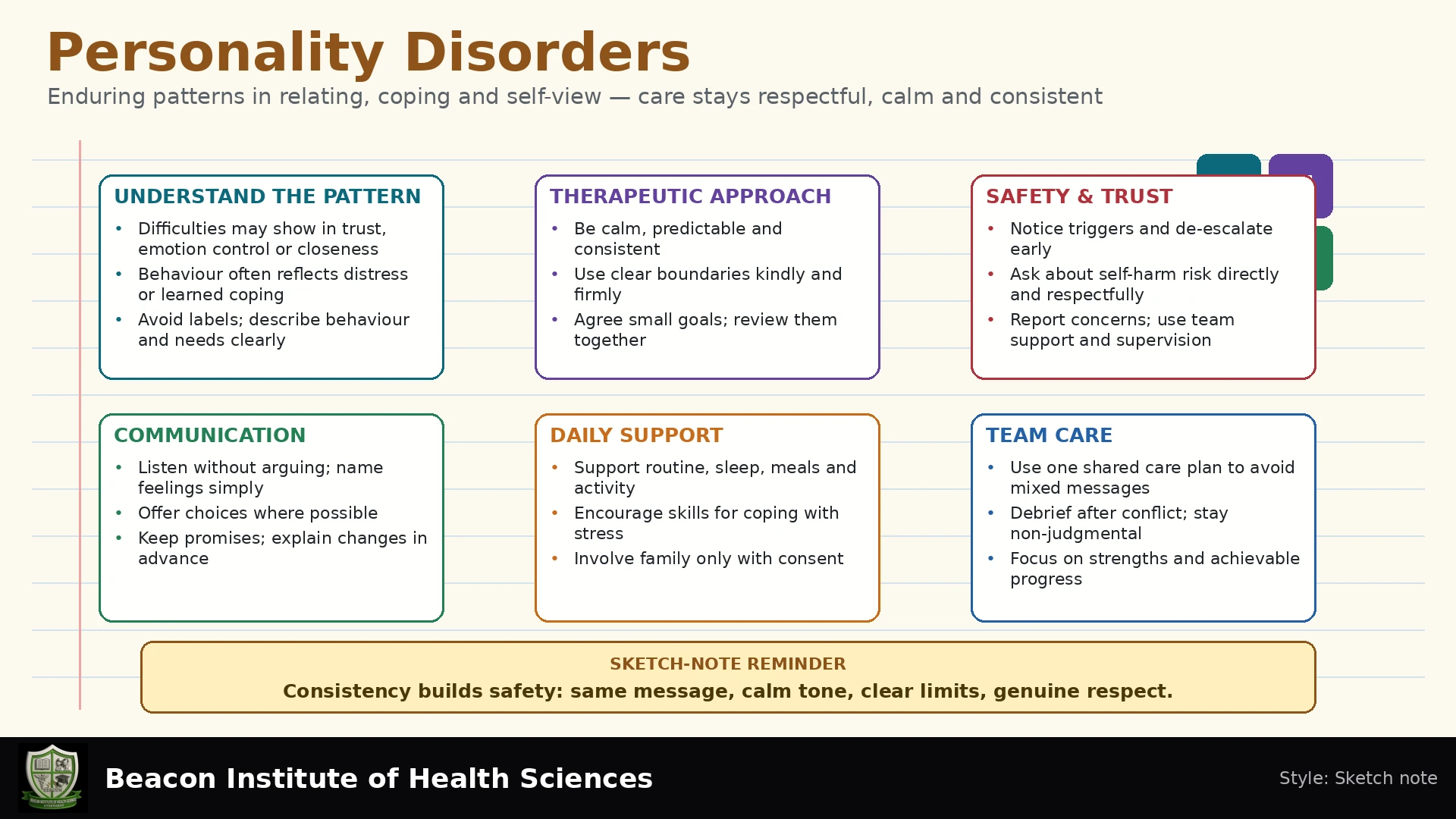
Understanding Personality Disorders: Core Concepts
Personality disorders are characterized by persistent maladaptive personality patterns that lead to significant impairment in social, occupational, or other important areas of functioning. These patterns are deeply ingrained, inflexible, and pervasive, deviating markedly from the expectations of the individual's culture.
Definition and Differentiation
It is crucial to differentiate personality disorders from mere personality traits or acute mood states. Personality traits are enduring patterns of perceiving, relating to, and thinking about the environment and oneself, which are exhibited in a wide range of social and personal contexts. When these traits become inflexible and maladaptive, causing significant distress or functional impairment, they may constitute a personality disorder.
Unlike acute mood states, which are typically time-limited emotional experiences (e.g., a period of depression or anxiety), personality disorders represent stable, long-standing patterns of inner experience and behavior that begin in adolescence or early adulthood and are pervasive across various situations. They are not merely reactions to specific stressors but are characteristic ways of interacting with the world.
Diagnostic Frameworks: DSM and ICD-11
The classification of personality disorders has traditionally utilized different diagnostic frameworks, each with its own approach. It is important to understand these systems without merging their distinct methodologies.
Traditional DSM-5 Clusters
The Diagnostic and Statistical Manual of Mental Disorders, Fifth Edition (DSM-5), groups personality disorders into three main clusters based on descriptive similarities:
- Cluster A: Odd or Eccentric
- This cluster includes paranoid, schizoid and schizotypal personality disorders.
- Features may include distrust, social detachment, and unusual perceptions or beliefs.
- Cluster B: Dramatic, Emotional, or Erratic
- This cluster includes antisocial, borderline, histrionic and narcissistic personality disorders, which have different diagnostic features.
- Features often involve instability in relationships, self-image, and affects, along with disregard for others' rights.
- Cluster C: Anxious or Fearful
- This cluster includes avoidant, dependent and obsessive-compulsive personality disorders.
- Features include pervasive anxiety, dependency, and a preoccupation with orderliness and control.
ICD-11 Perspective
In contrast to the categorical approach of the DSM clusters, the International Classification of Diseases, 11th Revision (ICD-11), conceptualizes personality disorders using dimensions of severity and trait specifications. This approach moves away from distinct categories towards a more dimensional understanding of personality pathology, allowing for a more nuanced description of individual presentations. It is crucial for healthcare professionals to recognize that these are distinct classification systems and should not be merged in clinical application or educational discussions.
Key Clinical Distinctions
Accurate diagnosis and appropriate care require understanding key differentiations between personality disorders and other mental health conditions that may present with similar symptoms.
Borderline Personality Disorder vs. Bipolar Disorder
Borderline Personality Disorder (BPD) is distinct from Bipolar Disorder. While both conditions can involve mood instability, their underlying patterns and primary features differ significantly:
- Borderline Personality Disorder: Characterized by pervasive instability in interpersonal relationships, self-image, and affects, and marked impulsivity. Mood shifts in BPD are often rapid, intense, and reactive to environmental stressors, typically lasting hours rather than days or weeks.
- Bipolar Disorder: Defined by distinct episodes of mania/hypomania and depression, which are sustained mood states lasting for days or weeks, often with less direct reactivity to immediate external triggers compared to the mood lability seen in BPD.
Obsessive-Compulsive Personality Disorder vs. Obsessive-Compulsive Disorder
Similarly, Obsessive-Compulsive Personality Disorder (OCPD) is distinct from Obsessive-Compulsive Disorder (OCD):
- Obsessive-Compulsive Personality Disorder (OCPD): Characterized by a pervasive preoccupation with orderliness, perfectionism, and mental and interpersonal control, at the expense of flexibility, openness, and efficiency. Individuals with OCPD typically view their patterns as ego-syntonic, meaning they see their traits as reasonable and desirable.
- Obsessive-Compulsive Disorder (OCD): Involves the presence of true obsessions (recurrent and persistent thoughts, urges, or images that are experienced as intrusive and unwanted) and/or compulsions (repetitive behaviors or mental acts that the individual feels driven to perform in response to an obsession or according to rigid rules). Individuals with OCD typically experience their symptoms as ego-dystonic, meaning they often experience them as unwanted and distressing, although insight varies.
Diagnosis and Treatment Principles
Diagnostic Process
It is vital to remember that a diagnosis of a personality disorder must be made by a qualified clinician. Diagnosis is not based on one isolated behavior but rather on a comprehensive assessment of long-standing patterns of internal experience and behavior across multiple contexts. Nursing professionals play a critical role in observing and documenting these patterns to assist in the diagnostic process, but they do not make the definitive diagnosis.
Therapeutic Approaches and Recovery
Recovery from personality disorders is possible and often involves a combination of therapeutic interventions. Psychotherapy is the cornerstone of treatment, with modalities like Dialectical Behavior Therapy (DBT) being particularly effective for conditions such as Borderline Personality Disorder. The focus of therapy is to help individuals develop healthier coping mechanisms, improve interpersonal skills, regulate emotions, and foster a more stable sense of self.
Role of Medication
Medication primarily targets indicated coexisting disorders (e.g., depression, anxiety, mood instability) rather than the personality disorder itself. There are no medications approved specifically to treat a personality disorder. However, pharmacotherapy can significantly improve symptoms associated with co-occurring conditions, thereby enhancing the individual's ability to engage in psychotherapy and manage their overall well-being.
Nursing Care and Ethical Considerations
Nurses are integral to providing compassionate and effective care for individuals with personality disorders. This requires a nuanced understanding of their needs and specific nursing strategies.
Establishing Compassionate Boundaries
One of the most critical aspects of nursing care is the establishment of consistent compassionate boundaries. This involves setting clear limits on behavior while maintaining empathy and respect for the individual. Boundaries provide structure and predictability, which can be profoundly therapeutic for individuals who often struggle with instability and impulsivity. Consistency across all staff members is paramount to support predictable care and reinforce therapeutic goals.
The Importance of Teamwork
Effective care for individuals with personality disorders necessitates robust staff teamwork. A unified approach ensures that all members of the healthcare team are adhering to the established care plan, communicating effectively, and providing consistent responses. This prevents staff from being drawn into maladaptive interpersonal dynamics and supports the individual's progress towards recovery.
Avoiding Stigmatizing Language
Nurses must conscientiously avoid using stigmatizing labels such as "manipulative" or "untreatable" when referring to individuals with personality disorders. Such labels are not only dehumanizing but also undermine the therapeutic relationship and the potential for recovery. Instead, focus should be on understanding the underlying patterns of behavior and providing evidence-based, person-centered care. Every individual, regardless of their diagnosis, deserves respectful and hopeful treatment.
Limitations of Safety Scales
Risk scales should not be used to predict suicide or determine treatment or discharge. Assess the person directly, including current thoughts, intent, recent actions, available support and immediate safety needs. Develop a collaborative safety plan and review it as circumstances change.
Case Study: Applying Concepts in Practice
In this fictional teaching case, consider Ms. Aliyah Khan, a 28-year-old female admitted to the psychiatric unit due to an escalation in self-harm behaviors following a significant interpersonal conflict. She has a history of unstable relationships, difficulty maintaining employment, and marked mood swings that last several hours in response to perceived slights or rejections. During her admission, Ms. Khan frequently approaches different nurses with urgent requests, sometimes contradicting information she provided to other staff members, leading to frustration among some team members who label her as "attention-seeking." She is also prescribed an antidepressant for persistent depressive symptoms, which began several months prior to this admission.
Discussion Questions
- How might Ms. Khan's presentation reflect "persistent maladaptive personality patterns with impairment" as described in the definition of personality disorders?
- Based on the principles of nursing care for personality disorders, what steps should the nursing team take to address the staff's frustration and ensure consistent, therapeutic care for Ms. Khan?
- Explain the role of Ms. Khan's antidepressant medication in her overall treatment plan, referencing the principles discussed regarding pharmacotherapy for personality disorders.
- What should an individualized safety assessment and discharge plan include for Ms. Khan?
Suggested Answers
- Ms. Khan's presentation reflects maladaptive patterns through her history of unstable relationships and employment difficulties, suggesting pervasive challenges in her interpersonal and occupational functioning. Her marked mood swings lasting for hours in response to external triggers demonstrate emotional dysregulation, which is a stable pattern rather than an acute, time-limited mood state. Her self-harm behaviors, particularly in response to interpersonal conflict, indicate a maladaptive coping mechanism that leads to significant impairment and distress.
- The nursing team should hold a team meeting to discuss Ms. Khan's care plan. Key steps include reinforcing the importance of consistent compassionate boundaries across all shifts and staff members, ensuring everyone responds to her requests in a unified manner. The team should actively discourage stigmatizing labels like "attention-seeking" and instead focus on understanding the function of her behaviors and providing therapeutic interventions that validate her distress while guiding her towards healthier coping. Emphasizing staff teamwork will support consistent and predictable care and foster a cohesive approach to her care.
- Ms. Khan's antidepressant medication is prescribed to target her coexisting depressive symptoms. As discussed, medication for personality disorders primarily addresses these co-occurring conditions, not the personality disorder itself. By alleviating her persistent depressive symptoms, the medication can improve her overall mood, potentially making it easier for her to engage in psychotherapy and develop more effective strategies for managing her underlying personality patterns.
- A comprehensive individual assessment is required: ask about current thoughts, intent, recent self-harm, access to means, distress, supports and practical needs. A numerical score cannot predict suicide or determine discharge. Agree a safety plan, arrange timely follow-up and share necessary information under local clinical and legal procedures.
For further learning and to test your understanding, please complete the quiz: