
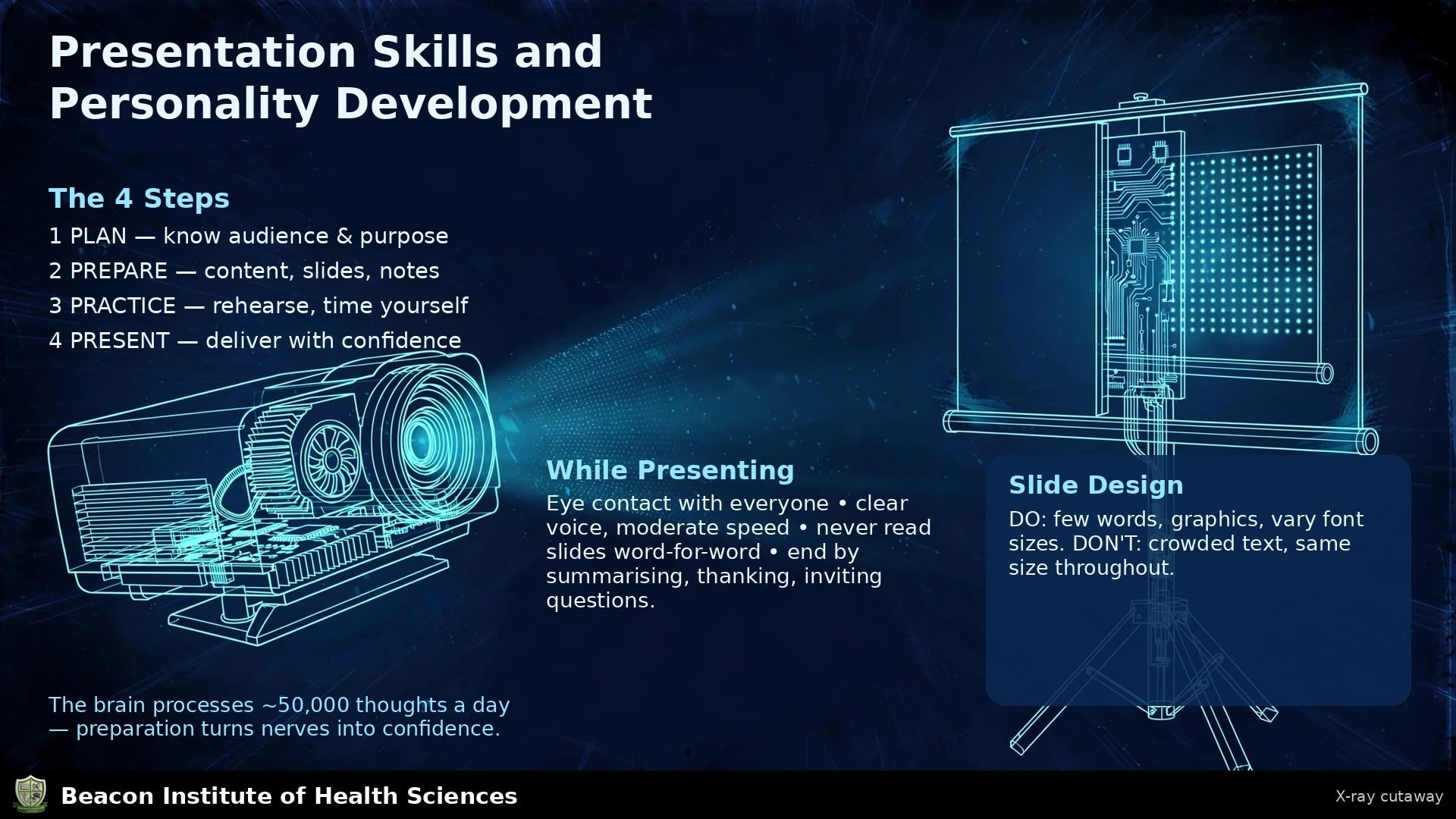
Introduction to Presentation Skills and Personality Development
For BSN students and nursing educators, mastering presentation skills and fostering robust personality development are indispensable for professional success and effective patient care. This lesson delves into essential components of delivering impactful presentations and cultivating personal attributes crucial for the healthcare environment.
Mastering Presentation Skills
Effective presentations require careful planning, clear delivery, and thoughtful interaction. Nurses frequently communicate complex medical information, making these skills vital.
Audience and Purpose
- Audience Analysis: Understand your listeners' prior knowledge, interests, and potential questions. For instance, explaining a medical procedure to patients requires different language than to fellow nurses.
- Purpose Clarification: Clearly define your presentation's goal—is it to inform, persuade, educate, or motivate? This guides content selection and delivery style.
Presentation Structure
A well-structured presentation ensures clarity and coherence, guiding the audience through your message.
- Opening: Capture attention, introduce the topic, state the purpose, and provide an overview of what will be covered.
- Body: Develop your main points logically, using evidence, examples, and data. Each point should transition smoothly to the next.
- Conclusion: Summarize key takeaways, reiterate the main message, and provide a memorable closing statement or call to action.
Slide Clarity and Accessibility
Visual aids should enhance, not distract from, your presentation.
- Clarity: Use clear, concise text, legible fonts, and high-quality images. Avoid overcrowding slides with too much information.
- Accessibility: Ensure slides are easy to read for everyone, considering font size, contrast, and avoiding jargon where simpler terms suffice, especially for diverse audiences or those with visual impairments.
Voice, Pace, Pauses, and Body Language
Your delivery style significantly impacts how your message is received.
- Voice: Project clearly, vary your tone to maintain engagement, and articulate words distinctly.
- Pace: Speak at a moderate rate, avoiding rushing or speaking too slowly. Adjust pace for emphasis.
- Pauses: Use strategic pauses to allow the audience to absorb information, emphasize a point, or transition between ideas.
- Body Language: Maintain open posture, make eye contact, use gestures naturally, and move purposefully to convey confidence and engagement.
Rehearsal and Managing Nerves
Preparation is key to a smooth delivery and managing anxiety.
- Rehearsal: Practice your presentation multiple times, ideally in front of a mirror or a small audience, to refine timing and flow.
- Managing Nerves: Deep breathing exercises, visualization, and focusing on your message rather than yourself can help reduce anxiety. Remember that a certain level of adrenaline can enhance performance.
Questions and Honest Answers
Engaging with your audience effectively means being prepared for questions.
- Anticipate: Consider potential questions your audience might ask.
- Listen: Pay close attention to the question asked before formulating your response.
- Honesty: If you don't know an answer, it's professional to admit it and offer to find the information or direct them to a reliable source.
Constructive Feedback
Receiving and giving feedback is essential for continuous improvement.
- Seek Feedback: Ask peers or mentors for their observations on your presentation.
- Analyze: Reflect on the feedback received, identifying areas for improvement and strengths to leverage.
- Apply: Integrate constructive suggestions into future presentations.
Developing a Professional Personality
Personality development for nursing professionals extends beyond communication, encompassing ethical behavior, teamwork, and continuous self-improvement.
Self-Awareness
Understanding your strengths, weaknesses, values, and emotions is foundational for personal and professional growth. This enables you to respond thoughtfully rather than react impulsively.
Confidence Without Arrogance
Exhibit self-assurance in your abilities and knowledge without displaying superiority. Confident nurses inspire trust and effectively advocate for their patients.
Empathy
The ability to understand and share the feelings of others is critical in nursing. Empathy builds rapport with patients and colleagues, fostering a supportive and caring environment.
Professional Ethics
Uphold the highest standards of conduct, integrity, and moral principles. Ethical practice is the cornerstone of nursing, ensuring patient safety and trust.
Teamwork
Collaborate effectively with interdisciplinary teams. In healthcare, patient outcomes often depend on seamless cooperation among diverse professionals.
Listening
Active listening—fully concentrating on what is being said rather than just passively 'hearing' the message—is crucial for accurate assessment, effective communication, and building trust.
Time Management
Prioritize tasks, manage workload efficiently, and meet deadlines. Excellent time management ensures optimal patient care delivery and reduces stress.
SMART Development Goals
Set goals that are Specific, Measurable, Achievable, Relevant, and Time-bound. This framework helps in structuring personal and professional development plans effectively.
Fictional Short Presentation Example
Classroom topic: Building a Better Study Routine. This original speech is a teaching example.
Good morning. Have you ever finished reading a chapter but struggled to explain its main idea? Today I will share three steps for a more active study routine: plan, recall and review.
First, plan a realistic study session. Choose one learning objective and remove avoidable distractions. Preview the headings and turn them into questions so your reading has a purpose.
Second, practise recall. After a short section, close the text and explain its key ideas in your own words. Check what you missed. This helps you identify gaps that rereading alone may hide.
Third, review your notes later and practise applying the ideas. Ask a classmate to explain a point differently, and record questions for your teacher. A routine works best when you can repeat it consistently.
To conclude, plan one focused session, recall what you learned and review the gaps. Tonight, try these steps with one short section and reflect on what improved. Thank you. What questions would you like to discuss?
Why the Model Works
The opening poses a relatable question and states the purpose. The body contains three signposted points. The conclusion repeats the main message and offers a practical action. A slide for each step needs only a short heading and a useful visual; the speaker supplies the explanation.
A Practical Development Plan
| Skill | Action | Evidence of Progress |
|---|---|---|
| Clear speaking | Rehearse a three-minute classroom talk twice each week for four weeks. | Record timing and ask a peer to identify one unclear sentence. |
| Listening | Summarize a classmate’s point before responding during the next three group meetings. | Ask whether the summary captured the meaning. |
| Time management | Prepare the outline two days before the next presentation. | Finish one timed rehearsal before the presentation day. |
Development means strengthening useful habits while respecting individual differences. Introversion, accent, appearance and disability do not determine professional worth. Adapt presentation methods to the speaker and audience.
Practice With Explained Answers
- Your slides contain full paragraphs. What should change? Keep a main idea and a few key points per slide, then explain details aloud.
- You cannot answer a question. What is a professional response? Acknowledge the limit honestly, clarify the question and offer to check a reliable source.
- How can feedback become useful? Ask for a specific observation and one practical change, such as slowing down when introducing a new term.
- Which goal is SMART? “Rehearse a three-minute talk twice a week for four weeks” specifies an action, measure and deadline; “be more confident” does not.
- How does empathy affect communication? It encourages the speaker to consider the listener’s needs and check understanding respectfully.
Before You Present
- Confirm the audience, purpose, time limit and required format.
- Check facts and acknowledge sources; protect confidential information.
- Use readable text, strong contrast and spoken explanations of visuals.
- Rehearse transitions, timing and likely questions.
- Afterward, record one strength and one change for the next talk.
Attempt Presentation Skills and Personality Development Quiz