
1. Learning objectives and purpose
An oral presentation is a planned spoken message delivered to an audience. BSN students use presentations to explain academic work, discuss projects and practise professional communication. This lesson concerns English language and presentation skills rather than clinical treatment. By the end, you should be able to define a clear purpose, organize linked ideas, deliver an understandable message, use supportive visuals and answer questions responsibly. You should also be able to evaluate a rehearsal and improve it.
2. Presentations and conversations
A conversation allows frequent changes between speaker and listener. A presentation usually gives one speaker a longer turn, with a planned beginning, middle and ending. It may still contain questions and interaction. Preparation is therefore needed to help listeners follow ideas without asking for clarification after every sentence.
Presentations can inform, persuade or demonstrate. An informative presentation explains a topic; a persuasive one supports a position with reasons; a demonstration shows a process. These purposes can overlap, but identify the main aim. Explaining a study timetable is different from arguing that students should adopt one.
3. Audience, task and central message
Ask who will listen, what they already know and what they should understand afterward. Check the assigned time, available equipment and assessment instructions. An audience of classmates may understand familiar course terms, while visitors may need explanations. Choose language and examples accordingly.
Narrow a broad subject to one manageable message. Student success is too broad for five minutes; how to organize a weekly study timetable is more focused. A central message could be that a useful timetable includes priorities, realistic study periods and regular review. Every main point should contribute to that message rather than introducing an unrelated subject.
4. Planning and evidence
List possible ideas, group related ones and select those the audience needs. Arrange them in a logical order: from a problem to a response, from an overview to details, or through a sequence of steps. Build an outline before designing slides. Each main point needs an explanation and, where appropriate, an example or supporting evidence.
Distinguish researched evidence from personal opinion and fictional illustration. Do not invent statistics or imply that an example represents research. Check sources, credit them and identify uncertainty. A presentation about clinical practice needs reliable professional evidence and appropriate supervision; language skills alone cannot establish the accuracy of clinical content.
5. Introduction, body and conclusion
The introduction establishes the topic and purpose and shows the audience the route ahead. The body develops a small number of connected ideas. The conclusion returns to the central message and closes clearly. It should not surprise listeners with a new major argument that has never been explained.
A useful opening might state that the talk will explain three ways to make a study timetable practical. The body can discuss priorities, manageable periods and review. The closing can remind listeners of those three actions and invite questions. This structure helps listeners know where they are and why each part matters.
6. Signposting and transitions
Signposts are short expressions that reveal the organization of a talk. Use them naturally rather than repeating the same phrase before every sentence. An opening can identify the focus; a transition can connect the previous idea with the next; a summary can gather the main points.
- Opening: This talk explains how to plan a realistic study week.
- Sequence: We will begin with priorities, then consider study periods.
- Example: Consider a student preparing for two assignments.
- Contrast: A detailed plan can help, but it must remain achievable.
- Transition: With priorities established, we can decide how much time to allocate.
- Closing: These three steps provide a starting point for your own plan.
A transition should express a real relationship. Adding however between two statements does not create a contrast unless the ideas actually differ.
7. A complete short model speech
Fictional student presentation: Good morning. Today I will explain how a weekly study timetable can become more useful. My main point is that a timetable should guide work realistically rather than simply fill every hour.
First, identify your priorities. List the tasks due soon and the topics you find difficult. A task with a close deadline may need attention before a topic you already understand well. This makes the plan purposeful.
Second, choose manageable study periods. Leave room for classes, travel, meals and rest. If your timetable assumes uninterrupted study every evening, one delay may make the whole plan unrealistic. A shorter period used carefully can be more practical.
Third, review the plan. At the end of the week, compare intended work with completed work. If a task took longer than expected, adjust the next plan. Reviewing is not an admission of failure; it is a way to learn how you work.
To finish, a practical timetable connects priorities with available time and regular review. These steps can help you create a plan suited to your own circumstances. Thank you for listening. I welcome your questions.
The opening states the purpose and central message. Three linked points form the body, each with explanation. The conclusion summarizes the same message and signals completion. This is an original teaching example, not a claim about measured academic outcomes.
8. Delivery and intelligibility
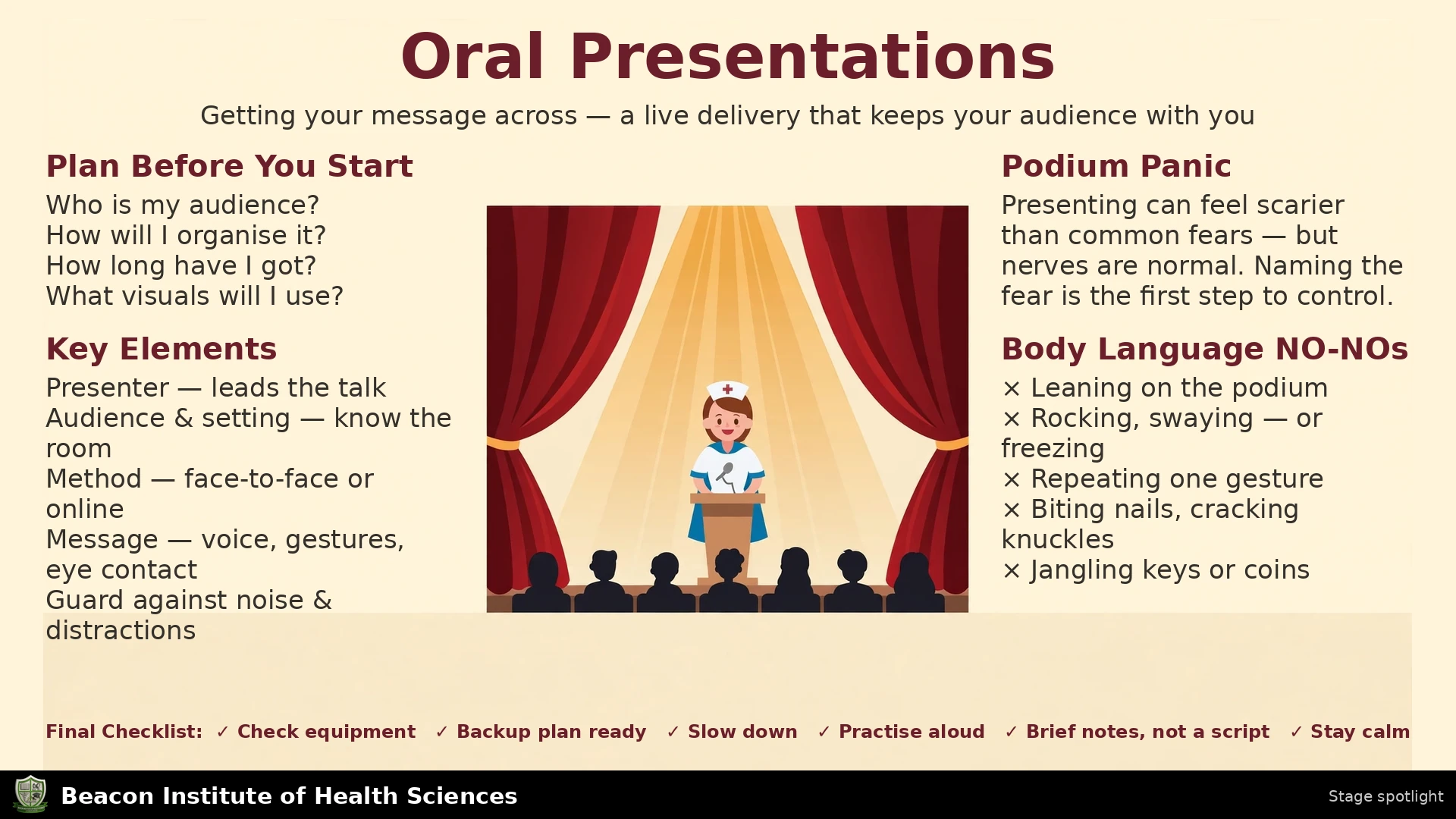
Speak at a pace the audience can follow. Use pauses after important ideas, sufficient volume and clear pronunciation. Vary emphasis to show which words matter. Avoid racing to fit material into the time limit; remove less useful content instead. Different accents are normal, and intelligibility matters more than copying one accent.
Brief notes can remind you of structure without becoming a full script. Look toward listeners when comfortable and appropriate, use natural gestures and maintain a stable position. Adapt these suggestions to cultural preferences and accessibility needs. A presenter who needs fuller notes or assistive technology can still give a clear, effective talk.
9. Visual aids and accessibility
Slides should support the message. Give each slide a clear purpose, use readable text and contrast, and avoid packing it with paragraphs you will simply read aloud. There is no single word-count rule that suits every presentation. Judge whether the audience can read the material from the actual viewing distance.
Explain graphs and diagrams aloud. Identify labels, units and the important pattern; do not assume the image speaks for itself. Avoid relying only on color to distinguish categories. Credit borrowed material and protect confidential information. Test the equipment, confirm that files open correctly and keep a practical backup, such as an outline you can use without slides.
10. Time management and rehearsal
For a fictional five-minute talk, you might allow about forty seconds for the opening, just over three minutes for the main points and forty seconds for the conclusion. This is an example allocation, not an official requirement. If questions must fit inside the same limit, reduce the speaking portion accordingly.
Rehearse aloud with the actual notes and visuals. Silent reading does not reveal the real delivery time. Ask a partner to identify your central message and any confusing section. Record a rehearsal only with appropriate permission. Revise content, practise transitions and rehearse again. Preparation usually gives more useful feedback than trying to memorize every sentence perfectly.
11. Questions and group presentations
Listen to the full question before answering. Clarify it if necessary, respond to the relevant point and acknowledge limits. A responsible answer can be: I do not have a verified answer to that detail; I will check the source. Inventing a confident answer damages accuracy.
If interrupted, acknowledge the question and explain when you will address it. If you disagree, respond to the idea respectfully. In group work, agree on a shared purpose, allocate sections, use consistent terminology and rehearse handovers between speakers. A collection of separate speeches is less coherent than a joint presentation with connected points and an integrated conclusion.
12. Common problems and corrections
- Problem: a broad topic without a central message. Correction: narrow the subject and write one sentence stating the main point.
- Problem: every slide contains a paragraph. Correction: select the key information and explain supporting detail orally.
- Problem: an unsupported statistic. Correction: verify and cite it, or remove the claim.
- Problem: speaking too fast. Correction: shorten the content and use deliberate pauses.
- Problem: an abrupt ending. Correction: prepare a brief recap and clear closing.
- Problem: group members repeat the same introduction. Correction: assign distinct sections and practise transitions.
13. Self-assessment with answers
- How is a presentation different from a conversation? It usually gives a speaker a longer planned turn and needs visible organization.
- What is a central message? The main idea that connects the whole talk.
- What belongs in the introduction? Topic, purpose and a useful overview of the route ahead.
- Why rehearse aloud? It reveals actual timing, difficult phrasing and weak transitions.
- Should a conclusion introduce new major evidence? Usually no; it draws together what the body established.
- What should you do with an uncertain answer? State the uncertainty and check a reliable source.
- What is the role of a slide? To support understanding, not replace explanation.
- How can a group improve coherence? Use a shared outline, consistent terms and rehearsed speaker transitions.
14. Final checklist and practice task
Prepare a three-minute presentation about a study skill. Check purpose, audience, organization, accuracy, delivery, visual clarity and timing. Use those categories as a sample practice rubric; follow your instructor's actual assessment requirements when provided. Ask a listener to summarize your main message without seeing the outline.
Before delivery, confirm the time limit, check sources and equipment, rehearse the opening and ending, and prepare for likely questions. Afterward, choose one improvement for the next attempt. Presentation skill develops through thoughtful preparation, feedback and repeated practice.