
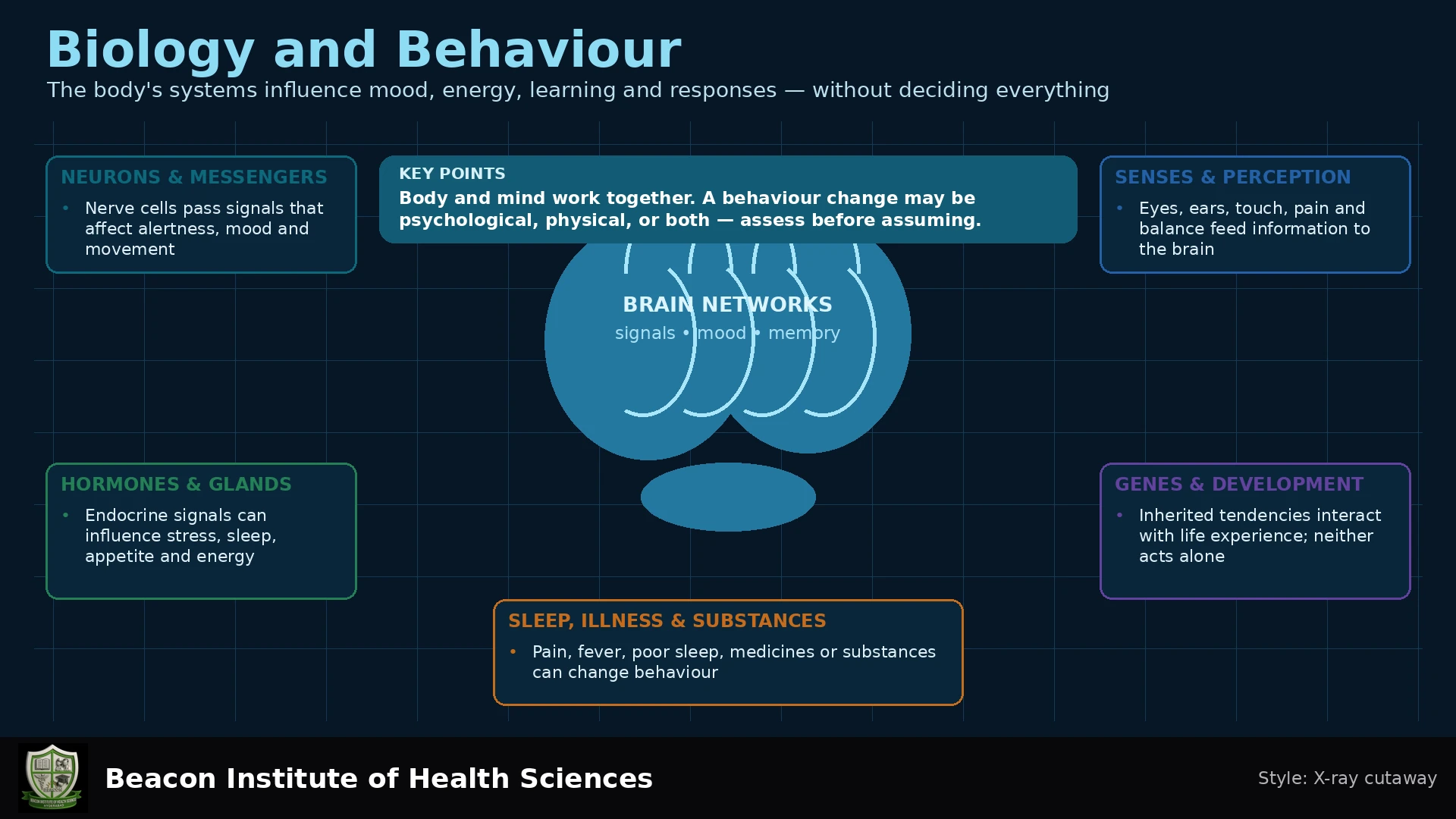
Understanding the intricate relationship between biology and behaviour is fundamental for nursing students. This lecture explores the biological underpinnings that shape human actions, thoughts, and emotions, providing essential context for clinical practice and patient care.
Learning Objectives
Upon completion of this lesson, BSN students will be able to:
- Describe the basic structure and function of a neuron and the process of neural transmission.
- Explain the multifaceted roles of neurotransmitters and critically evaluate simplistic views of their function.
- Differentiate between the central and peripheral nervous systems, including their subdivisions and key functions.
- Identify major brain structures and their associated roles in behaviour, while debunking common neurological myths.
- Compare and contrast neural and endocrine signalling mechanisms and their impact on the body.
- Discuss how genetics and environment interact to influence behavioural predispositions.
- Explain the concept of neuroplasticity and its implications for recovery and adaptation.
- Recognize various biological and environmental factors that influence behaviour.
- Apply principles of biological behaviour to nursing assessment and interventions through a case study example.
The Neuron: Foundation of Neural Communication
The human nervous system relies on specialized cells called neurons to transmit information. Each neuron consists of several key parts:
- Dendrites: Tree-like branches that receive signals from other neurons.
- Soma (Cell Body): Contains the nucleus and integrates incoming signals.
- Axon: A long, slender projection that transmits electrical signals away from the soma to other neurons or effector cells.
Neural Transmission: Electrical Impulses and Chemical Messengers
Information travels within a neuron as an electrical impulse, known as an action potential, along the axon. When this electrical signal reaches the end of the axon, it typically triggers the release of chemical messengers called neurotransmitters into a tiny gap known as the synapse. At most synapses, transmission is chemical, where neurotransmitters bind to receptors on the dendrites or soma of the next neuron, thereby relaying the signal.
Neurotransmitters: Beyond Simple Chemical Imbalance
Neurotransmitters play multiple critical roles in regulating mood, cognition, and behaviour. It is crucial to understand that there is no one chemical that solely equates to one emotion. Furthermore, mental illness cannot be accurately reduced to a simple chemical imbalance. The interplay of various neurotransmitters, their receptors, and complex neural circuits contributes to the intricate nature of mental health and illness.
The Nervous System: A Coordinated Network
The nervous system is broadly divided into two main parts:
Central Nervous System (CNS)
The CNS comprises the brain and the spinal cord. It is responsible for processing information, coordinating actions, and controlling various bodily functions.
Peripheral Nervous System (PNS)
The PNS includes all the nerves outside the brain and spinal cord. It further divides into:
- Somatic Nervous System: Controls voluntary movements of skeletal muscles.
- Autonomic Nervous System: Regulates involuntary bodily functions. This system has two branches:
- Sympathetic Nervous System: Prepares the body for 'fight or flight' responses, coordinating stress responses such as increased heart rate and dilated pupils.
- Parasympathetic Nervous System: Promotes 'rest and digest' activities, facilitating recovery and maintaining homeostasis.
Key Brain Structures and Their Functions
The brain is a complex organ with various regions specialized for different functions, working together in distributed networks:
- Cortex Lobes: Involved in higher-level cognitive functions like perception, thought, and voluntary movement. These functions are processed through distributed networks rather than isolated regions.
- Cerebellum: Primarily responsible for movement coordination, balance, and motor learning.
- Brainstem: Regulates vital functions essential for survival, such as breathing, heart rate, and sleep-wake cycles.
- Hippocampus: Critical for the formation of new memories.
- Amygdala: Involved in processing emotions, particularly fear, and assessing the salience or importance of stimuli.
- Hypothalamus: A key regulator of homeostasis, controlling functions like body temperature, hunger, thirst, and hormone release.
Debunking Neurological Myths
It is important to dispel common misconceptions about the brain:
- Left-Brain/Right-Brain Personality Myth: The idea that individuals are either 'left-brained' (logical) or 'right-brained' (creative) is an oversimplification. Both hemispheres work in concert, and complex behaviours involve extensive communication across the brain.
- Isolated Brain Centres: While certain areas are specialized, no single brain centre operates in isolation. Functions emerge from the dynamic interaction of multiple brain regions and networks.
The Endocrine System: Hormonal Regulation
The endocrine system comprises glands that produce and secrete hormones directly into the bloodstream. These hormones act as chemical messengers, travelling through the circulatory system to target cells and organs throughout the body.
Endocrine Signalling vs. Neural Signalling
While both neural and endocrine systems coordinate bodily functions, they differ in their mechanisms:
| Feature | Neural Signalling | Endocrine Signalling |
|---|---|---|
| Messenger | Neurotransmitters | Hormones |
| Medium | Synaptic cleft, local nerves | Bloodstream |
| Speed | Fast (milliseconds) | Slower (seconds to hours) |
| Duration | Short-acting | Longer-acting |
| Target | Specific neurons/cells | Widespread via circulation |
| Mechanism | Electrical impulses, chemical release | Chemical release, feedback loops |
Endocrine signalling often involves complex feedback loops, where the presence of a hormone can inhibit its further release, maintaining physiological balance.
Genetics and Behaviour: Predispositions, Not Destiny
Genes significantly influence predispositions towards certain behaviours and traits. However, this influence is rarely deterministic and always involves complex interactions with environmental factors. Heritability, which refers to the proportion of phenotypic variation in a population that is attributable to genetic variation, is population-specific and does not imply individual destiny. An individual's behaviour is a product of both their genetic makeup and their unique life experiences and environment.
Neuroplasticity: The Brain's Adaptability
Neuroplasticity refers to the brain's remarkable ability to reorganize itself by forming new neural connections throughout life. This allows for experience-related change, enabling learning, memory formation, and adaptation to new environments or injuries. However, neuroplasticity has limits and is not a promise of full recovery for all neurological damage or disorders. The extent of change depends on various factors, including age, intensity of experience, and individual biological differences.
Factors Influencing Behaviour
Behaviour is a complex outcome influenced by a multitude of interacting factors, including:
- Sleep patterns
- Nutritional status
- Experience of pain
- Effects of prescribed medicines
- Underlying illness or disease states
- Substance use
- Quality of relationships
- Ongoing learning and experiences
Nursing Implications: A Fictional Case Study
Consider a fictional case: A BSN student, normally attentive in class, suddenly exhibits poor attention, difficulty concentrating, and irritability during morning lectures.
Detailed Case Reasoning for Nurses
When faced with such a change in behaviour, a nurse must adopt a comprehensive and empathetic approach. It is crucial to:
- Assess Context: Inquire about recent stressors, changes in routine, sleep quality, diet, or any new medications. The observed behaviour (poor attention, irritability) could stem from various factors, such as acute sleep deprivation.
- Prioritize Basic Needs: Recommend adequate rest and assess for other physiological needs like nutrition and hydration. Supportive routines, such as consistent sleep schedules, can be beneficial.
- Avoid Premature Diagnosis: Do not jump to conclusions or make a diagnosis from a single observed behaviour. Poor attention is a symptom, not a diagnosis, and could indicate anything from temporary fatigue to an underlying physical or psychological issue.
- Focus on Support: Offer practical support and encourage healthy coping mechanisms. If the behaviour persists or worsens, further clinical assessment is warranted.
Safe Nursing Considerations
A sudden change in a patient's behaviour, such as acute confusion, requires immediate and prompt clinical assessment to rule out underlying physical causes. This includes checking vital signs, assessing for pain, reviewing medications, and screening for infections or other acute medical conditions. It is critical to avoid labelling patients based on observed behaviours (e.g., 'difficult patient') and instead focus on identifying and addressing the root cause through a holistic nursing assessment.
Glossary
- Action Potential: An electrical impulse that travels along the axon of a neuron.
- Amygdala: Brain region involved in processing emotions and salience.
- Axon: Neuron's projection that transmits signals away from the cell body.
- Brainstem: Part of the brain regulating vital functions.
- Central Nervous System (CNS): Consists of the brain and spinal cord.
- Cerebellum: Brain region crucial for movement coordination and balance.
- Dendrites: Branch-like structures of a neuron that receive signals.
- Endocrine System: Glands that secrete hormones into the bloodstream.
- Heritability: The proportion of variation in a trait in a population due to genetic variation.
- Hippocampus: Brain structure vital for memory formation.
- Homeostasis: The body's ability to maintain a stable internal environment.
- Hypothalamus: Brain region controlling homeostasis and hormone release.
- Neuroplasticity: The brain's capacity to change and reorganize itself.
- Neuron: Basic unit of the nervous system, transmits electrical and chemical signals.
- Neurotransmitter: Chemical messenger released at synapses.
- Peripheral Nervous System (PNS): Nerves outside the CNS, including somatic and autonomic systems.
- Soma (Cell Body): Contains the neuron's nucleus and integrates signals.
- Synapse: A specialized communication junction; the synaptic cleft is its gap at a chemical synapse.
Self-Check Questions
1. Sudden confusion
A patient becomes newly disoriented. Should the nurse first assume poor cooperation or seek urgent clinical assessment?
Answer: Seek prompt assessment and follow the local escalation pathway. New confusion can accompany physical illness, medicine effects or other urgent problems. A behavioural label must not replace assessment.
2. Hormonal and neural signalling
Why can a hormone circulating throughout the body affect only selected cells?
Answer: Cells need suitable receptors and downstream mechanisms to respond. Circulation is widespread, but the response depends on the target cell. Neural signals also depend on receptors at chemical synapses.
3. Genes and behaviour
Does a genetic predisposition mean a person will certainly show a particular behaviour?
Answer: No. Many traits reflect numerous genetic and environmental influences. Population heritability estimates do not give the percentage of one person’s behaviour caused by genes.
Useful qualifications
The somatic system includes sensory pathways as well as control of skeletal muscles. Autonomic divisions work together rather than acting as simple on/off switches; enteric networks also regulate digestive activity. Neural effects are often rapid and hormonal effects often more sustained, but speed and duration vary. Hormones affect cells with appropriate receptors rather than every cell equally.
A synapse is a specialized junction between a neuron and another cell; the synaptic cleft is the gap at a chemical synapse. Electrical synapses also exist. Brain plasticity includes changes in connection strength and network organization as well as formation of connections.
Summary
Behaviour emerges through interacting nervous, endocrine, genetic, psychological and social processes. Biological knowledge helps nurses ask better questions, recognize changes that need assessment and avoid blaming a person for symptoms. It does not allow diagnosis from a single behaviour or prediction of an individual’s future from one biological feature.