
1. Learning objectives
The endocrine system uses hormones to coordinate activities across the body. BSN students should identify major glands, distinguish endocrine from exocrine secretion, explain target-cell responses and trace feedback loops. Growth, metabolism, fluid balance and reproduction depend on interacting systems. This lesson develops anatomy and physiology knowledge and does not prescribe tests, medicines or treatment. A hormone-related symptom is not sufficient to diagnose a disease without appropriate clinical assessment.
2. Endocrine and exocrine secretion
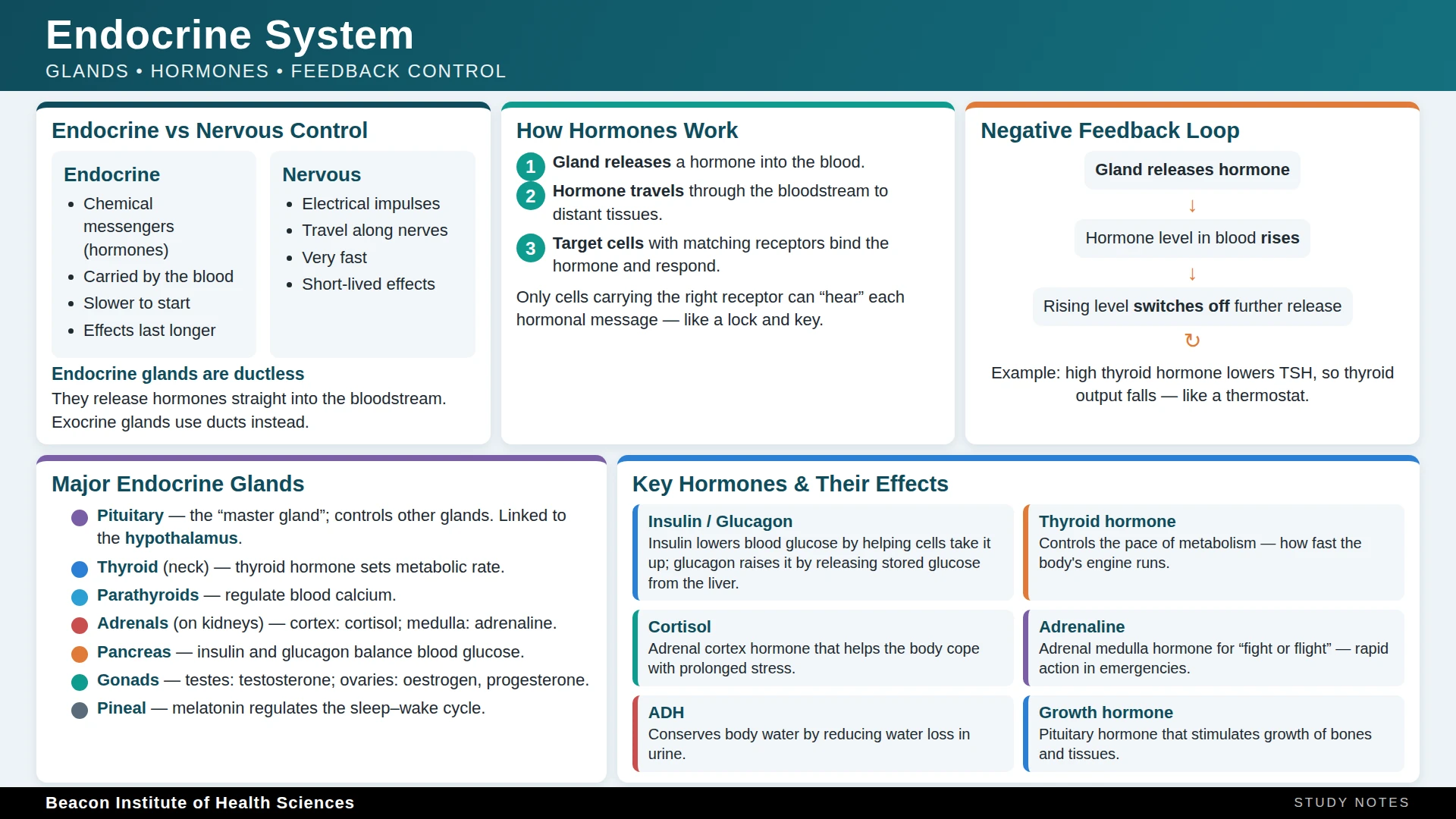
Endocrine cells release hormones into interstitial fluid and then circulation. Exocrine glands deliver secretions through ducts to surfaces or cavities. Some organs have both functions, such as the pancreas. A circulating hormone affects cells with suitable receptors rather than every cell equally. Hormone concentration, receptor availability and local conditions influence the response. The presence of a gland on a diagram does not mean it produces only one substance or acts independently of other organs.
3. Hormone classes and receptors
Peptide hormones commonly act through membrane receptors and intracellular signaling pathways. Steroid hormones commonly act through intracellular receptors affecting gene expression. Thyroid hormones also have important intracellular actions. These broad categories help learning, but real signaling includes additional complexity. Water solubility, transport and receptor location affect how a hormone acts. Avoid assuming that all hormones have the same onset, duration or clearance. A target cell must be considered along with the hormone itself.
4. Negative and positive feedback
Negative feedback opposes a change and helps regulation around a physiological range. A rise in a regulated variable can reduce signals that produced it. Positive feedback amplifies a process until a terminating event, such as childbirth, changes the situation. Feedback is not a claim that every hormone value is constant throughout the day. Rhythms, meals, stress and developmental stage can change secretion. Draw the direction of each effect and identify what is actually being regulated.
5. Hypothalamus and pituitary
The hypothalamus links neural information with endocrine control. Releasing and inhibiting signals regulate the anterior pituitary through a vascular connection. The posterior pituitary stores and releases hormones made by hypothalamic neurons, including antidiuretic hormone and oxytocin. It does not manufacture those hormones as an independent gland. This distinction is a common examination point. Pituitary activity depends on feedback and context, so calling it the master gland should not obscure hypothalamic and peripheral regulation.
6. Anterior pituitary hormones
The anterior pituitary releases hormones including growth hormone, prolactin, thyroid-stimulating hormone, adrenocorticotropic hormone, follicle-stimulating hormone and luteinizing hormone. Some mainly regulate other endocrine tissues, while others act on additional targets. Growth hormone influences growth and metabolism partly through insulin-like growth factors. Prolactin supports milk production; oxytocin supports milk ejection. Learn each hormone with its source, principal target and regulation rather than treating abbreviations as a disconnected list.
7. Thyroid gland
The thyroid produces thyroid hormones involved in metabolism, growth and development. Thyroid-stimulating hormone contributes to their regulation, and feedback operates through the hypothalamic-pituitary-thyroid axis. Iodine is needed for thyroid hormone synthesis, but supplementation should not be improvised from a classroom lesson. Thyroid C cells produce calcitonin, which is distinct from thyroid hormones. Changes in energy, weight or temperature tolerance can have multiple causes; normal physiology does not establish a diagnosis from symptoms alone.
8. Parathyroid and calcium regulation
Parathyroid hormone helps regulate calcium balance through effects involving bone, kidneys and vitamin D-related intestinal absorption. Calcium supports muscle, nerve and other cellular functions. Regulation is coordinated rather than a single action of one organ. Calcitonin has different physiological actions, and adult calcium control should not be reduced to a perfectly symmetrical pair of hormones. A teaching diagram should identify the regulated variable and show the relevant organ interactions without suggesting that calcium should be self-treated.
9. Adrenal cortex and medulla
The adrenal cortex produces steroid hormones, including glucocorticoids, mineralocorticoids and adrenal androgens. Cortisol participates in metabolic and stress-related regulation. Aldosterone influences sodium handling and therefore fluid balance, with effects on potassium handling as well. The medulla releases catecholamines in association with sympathetic activity. Cortex and medulla differ in origin, signals and function. Stress responses involve many systems; measuring a single hormone is not a universal way to determine a person's psychological stress.
10. Endocrine pancreas
Pancreatic islets contain cells with endocrine roles. Insulin from beta cells supports glucose use and storage in relevant tissues and helps reduce circulating glucose in appropriate contexts. Glucagon from alpha cells supports glucose availability, including hepatic production. These actions depend on nutritional state and other signals. The pancreas also has exocrine digestive functions. Insulin is not an enzyme that digests sugar. A glucose value or symptom needs context and professional interpretation, not treatment based on a study illustration.
11. Fluid balance and other endocrine organs
Antidiuretic hormone helps the kidneys conserve water through effects on collecting-duct water permeability. Aldosterone primarily influences electrolyte handling, so it is not interchangeable with antidiuretic hormone. Kidneys also release erythropoietin and participate in vitamin D activation; the heart releases natriuretic peptides. The pineal gland produces melatonin associated with circadian timing. These examples show that endocrine activity is not confined to a few isolated glands and that one physiological function can have several regulators.
12. Gonadal hormones and life stages
Testes and ovaries produce hormones that support reproductive function and other body processes. Hypothalamic and pituitary signals coordinate gonadal activity through feedback. Hormone patterns change with development and reproductive life stages. Estrogens, progesterone and testosterone are present in varying amounts across individuals and should not be treated as exclusive markers of identity. Pregnancy introduces additional hormonal sources and regulation. Respectful nursing education separates physiological description from assumptions about a person's gender, fertility or preferences.
13. Worked feedback case
In a fictional learning diagram, thyroid hormones rise after an increase in axis activity. Show how feedback can reduce upstream hypothalamic and pituitary stimulation. Next compare a meal-related glucose response with fasting regulation, naming the pancreas and liver. Finally distinguish water conservation by antidiuretic hormone from sodium-related actions of aldosterone. These are normal-physiology exercises, not laboratory interpretation rules. State the variable, sensor or regulatory input, hormone, target and effect in each example.
14. Answered review and practical task
Make a table with gland, hormone, target and main effect. Answers: endocrine glands release into circulation without an exocrine duct; the posterior pituitary releases hypothalamic hormones; prolactin supports milk production; beta cells produce insulin; the adrenal medulla releases catecholamines; negative feedback tends to oppose change. Why consider receptors? They determine target responsiveness. Why are symptoms insufficient? Different conditions can cause similar changes. Recap by drawing one complete feedback loop and checking the direction of every arrow.