
Learning Objectives
- Distinguish sociology, anthropology, society and culture.
- Explain values, beliefs, norms, status and roles.
- Use cultural humility and basic anthropological approaches in nursing assessment.
- Connect social conditions with health without stereotyping individuals.
Why These Concepts Matter in Nursing
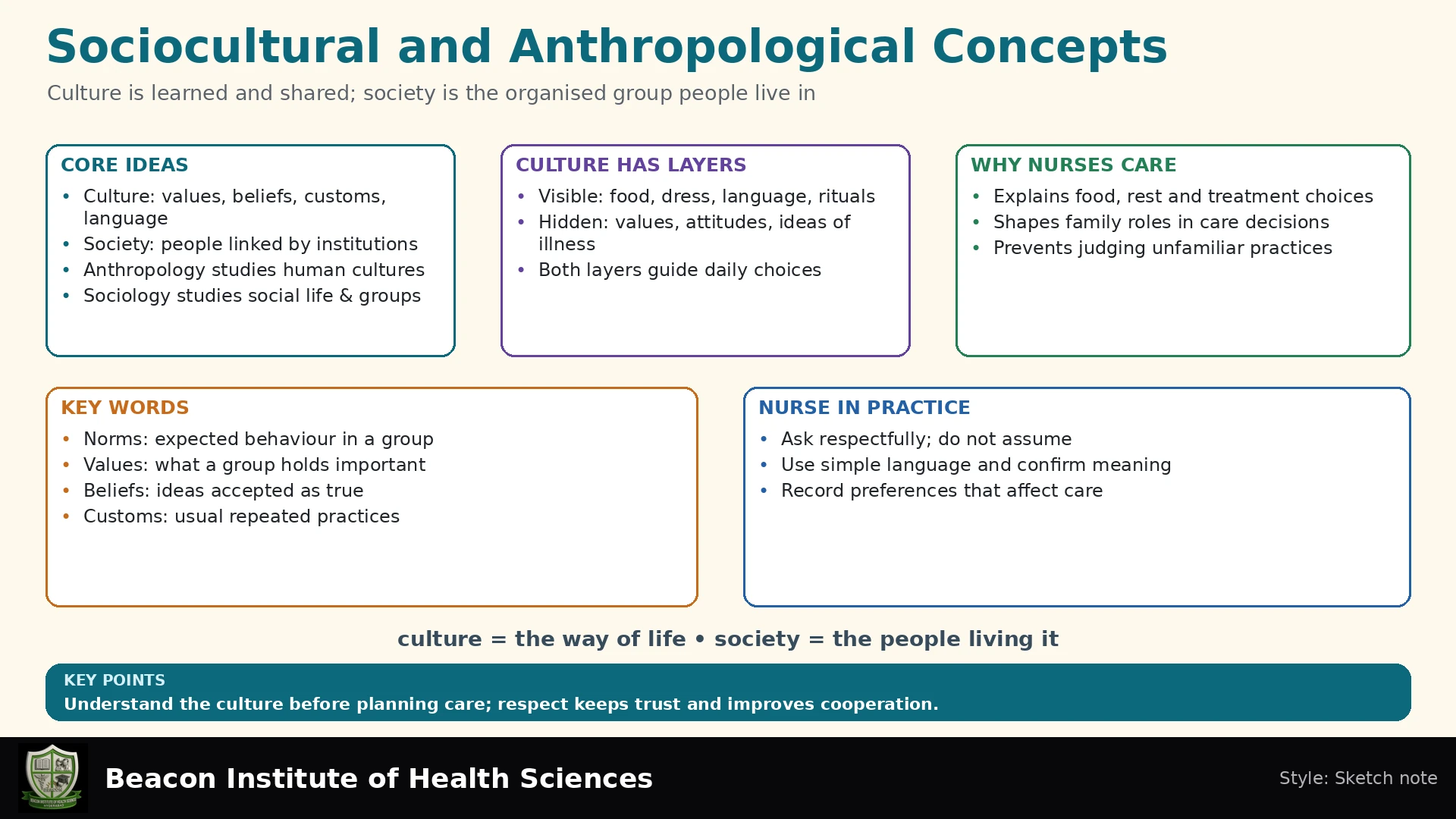
Nursing care takes place within social relationships. Language, family support, work, income, beliefs and previous experiences can affect how a person describes illness and uses services. Sociology and anthropology help nurses ask better questions and understand context. They complement clinical assessment; they do not replace it.
A person's group identity does not predict every preference. Two relatives may have different views about food, privacy, treatment or spiritual care. Begin with the person's own account, then consider the wider circumstances shaping their choices.
Sociology and Anthropology
Sociology examines social relationships, institutions, groups and patterns of inequality. It can help explain how working conditions or service organization affect health. Anthropology studies human life, diversity and change across time and place. A common four-field classification includes sociocultural anthropology, biological anthropology, archaeology and linguistic anthropology, although disciplinary organization varies internationally.
Medical anthropology examines health, illness, healing and care in their social and cultural settings. It may explore how people explain symptoms, how authority operates in a clinic or how migration changes access to care. Biological differences and learned practices should not be confused: culture is not a fixed genetic trait.
Society and Culture
A society is a network of people connected through sustained relationships and social organization. Culture includes learned meanings, practices, knowledge, values and material life. Society concerns relationships and organization; culture concerns ways of understanding and living within them. Both change and contain disagreement.
| Concept | Meaning | Nursing example |
|---|---|---|
| Value | A broad idea about what is important or desirable | A person values independence in daily care |
| Belief | An understanding regarded as true | A person believes a remedy relieves discomfort |
| Norm | A shared expectation about behaviour | Expectations about visitors or respectful address |
| Symbol | Something carrying shared meaning | A uniform conveys a professional role |
| Language | A system for communicating meanings | Preferred spoken language and symptom terms |
| Material culture | Objects and technologies used in social life | Food utensils, mobility aids or care equipment |
Formal norms may be written in laws or policies; informal norms are learned through interaction. Social approval or disapproval can reinforce them. A norm is not automatically ethical or clinically safe. Nurses must consider consent, dignity and harm rather than accepting a practice solely because it is familiar.
Status, Roles and Social Position
Status means a recognized social position, such as student, parent or nurse. An ascribed status is assigned without being primarily achieved through personal effort; an achieved status is acquired through activity or accomplishment. These categories are social descriptions, not measures of worth.
A role involves expectations attached to a position. Role conflict occurs when expectations from different roles clash, such as paid work and caregiving. Role strain involves competing demands within one role. A patient missing appointments may be struggling with these demands rather than being uninterested in care.
Learning and Cultural Change
Enculturation is learning the meanings and practices of one's cultural setting. Socialization is the broader process of learning social participation, norms and roles. They overlap. Acculturation involves changes arising from sustained cultural contact; it does not necessarily require abandoning an earlier identity. Assimilation describes a more extensive movement toward a dominant group's patterns and is not the inevitable outcome of contact.
People participate in several cultural settings, including family, occupation, religion and digital communities. A nurse also belongs to a professional culture, with its own language and assumptions. Awareness of that culture helps identify why hospital routines can feel unfamiliar or intimidating to patients.
Ethnocentrism, Relativism and Humility
Ethnocentrism means judging other ways of life primarily through one's own standards, often treating those standards as superior. Cultural relativism seeks to understand a practice within its context before judging its meaning. It does not require accepting abuse, coercion or unsafe care.
Cultural humility involves continuing self-reflection, recognizing the limits of one's knowledge and attending to power differences. Cultural competence is often used for developing relevant knowledge and skills; it should not be treated as mastering a list of traits for each ethnic group. Ask patients what matters to them and remain open to correction.
Basic Anthropological Approaches
An emic perspective concerns meanings from within the community or participant's viewpoint. An etic perspective uses an analytical framework to compare or explain observations. Both can contribute to understanding. A patient's explanation of weakness and a clinical assessment of symptoms answer related but different questions.
Ethnography involves sustained, contextual study of social life, often using observation and interviews. Participant observation combines involvement with careful observation. Research requires appropriate ethical review, consent and confidentiality. A short nursing conversation can use respectful open questions, but it should not be presented as a complete ethnographic study.
Health, Disease and Illness
Disease commonly refers to a professionally identified biological or psychological condition. Illness describes the person's lived experience of symptoms and suffering. Some sociological approaches use sickness for the social recognition and roles associated with being unwell. Definitions vary across disciplines, so explain the intended use.
A laboratory result does not capture every concern about work, family responsibility or stigma. Conversely, understanding a belief does not establish that the belief's medical explanation is correct. Nurses can acknowledge distress while explaining evidence and arranging appropriate assessment.
Social Conditions and Nursing Assessment
Income, housing, education, discrimination, transport and employment influence health opportunities. Culture interacts with these conditions; it should not become a catch-all explanation for missed care. Ask about affordability and service access as well as beliefs.
- Ask the preferred language, name and form of address.
- Ask how the person understands the problem and what worries them most.
- Explore medicines, home remedies and other care without ridicule.
- Ask whom the person wants involved; do not assume family authority overrides their choices.
- Use appropriate language support and check understanding with teach-back.
- Document specific preferences and agreed actions rather than group stereotypes.
Fictional Worked Nursing Example
A fictional patient, Mariam, has missed two follow-up visits. A staff member assumes that her community distrusts hospitals. A private conversation reveals that she wants care but cannot leave an older relative alone and cannot afford repeated travel. She also wants to discuss a home remedy she uses.
The nurse separates observation from interpretation: missed visits are documented facts; distrust is an unverified assumption. With Mariam's agreement, the team explores appointment coordination, available support and a medication review. The remedy's safety is assessed through the appropriate clinical process. Family involvement follows Mariam's wishes.
A fictional service review finds that 9 of 12 interviewed patients report transport difficulties: 9/12 × 100 = 75%. This describes this small interview group, not every patient or cultural community. The finding suggests a service question worth investigating rather than proof that transport caused every missed visit.
Practice Questions with Explained Answers
- Is culture inherited biologically?
No. Culture is learned and socially transmitted, although human life also has biological dimensions.
- Does cultural relativism mean accepting harm?
No. Understanding meaning is compatible with protecting dignity, consent and safety.
- What was the unverified assumption in Mariam's case?
That missed visits demonstrated a community-wide distrust of hospitals. Her own account identified practical barriers.
- How do emic and etic perspectives differ?
Emic emphasizes participant meanings; etic uses analytical categories. Neither alone supplies the whole picture.
- What should be documented about preferences?
The individual's stated wishes, needs and agreed plan, rather than presumed traits of a group.
Conclusion
Sociocultural and anthropological concepts help nurses understand people within relationships and living conditions. Respectful questions, self-reflection and careful distinction between evidence and assumptions support individualized care. Cultural understanding works best alongside clinical knowledge, patient choice and practical action on barriers.