
1. Learning objectives and system map
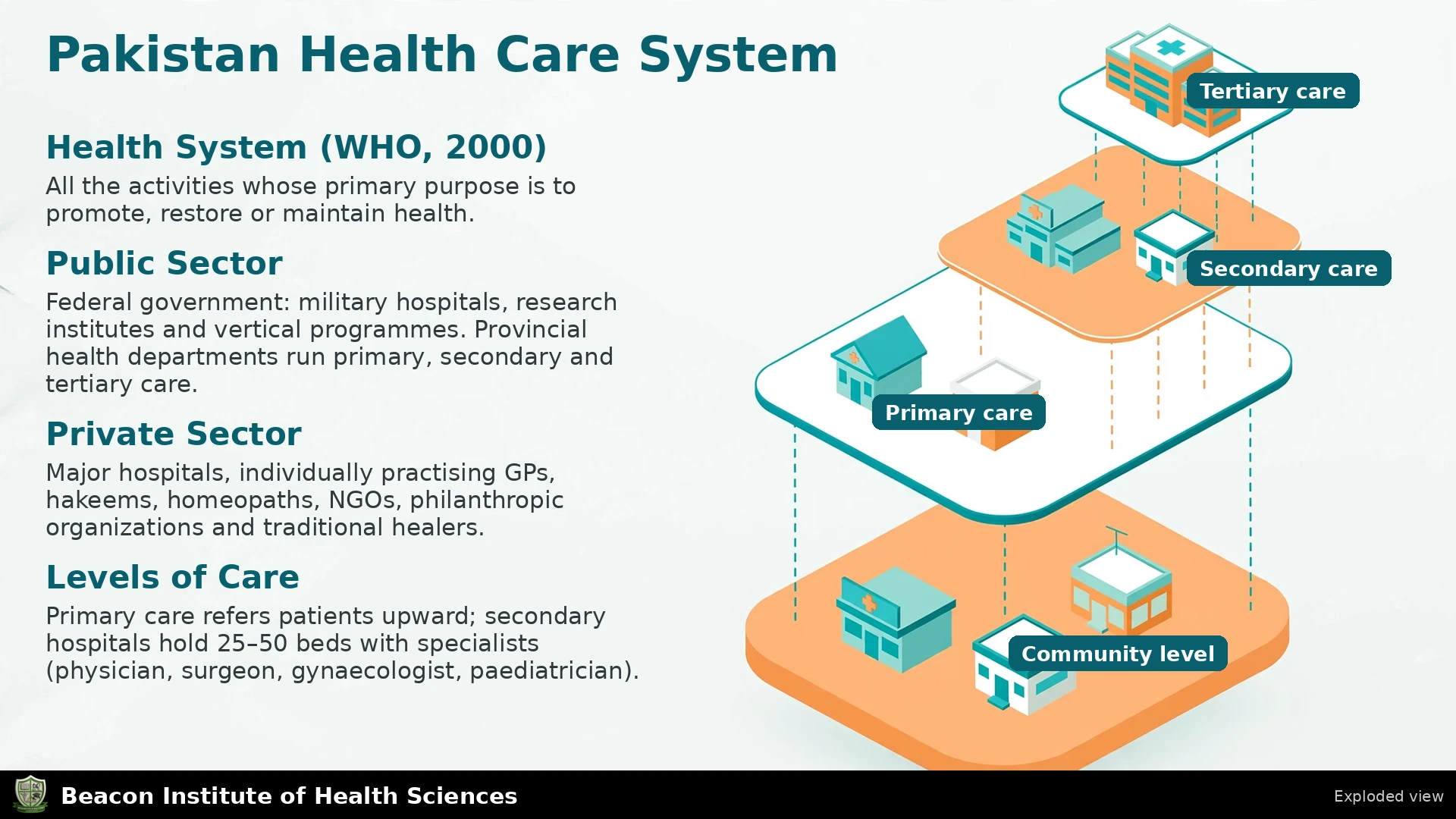
BSN students should identify major service levels, distinguish service delivery from governance, describe a referral pathway and explain how nurses support continuity. A health system includes workers, facilities, financing, information, medicines and leadership. A hospital building is only one part. Map how a person moves between home, community services and facilities, and note who is responsible for each step. This makes the topic practical rather than a list of institution names.
2. A mixed delivery system
People in Pakistan receive care through public facilities, private providers and charitable or other nongovernmental services. The mix varies by location and type of care. A public-private distinction alone does not establish quality, affordability or availability. Ask what services are offered, who is qualified to provide them and what referral arrangements exist. For learning, compare two fictional services using the same criteria instead of assuming that every provider in one sector behaves alike.
3. Governance and local variation
Health administration includes national coordination and important provincial responsibilities, with local service arrangements differing across provinces and districts. Avoid presenting one provincial facility description as an exact national standard. A student should identify the relevant health department, programme and facility management for the placement area. Verify current service hours, staffing, programme eligibility and referral destinations locally. This lesson describes the general structure and does not certify the operational capacity of a particular facility.
4. Primary-level facilities
Basic Health Units, commonly called BHUs, and Rural Health Centres, or RHCs, are important names in public primary-level services. They may provide preventive, outpatient, maternal and child health, diagnostic and referral activities according to local capacity. An RHC generally supports a wider range of services than a BHU, but actual availability must be checked. Learn their relationship to community services rather than memorizing a single bed or population figure as universal across Pakistan.
5. Secondary referral services
Tehsil Headquarters and District Headquarters hospitals, abbreviated THQ and DHQ, are familiar secondary-level referral facilities. They provide services beyond many first-level facilities, including inpatient care and specialist services according to available capacity. A referral should be based on the needed service and urgency, not merely the size of the building. Before advising routine attendance, confirm that the relevant clinic operates and that the person understands where to report. Emergency pathways require prompt qualified assessment.
6. Tertiary and specialist care
Teaching and specialist hospitals commonly provide tertiary care for complex conditions and advanced services. They also contribute to education and training. Tertiary care should connect with lower-level services through communication and follow-up. A complex procedure may be completed in a major hospital while continuing support occurs near home. The learning task is to identify which functions require specialist resources and which can be safely supported locally through an agreed plan.
7. Community and outreach connections
Outreach brings selected services closer to people who cannot easily reach facilities. Lady Health Workers provide an important connection with households, while nurses, midwives, vaccinators and other qualified workers contribute distinct roles. Do not treat these professional categories as interchangeable. Know the supervision arrangement and referral route in the placement area. A community worker identifying a concern and a facility team completing assessment are connected parts of care rather than competing alternatives.
8. Public health programmes
Public health activities include immunization, maternal and child health, prevention and control of communicable disease, and work on environmental and other population risks. Programmes need community information, trained personnel, supplies, records and follow-up. Names, schedules and operating arrangements can change, so use current official guidance for practice. Classroom notes should explain why a programme exists and how its activities connect, while avoiding unsupported claims about nationwide coverage or service availability.
9. Financing and access
Financing affects whether people can obtain care and whether costs create hardship. Direct fees are only part of the burden: transport, lost work and repeated visits also matter. Do not promise free treatment or insurance eligibility without checking the current programme rules. Nurses can help explain verified options and identify barriers to the authorized team. A service may be geographically close yet difficult to use because its hours, cost or communication arrangements do not fit household circumstances.
10. Workforce, supplies and quality
A functioning service needs appropriately trained staff, usable equipment, medicines, infection-prevention supplies and reliable information. Availability is different from quality. A clinic may be open but lack a required test or referral arrangement. Record the specific gap instead of describing the whole service as good or bad. Nursing quality includes respectful care, safe communication, documentation and escalation of concerns. Improvement plans should identify an accountable action and a measure that can be reviewed.
11. Referral information and continuity
For a routine referral, record the reason, relevant findings, requested service and destination. Explain what the person should do next and confirm foreseeable barriers. When information returns from the receiving service, update the agreed care plan through authorized records. Referral is a communication process rather than a paper handed over once. Do not include unnecessary private information in informal messages. Urgent symptoms require the appropriate emergency pathway, not a classroom sequence of appointments.
12. Health information and responsible interpretation
Service records can guide planning, but counts need context. Define the population, reporting period and data source. Missing entries are not always proof that no service was delivered, and repeated visits are not always different people. A student should check whether a figure counts consultations, individuals or households. Confidentiality applies to paper and electronic records. Use aggregated or fictional data for presentations unless identifiable information has an appropriate authorized purpose.
13. Worked referral learning case
A fictional family attends a first-level facility and needs a service that is not available there. The nurse explains the receiving facility, gives the relevant documentation and checks the next step with the qualified team. Later, the family reports that the clinic operates only on certain days. The improvement is to verify clinic arrangements before routine referral and communicate them clearly. This case demonstrates why an accurate facility map must include actual services and access conditions.
14. Answered review and practical task
Draw a local service map using verified information from your supervised placement. Include community contacts, first-level care, referral hospitals and a return pathway. Answers: BHU means Basic Health Unit; RHC means Rural Health Centre; THQ and DHQ identify familiar referral hospitals; tertiary care usually supports advanced specialist needs; a referral requires communication and follow-up. Explain why one provincial description cannot represent every district. Recap: understand the connections between services, resources, access and responsibility.