
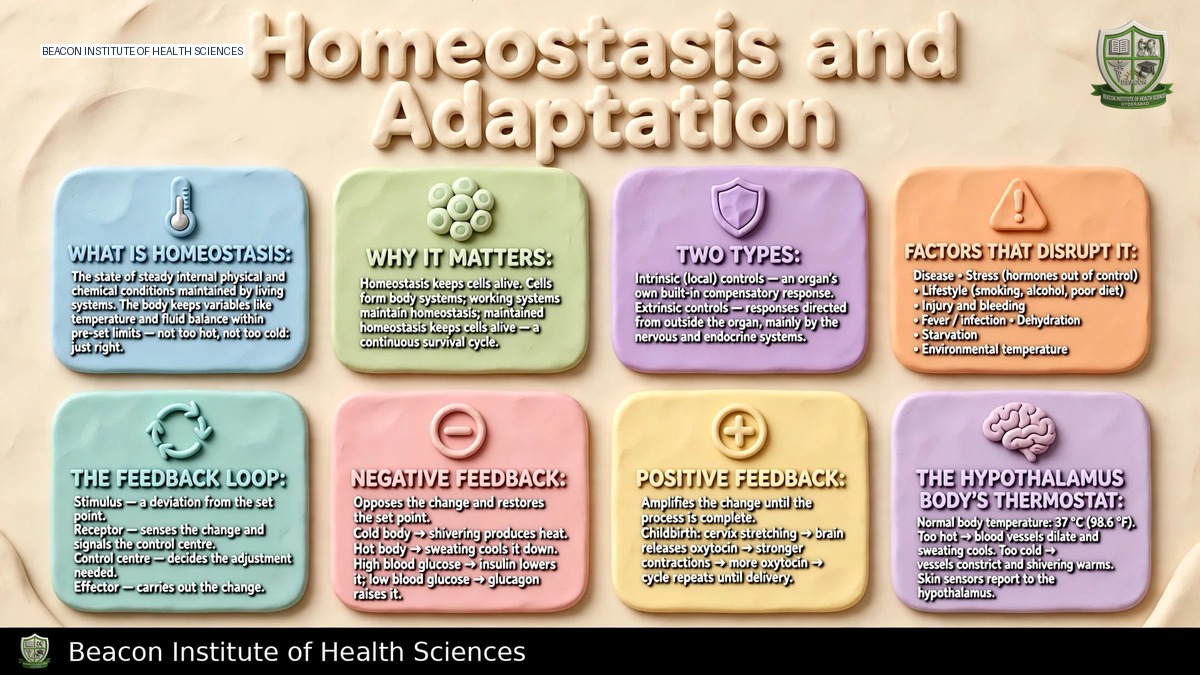
Introduction to Homeostasis and Adaptation
This BSN lecture focuses on understanding homeostasis and adaptation, essential concepts in Anatomy and Physiology I. We will define the internal environment, homeostasis, and adaptation, identify control loops, compare negative and positive feedback mechanisms, and explore examples related to temperature, glucose, and circulatory regulation. A key distinction will be made between successful compensation and loss of physiological reserve, with an emphasis on normal regulation and nursing examples that highlight the importance of trends.
The Internal Environment
Cells within the body function within extracellular fluid, which comprises interstitial fluid surrounding cells and plasma (the fluid portion of blood). Intracellular fluid is located inside the cells. Vital substances such as oxygen, nutrients, water, electrolytes, and wastes continuously move between these compartments.
Homeostasis is defined as a dynamic condition where essential physiological variables remain within limits compatible with normal function. Examples of regulated variables include temperature, glucose, blood pressure, osmolality, and acid-base balance. These are maintained by various interacting systems. Homeostasis is not a state of complete stillness; it requires continuous energy and ongoing feedback mechanisms.
Control-Loop Vocabulary
A homeostatic control loop involves several components:
- Stimulus: A change that affects a regulated variable.
- Receptor: Detects the change in the regulated variable. An input pathway then carries this information to a control centre.
- Control Centre: Integrates signals in relation to a target value or acceptable range. It then sends an output signal to an effector.
- Effector: Changes its activity to produce a response.
- Feedback: Describes how the response influences the original stimulus.
Receptors, integrators, and effectors can be found in different organs or combined within a single cell type. It is crucial to note that a target value can fluctuate due to circadian rhythms and various physiological circumstances, and should not be confused with a single, universal diagnostic cut-off point.
Negative and Positive Feedback
There are two primary types of feedback mechanisms:
Negative Feedback
Negative feedback acts to oppose a deviation from a set point and stabilizes the variable. For example, if body temperature rises, heat-loss mechanisms become more active. As the deviation decreases, the corrective response also diminishes. The term "negative" refers to the direction of the feedback, meaning it works to reverse the initial change, not that the effect is undesirable. Most routine homeostatic regulation in the body utilizes negative feedback.
Positive Feedback
Positive feedback amplifies an initial change. It typically requires a defined endpoint or limiting mechanism to prevent runaway effects. Examples include:
- Labor: Cervical stretch promotes oxytocin-mediated uterine contractions, which further increase cervical stretch until the birth of the baby removes the stimulus.
- Platelet Activation and Clotting: These reactions can amplify locally to seal a vessel injury, with regulatory mechanisms eventually restricting the response.
Positive feedback is not inherently harmful, but it is not the usual mechanism for maintaining a stable physiological baseline.
Temperature Regulation as an Example
Thermoreceptors provide essential information about body temperature to neural control systems, notably the hypothalamus. The body employs various mechanisms to regulate temperature:
- In Heat: Increased skin blood flow and sweating promote heat transfer away from the body. Evaporation of sweat removes heat, provided environmental conditions permit.
- In Cold: Reduced skin blood flow helps conserve heat, and shivering increases muscular heat production.
- Behavioral Regulation: Actions like changing clothing or seeking shelter also support temperature regulation.
It's important to recognize that core and skin temperatures can differ, and measurement site, time, activity, and technique all influence temperature readings.
Distinguishing Fever from Hyperthermia
- Fever: Involves an elevated thermoregulatory target point within the hypothalamus.
- Hyperthermia: Occurs when heat gain exceeds heat loss without a change in the thermoregulatory target.
One must avoid interpreting a single temperature reading in isolation; always consider the clinical setting. Approximate textbook values help explain mechanisms but do not replace specific institutional assessment thresholds.
Other Feedback Examples in Homeostasis
Glucose Regulation
After a meal, pancreatic beta cells release insulin in response to increased glucose levels. Insulin facilitates glucose uptake by responsive tissues and storage, including the formation of liver glycogen. During fasting, glucagon supports hepatic glucose production. Declining glucose reduces the stimulus for insulin release, while pancreatic alpha cells primarily produce glucagon, not insulin. This distinction is crucial when illustrating the feedback loop.
Baroreflex and Water Balance
- Baroreceptors: These respond to arterial stretch. Neural responses can alter heart rate, contractility, and vascular tone when blood pressure changes.
- Water Balance: Involves thirst, kidney function, and antidiuretic hormone (ADH). Changes in water concentration directly influence water conservation.
Respiratory and renal mechanisms also work collaboratively in acid-base regulation. These examples highlight that physiological control systems are highly interconnected, rather than individual organs acting in isolation.
Adaptation, Stress, and Compensation
Adaptation refers to a change that improves function under repeated or sustained conditions, remaining within biological limits. Examples include acclimatization to environmental conditions and training-related physiological changes. Acute stress responses involve sympathetic nervous system activity and endocrine responses that mobilize resources; however, prolonged or excessive demands can impair health.
Allostasis describes the physiological adjustments that support stability during changing demands, while allostatic load refers to the cumulative burden resulting from repeated adaptation.
Cellular adaptation is a related concept and includes:
- Hypertrophy: Increase in cell size.
- Hyperplasia: Increase in cell number.
- Atrophy: Reduction in cell size or tissue mass.
- Metaplasia: Change of one mature cell type to another.
These terms are not interchangeable and should not be misinterpreted as proof of malignancy. Normal physiological adaptation differs from injurious changes that exceed the body's reserve; detailed pathology is addressed in subsequent studies.
Nursing Reasoning and Revision
In nursing practice, understanding these concepts is vital:
- A rise in heart rate during exercise helps support increased oxygen delivery. However, tachycardia during blood loss, while initially compensating for reduced circulating volume, does not correct the underlying cause.
- A seemingly maintained blood pressure can coexist with declining perfusion. Therefore, it is crucial to observe serial vital signs, level of consciousness, urine output, and other relevant findings.
- Escalate concerning changes according to local protocols and never assume that adaptation automatically means a patient is safe.
For revision, students should practice drawing a complete feedback loop, labeling the receptor, control centre, and effector, and describing the response's effect on the initial stimulus. They should be able to explain how labor (positive feedback) differs from temperature regulation (negative feedback), distinguish between homeostasis and adaptation, and discuss how reduced physiological reserve in aging or illness can alter tolerance to stress. Always use context-specific clinical guidance for patient care rather than applying classroom examples as direct treatment instructions.