
Learning Objectives for BSN Anatomy and Physiology I
This foundational lesson provides BSN students with an introduction to the body as a whole, covering essential concepts for Anatomy and Physiology I. Upon completion, students should be able to:
- Explain the definitions and relationship between anatomy and physiology.
- Arrange the body's levels of organization hierarchically.
- Name the major organ systems and understand their basic roles.
- Utilize anatomical position, directional terms, and body planes accurately.
- Locate major body cavities and abdominal regions.
- Connect these fundamental concepts to basic nursing observations.
This module focuses on the principles of Anatomy and Physiology I, serving as a basis for further study, rather than specific disease management or nursing history topics.
Anatomy, Physiology, and Organizational Hierarchy
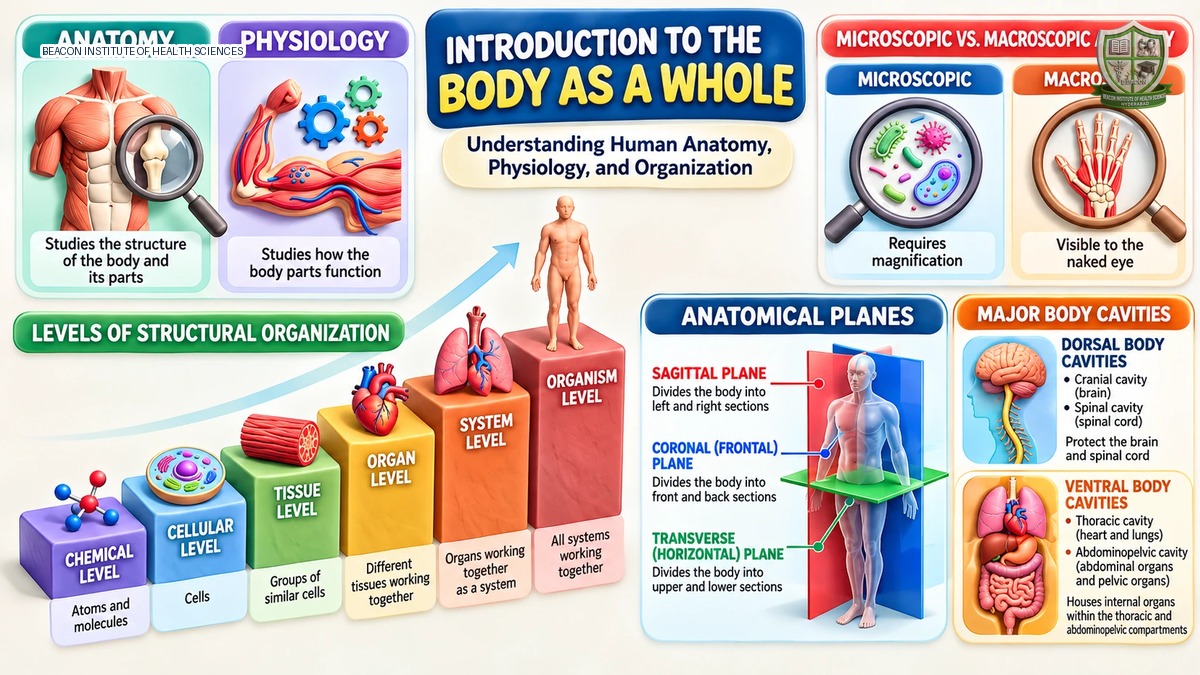
Anatomy is the study of the structure of body parts and their relationships to one another. Physiology, conversely, focuses on how these structures function. An organ's specific shape, its constituent tissues, and its blood supply are crucial in explaining its function; for instance, the thin walls of alveoli facilitate gas exchange, while the muscular ventricular wall is designed to generate pressure.
Divisions of Anatomy
- Gross anatomy examines structures visible without a microscope.
- Regional anatomy focuses on all anatomical structures in a specific area of the body.
- Systemic anatomy studies the structures of specific organ systems.
- Microscopic anatomy involves the study of cells (cytology) and tissues (histology).
- Developmental anatomy considers structural changes that occur throughout the lifespan.
Levels of Organization
The human body is organized in a hierarchical manner, progressing from the simplest to the most complex:
- Atoms and Molecules: The fundamental chemical level.
- Organelles: Specialized structures within cells.
- Cells: The basic living unit of the body.
- Tissues: Groups of related cells and extracellular material that perform shared functions.
- Organs: Structures composed of two or more different tissue types that perform specific functions. For example, the stomach comprises epithelium for secretion, smooth muscle for mixing contents, connective tissue for wall support, and nerves to coordinate activity. It is important not to describe an organ as a single tissue type.
- Organ Systems: Groups of organs that work together to accomplish a common purpose.
- Organism: The entire living being, representing the sum of all structural levels working in harmony.
Fundamental Life Processes and Requirements
Human life is characterized by several essential processes:
- Metabolism: The sum of all chemical reactions in the body, encompassing anabolism (building molecules) and catabolism (breaking down molecules).
- Responsiveness: The ability to sense and respond to stimuli.
- Movement: Includes actions at all levels, from cellular movement to the movement of the entire body.
- Growth: An increase in size of a body part or the organism as a whole.
- Differentiation: The process by which unspecialized cells develop into specialized ones.
- Reproduction: The production of offspring at the cellular or organismal level.
Cellular work is supported by vital processes such as digestion, respiration, circulation, and excretion. Cells require specific conditions for optimal function: appropriate oxygen, nutrients, water, temperature, and pressure. Homeostasis is the ability to maintain a relatively stable internal environment despite external changes through active regulation. It does not imply that every value remains absolutely constant, but rather within workable limits. The proper functioning of the human body relies on the cooperation of different organ systems, meaning dysfunction in one system can significantly affect several others.
Major Organ Systems in Context
The human body is composed of eleven major organ systems that collaborate to maintain life:
- Integumentary System: Protects the body's surface and assists in temperature regulation.
- Skeletal System: Provides support and protection for internal organs.
- Muscular System: Enables body movement and generates heat.
- Nervous System: Coordinates responses through neural signals.
- Endocrine System: Coordinates responses through hormones.
- Cardiovascular System: Transports blood, oxygen, nutrients, and waste throughout the body.
- Lymphatic and Immune Systems: Return tissue fluid to the blood and defend the body against pathogens. (Often combined in the eleven-system framework.)
- Respiratory System: Facilitates the exchange of gases (oxygen and carbon dioxide).
- Digestive System: Breaks down food and absorbs nutrients.
- Urinary System: Regulates fluid, electrolyte balance, and waste excretion.
- Reproductive System: Produces gametes and supports reproduction.
While the integumentary and combined lymphatic/immune functions are commonly included in the eleven-system framework, lists may group systems differently.
Anatomical Position and Directional Terminology
To ensure consistent communication, anatomy uses a standard reference point called the anatomical position. This position is defined as a person standing upright, facing forward, with feet directed forward, arms at the sides, and palms facing forward. Right and left always refer to the person’s sides, not the observer’s. Supine means lying face upward; prone means lying face downward. A clinical position can change without changing anatomical terminology.
Directional Terms
Superior means toward the head; inferior toward the feet. Anterior means toward the front; posterior toward the back. Medial means toward the midline; lateral away from it. Proximal means nearer an attachment or origin; distal farther away. Superficial is nearer the surface; deep is farther within. Ipsilateral structures are on the same side and contralateral structures on opposite sides. For example, the wrist is distal to the elbow, and the sternum is anterior to the heart. Direction is a relationship, so include the comparison structure when explaining it.
Planes, Sections and Body Cavities
A sagittal plane separates right and left portions; midsagittal creates equal halves. A frontal or coronal plane separates anterior and posterior portions. A transverse plane separates superior and inferior portions. An oblique cut is angled. A plane is an imaginary reference; a section is a cut or image along it.
The dorsal cavity includes the cranial cavity containing the brain and vertebral canal containing the spinal cord. The ventral cavity includes thoracic and abdominopelvic divisions, separated by the diaphragm. The thorax contains two pleural cavities and the mediastinum; the pericardial cavity surrounds the heart within the mediastinum. The abdominal region contains many digestive organs; the pelvic region contains the bladder, rectum and internal reproductive organs. Parietal serosa lines a cavity wall, whereas visceral serosa covers an organ; a thin fluid layer reduces friction. The entire mediastinum is not the pericardial cavity.
Abdominal Mapping for Nursing
Four quadrants are right upper, left upper, right lower and left lower, formed by intersecting median and transverse lines at the umbilicus. The nine regions, from the person’s right to left, are right hypochondriac, epigastric and left hypochondriac; right lumbar, umbilical and left lumbar; right iliac/inguinal, hypogastric/pubic and left iliac/inguinal. The liver is mainly in the right upper abdomen and the stomach mainly in the left upper abdomen, but organs can span regions. Document a symptom’s site precisely; location alone does not establish a diagnosis.
Revision and Application
Practise labelling body planes on a diagram and locating the heart, lungs, liver and bladder. Compare a tissue with an organ, then explain why coordinated circulation and respiration are needed for cells. A patient reporting right lower abdominal pain should be documented using the patient’s right side; findings require assessment and escalation under local practice, rather than diagnosing from a quadrant label.
- Define proximal and give a comparison example.
- Distinguish sagittal from frontal planes.
- Explain parietal versus visceral serosa.
- List the nine abdominal regions without reversing right and left.
These original reference-based BSN study notes support Anatomy and Physiology I revision and do not claim to reproduce a particular YouTube lecture.