
Learning Objectives
Upon completing this lesson, BSN students and nursing educators will be able to:
- Define health psychology and its scope in nursing practice.
- Compare and contrast the biomedical and biopsychosocial models of health and illness.
- Identify key components of the Health Belief Model and the Theory of Planned Behavior.
- Discuss practical considerations influencing health behavior change and patient adherence.
- Explain principles of shared decision-making and respectful communication in patient care.
- Recognize different levels of prevention and strategies for addressing health inequalities.
- Apply health psychology principles to a clinical scenario, focusing on patient-centered care.
Understanding Health Psychology
Health psychology is a field that explores the intricate interactions between biological, psychological, and social factors in relation to health and illness. It encompasses understanding how these factors influence an individual's health status, their response to illness, their coping mechanisms, and their engagement with healthcare systems. For nursing students, comprehending health psychology is crucial for providing holistic, patient-centered care that addresses the multifaceted nature of health challenges.
The Biopsychosocial Model Versus the Biomedical Model
Two primary models guide our understanding of health and illness: the biomedical model and the biopsychosocial model. While both are important, the biopsychosocial model offers a more comprehensive framework for nursing practice.
Table: Comparison of Biomedical and Biopsychosocial Models
| Feature | Biomedical Model | Biopsychosocial Model |
|---|---|---|
| Focus | Primarily on biological factors (e.g., pathogens, genetics, physiological malfunction). | Integrates biological, psychological (e.g., thoughts, emotions, behaviors), and social (e.g., culture, family, socioeconomic status) factors. |
| Illness Definition | Disease is primarily a physiological malfunction with specific causes. | Illness is an experience influenced by a complex interplay of physical, mental, and social factors. |
| Treatment Approach | Emphasizes disease mechanisms and appropriate medical interventions, such as medicines or surgery. | Holistic, considers medical interventions alongside psychological and social support. Does not imply symptoms are imaginary; acknowledges the reality of pain and symptoms. |
| Role of Patient | May receive predominantly clinician-directed care, although biomedical practice can also involve shared decisions. | Active participant in their care and recovery process. |
| Role of Healthcare Provider | Focuses on diagnosing and treating physical symptoms. | Addresses the whole person, including their lived experience, beliefs, and social context. |
It is important to emphasize that the biopsychosocial model does not reject medical treatment or imply that symptoms are imaginary. Instead, it expands our understanding to acknowledge the profound impact of psychological and social dimensions on genuine physical experiences, including pain.
Health Beliefs and Behavior Change
Understanding how individuals perceive health threats and potential benefits of health actions is fundamental to promoting positive health behaviors. Two prominent models help explain these dynamics:
The Health Belief Model
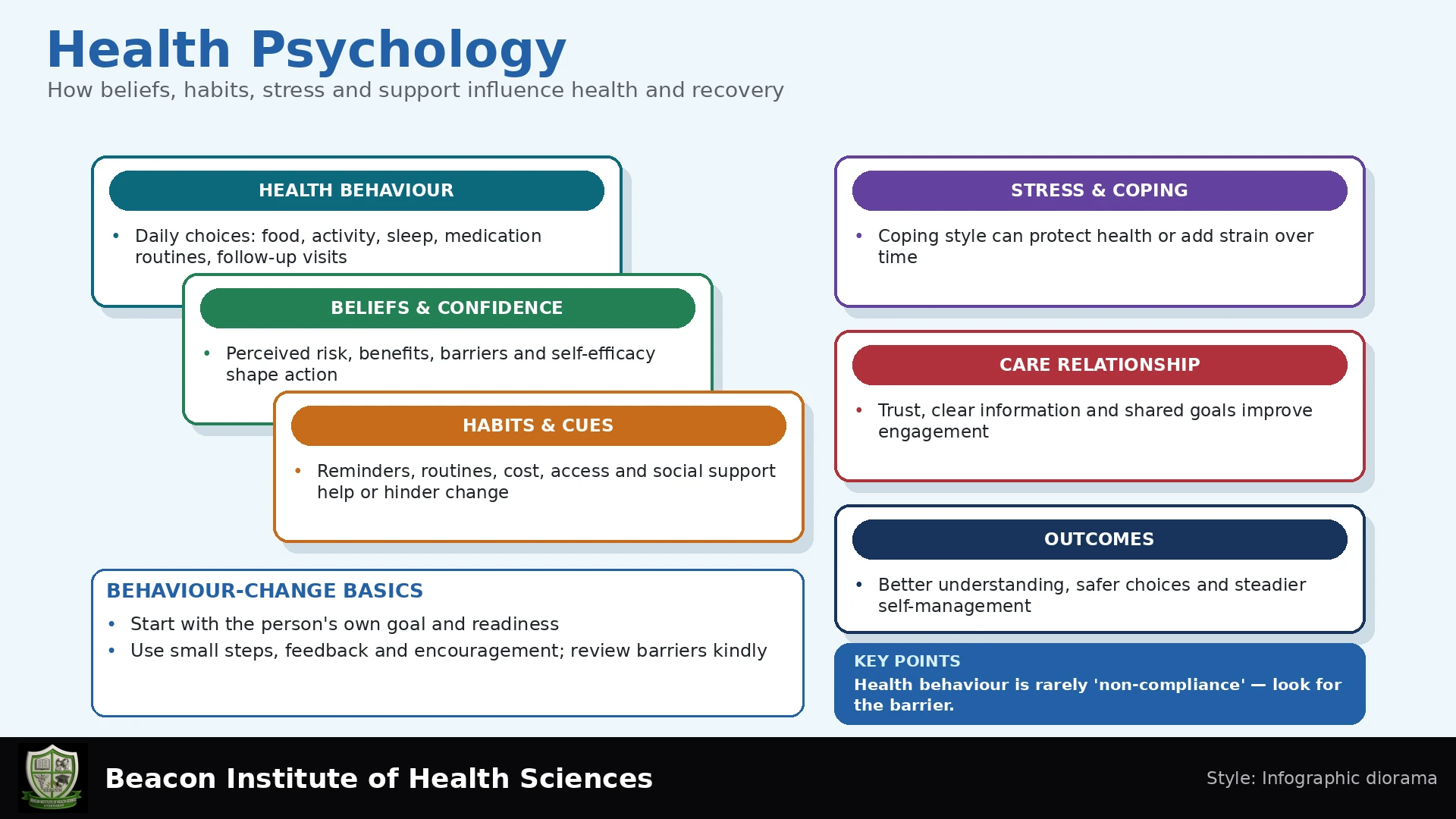
The Health Belief Model (HBM) suggests that an individual's health behavior is influenced by their perceptions regarding a health threat and the effectiveness of a recommended health action. Key components include:
- Perceived Risk (or Susceptibility): An individual's subjective perception of the risk of contracting a health condition.
- Perceived Severity: An individual's subjective perception of the seriousness of the health condition and its potential consequences.
- Perceived Benefits: An individual's belief in the effectiveness of the advised action to reduce the health risk.
- Perceived Barriers: An individual's belief about the potential negative aspects of a health action, such as cost, inconvenience, discomfort, or side effects.
- Cues to Action: Internal or external stimuli that trigger the individual to take action (e.g., symptoms, media campaigns, advice from others).
- Self-Efficacy: An individual's confidence in their ability to successfully perform the recommended health behavior.
The Theory of Planned Behavior
The Theory of Planned Behavior (TPB) proposes that an individual's intention to perform a given behavior is the most immediate determinant of that behavior. Intentions are, in turn, shaped by three core components:
- Attitude Towards the Behavior: An individual's positive or negative evaluation of performing the behavior.
- Subjective Norms: An individual's perception of the social pressure to perform or not perform the behavior, influenced by beliefs about what important others think they should do.
- Perceived Behavioral Control: An individual's belief in their ability to perform the behavior and overcome potential obstacles. This is similar to self-efficacy.
It is crucial to recognize the limitations of these models; intention is not guaranteed action. Real-world behavior change also depends on capability, opportunity, and motivation. These factors include practical considerations like access to resources, financial costs, and work schedules. It is imperative for nurses to avoid victim-blaming and instead explore these systemic and individual barriers respectfully.
Patient-Centered Care and Adherence
Effective patient care requires a commitment to patient autonomy and shared decision-making, which are crucial for promoting adherence to treatment plans.
Shared Decision-Making and Communication
Shared decision-making involves a collaborative process where healthcare providers and patients work together to make healthcare decisions. Key principles include:
- Respect for Autonomy: Recognizing the patient's right to make choices about their own health.
- Respectful Communication: Engaging in open, honest, and empathetic dialogue.
- Asking What Matters: Eliciting the patient's values, preferences, and concerns.
- Assessing Readiness: Evaluating the patient's willingness and preparedness to engage in behavior change or treatment.
- Agreeing on Goals: Collaboratively setting small, feasible, and specific goals that are acceptable to the patient.
- Using Teach-Back: Confirming patient understanding by asking them to explain information in their own words.
- Review and Adjustment: Periodically reassessing the plan and making necessary adjustments based on patient feedback and progress.
It is vital to ensure that this process is free from coercion or the imposition of mandatory stages, respecting the patient's pace and choices.
Assessing and Supporting Adherence
Adherence refers to the practical implementation of an agreed-upon plan of care. Before judging a patient's adherence, nurses should openly inquire about various factors that might influence their ability to follow the plan. These factors include:
- Side effects of medications or treatments.
- Patient's understanding of the treatment rationale and instructions.
- Personal beliefs about the illness or treatment.
- Financial constraints.
- Impact on daily routine or lifestyle.
By exploring these aspects, nurses can identify barriers and collaborate with the patient to find practical solutions, thereby fostering better adherence and improving health outcomes.
Coping with Illness and Pain
Illness representations, which are how individuals understand and make sense of their health condition, significantly affect their coping strategies. For example, perceiving an illness as chronic and uncontrollable might lead to different coping behaviors than viewing it as acute and treatable.
Pain, a complex experience, is always real and is influenced by multiple biological, psychological, and social systems. Nurses must never dismiss symptoms, particularly pain, merely because stress or psychological factors exist. Acknowledging the patient's pain experience as valid is a cornerstone of compassionate and effective nursing care.
Levels of Prevention
Prevention in health psychology and nursing aims to reduce disease incidence and impact. It is categorized into three levels:
- Primary Prevention: Aims to prevent disease or injury before it ever occurs. An accurate example is health education programs promoting healthy lifestyles, vaccinations, or safe practices to prevent illness.
- Secondary Prevention: Aims to reduce the impact of a disease or injury that has already occurred. An example is appropriate screening tests (e.g., mammograms, blood pressure checks) to detect and treat diseases early.
- Tertiary Prevention: Aims to soften the impact of an ongoing illness or injury that has lasting effects. An example is rehabilitation programs (e.g., physical therapy after a stroke, support groups for chronic conditions) to improve function and quality of life.
Addressing Health Inequalities
Health inequalities are differences in health between groups. Health inequities are differences judged unfair and avoidable; practical barriers and unequal opportunities need attention. Addressing these disparities requires not only individual actions but also broader system changes. Nurses play a critical role in advocating for policies and practices that promote equitable access to healthcare, education, and resources, thereby reducing the impact of social determinants on health outcomes.
Clinical Application: A Fictional Case Study
Scenario: Ms. Anya Sharma, a 45-year-old factory worker, was discharged from the hospital three weeks ago after treatment for newly diagnosed Type 2 Diabetes. She was instructed to follow up with the outpatient clinic in two weeks for medication review and diabetes education. The clinic nurse notes that Ms. Sharma missed her scheduled follow-up appointment.
Nursing Approach:
- Open communication: The nurse checks that it is an appropriate and private time, then asks, “What made it difficult to attend, and what would help with the next appointment?”
- Explore the explanation: In this fictional example, the patient reports shift work and transport costs. The nurse also checks understanding, concerns and any symptoms needing assessment.
- Agree a feasible plan: Explore suitable clinic times and available support with the responsible team. Provide an accessible written plan agreed with the patient. Do not change medicines independently or assume that education alone removes cost barriers.
- Review: Agree when to check whether the plan was feasible. Appropriate measures include whether the appointment was accessible, whether the patient can explain the next steps and whether remaining concerns were addressed. A planned action is not a proven outcome.
Turning a model into a respectful conversation
The purpose of a behavioural model is to organize questions, not to decide in advance why someone acted. A patient may believe an action is beneficial and intend to take it while lacking the transport, money, equipment or time needed. Explore both beliefs and practical opportunities. Information should be accurate and proportionate; fear or shame should not be used to force agreement.
| Perspective | Useful question | Limit to remember |
|---|---|---|
| Health Belief Model | “What benefits or difficulties do you expect from this plan?” | Beliefs do not capture every social or material constraint. |
| Planned behaviour | “How does the plan fit with what matters to you and the support available?” | Intention may not become action; actual control matters. |
| Capability, opportunity and motivation | “Do you have the information, skills, resources and support needed?” | More than one factor may need attention, including service design. |
A practical nursing sequence
- Clarify the concern and assess any immediate health needs.
- Ask for the patient’s understanding, priorities and preferred involvement.
- Explore practical barriers, existing strengths and available support.
- Explain options within your role and check understanding with teach-back.
- Agree a specific, achievable next step without coercion.
- Document the agreed plan and arrange appropriate review or referral.
- Evaluate both the person’s experience and relevant outcomes, then revise.
For example, “I will contact the clinic tomorrow to ask about appointments after my shift” is a specific action that can be reviewed. It should not be imposed if it is impractical or not the patient’s choice. If symptoms worsen or a new concern arises, assessment takes priority over completing a behaviour-change worksheet.
Self-check with explained answers
1. A patient intends to attend but cannot afford transport. Is low motivation the only reasonable explanation?
Answer: No. Opportunity is constrained. Explore available support and service arrangements rather than repeating education or blaming the patient.
2. Does a biopsychosocial approach mean that pain is imagined?
Answer: No. It considers interacting influences on a real experience. A person still needs appropriate assessment and care; psychological factors do not exclude physical causes.
3. Which prevention level includes detecting an existing condition early through appropriate screening?
Answer: Secondary prevention. Primary prevention aims to prevent onset, while tertiary prevention reduces complications or supports function after an established condition. Screening suitability depends on the person and relevant guidance.
Glossary and conclusion
Self-efficacy: belief in one’s ability to perform a particular action. Perceived barrier: an anticipated difficulty. Adherence: implementation of an agreed plan. Shared decision-making: discussion of options in light of evidence and the patient’s values. Health inequity: an unfair and avoidable difference in health or access.
Health psychology helps nurses understand the person’s experience and the conditions that enable or obstruct care. Combine accurate medical assessment with respectful inquiry, achievable shared plans and attention to social barriers. Neither a theory nor a first impression should replace listening to the individual.