
Introduction & Core Curricular Questions
In professional nursing education, clinical decisions must extend beyond isolation or mechanical procedures. Value and Belief are fundamental concepts that define patient individuality, spiritual outlook, and nursing professionalism. Unit 10 of the Fundamentals of Nursing (FON) curriculum introduces the Concept of Value Belief to address standardized curricular questions essential for every BSN student. These questions guide the professional training of nurses, fostering a transition from intuitive care providers to highly analytical, ethically grounded, and culturally sensitive professionals.
Primary Syllabus Questions Addressed in this Unit include:
- What is the definition of a Value and a Belief, differentiating these core concepts academically?
- How are values formed and transmitted, identifying environmental, social, and familial sources?
- What is the difference between Personal and Professional Values, and how do nurses manage their moral compass versus clinical standards?
- What are Professional Nursing Values, exploring the specific code of values governing clinical nurse behaviors?
- What are the sources and functions of professional values, indicating their origin and guidance in practice?
- What are the 7 AACN values and the 4 general nursing values, categorizing professional standards of ethics?
- What is the role of family, culture, and society in shaping individual and group worldviews?
- What is the Valuing Process, breaking down its cognitive, affective, and behavioral components?
- How do nurses clarify values and resolve conflicts, providing practical strategies for ethical dilemmas?
Defining Value and Belief: Conceptual Frameworks
Values and beliefs, though related, are distinct mental constructs. Understanding their precise boundaries is crucial for ethical nursing practice.
Concept of Value
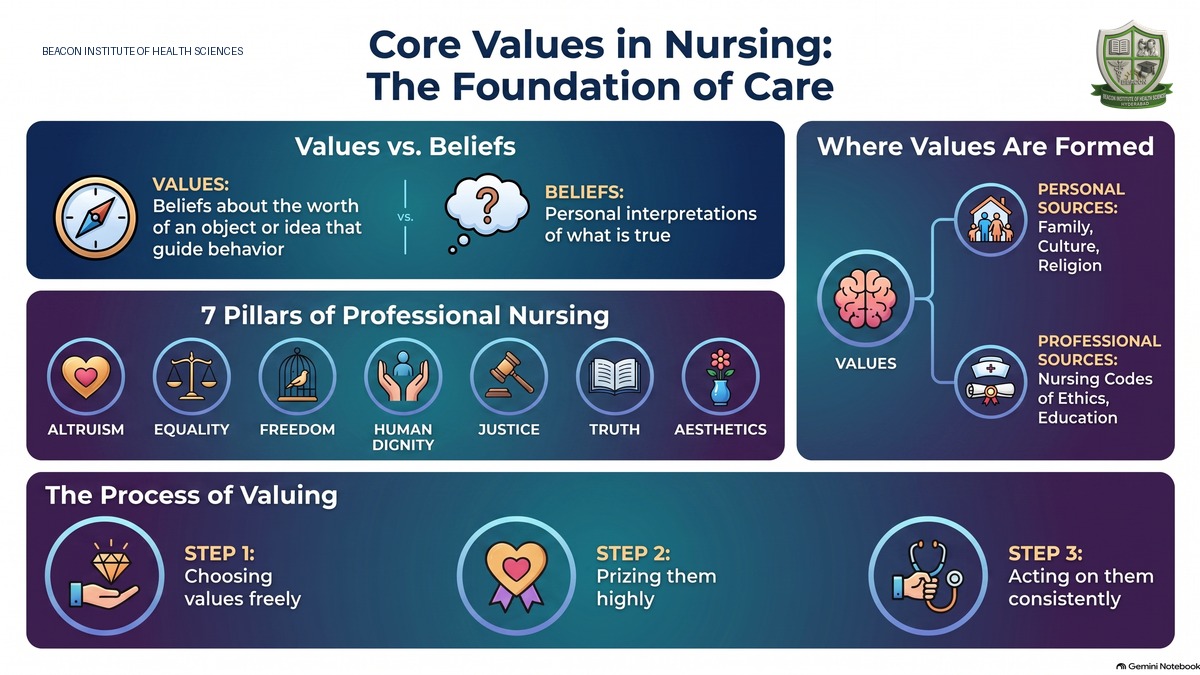
A Value is an enduring belief or attitude regarding the worth of a person, object, idea, action, or custom. Values represent what an individual holds dear, considers important, or deems desirable. They function as internal standards influencing choices, shaping decisions, and guiding behavior. Values are highly personalized, dictating what an individual perceives as right or wrong, good or bad, beautiful or ugly.
Concept of Belief
A Belief is an interpretation or acceptance of a statement, reality, or phenomenon as true. It signifies a very specific attitude that does not necessarily require objective, physical proof. A belief represents a person's cognitive understanding of 'what is true' about the world, a situation, or a concept. For instance, the assertion 'honesty is always rewarded' is a belief, whereas the importance an individual assigns to honesty in daily life is a value.
Clinical Integration Note: The Value-Belief Pattern is recognized as one of Marjory Gordon's 11 Functional Health Patterns. During health assessment, nurses analyze this pattern to understand the spiritual, moral, and religious worldviews that influence a client's medical choices and personal lifestyle.
Value Formation: Transmission and Acquisition
Values are not innate or genetically inherited. Every human is born without preconceived values; instead, values are slowly and systematically acquired, learned, and internalized over a lifetime through direct social transmission and personal experiences. This transmission occurs through various foundational social pillars:
- The Family: The primary and most significant source of value transmission. From early childhood, parents and immediate family members teach children acceptable, safe, and proper behaviors, establishing foundational value sets.
- Cultural Systems: Culture provides standard rules of conduct, social customs, and norms. Individuals growing within a specific culture unconsciously absorb its values concerning roles, behaviors, and social orders.
- Religious Teachings: Religion provides structured moral codes, spiritual teachings, and ethical standards that guide individuals in defining right versus wrong and life's ultimate purpose.
- Educational Institutions (School): Schools act as vital agents of secondary socialization. Teachers, textbooks, and peer interactions reinforce social rules, teaching cooperation, sharing, and conflict management.
- Personal & Life Experiences: Throughout life, personal experiences, successes, failures, and interpersonal relationships shape, refine, and modify an individual's value system, teaching what works best for personal and emotional survival.
Personal Versus Professional Values
Nurses must clearly differentiate between the values they hold as individuals in their private lives and those they must uphold as licensed clinical professionals.
Personal Values
Personal Values are internal standards freely chosen by an individual to guide their private life, relationships, and individual choices. These values represent the individual's personal moral code, formed by family, religion, and life path. Examples include personal religious practices, political beliefs, or family traditions. Individuals act on personal values out of free will and commitment.
Professional Values
Professional Values are the shared, formalized standards of conduct acquired by an individual during their socialization into a professional discipline, such as nursing. These values are not personal choices; they are mandated by professional bodies, codes of ethics, clinical standards, and state laws. A nurse must adhere to these professional values during clinical practice, even if they occasionally conflict with personal values.
Professional Boundaries: A professional nurse must never impose their personal values on a patient. If a patient's personal choice conflicts with the nurse's personal value of preserving life, the nurse must rely on the professional value of Autonomy to respect and support the patient's self-directed choice.
Professional Nursing Values: Sources and Functions
Professional nursing values provide the structural foundation for safe, therapeutic, and evidence-based patient care, dictating how nurses interact with clients, families, colleagues, and the broader healthcare system.
Core Functions of Professional Values in Nursing
- Guides Clinical Conduct: Acts as an ethical blueprint for nurse behavior in clinical settings.
- Facilitates Ethical Decision-Making: Provides a clear path when nurses face complex medical alternatives.
- Ensures Quality, Non-Discriminatory Care: Guarantees that every patient receives equal and respectful treatment.
- Promotes Collaborative Environments: Fosters professional respect and teamwork among healthcare providers.
- Nurtures Professional Identity: Strengthens the nurse's professional pride, personal creativity, and growth.
- Protects Patient Choice: Mandates advocacy for the patient's freedom to make independent healthcare choices.
The Five Primary Sources of Professional Nursing Values
- Professional Codes of Ethics: Written guidelines, such as the ICN or ANA Code of Ethics, establishing clinical expectations.
- Nursing Standards & Clinical Procedures: Government-approved clinical guidelines and institution protocols.
- Academic Educators & Teachers: Nursing faculty who model professional clinical conduct.
- Clinical Peers & Senior Mentors: Socialization through observing seasoned professionals in practice.
- Scientific Research & Evidence: Research findings that validate clinical practices scientifically.
Core Professional Nursing Values
In academic nursing, professional values are categorized into two core frameworks: the General Core Nursing Values and the American Association of Colleges of Nursing (AACN) Professional Values.
A. The Four General Core Values of Nursing:
- Commitment to Service: Unwavering dedication to providing clinical care to patients under all circumstances.
- Dignity and Worth of Each Person: Active respect for the unique nature and individuality of every patient, treating them as unique beings rather than standardized cases.
- Commitment to Education: A lifelong commitment to academic excellence, continuous learning, and professional skill development.
- Professional Autonomy/Status: Maintaining high professional standards, accountability, and clinical responsibility.
B. The American Association of Colleges of Nursing (AACN) 7 Values:
The AACN identifies seven key values that must be internalized by every professional nurse:
| AACN Value | Clinical Definition | Clinical Nursing Example |
|---|---|---|
| 1. Altruism | Concern for the welfare and well-being of others (patients, colleagues, and other providers). | Comforting a patient in pain, advocating for a vulnerable family's needs, or mentoring a junior nurse. |
| 2. Autonomy | Respecting the patient's right to self-determination and independent choice. | Supporting a patient's informed decision to refuse a treatment, or ensuring they sign informed consent freely. |
| 3. Human Dignity | Respect for the inherent worth, uniqueness, and value of every individual. | Maintaining patient privacy during a physical exam, or speaking to them with respect regardless of their background. |
| 4. Integrity | Acting honestly, morally, and ethically in accordance with professional codes and standards. | Admitting and documenting a medication error immediately, or refusing to take credit for another nurse's work. |
| 5. Social Justice | Upholding moral, legal, and humanistic principles related to access to equal care. | Ensuring a homeless patient receives the exact same high-quality care, resources, and discharge planning as a wealthy patient. |
| 6. Equality | Affirming that all individuals possess the same inherent worth and deserve equal opportunities. | Providing equal, unbiased, and standardized clinical nursing services to all patients without discrimination. |
| 7. Freedom | Providing patients the capacity to exercise choice and make self-directed health decisions. | Allowing a patient to choose their preferred daily hygiene schedule or plan their post-discharge home routine. |
The Valuing Process & Strategies for Value Clarification
Adopting a value is a complex human process, not a simple cognitive decision. This three-step framework, known as the Valuing Process, spans three main domains of human experience: Cognitive (Thinking), Affective (Feeling), and Behavioral (Acting).
| Phase of Valuing | Core Internal Activities | Clinical Nursing Application Example |
|---|---|---|
| 1. Choosing (Cognitive) |
| A nursing student chooses the value of 'Integrity' after seeing the potential legal and clinical consequences of falsifying records, deciding freely that honesty is essential. |
| 2. Prizing (Affective) |
| A clinical nurse feels proud of maintaining patient privacy and publicly defends patient rights during a multi-departmental hospital board meeting. |
| 3. Acting (Behavioral) |
| The nurse routinely double-checks medication doses, admits errors immediately, and practices honest clinical documentation on every shift, year after year. |
Strategies for Value Clarification:
Value Clarification is a highly specific clinical process where a nurse examines their own values and helps patients identify and understand theirs. In clinical settings, patients often face high-stress decisions that challenge their values. The nurse can facilitate clarification using these structured cognitive questions:
- Explore Alternatives: Ask the patient, 'Have you considered other options?' or 'What other paths are available to you?'
- Analyze Consequences: Ask, 'What do you think will happen if you choose this option?' or 'How will this choice affect your family?'
- Evaluate Feeling (Prizing): Ask, 'How do you feel about this decision?' or 'Is this choice something you are proud of?'
- Confirm Free Choice: Ask, 'Are you making this choice of your own free will, or is someone forcing you?'
- Observe Consistency (Acting): Ask, 'Is this choice consistent with how you have lived your life in the past?'
Facilitator Role: During value clarification, the nurse must remain neutral and non-judgmental. The nurse's role is not to tell the patient what to choose, but to guide them in clarifying their own internal standards so they can make an informed, stress-free choice.
Managing & Resolving Value Conflicts in Clinical Practice
In the modern healthcare ecosystem, values frequently collide due to diverse backgrounds among patients, families, nurses, doctors, and administrators. Clinical disagreements are common. To prevent these conflicts from compromising patient care, nurses must understand their sources and how to resolve them.
Common Sources of Value Conflicts:
- Nurse-to-Patient Conflicts: Arise when a patient's lifestyle choices or treatment decisions (e.g., refusing life-saving therapies due to religious beliefs) conflict with the nurse's personal or professional commitment to preserving life.
- Nurse-to-Doctor Conflicts: Occur when a physician's treatment plan seems to compromise patient comfort or violates the patient's expressed wishes, placing the nurse in a difficult position as a patient advocate.
- Nurse-to-Family Conflicts: Occur when family members disagree with the patient's independent medical choices or try to impose their own wishes over the patient's autonomy.
Standard Clinical Conflict Resolution Protocol:
- Establish Open and Honest Communication: The nurse must initiate active, transparent, and non-judgmental communication. Getting all parties (doctors, supervisors, patient, and family) to speak openly is the first step.
- Maintain Mutual Respect: The nurse must model and maintain an environment of professional respect, acknowledging that different viewpoints are valid to the individuals who hold them.
- Utilize Value Clarification: Walk the patient and family through the alternatives and consequences of their choices, reducing emotional panic and clarifying their true priorities.
- Prioritize Patient Safety & Autonomy: Ensure that the patient's legal rights, clinical safety, and self-directed wishes remain the primary focus of all discussions.
The Role of Culture and Society in Belief Development
Culture and society are the primary environments where individual values and beliefs are formed, refined, and maintained. A society cannot function without a shared cultural framework, which provides four vital functions:
- Provides Critical Knowledge: Culture provides the essential, practical knowledge necessary for both the physical and social survival of individuals within a group.
- Ensures Intergenerational Transmission: Culture is systematically transmitted from generation to generation through language, symbols, rituals, and early child rearing.
- Regulates Social Order & Control: Culture sets standard norms (what is acceptable) and values. It rewards behaviors that conform to these standards and punishes or controls deviant behaviors, maintaining a stable social order.
- Supports Self-Concept and Satisfaction: By establishing roles and expectations, culture provides individuals with a predictable framework for achieving happiness, purpose, and life satisfaction.
Cultural Safety in Nursing: A culturally safe nurse recognizes that their own values are culturally biased. By understanding the role of culture in belief development, the nurse avoids making snap judgments or imposing their own cultural standards on patients from diverse backgrounds.
Academic Review and Summary Grid
This summary grid offers an academic review of Unit 10, mapping the relationship between core concepts, their societal sources, professional nursing expectations, and clinical applications.
| Unit Core Concept | Pillar Social Sources | Professional Expectation | Clinical Nursing Practice Action |
|---|---|---|---|
| Value | Family, Culture, School | Uphold professional standards over personal bias. | Maintain patient privacy and provide equal care to all patients regardless of personal background. |
| Belief | Religion, Personal Experience | Respect spiritual worldviews and moral convictions. | Support a patient's informed choice to refuse or accept specific treatment therapies. |
| AACN Values | Nursing Codes, Educators, Research | Internalize Altruism, Autonomy, Dignity, Integrity, Social Justice. | Document clinical medication errors honestly, and advocate for vulnerable, homeless patients. |
| Valuing Process | Cognitive, Affective, Behavioral choices | Support patients through Choosing, Prizing, and Acting. | Ask structured, non-judgmental questions to help patients clarify their clinical priorities. |
| Value Conflict | Background differences, clinical disagreements | Resolve disputes through open, honest communication. | Assemble doctors, supervisor, and family to discuss options while protecting patient autonomy. |
Key Unit Takeaways for Examination Preparation:
- Definition Mastery: Remember that a Value is an enduring belief about the worth of something, while a Belief is an acceptance of something as true.
- The ADPIE Mnemonic Link: The Value-Belief Pattern is assessed during the Assessment phase (Marjory Gordon's 11 Patterns) and directly shapes Planning and Implementation.
- AACN 7 Values: Be prepared to define and give clinical examples for Altruism, Autonomy, Human Dignity, Integrity, Social Justice, Equality, and Freedom.
- Conflict Resolution: Always choose answers that prioritize open and honest communication, mutual respect, and patient autonomy when resolving clinical ethical dilemmas.