
Learning Objectives
Upon completing this lesson, BSN students will be able to:
- Distinguish behavioural psychology from historical behaviourism within nursing context.
- Describe the scientific goals and research methods of psychology.
- Explain the core principles of classical conditioning, including key terms and examples.
- Differentiate between the four types of operant conditioning (positive/negative reinforcement, positive/negative punishment) with appropriate examples.
- Recognize the importance of observational learning in skill acquisition.
- Apply the Antecedent-Behaviour-Consequence (ABC) assessment framework.
- Identify interacting biological, cognitive, social, and cultural influences on behaviour.
What is Behavioural Psychology?
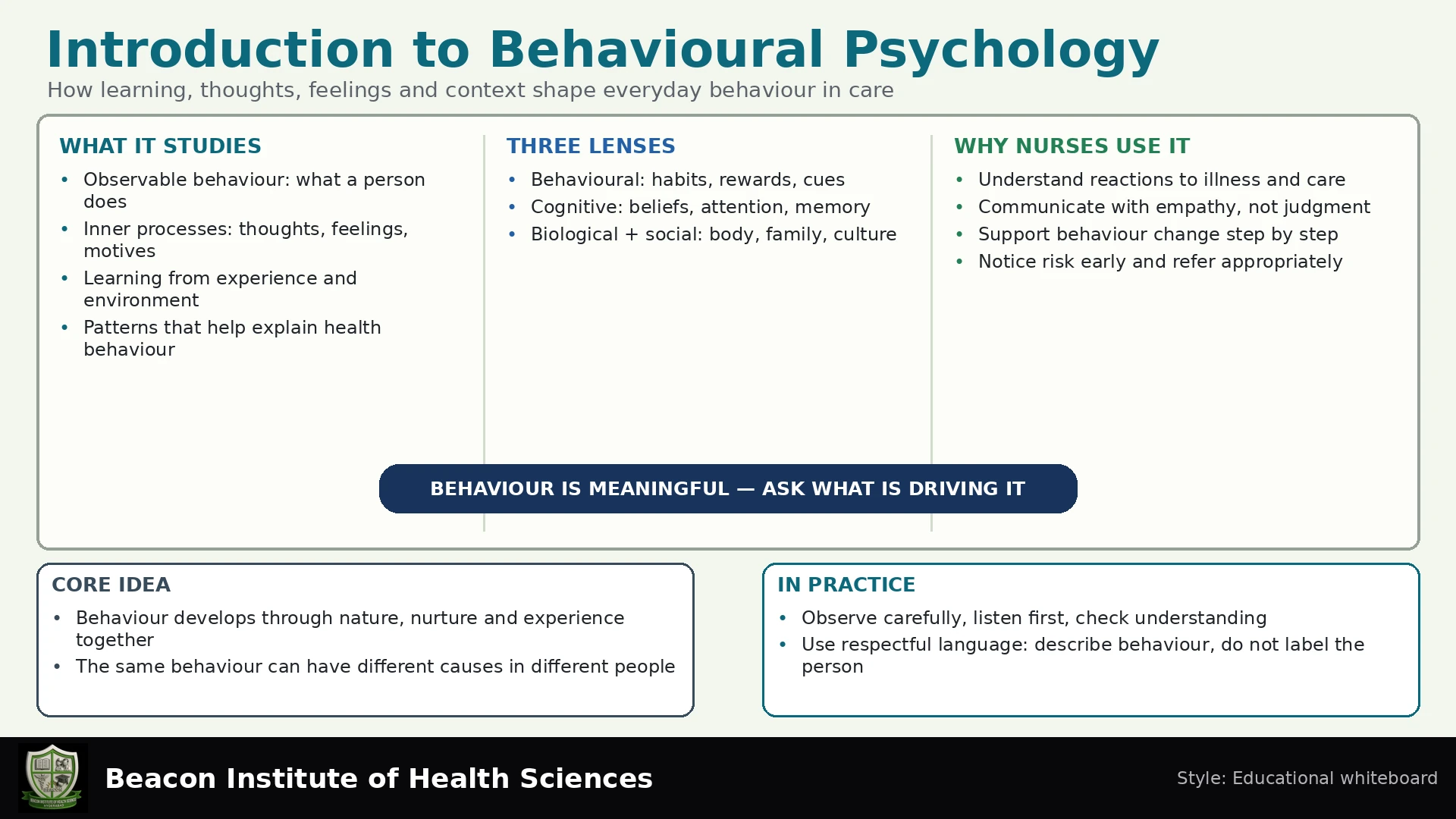
Psychology, in its broadest sense, is the scientific study of behaviour and mental processes. For nursing students, understanding behavioural psychology goes beyond simply observing actions; it involves comprehending the underlying principles that shape human responses in health and illness. While historical behaviourism focused exclusively on observable behaviour, modern behavioural psychology acknowledges the interplay of thoughts, emotions, and environmental factors.
Scientific Goals of Psychology
The scientific study of psychology aims to achieve four primary goals:
- Description: Systematically observing and documenting behaviour.
- Explanation: Understanding the causes behind observed behaviours.
- Prediction: Forecasting future behaviours based on established patterns and causes.
- Ethical Change: Applying psychological principles to promote positive, healthy, and adaptive behaviours, always ensuring interventions are client-centered and ethical.
Research Methods in Behavioural Psychology
Psychologists employ various methods to study behaviour:
- Observation: Directly watching and recording behaviour in natural or controlled settings.
- Interviews: Gathering self-reported information about experiences, thoughts, and feelings.
- Experiments: Manipulating one variable (independent variable) to observe its effect on another (dependent variable), supporting causal conclusions when design, control and analysis justify them.
- Correlational Studies: Examining the relationship between two or more variables. It is crucial to remember that correlation does not prove causation.
Ethical considerations such as informed consent and confidentiality are paramount in all psychological research and practice.
Foundational Concepts: Behaviourism and Learning
Watson emphasized observable behaviour as the subject of scientific study. Skinner studied how consequences shape behaviour; his radical behaviourism also considered private events such as thoughts and feelings, rather than denying their existence. Ivan Pavlov's groundbreaking work on classical conditioning also laid crucial groundwork. While modern psychology integrates cognitive and biological perspectives, the principles discovered by these pioneers remain fundamental to understanding learning.
Classical Conditioning
Classical conditioning, as demonstrated by Pavlov, involves learning through association. An organism learns to associate a neutral stimulus with a significant one, leading to a new, learned response.
- Unconditioned Stimulus (UCS): A stimulus that naturally and automatically triggers a response (e.g., food).
- Unconditioned Response (UCR): The natural, unlearned reaction to the UCS (e.g., salivation to food).
- Neutral Stimulus (NS): A stimulus that initially does not elicit the target response (e.g., a bell before conditioning).
- Conditioned Stimulus (CS): The formerly neutral stimulus that, after association with the UCS, comes to trigger a conditioned response (e.g., the bell after conditioning).
- Conditioned Response (CR): The learned response to the previously neutral (now conditioned) stimulus (e.g., salivation to the bell).
Example: In a classroom setting, if a teacher consistently plays a specific, pleasant jingle (NS/CS) right before announcing a fun, activity-based learning session (UCS), students might eventually feel a sense of excitement (CR) simply upon hearing the jingle, even without the activity being announced.
Additional Concepts in Classical Conditioning
- Extinction: The weakening and eventual disappearance of a conditioned response when the CS is repeatedly presented without the UCS.
- Generalization: The tendency for a conditioned response to be elicited by stimuli similar to the original CS.
Operant Conditioning
Operant conditioning, primarily associated with B.F. Skinner, suggests that behaviour is shaped by its consequences. Behaviours followed by desirable consequences are more likely to be repeated, while those followed by undesirable consequences are less likely.
- Reinforcement: Any consequence that increases the likelihood of a behaviour recurring.
- Punishment: Any consequence that decreases the likelihood of a behaviour recurring.
- Positive: Means adding something to the environment.
- Negative: Means removing something from the environment.
It is critical to remember that negative reinforcement is NOT punishment. Negative reinforcement increases behaviour by removing an aversive stimulus, whereas punishment decreases behaviour by adding an aversive stimulus or removing a desirable one.
Types of Operant Conditioning with Classroom Examples
| Type | Description | Classroom Example |
|---|---|---|
| Positive Reinforcement | Adding a desirable stimulus to increase a behaviour. | A student answers a question correctly, and the teacher offers verbal praise (e.g., "Excellent point!"). The student is more likely to participate again. |
| Negative Reinforcement | Removing an undesirable stimulus to increase a behaviour. | In a fictional learning game, completing the required step stops an irritating reminder sound. If completion becomes more frequent, removal of the sound has reinforced it. |
| Positive Punishment | Adding an undesirable stimulus to decrease a behaviour. | In a fictional computer game, an incorrect move adds a warning sound. If that move becomes less frequent, the added consequence functions as punishment. |
| Negative Punishment | Removing a desirable stimulus to decrease a behaviour. | In a fictional computer game, breaking a game rule removes a point. If rule-breaking becomes less frequent, loss of the point functions as punishment. |
Observational Learning
Observational learning, or social learning, involves acquiring new behaviours by observing others (models). This is particularly relevant in nursing education, where students learn through:
- Modelling: Imitating behaviours demonstrated by instructors or experienced nurses.
- Practice: Rehearsing observed behaviours to refine skills.
The ABCs of Behavioural Assessment
The Antecedent-Behaviour-Consequence (ABC) framework is a useful tool for systematically analyzing behaviour. It helps to understand why a behaviour occurs by identifying its triggers and outcomes.
- Antecedent (A): What happened immediately before the behaviour? (Environmental cues, internal thoughts/feelings).
- Behaviour (B): The specific, observable action or response.
- Consequence (C): What happened immediately after the behaviour? (Reactions from others, internal feelings, changes in environment).
When using the ABC assessment:
- Focus on describing observable behaviour rather than making assumptions about internal states.
- Consider potential unmet needs or medical causes that might contribute to the behaviour.
- Avoid using stigmatizing labels or blame; the focus is on understanding and facilitating positive change.
Interacting Influences on Behaviour
Behaviour is rarely determined by a single factor. It is a complex interplay of:
- Biological Influences: Genetics, brain chemistry, physiological states (e.g., fatigue, pain).
- Cognitive Influences: Thoughts, beliefs, expectations, perceptions.
- Social Influences: Peer pressure, social norms, family dynamics.
- Cultural Influences: Cultural values, traditions, and practices.
Nursing Teaching Case: Addressing Student Anxiety
Scenario: A BSN student consistently expresses high anxiety before nursing skills demonstrations, often stating, "I know I'll mess it up." This anxiety leads to visible tremors and hesitation during practice sessions, even though the student demonstrates good theoretical knowledge.
Behavioural Psychology Application:
- ABC Assessment:
- Antecedent: Upcoming skills demonstration, student's negative self-talk.
- Behaviour: Expressing anxiety, tremors, hesitation during practice.
- Consequence: Reduced performance, increased self-doubt. - Intervention Strategy:
- Supportive Explanation: The educator explains the normal physiological responses to stress and reframes the demonstration as a learning opportunity, not just an evaluation.
- Rehearsal (Observational Learning & Practice): The educator demonstrates the agreed safe technique, then guides the student through repeated practice sessions, offering clear instructions.
- Voluntary Achievable Goals: The student is encouraged to set small, manageable goals for each practice session (e.g., "Today, I will focus on proper hand hygiene and sterile field setup").
- Specific, Timely Feedback (Positive Reinforcement): The educator provides precise, constructive feedback, immediately praising correctly performed steps (e.g., "Your sterile glove technique was flawless today, that's excellent progress!") while gently correcting errors without judgment.
- Self-Report & Observation: The educator regularly asks the student about their confidence levels (self-report) and observes their technical skill improvement.
This fictional plan aims to support confidence and skill development. Progress must be checked through the student’s report and observed performance; improvement is not guaranteed.
Common Misconceptions
- All psychology is behaviourism: Modern psychology is multifaceted, integrating cognitive, biological, and socio-cultural perspectives alongside behavioural principles.
- Negative reinforcement is punishment: Negative reinforcement increases behaviour by removing an unpleasant stimulus, while punishment decreases behaviour.
- Focusing on behaviour ignores feelings: Behavioural approaches aim to understand the context and function of behaviours, which often include underlying emotional states, without solely relying on introspection.
Glossary
- Antecedent: A stimulus or event that occurs immediately before a behaviour.
- Behaviourism: A school of thought in psychology that emphasizes the study of observable behaviour and its relationship to environmental stimuli.
- Classical Conditioning: A type of learning where an organism associates a neutral stimulus with a significant one, leading to a new, learned response.
- Conditioned Response (CR): The learned reaction to a previously neutral (now conditioned) stimulus.
- Conditioned Stimulus (CS): A formerly neutral stimulus that, after association with an unconditioned stimulus, comes to trigger a conditioned response.
- Consequence: An event that follows a behaviour and affects its future probability.
- Extinction: The gradual weakening and disappearance of a conditioned response.
- Generalization: The tendency for a conditioned response to be elicited by stimuli similar to the original conditioned stimulus.
- Negative Reinforcement: The removal of an aversive stimulus following a behaviour, which increases the likelihood of that behaviour occurring again.
- Neutral Stimulus (NS): A stimulus that initially does not elicit the target response.
- Observational Learning: Learning by watching and imitating the behaviour of others.
- Operant Conditioning: A type of learning where behaviour is strengthened or weakened by the consequences that follow it.
- Positive Reinforcement: The addition of a desirable stimulus following a behaviour, which increases the likelihood of that behaviour occurring again.
- Positive Punishment: The addition of an aversive stimulus following a behaviour, which decreases the likelihood of that behaviour occurring again.
- Negative Punishment: The removal of a desirable stimulus following a behaviour, which decreases the likelihood of that behaviour occurring again.
- Punishment: Any consequence that decreases the likelihood of a behaviour recurring.
- Reinforcement: Any consequence that increases the likelihood of a behaviour recurring.
- Unconditioned Response (UCR): The natural, unlearned reaction to an unconditioned stimulus.
- Unconditioned Stimulus (UCS): A stimulus that naturally and automatically triggers a response.
Practice Questions
In a learning example, a sound is repeatedly paired with food and later elicits salivation on its own. Which learning process does this illustrate?
Answer: Classical Conditioning. The sound becomes the conditioned stimulus after pairing with food, the unconditioned stimulus. Salivation to the sound is the conditioned response.
A nursing instructor praises a student for submitting their care plan on time, and the student consistently submits future care plans punctually. What operant conditioning principle is at play?
Answer: Positive Reinforcement. The instructor is adding a desirable stimulus (praise) after the behaviour (submitting on time) to increase the likelihood of the behaviour recurring.
In a simulation laboratory, a student watches an instructor demonstrate hand hygiene, then rehearses the sequence on their own with feedback. Which learning processes are involved?
Answer: Observational Learning with practice. The student observes a model and then practises the sequence. Observation alone does not establish competence; performance needs assessment.
Test your knowledge further with our quiz: Introduction to Behavioural Psychology Quiz
Conclusion
Behavioural psychology provides a robust framework for understanding and influencing human actions. For BSN students, grasping concepts like classical and operant conditioning, observational learning, and the ABC assessment is crucial for effective patient care, health education, and professional development. By applying these principles ethically and thoughtfully, nurses can better support patients in developing positive health behaviours and manage complex care situations, always remembering to consider the multifaceted biological, cognitive, social, and cultural influences that shape each individual's behaviour.
Using learning principles ethically
The game examples classify consequences; they are not recommendations to punish patients or students. Reinforcement and punishment are defined by their observed effect on later behaviour, not simply by the intention to reward or discourage. Essential care, pain relief, food, dignity and access to support must never be made conditional on compliance. Ask what the person needs and agree supportive goals.
ABC records suggest patterns rather than proving a cause from a single episode. Record thoughts or feelings as the person’s report, and record visible actions separately. Conditioned associations can weaken or return depending on context; extinction does not necessarily erase the original learning.