
1. Learning objectives and central idea
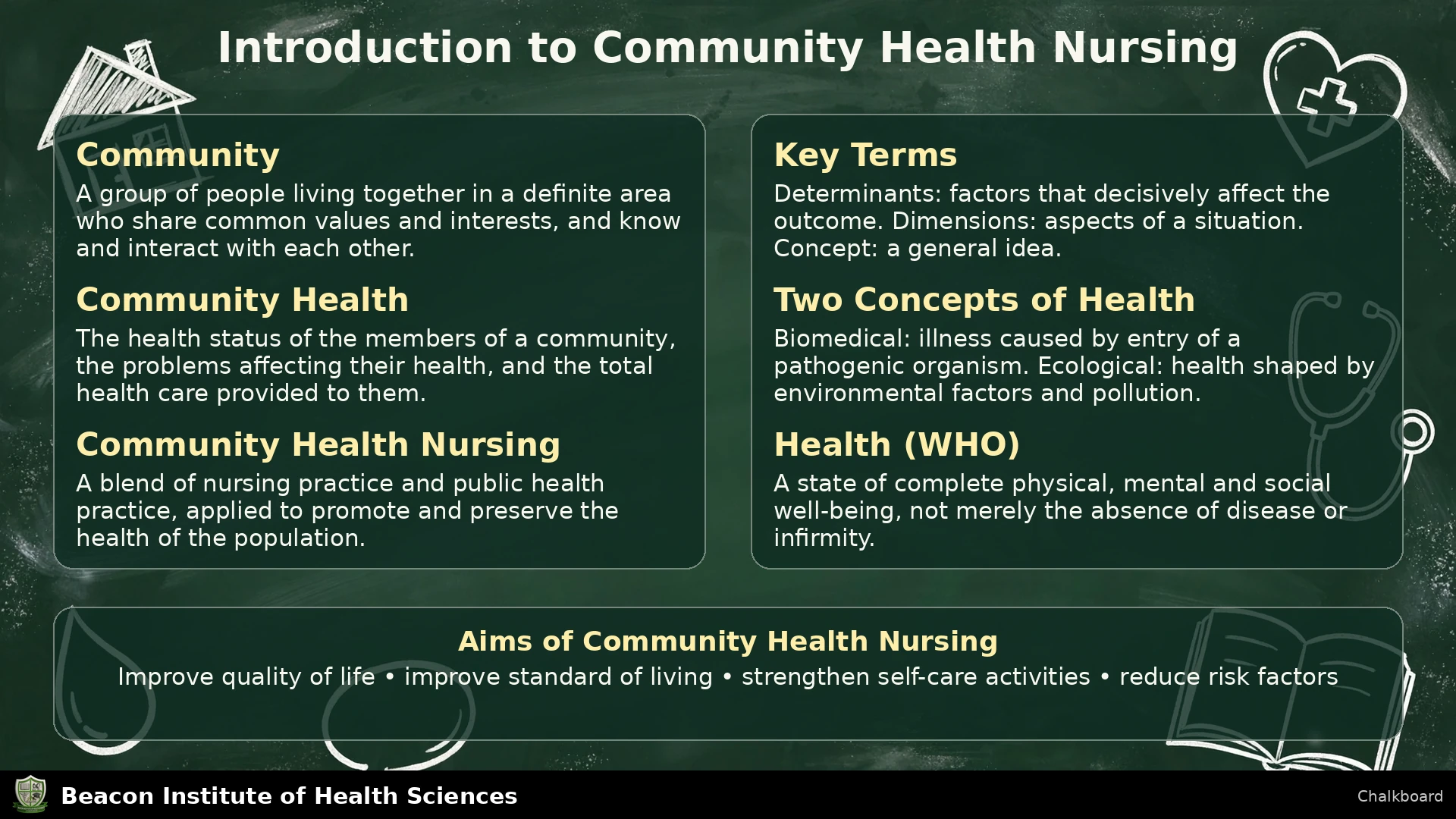
Community health nursing connects nursing care with the conditions in which people live, learn and work. By the end of this lesson, BSN students should explain population focus, distinguish levels of prevention, organize a simple community assessment and plan a measurable intervention. The central question is broader than who needs treatment today: which conditions repeatedly make people unwell, and how can the community and health team improve them?
2. Community, population and family
A community can be defined by place, shared interests or common experiences. A population is a group selected for analysis, such as schoolchildren in one district. Families and households provide support but are not identical terms. Define the group before counting health needs. A household survey does not automatically represent every resident. Record who was included, who was missed and why, so a community plan does not hide people who have difficulty accessing services.
3. Care in the community and care for the community
Providing an individual dressing at home is care delivered in a community setting. Identifying why many homes cannot access wound-care supplies introduces a population concern. Both activities matter, but their objectives and evaluation differ. The first may measure healing and comfort; the second may measure supply access across households. Community health nursing connects these levels rather than assuming that moving a hospital procedure outside the hospital creates a complete population programme.
4. Determinants of health and equity
Health is influenced by income, education, housing, transport, social support and environmental conditions as well as biological factors. Equity means responding fairly to different needs and barriers. Giving everyone the same appointment time may disadvantage people who work shifts or travel far. Ask about practical obstacles without blaming families. A nursing plan should describe both the health concern and the barrier that prevents a person or group from receiving suitable support.
5. Health promotion and prevention
Health promotion helps people and communities gain greater influence over health. Prevention can be organized into primary, secondary and tertiary levels. A prevention example is improving safe-water access before illness; early detection is a secondary activity; reducing disability after established illness is tertiary prevention. The classification depends on the purpose and timing. A single programme can include more than one level, so label its separate activities instead of forcing the whole programme into one category.
6. Roles of the community health nurse
Roles include assessment, education, care coordination, advocacy and evaluation. A nurse may help a family understand a referral, support an outreach session or communicate recurring barriers to the responsible team. These tasks require clinical judgment and knowledge of the local service network. Work within training, supervision and professional scope. Teamwork does not mean replacing another profession: it means knowing whose expertise is needed and making the connection clear to the person receiving care.
7. Community assessment: needs and assets
Begin with a defined area and purpose. Use available service records, respectful conversations and supervised observation to identify concerns. Also identify assets: trusted volunteers, schools, functioning water points and supportive family networks. A problem-only description can overlook resources already available. Separate observed facts from interpretations. For example, a closed clinic on one visit is an observation; claiming the clinic never opens requires further evidence. Community members should help explain what the information means.
8. Using the nursing process
Assessment gathers information; diagnosis describes the nursing concern; planning sets priorities and outcomes; implementation carries out agreed activities; evaluation checks progress. At community level, include the affected group and the setting. A classroom example is difficulty accessing child health sessions among households distant from the clinic. Avoid treating a community diagnosis as a medical diagnosis for every resident. Connect the plan to the evidence and review it when new information changes the original interpretation.
9. Priorities and realistic objectives
Discuss the seriousness of the concern, number of people affected, community preferences, available resources and feasibility. A common concern is not always the most urgent one. An objective should identify an action, target group, measure and review period. For a fictional project: within four weeks, a student team will provide verified clinic-location information to twenty consenting households and check whether each household can explain the route. This measures a practical result rather than merely distributing leaflets.
10. Family partnership and respectful communication
Ask permission before interviewing, explaining or examining. Use language the person understands and check meaning rather than asking only whether everything is clear. Recognize family strengths and the person who makes decisions about their own care. Do not assume that a household spokesperson can consent for every competent adult. When an interpreter is needed, protect confidentiality and use an appropriate arrangement. A respectful relationship improves the quality of information as well as participation in the plan.
11. Referral and continuity
A referral should state the reason, urgency, destination and relevant findings. Explain the next step and check transport or cost barriers when appropriate. Confirm follow-up through the authorized service pathway rather than assuming that giving an address completes the referral. Community workers, nurses and facilities contribute different skills. In Pakistan, Lady Health Workers provide an important community connection, while clinical assessment and treatment depend on the appropriate qualified team and local arrangements.
12. Records, confidentiality and simple indicators
Document relevant findings objectively and keep identifiable information in approved records. Classroom exercises should use fictional data. An indicator needs a numerator, denominator and defined period. If eighteen of twenty participating households can explain the clinic route, the result is eighteen divided by twenty times one hundred, or ninety percent. Report it as a result among participating households, not as proof that ninety percent of the entire community has access to care.
13. Worked community learning case
A fictional settlement reports missed outreach appointments. The student team initially proposes a poster, but conversations reveal that the session time conflicts with paid work. A better plan is to discuss alternative times with the service team, provide clear information and check attendance after any approved change. The lesson is that information alone may not remove a service barrier. Evaluate both reach and usefulness, and avoid promising changes that students cannot authorize.
14. Answered review and practical task
Define your chosen population, list two needs and two assets, and draft one measurable objective using fictional information. Answers: a community may be place-based or interest-based; primary prevention acts before the target illness; equity considers different barriers; referral requires a clear next step; an indicator must specify its denominator. Explain why a household sample may miss some residents. Recap: effective community health nursing joins individual care, population thinking, partnership and accountable follow-up.