
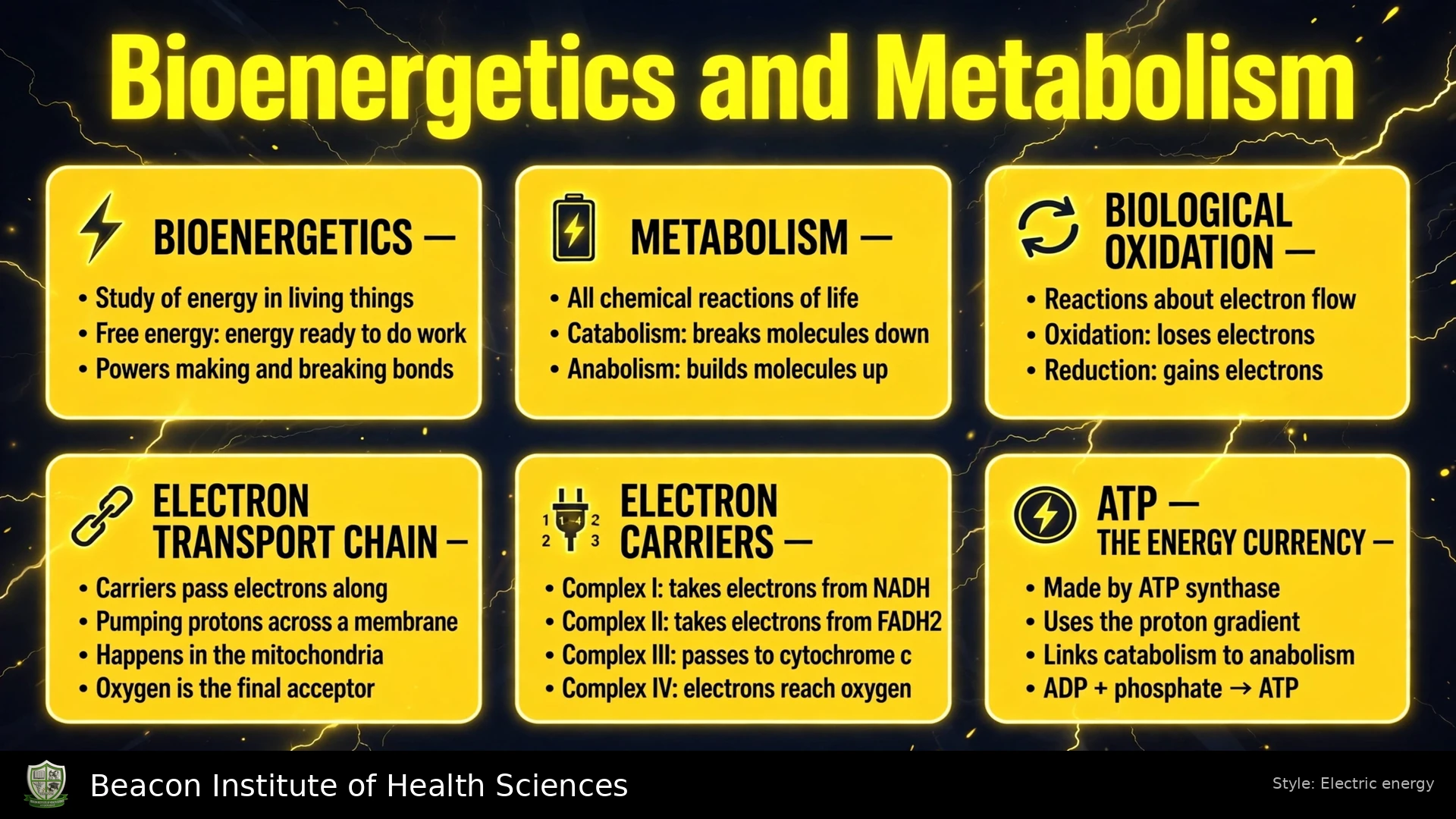
Bioenergetics explains how living cells obtain, transform and use energy. These independently prepared BSN biochemistry notes connect free energy, ATP and biological oxidation to metabolism and nursing observations. The emphasis follows the bioenergetics and introductory metabolism objectives used in Pakistan nursing curricula; students should compare the sequence with their own university outline.
1. Learning objectives and curriculum connection
Pakistan nursing biochemistry outlines include bioenergetics, oxidation and reduction, the electron transport chain, oxidative phosphorylation, anabolism and catabolism. The revised BSN outline hosted by CMH Lahore also explicitly includes free energy and ATP as the link between breakdown and synthesis. This lesson concentrates on that energy connection. For broader nutrient pathways, read the companion Metabolism notes.
- Define bioenergetics and distinguish it from metabolism.
- Interpret the sign of a free-energy change and explain energy coupling.
- Explain how ATP supports chemical, transport and mechanical work.
- Follow electrons from reduced coenzymes to oxygen and explain chemiosmosis.
- Compare substrate-level phosphorylation with oxidative phosphorylation.
- Apply the concepts to oxygen delivery, fasting, glucose use and clinical observations.
2. Energy transformations in the human body
Energy is the capacity to perform work. Chemical potential energy in nutrients can be transferred into ATP, an electrochemical gradient, movement and heat. Kinetic energy is associated with motion. A proton gradient across a membrane stores potential energy because the ions are separated against their tendency to equilibrate.
The first law of thermodynamics describes energy conservation: metabolism transforms energy rather than creating it. The second law explains why energy transfers increase the total entropy of a system and its surroundings. Cells maintain local organisation by taking in nutrients and releasing heat and waste; they are open systems. Heat released during metabolism contributes to body temperature, but it cannot all be recovered to perform useful cellular work.
3. Free energy, reaction direction and activation energy
Gibbs free energy is the energy available for useful work at constant temperature and pressure. The change in free energy between products and reactants is written as ΔG. A useful relationship is:
ΔG = ΔH − TΔS
Here ΔH is the enthalpy change, T is absolute temperature in kelvin, and ΔS is the entropy change. Temperature must not be inserted in degrees Celsius in this expression.
- ΔG < 0: an exergonic reaction is thermodynamically favourable in the stated direction.
- ΔG > 0: an endergonic reaction requires coupling to a favourable process or altered conditions.
- ΔG = 0: the reaction is at equilibrium, with no net change from forward and reverse reactions.
Favourable does not mean instantaneous. Activation energy is the barrier that must be overcome for a reaction to proceed. Enzymes lower this barrier and increase reaction rate; they do not change the reaction's ΔG or the equilibrium position. Exergonic and exothermic are also different terms: free-energy change and heat change are related but are not identical.
4. ATP: structure, hydrolysis and regeneration
Adenosine triphosphate consists of adenine, ribose and three phosphate groups. Its hydrolysis to ADP and inorganic phosphate can be coupled to cellular work:
ATP + H2O → ADP + Pi
Pi means inorganic phosphate. The overall hydrolysis reaction has a negative free-energy change under typical cellular conditions. Calling a phosphate bond “high energy” describes a large favourable free-energy change of hydrolysis; breaking a bond alone requires energy. The more stable products and their interactions with water help explain the net release.
ATP is continually regenerated from ADP and phosphate using energy supplied by other processes. It is a rapidly cycling energy-transfer molecule, while glycogen and triglycerides are fuel reserves. A cell cannot sustain normal function simply by using up a fixed store of ATP without replenishment.
5. Energy coupling links catabolism and anabolism
Catabolism breaks down molecules and can supply energy and building blocks. Anabolism constructs molecules and requires energy. ATP connects the two: energy captured during nutrient breakdown supports ATP formation, while coupled ATP reactions help drive biosynthesis and other work. Catabolic and anabolic pathways operate together, with their relative activities changing according to need.
Worked example: adding free-energy changes
Suppose a synthetic reaction has ΔG = +20 kJ/mol and a directly coupled driving reaction has ΔG = −30 kJ/mol under the same conditions. Their combined free-energy change is:
ΔGcombined = +20 + (−30) = −10 kJ/mol
The combined process is favourable. These are illustrative values, not measurements of a particular patient or a universal value for ATP hydrolysis. Merely putting two substances in the same container does not establish coupling: the reactions need a shared intermediate or a molecular mechanism that connects them.
Examples of ATP-dependent work
- Chemical work: activation of substrates and synthesis of cellular molecules.
- Transport work: ion pumps that maintain gradients across membranes.
- Mechanical work: muscle contraction and movement of motor proteins.
6. Biological oxidation and reduction
Oxidation is loss of electrons; reduction is gain of electrons. They occur together because electrons removed from one substance are accepted by another. In nutrient oxidation, carbon-containing fuels progressively lose electrons, and carriers transfer reducing equivalents to other reactions.
NAD+ is reduced to NADH, and FAD is reduced to FADH2. The reduced forms can donate electrons into energy-producing processes. They are electron carriers rather than alternative names for ATP. NADPH mainly supports reductive biosynthesis and antioxidant systems; its usual cellular role differs from that of NADH.
A memory aid is “oxidation loses, reduction gains.” Apply it to the electrons, not just to whether oxygen appears in the name of a reaction. Many biological redox reactions involve hydrogen transfer without oxygen being a direct reactant.
7. Where glucose energy is captured
Complete glucose oxidation involves several connected stages. Glycolysis occurs in the cytosol. Pyruvate oxidation and most citric acid cycle reactions occur in the mitochondrial matrix. Electron transport and ATP synthase are associated with the inner mitochondrial membrane.
- Glycolysis, per glucose: two pyruvate, two net ATP and two NADH. Four ATP are formed after two were invested.
- Pyruvate oxidation, per glucose: two acetyl-CoA, two NADH and two CO2; this link reaction produces no ATP directly.
- Citric acid cycle, per glucose: two turns yield six NADH, two FADH2, two GTP or ATP equivalents and four CO2.
The cycle is also called the Krebs or tricarboxylic acid cycle. Most of its captured energy is carried by reduced coenzymes for subsequent electron transport. The cycle also supplies intermediates for synthesis, so it serves both breakdown and biosynthetic functions.
8. Electron transport chain
The mitochondrial electron transport chain transfers electrons through a sequence of carriers toward oxygen. The main respiratory complexes are I, II, III and IV. Coenzyme Q and cytochrome c act as mobile carriers between complexes.
- Matrix NADH donates electrons through complex I.
- Electrons from succinate oxidation enter through complex II and its associated FAD.
- Coenzyme Q passes electrons to complex III, and cytochrome c passes them to complex IV.
- Complex IV transfers electrons to oxygen, which is reduced to water.
Complexes I, III and IV help move protons from the matrix to the intermembrane space. Complex II does not pump protons. Electron entry that bypasses complex I therefore supports a smaller proton transfer and usually a smaller ATP yield. Oxygen is the terminal electron acceptor; it does not supply the original electrons extracted from nutrients.
9. Chemiosmosis and oxidative phosphorylation
Proton pumping creates an electrochemical gradient across the inner mitochondrial membrane. This gradient includes a concentration difference and an electrical difference. Protons can return toward the matrix through ATP synthase, coupling their movement to ATP formation from ADP and phosphate.
Nutrient oxidation → reduced carriers → electron transfer → proton gradient → ATP synthesis
Oxidative phosphorylation describes ATP production coupled to oxidation through this system. ATP synthase is often called complex V, but its task differs from the electron-transfer complexes: it uses the gradient rather than directly passing electrons to oxygen. Efficient operation needs an intact inner membrane, a continuing electron supply, oxygen, ADP and phosphate.
An inhibitor can block a step in electron transfer or ATP synthesis. An uncoupler dissipates the proton gradient, so oxidation and oxygen consumption may continue while less energy is captured as ATP and more is released as heat. These are biochemical distinctions, not instructions to use such substances.
10. Comparing the two ATP-producing mechanisms
- Substrate-level phosphorylation: an enzyme transfers phosphate from a phosphorylated substrate to ADP, or to GDP in a GTP-forming reaction. Examples occur in glycolysis and the citric acid cycle.
- Oxidative phosphorylation: ATP synthase uses a proton gradient generated by respiratory electron transfer. It accounts for most ATP from complete aerobic glucose oxidation.
Glycolysis itself does not directly require oxygen. Oxidative phosphorylation depends on oxygen as the final electron acceptor. Mature red blood cells lack mitochondria and obtain ATP through glycolysis, demonstrating why oxygen carried in blood does not mean every cell uses mitochondrial respiration.
Worked example: gross and net ATP
If glycolysis uses two ATP and later forms four, its net ATP return is 4 − 2 = 2 ATP per glucose. When pyruvate becomes lactate, NADH is reoxidised to NAD+, allowing glycolysis to continue. Lactate formation adds no further ATP to that glycolytic total. Lactate can later be used as a fuel or as a glucose precursor.
Whole-cell ATP totals depend on shuttle systems, transport costs and the accounting model. A glycolytic net yield is not the same as the ATP yield from complete oxidation. State assumptions when comparing textbook totals rather than treating one whole-cell number as an invariant patient measurement.
11. Essential metabolism terms
- Glycogenesis: production of glycogen for glucose storage.
- Glycogenolysis: breakdown of stored glycogen; liver glycogen supports blood glucose, while muscle glycogen mainly supports that muscle's use.
- Gluconeogenesis: glucose production from suitable precursors, including lactate, glycerol and glucogenic amino-acid carbon skeletons; it requires energy.
- Transamination: transfer of an amino group between molecules.
- Deamination: removal of an amino group; nitrogen subsequently needs safe handling and disposal.
- Ketogenesis: formation of ketone bodies, principally in the liver.
- Ketosis: increased ketone-body availability; its interpretation depends on the clinical context.
Fatty-acid beta-oxidation supplies acetyl-CoA and reduced carriers. Amino-acid carbon skeletons enter pathways after their nitrogen groups are handled. These routes explain how different fuels converge on mitochondrial energy production. Their detailed reactions are covered in the companion nutrient-metabolism lessons.
12. Regulation and the fed-to-fasting transition
Pathway activity is regulated through substrate availability, enzyme activity, compartmentation and hormonal signals. Feedback from products and indicators of cellular energy availability helps match ATP supply to demand. Increasing ATP use produces more ADP, which can support increased respiratory ATP production when other requirements are available.
After a meal, insulin promotes nutrient use and storage. Between meals, a lower insulin-to-glucagon ratio favours mobilisation of stored fuels and maintenance of blood glucose. Longer fasting increases reliance on fat oxidation and ketone use, while gluconeogenesis continues for tissues that require glucose. These are coordinated changes in relative rates, not a complete switch that turns all other pathways off.
Physiological ketone production during reduced carbohydrate availability differs from diabetic ketoacidosis. Ketoacidosis involves a clinical disturbance with excessive ketones and metabolic acidosis; ketones alone do not establish its diagnosis.
13. Nursing scenario: impaired oxygen delivery
A patient with acute respiratory deterioration becomes breathless and increasingly confused. The biochemical connection is that insufficient tissue oxygen delivery can limit electron transport and oxidative ATP production. ATP-dependent membrane pumps and other essential functions may then be compromised.
The nurse assesses breathing, oxygenation, circulation, mental status and trends in observations, and promptly escalates deterioration using the institution's emergency process. A saturation reading is one part of assessment: blood oxygen content and tissue delivery also depend on haemoglobin and circulation. The biochemical explanation supports clinical reasoning; it does not replace bedside assessment or the prescribed care plan.
14. Nursing scenarios: fasting and abnormal metabolism
Reduced food intake
A patient has eaten very little because of persistent nausea. Ask about the duration and amount of intake, review the care plan and prescribed monitoring, and observe hydration, weight trends and relevant glucose results. Explain that stored fuels can support energy production temporarily, but prolonged inadequate intake can also draw on tissue protein. Record findings and communicate nutritional concerns for an appropriate assessment.
Possible ketoacidosis
A person with diabetes reports vomiting and abdominal discomfort and develops deep, rapid breathing. Increased ketone formation and disturbed acid-base balance are relevant possibilities. Prompt clinical assessment is needed, with glucose, ketones and acid-base investigations as directed by the local pathway. Do not label every fasting ketone result as diabetic ketoacidosis or assume that the glucose value alone excludes it.
Interpreting an elevated lactate
Lactate can rise through increased production or reduced clearance, and it can be produced even when oxygen is available. Interpret a lactate result with the patient's clinical state and serial observations. It is not proof of one diagnosis, nor is lactate simply a useless waste substance. Report deterioration and abnormal trends through the appropriate clinical team.
15. Revision prompts and common errors
- Why is ATP a link between catabolism and anabolism? Breakdown can support ATP regeneration; coupled ATP reactions can drive synthesis and cellular work.
- Does a negative ΔG guarantee a fast reaction? No. It describes thermodynamic favourability, while activation energy influences rate.
- Where are the respiratory chain and ATP synthase? In the inner mitochondrial membrane.
- Which respiratory complexes pump protons? I, III and IV; complex II does not.
- What is oxygen's role? It accepts electrons at the end of the respiratory chain and is reduced to water.
- What is chemiosmosis? Use of an electrochemical proton gradient to support ATP synthesis.
- Does glycolysis directly consume oxygen? No. Its continuation requires regeneration of NAD+.
- Does lactate formation give extra ATP? No; it regenerates NAD+ and supports continued glycolysis.
For an exam answer, define the process, identify its location, state its inputs and outputs, explain its energy role, and add one relevant nursing connection. Use the linked topic quiz to check understanding after reviewing these notes.