
These are independently prepared, reference-based foundation notes for the BSN nursing program. They are not a transcript or a verified account of every point in the supplied lecture.
1. Meaning of metabolism
Metabolism is the combined set of chemical reactions through which the body uses nutrients, obtains usable energy and makes its own substances. It includes breakdown and synthesis. The processes operate together: materials released by one pathway can enter another, while energy transferred during nutrient oxidation can support cellular work.
Catabolism and anabolism
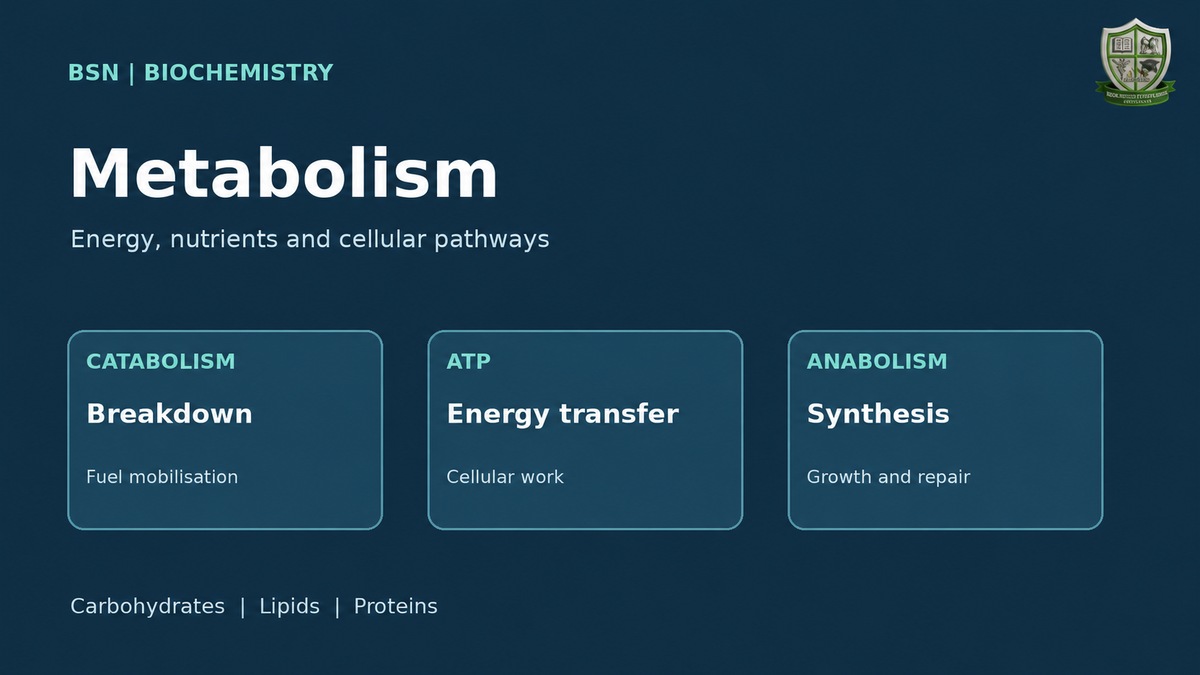
Catabolism breaks larger substances into smaller products. Nutrient breakdown can transfer chemical energy into ATP and electron carriers. Anabolism assembles larger substances from smaller components and requires an energy supply. Protein synthesis from amino acids and glycogen formation from glucose illustrate biosynthesis.
These terms describe reaction direction and energy relationships, not simply whether a substance is useful or harmful. Tissue maintenance needs both: breakdown provides substrates and energy, while synthesis replaces molecules and supports growth and repair.
Energy carriers
ATP contains adenine, ribose and three phosphate groups. Cells continually cycle ATP and ADP as energy is transferred between reactions. NADH and FADH2 carry electrons obtained during oxidation; they are not interchangeable names for ATP. Oxidation means electron loss and reduction means electron gain. The two occur together when electrons pass between substances.
2. Enzymes and pathway regulation
An enzyme is a biological catalyst. It lowers the activation barrier for a reaction without changing the overall free-energy difference between reactants and products. The enzyme is regenerated after catalysis rather than being permanently consumed as a fuel.
Substrates and active sites
The substrate is the substance on which an enzyme acts. It binds at an active site whose chemical environment favours the reaction. Binding can change the shapes of enzyme and substrate; this dynamic interaction is described by the induced-fit model.
Enzyme activity depends on conditions, including temperature, pH, substrate availability and the presence of necessary helper substances. Extreme conditions can disrupt protein structure. Cofactors include required inorganic ions; coenzymes are organic helper molecules, some made from vitamins.
Controlling a metabolic pathway
In a pathway, successive enzymes convert starting materials through intermediates into products. Cells can regulate enzyme amount, activity and location. Competitive inhibitors compete at the active site. Other regulators act elsewhere on the enzyme. In feedback inhibition, a pathway product helps slow its own further production. This prevents the assumption that every enzyme operates at its maximum rate continuously.
3. Glycolysis: the cytosolic stage of glucose breakdown
Glycolysis converts one six-carbon glucose molecule into two three-carbon pyruvate molecules through ten enzyme-catalysed reactions in the cytosol. Molecular oxygen is not a direct reactant in this pathway.
Investment and return
- The early reactions invest two ATP molecules and prepare glucose for splitting.
- The six-carbon intermediate is divided into three-carbon units that proceed through the later reactions.
- Oxidation transfers electrons to NAD+, producing two NADH per glucose.
- Later phosphate-transfer reactions produce four ATP, giving a net return of two ATP after the initial investment.
- The final carbon products are two pyruvate molecules.
Net accounting per glucose: two pyruvate, two ATP and two NADH. Gross ATP production and net ATP production must be distinguished; four produced minus two used equals two net.
Maintaining the electron acceptor supply
Glycolysis needs a continuing supply of NAD+. Conversion of pyruvate to lactate can regenerate NAD+ from NADH, allowing glycolysis to continue when oxidative processing cannot meet demand. Lactate formation does not itself add extra ATP to glycolysis's net yield. In aerobic metabolism, electrons carried by NADH can instead reach mitochondrial electron-transfer processes.
4. Mitochondrial oxidation and ATP production
Pyruvate can enter mitochondria and be converted into acetyl-CoA. Carbon dioxide is released and NADH is formed during this link between glycolysis and the citric acid cycle. Fatty-acid breakdown can also supply acetyl-CoA, making it a point where different fuels converge.
Citric acid cycle
The citric acid cycle, Krebs cycle and tricarboxylic acid cycle are names for the same pathway. Its reactions occur in the mitochondrial matrix. Acetyl-CoA contributes carbon to the cycle, carbon is released as carbon dioxide, and electron carriers are reduced. The pathway also supplies intermediates for other cellular reactions.
Electron transport and chemiosmosis
Electron-transfer complexes in the inner mitochondrial membrane accept electrons from reduced carriers. Energy transfer helps move protons across the membrane, creating a gradient. Their return through ATP synthase supports ATP formation from ADP and inorganic phosphate. Oxygen receives electrons at the end of the chain and contributes to water formation.
The electron transport chain creates the gradient; ATP synthase uses it. These coupled processes are distinct from glycolysis's direct phosphate transfers. Complete glucose oxidation produces substantially more ATP than glycolysis alone. Exact accounting depends on the assumptions and transport systems used, so glycolysis's net two ATP should not be confused with a whole-cell total.
5. Carbohydrate storage and glucose production
Dietary carbohydrates must be digested and absorbed before their components can be used by tissues. Absorbed glucose may be oxidised, stored or redirected into other synthetic pathways.
Terms that must be distinguished
- Glycolysis: breakdown of glucose to pyruvate.
- Glycogenesis: synthesis of glycogen from glucose units.
- Glycogenolysis: breakdown of stored glycogen.
- Gluconeogenesis: formation of glucose from suitable non-carbohydrate precursors.
Glycogen is a glucose reserve in liver and skeletal muscle. Storage and mobilisation help match an intermittent nutrient supply to continuing energy needs. Gluconeogenesis can use substrates such as lactate, glycerol and glucogenic amino-acid carbon skeletons. It involves an energy requirement and bypass reactions; it is not simply every glycolytic reaction running backward.
Oxygen and pyruvate fate
Glycolysis and mitochondrial oxidation should be considered separately. Glycolysis does not directly consume oxygen. Mitochondrial electron transport depends on oxygen as its terminal electron acceptor. Mature red blood cells lack mitochondria and rely on glycolysis for ATP. In other tissues, pyruvate's subsequent processing depends on cellular conditions and capacity. Lactate can be transported and reused rather than being treated as a permanently useless end product.
6. Lipid metabolism
Triglycerides provide a major energy reserve. Dietary fat must be digested, absorbed and transported before being stored or used. Bile assists the handling of fat in the intestine, while lipases catalyse its chemical breakdown. Intestinal cells package much absorbed dietary lipid into chylomicrons, which pass through lymph before entering the bloodstream.
Mobilisation and oxidation
Lipolysis releases fatty acids and glycerol from triglyceride. Beta-oxidation processes fatty acids through repeated reactions that generate acetyl-CoA and reduced electron carriers. These products connect fat use with mitochondrial ATP production.
Synthesis and ketone bodies
Lipogenesis means lipid synthesis and storage, whereas lipolysis means mobilisation. Similar wording should not obscure their opposite directions. When the liver produces ketone bodies from acetyl-CoA, the process is called ketogenesis. Ketones can supply fuel to other tissues.
A change in fuel use does not automatically establish a disease. Ketone formation during adaptation to reduced carbohydrate availability must be distinguished from clinically dangerous ketoacidosis. Interpretation requires the person's clinical state and appropriate measurements. Fat and carbohydrate pathways are connected, but an acetyl-CoA supply is not equivalent to a supply of newly formed glucose.
7. Protein and nitrogen metabolism
Proteins serve structural, transport, signalling and catalytic roles. Digestion releases amino acids and small peptides; absorbed amino acids enter the body's available amino-acid supply and can support new protein synthesis. Some amino acids must come from dietary sources because humans cannot make them in sufficient amounts.
Using an amino acid
An amino acid has both a nitrogen-containing group and a carbon skeleton. When it is used as a fuel, these parts require different handling. Transamination transfers an amino group between molecules. Deamination removes nitrogen from a molecule. The remaining carbon skeleton can enter pathways related to energy production or biosynthesis.
Ammonia is toxic when it accumulates. The liver's urea cycle converts nitrogen into urea, which can be carried to the kidneys for excretion. Liver nitrogen processing and renal excretion are therefore related but different functions.
Glucogenic and ketogenic carbon skeletons
Glucogenic amino acids can contribute carbon to glucose-producing pathways. Ketogenic amino acids produce carbon products associated with acetyl-CoA or ketone-body formation. Some amino acids have both classifications. The body has no dedicated protein energy store comparable with glycogen or triglyceride; extensive use of tissue protein can compromise functional tissues.
8. Fed, fasting and prolonged nutrient deprivation
The body's metabolic pattern changes with nutrient availability. These are shifts in relative pathway activity rather than switches that stop all competing reactions.
Absorptive state
After a meal, nutrients enter circulation. Increased insulin action favours use and storage of incoming nutrients, including glycogen formation, lipid storage and protein synthesis. Immediate activity can use newly absorbed fuel instead of storing all of it.
Postabsorptive state
Between meals, absorbed nutrient input declines. Reduced insulin and increased glucagon influence help the liver support blood glucose through glycogen mobilisation and glucose formation. Fatty-acid mobilisation also increases. Different tissues do not all use the same fuel in the same proportion.
Prolonged deprivation
With sustained food deprivation, glycogen reserves become inadequate, gluconeogenesis continues and lipid-derived fuels become increasingly important. Ketones can help supply brain energy as adaptation progresses. Protein breakdown supplies some precursors, but adaptation can reduce its relative demand; it does not make starvation harmless.
For study, compare each state using the same questions: what fuel is arriving, what is stored, what is mobilised, how is blood glucose supported, and which hormonal signals favour the pattern? A single measurement cannot describe every pathway operating in the body.
9. Metabolic rate, heat and energy balance
Metabolic rate describes energy use over time. Basal metabolic rate refers to energy expenditure under defined resting, fasting conditions. Actual daily expenditure also includes activity and the energy cost of processing food. Body composition and physiological circumstances influence requirements; one fixed calorie value does not suit everyone.
Heat production and loss
Nutrient oxidation does not convert all available energy into useful cellular work. Heat is also produced. The hypothalamus coordinates thermoregulation through responses such as sweating, changes in skin circulation and shivering.
- Conduction: heat transfer through direct contact.
- Convection: heat transfer through moving air or water.
- Radiation: heat exchange without direct contact.
- Evaporation: heat loss when liquid water becomes vapour.
Shivering uses muscle activity to increase heat production. Sweating can support heat loss when evaporation occurs. Environmental conditions therefore influence the effectiveness of a response. Energy balance compares intake with expenditure over time: sustained surplus can increase stored energy and sustained deficit draws on reserves. Energy expenditure, body temperature and nutritional status are connected concepts, but they are not identical measurements.
10. Nutrients and nursing interpretation
Carbohydrates, fats and proteins supply both energy and materials. Vitamins and minerals support specific functions, including enzyme activity; they are not equivalent to a supply of ATP or calories. Nutritional adequacy concerns both the amount of food and its composition.
Energy units
The food-label Calorie is a kilocalorie: 1 kcal equals 1000 small calories and approximately 4.184 kJ. Carbohydrate and protein are commonly assigned about 4 kcal per gram, and fat about 9 kcal per gram. These are practical nutritional estimates, not a claim that every molecule produces the same ATP yield in every cell.
A structured interpretation sequence
- Identify the substrate or nutrient being discussed.
- Name the pathway and distinguish synthesis from breakdown.
- Identify the relevant tissue and cellular compartment.
- Separate carbon handling, nitrogen handling and electron transfer.
- Consider whether the person is fed, fasting or experiencing prolonged inadequate intake.
- Relate the concept to documented nutrition, activity and clinical measurements rather than diagnosing from one isolated biochemical term.
In nursing study, these distinctions connect nutrition and physiological monitoring with cellular processes. They support interpretation of the clinical information already available; medication, feeding and treatment decisions still require the prescribed plan and relevant clinical assessment.