
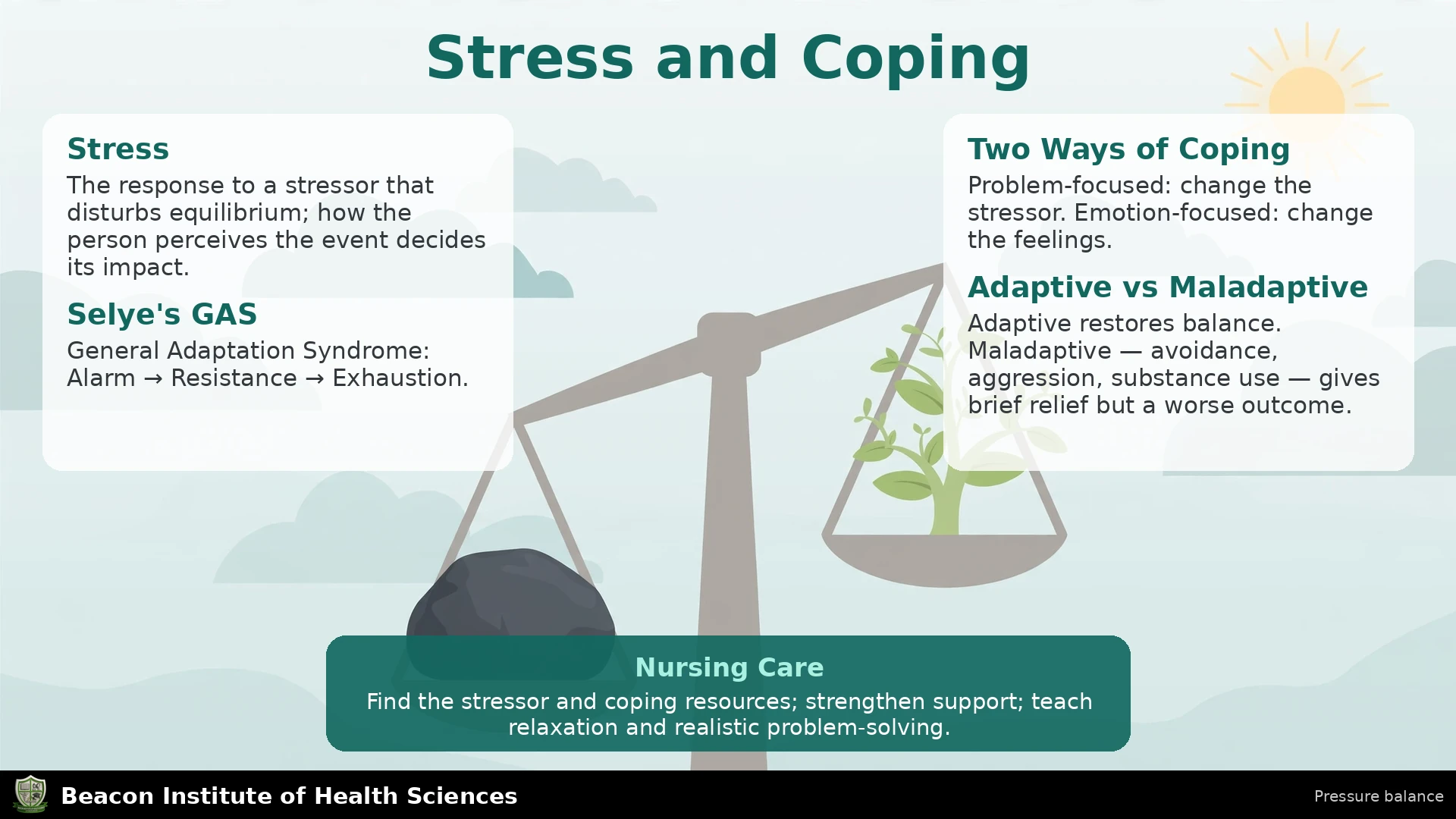
1. Learning objectives and meaning
Stress describes a response to demands that a person experiences as challenging or threatening. A stressor is the demand or event; the stress response is the reaction. Coping describes efforts to manage the demand, the reaction or both. BSN students should distinguish these ideas, recognize individual differences, describe supportive nursing assessment and evaluate a coping plan. This lesson provides general education, not diagnosis or an individual treatment plan.
2. Stressors and individual context
Stressors may involve illness, uncertainty, financial pressure, family responsibilities, examinations or workplace demands. Some events are brief; others continue for weeks or longer. The same event can have different meanings for different people. A student may welcome a presentation but worry about an unfamiliar practical assessment. Ask about the person's own experience rather than judging stress from the event alone. Social conditions and available resources matter.
3. Appraisal and perceived resources
Appraisal is the meaning a person gives to a situation. Primary appraisal considers whether the event represents harm, threat or challenge. Secondary appraisal considers possible actions and available resources. These processes can change as new information appears. A person who understands an unfamiliar procedure may feel more able to manage it. Accurate information, choice and support can influence coping, but nurses should not promise that explanation will remove every concern.
4. Body responses and adaptation
Stress can activate sympathetic and hormonal responses, preparing the body for action. Heart rate, alertness and muscle tension may change. Such responses do not prove that a person has a specific disorder. The classic general adaptation model describes alarm, resistance and exhaustion as a teaching framework, not a rigid timetable for every individual. Persistent demands with inadequate recovery can affect functioning. Physical symptoms also require appropriate assessment rather than being automatically attributed to stress.
5. Acute, persistent and helpful demands
Acute stress is associated with a more immediate demand; persistent stress involves continuing pressure. Manageable challenge may help motivation, while overwhelming demands can interfere with concentration or daily activities. Avoid assuming that all stress is harmful or that a person should simply become tougher. Coping depends on context, health and support. A nursing student needs opportunities for recovery, supervision and realistic workload, alongside personal learning strategies.
6. Problem-focused and emotion-focused coping
Problem-focused coping addresses a changeable part of the demand, such as making a study plan or asking for clarification. Emotion-focused coping addresses emotional responses, such as seeking supportive conversation or practising a calming skill. Both can be useful and often occur together. The best approach depends partly on what can be controlled. A person cannot instantly remove an illness, but may still ask questions, express concerns and participate in appropriate decisions.
7. Evaluating coping strategies
Assess a strategy by its short-term effect, longer-term consequences and fit with the situation. Avoid labelling a person as a poor coper. Withdrawal might temporarily reduce discomfort but also prevent needed support. Substance use or harmful behavior can create additional problems. Healthy coping is not constant positivity. It can include acknowledging difficult feelings while taking a manageable action. Review what has helped before and whether the person wants to try it again.
8. Supportive nursing assessment
Begin with a respectful conversation about the main concern, duration, effect on sleep and function, available support and current coping. Use open questions, allow time and protect privacy. Ask what the person most wants help with. Observe changes without assuming their cause. Assessment tools support a trained evaluation but do not replace it. Refer significant concerns through the appropriate clinical or student-support pathway. A classroom article cannot determine a diagnosis from a checklist.
9. Communication and person-centered planning
Listen without minimizing feelings or insisting that another person has worse problems. Reflect the concern accurately, explain available information and ask permission before offering suggestions. Agree on a small goal that matters to the person. For example, a fictional student may aim to identify two difficult topics and arrange a supervised practice session. Document the plan appropriately and avoid making promises about outcomes. Culture, language, faith and family preferences should be explored without stereotypes.
10. Everyday support and recovery
A regular routine, suitable sleep habits, physical activity and contact with trusted people can support coping. These measures should fit the individual's situation and health. Limit distressing media exposure when it increases worry. Simple grounding practice can involve noticing the surroundings and returning attention to the current task. It is a coping exercise rather than a cure. Persistent difficulties deserve help from a qualified professional, not pressure to solve everything through self-help.
11. Safety, referral and professional boundaries
Seek assessment when distress is persistent, worsening or significantly affects daily life. Do not dismiss severe physical symptoms as anxiety. If a person expresses thoughts of self-harm or seems unable to stay safe, use the local urgent-help or emergency pathway and obtain qualified support promptly. Nurses and students must work within their roles. Maintain confidentiality within applicable limits, and explain when safety concerns require involving the appropriate team.
12. Fictional case: examination pressure
A fictional BSN student feels overwhelmed by three assignments and an upcoming skills assessment. First identify the actual deadlines and the areas needing practice. A problem-focused step is to divide work into specific tasks and ask the instructor about unclear requirements. An emotion-focused step is a supportive conversation or brief grounding break. Review the plan after several days using completed tasks and the student's experience. Do not assume one successful day proves that all stress has resolved.
13. Practical reflection activity
Create a private learning worksheet with four headings: demand, what can be influenced, available support and next action. Use a fictional or ordinary academic situation, without recording patient identifiers. Choose an action that is specific and feasible. Set a review time and identify what would indicate that more support is needed. Reflection should promote learning, not require public disclosure of personal distress or pressure students to reveal sensitive experiences.
14. Answered review and recap
What is the difference between a stressor and stress? The stressor is the demand; stress is the response. Is emotion-focused coping always avoidance? No; it can support appropriate emotional management. Does a stress symptom prove a diagnosis? No. Why assess resources? They affect possible coping actions. Should persistent impairment be managed only by self-help? No; appropriate professional assessment may be needed. Recap: understand the context, support agency, choose feasible coping actions and review their effects.