
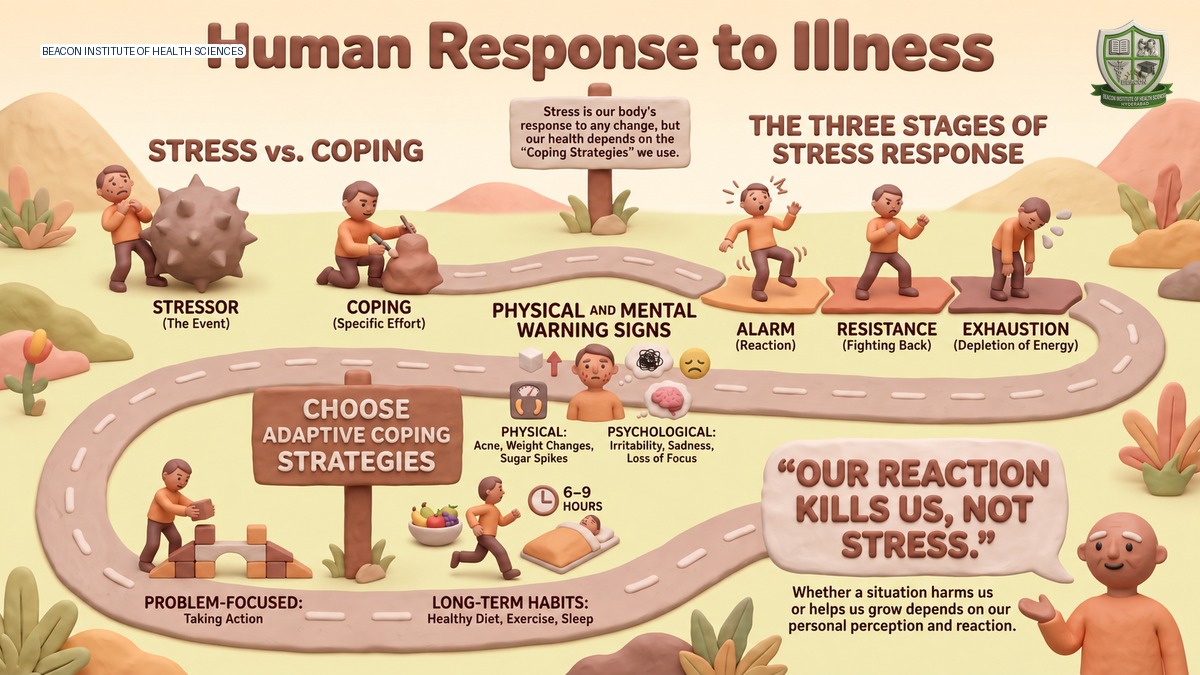
In professional clinical practice, a patient's recovery is governed not only by pharmacological therapies and surgical interventions, but also by their psychological and behavioral adaptation to illness. The human response to illness is a multi-dimensional process that integrates physiological systems, emotional resilience, and coping habits. This academic content, designed for BSN Semester II (Year 1) Fundamentals of Nursing II (FON-II) students and educators, provides a structured roadmap to analyze and manage stress in clinical settings.
The nurse must understand that stress is not a simple emotional worry, but a complex, multi-systemic physiological and psychological reaction that directly influences a patient's healing trajectory, hospital coping, and overall clinical outcomes.
Marjory Gordon's Coping-Stress Tolerance Pattern
Under Marjory Gordon's Functional Health Patterns, the Coping-Stress Tolerance Pattern is established as a vital assessment domain. This pattern indicates how someone will allow their personal life to be influenced by an event, how they deal with the resulting stress, and what they will take away from the experience.
This pattern evaluates three specific clinical elements:
- Stress Perception: How the individual cognitively registers and evaluates an incoming life crisis or physical illness.
- Coping Practice: The physical, mental, or social mechanisms the person employs to manage or reduce the trouble.
- Experience Integration: What the individual learns or takes away from the experience once the stressor has passed.
Pillar of Coping Strength: An individual's coping pattern or stress tolerance pattern is considered strong and resilient when they deal with any incoming trouble or crisis practically and, after emerging from that trouble, they learn something positive from the experience to facilitate personal growth and cognitive maturity.
Conceptual Definitions: Stress, Stressors & Coping
- Stress: In simple terms, stress is described as 'worry' or 'trouble'. Academically, stress is a condition in which an individual experiences a change in their normal balanced state. It is a biological and psychological disruption that forces the body and mind away from their healthy, balanced homeostatic equilibrium.
- Stressor: A stressor is any event or stimulus that causes an individual to experience stress. It represents the underlying source, trigger, or cause of the stress response.
- Coping Responses (Coping Strategies / Mechanisms): Coping responses are the cognitive, behavioral, or physiological strategies that an individual uses to deal with, adapt to, or resolve a stressor and the stress it causes.
Three Models of Stress
To understand how different patients perceive, experience, and handle stress, the professional BSN nursing curriculum utilizes three primary models of stress. These are also known as the three main conceptualizations of stress: Stress as a Stimulus, Stress as a Response, and Stress as a Transaction.
Stress as a Stimulus (Stimulus-Based Stress Model)
In the Stimulus-Based Stress Model, stress is defined as a stimulus—a specific life event, circumstance, or environmental pressure that targets an individual and excites physiological or psychological reactions. In this view, the stressor itself is the active, attacking force. If an individual is vulnerable or lacks protective resources, this stimulus will directly disrupt their life.
To document and measure these life changes, clinicians utilize the Scale of Stressful Life Events, which documents and tracks a patient's recent stressful experiences to evaluate their vulnerability.
Three Core Clinical Examples of Stress as a Stimulus:
- 1. Physical Trauma or Accident: A motor vehicle accident acts as a sudden physical stimulus. It causes physical tissue injury, initiates severe pain, and triggers a secondary, immediate cascade of physiological and psychological stress.
- 2. Pregnancy: Pregnancy acts as a prolonged physiological and hormonal stimulus. Throughout the 9-month gestational period, the female experiences continuous physical changes and anxiety regarding childbirth, keeping her in a state of stress until the delivery is successfully completed.
- 3. Retirement from Employment: Retirement acts as a major life-altering stimulus. The sudden termination of daily professional routines forces the individual to sit at home. This drastic shift changes their daily life, producing new responses such as engaging in healthy hobbies, or conversely, falling into depression—responses that were not present before.
Stress as a Response (Response-Based Model - Hans Selye)
In the Response-Based Stress Model, stress is defined as the non-specific response of the body to any demand made upon it. This landmark physiological concept was pioneered and defined by the famous Canadian endocrinologist Dr. Hans Selye.
Under normal conditions, the human body maintains a stable, healthy balance (homeostasis). However, when we place excessive demands on the body (such as increasing physical work overload or subjecting the mind to severe emotional torture and psychological strain), the body responds. Selye observed that this response is characterized by a chain or pattern of physiological events that occur systematically across body systems.
Clinical Examples of Response Chains & Patterns:
- Chain of Illness: A patient suffers from one illness, which weakens their immunity and leads to a second pathology, followed by a third, forming an escalating chain of physical symptoms.
- Chemotherapy Pattern: Chemotherapy is a long-term medical treatment that acts as a profound stress response trigger. Over a prolonged period of therapy, it creates a systemic, highly visible pattern of physical changes. It alters the patient's appearance from head to toe, causing total hair loss (alopecia), severe muscle wasting and weakness, appetite loss (anorexia), and gastrointestinal disruptions. The entire body responds in a patterned form to this clinical stressor.
General Adaptation vs. Local Adaptation:
Selye discovered that the body's response to stress can occur either globally across all systems or locally in a single organ:
- General Adaptation Syndrome (GAS): A systemic, global, head-to-toe response of the entire body to a stressor.
- Local Adaptation Syndrome (LAS): A localized response of a specific organ, tissue, or body part to a localized stressor (e.g., localized inflammatory response to a skin wound).
The Three Stages of GAS and LAS:
Both General and Local Adaptation Syndromes progress through three distinct, chronological stages:
| Stage | Name | Physiological Mechanism & Changes |
|---|---|---|
| Stage 1 | Alarm Reaction | The stressor disrupts normal homeostasis. The body enters a 'shock phase' where the mind and body temporarily lose balance and performance drops. This triggers immediate autonomic reflexes, initiating the 'Fight-or-Flight' response to prepare the body for action. |
| Stage 2 | Resistance | The body actively begins to fight and resist the stressor. It mobilizes endocrine, hormonal, and adaptation resources to combat the trouble, aiming to neutralize the stressor and restore baseline homeostasis. |
| Stage 3 | Exhaustion | If the stressor persists for too long or is too intense, the body's adaptation resources and energy stores are completely depleted. This stage has two possible outcomes: • Recovery: If the stressor is successfully resolved, the body returns to normal homeostasis. • Death: In chronic, severe, and unresolved cases, the physical and psychological systems collapse, leading to death. |
Stress as a Transaction (Transaction-Based Model - Lazarus)
Pioneered and formulated by psychologists Richard Lazarus and Susan Folkman, the Transaction-Based Stress Model emphasizes that stress is not merely an external stimulus or an internal physiological response. Instead, stress is a dynamic, reciprocal relationship (transaction) between the individual and their environment.
This model highlights that stress is highly subjective. Different individuals perceive, evaluate, and respond to the exact same stressor in vastly different ways. How much stress a person experiences is determined entirely by their cognitive appraisal of the situation—how they perceive and evaluate the threat relative to their coping resources.
The Child vs. Adult Pencil Example:
To understand the role of cognitive perception, consider a simple clinical example:
- The Child's Perspective: If a young child loses their favorite pencil, has their homework page torn, or has water spilled over their writing notebook, it represents a catastrophic, overwhelming stressor. They will scream, cry, and experience intense psychological distress because they perceive this event as a massive, unresolvable loss.
- The Adult's Perspective: If an adult writes a page of text and it is accidentally ruined or lost, they perceive it as a minor, temporary inconvenience. They do not collapse or panic; instead, they rationally decide to sit down and write the text again. Because their cognitive appraisal, intellectual maturity, and coping capacity are significantly higher, the same physical event does not trigger a severe stress reaction.
Individual Variations in Medical Disease Perception:
Lazarus's transaction model is critical in clinical medicine because it explains why patients diagnosed with the exact same medical pathology (such as cancer or heart disease) react in completely different behavioral ways:
- Reaction 1: Denial: One patient may cognitively deny the reality of the illness entirely to protect their mind ('This laboratory report is wrong, I cannot have cancer'). They continue living as if nothing happened.
- Reaction 2: Anxiety and Worry: A second patient accepts the medical diagnosis but experiences high levels of worry, fear, and physiological stress. They ask constant questions, seek multiple medical opinions, and remain on high alert.
- Reaction 3: Depression and Withdrawal: A third patient is completely overwhelmed by the diagnosis. They fall into severe depression, become completely silent, withdraw from social interaction, refuse to talk to family, and give up all hope of recovery, choosing to cease active participation in their care.
Systemic Physiological Manifestations of Stress
When an individual experiences stress, the autonomic nervous system and endocrine pathways trigger acute and chronic physiological changes across multiple body systems. The nurse must assess these physical manifestations during examinations:
| Body System | Physiological Symptoms and Manifestations |
|---|---|
| Integumentary (Skin) | Stress triggers localized skin conditions, resulting in a marked increase in acne (facial pimples), eczema flare-ups, pruritus (severe skin itching), hives, and urticaria. |
| Metabolic & Weight | Metabolic rates alter under stress. Some individuals experience sudden, rapid weight loss, while others experience weight gain due to stress-induced overeating or hormonal changes. |
| Endocrine System | Stress hormones (cortisol, adrenaline) trigger a rapid rise in blood sugar levels. (Clinical Alert: This is why nurses do not suddenly share bad news or extreme happy news with diabetic or cardiac patients, as the sudden glycemic or heart rate surge can trigger severe hyperglycemia or cardiac arrest). |
| Gastrointestinal (GI) | Stress affects gastric motility. Patients commonly experience bloating, indigestion, diarrhea, abdominal cramping, and the classic feeling of 'butterflies in the stomach' (commonly felt before exams or practical vivas). |
| Neurological & Sleep | Disrupted sleep architecture, resulting in severe insomnia (sleeplessness) or highly fragmented, non-restorative sleep. |
| Respiratory & Cardiac | Exacerbation of asthma attacks, onset of hay fever, elevated heart rate, and increased workload on the heart, which can worsen congestive heart failure. |
Psychological, Cognitive & Emotional Manifestations
Psychological stress directly impairs cognitive functioning and emotional regulation. The nurse must monitor for these symptoms:
- Feeling of Sadness & Hopelessness: Experiencing deep, persistent sadness and a complete loss of hope for the future.
- Heightened Irritability: A strong desire to be left alone and a refusal to communicate ('Don't talk to me, leave me alone').
- Low Frustration Tolerance (Short Temper): Becoming highly short-tempered, easily angered, and unable to tolerate minor delays, noises, or comments.
- Feeling Easily Overwhelmed: Perceiving minor, daily tasks or minor medical procedures as massive, unmanageable crises.
- Loss of Motivation: Lacking the internal drive or energy to participate in recovery, hobbies, or self-care activities.
- Lack of Concentration & Restlessness: Inability to focus thoughts on a task, accompanied by physical and mental restlessness.
- Obsessive Thinking Pattern: Engaging in continuous, repetitive, and obsessive overthinking (rumination) about the source of worry.
The Six Classifications of Coping Strategies
To survive and resolve life crises, individuals employ various coping strategies. In the professional nursing curriculum, coping is defined as dealing with change, whether successfully or unsuccessfully. It represents the cognitive and behavioral efforts made to manage, tolerate, or minimize internal or external demands.
Coping strategies are categorized into six primary types based on their focus, duration, and clinical efficacy:
1. Problem-Focused Coping
Problem-focused coping involves making changes or taking direct action to solve the problem. It is a highly practical, task-oriented approach. Instead of merely thinking or worrying, the individual actively works to modify or eliminate the stressor. (e.g., a student failing a course decides to hire a tutor and study extra hours).
2. Emotion-Focused Coping
Emotion-focused coping includes thoughts and actions that release or relieve emotional distress. It does not change or improve the actual problem, but it helps the person feel emotionally better temporarily (e.g., crying, seeking comfort from a loved one, or praying). This relief is vital because it calms the nervous system, allowing the individual to make rational decisions later when they are calm.
3. Long-Term Coping
Long-term coping strategies are constructive, practical, and yield sustainable, positive health outcomes. They target the root cause of stress over a prolonged duration.
- Clinical Example: A patient diagnosed with obesity and a high BMI adopts a long-term coping strategy of a balanced, nutritious diet and a structured daily exercise regimen. This approach safely and permanently restores their healthy BMI and reduces long-term cardiovascular risks.
4. Short-Term Coping
Short-term coping strategies provide temporary, quick-fix physical or mental relief, but do not produce lasting, healthy results.
- Clinical Example: A person goes on an extreme, unscientific keto diet for rapid, short-term weight loss. Once they abandon the diet, they experience a physical rebound, weight gain, and mental stress. This quick-fix approach does not yield a permanent, healthy change.
5. Adaptive Coping (Effective Coping)
Adaptive coping consists of healthy, functional behaviors where the individual successfully manages and resolves the stressor. It leads to a gradual reduction in anxiety, maintains personal integrity, and restores peace and balance.
6. Maladaptive Coping (Ineffective Coping)
Maladaptive coping consists of unhealthy, dysfunctional behaviors that fail to resolve the stressor and actually create more severe problems over time.
- Example 1 (The Lie Trap): An individual tells a lie to cover up a small mistake. To keep this lie hidden, they are forced to tell dozens of additional lies, falling into an escalating cycle of deception that worsens their stress.
- Example 2 (The Debt Trap): A person takes out a loan to pay off an outstanding debt. Because they cannot pay it back, they take out a second loan from another source, accumulating compounding debts and falling into a severe financial crisis.
Factors Affecting Coping Patterns During Hospitalization
A hospitalized patient faces intense, unfamiliar stressors. Their capacity to cope effectively is heavily influenced by several primary factors. The nurse must assess these factors to identify vulnerabilities:
- Diet & Nutrition: A well-balanced, nutritious diet rich in essential minerals and vitamins provides the physiological energy and cellular stamina required to cope with physical illness and recover.
- Activity & Exercise: Regular, structured physical activity stimulates positive biological pathways and assists the body in recovering from stress and muscle tension.
- Sleep Hygiene: Getting 6 to 9 hours of uninterrupted sleep relaxes the brain, reduces stress hormones, and allows the patient to view their clinical situation from multiple, constructive perspectives, finding better solutions.
- Security & Support Systems (Social & Financial):
- Social Support: Knowing that family members, friends, or community networks are actively present to help.
- Financial Security: Having financial resources, health insurance, or property/assets that can be utilized to cover the high costs of medical treatments, preventing financial panic.
- Previous Coping Experiences: A history of successfully overcoming similar life crises or illnesses in the past builds self-confidence, coping skills, and cognitive resilience.
- Stress Management Style (Dividing the Stressor): The ability to manage stress by dividing a massive trouble into small, manageable parts.
- The Book Chapter Example: If a student has a textbook with 16 to 17 chapters to study for an exam, trying to study the entire book at once creates overwhelming stress. Instead, they manage the stressor: they study four easy chapters first, then one difficult chapter, take a brief rest, and repeat. By dividing the stressor, they complete the task successfully without panic.
- The Unmanaged Case: If a patient has 10 to 15 different small worries cluttered in their brain without structure or priority, they feel completely overwhelmed, and their coping capacity collapses.
- Absence of Support System: Hospitalized patients who lack family, financial resources, or community support are highly vulnerable to coping failure and clinical depression.
- Perceptual Accuracy: If a patient has highly distorted, irrational, or unscientific perceptions of their illness, they will struggle to develop effective coping strategies.
Clinical Application of the Nursing Process (ADPIE)
To effectively manage patients experiencing altered coping during hospitalization, nurses apply the five steps of the Nursing Process:
Step 1: Assessment (A)
To manage a patient with altered coping, the nurse must conduct a thorough, structured assessment:
- Nursing History: Interview the patient to document past medical conditions, family dynamics, and past coping habits.
- Physical Exam (Indicators of Stress): Observe the patient for physical signs of high stress, such as biting nails, crossing/shaking legs, rapid pacing, and tensed muscle tone.
- History of Changes: Ask about sudden weight changes (rapid weight gain or weight loss) and check for other health problems such as hypertension or dyspnea.
- Cognitive Evaluation: Ask open-ended questions: 'How do you currently feel? What do you think about your current worry?'
Step 2: Diagnosis (D)
Based on validated data, the nurse formulates specific NANDA nursing diagnoses:
- Anxiety: A state of apprehension or dread caused by a perceived or real danger, alerting the body to an upcoming crisis.
- Caregiver Role Strain: Physical, emotional, and financial exhaustion experienced by an individual responsible for providing continuous, long-term care to a chronically ill relative, leaving them unable to fulfill their own roles.
- Compromised Family Coping: Occurs when a primary supportive family member or close friend provides insufficient, ineffective, or compromised emotional and physical support, hindering the patient's recovery.
Step 3: Planning (P)
The nurse collaborates with the patient and family to develop an individualized care plan aligned with the patient's health status. Goals must be realistic and measurable. Planning involves breaking massive worries into small, manageable parts, incorporating spiritual/religious support, and coordinating community resources.
Step 4: Implementation (I)
The nurse executes evidence-based interventions targeting all factors influencing coping:
- Health Promotion: Educate on balanced nutrition, encourage appropriate exercise, and optimize sleep hygiene.
- Time Management: Assist the patient in organizing daily routines to reduce chaos and feel in control.
- Anxiety & Anger Mediation: Provide comfort, actively de-escalate anxiety, and manage outbursts of anger.
- Relaxation Techniques: Implement soothing, non-pharmacological interventions such as back massages, occupational therapy, music therapy, and religious or spiritual practices.
Step 5: Evaluation (E)
Evaluation is a continuous quality-control loop where the nurse measures the outcomes of the care plan:
- How did the client perceive and handle the problem? Were they able to cope successfully?
- Were the nursing interventions and strategies sufficient to achieve positive outcomes?
- If the coping is still ineffective, what additional strategies must be implemented?
Academic Review and Summary Matrix
| Stress/Coping Concept | Physiological / Behavior Sign | Primary Nursing Action & Intervention |
|---|---|---|
| Alarm Reaction Stage (GAS) | Disrupted homeostasis, autonomic shock phase, immediate fight-or-flight activation. | Assess baseline vital signs, prepare patient for fight-or-flight, provide immediate emotional reassurance. |
| Stress as a Response | Systemic response chain (e.g., hair loss, muscle wasting, anorexia from chemotherapy). | Cluster nursing care, manage nutritional intake, coordinate with dietitians, promote rest. |
| Problem-Focused Coping | Taking direct, task-oriented action to modify or solve the stressor. | Assist patient in identifying actionable steps, educate on problem-solving, support independent choices. |
| Anxiety (NANDA Diagnosis) | Apprehension regarding a perceived danger, nail-biting, crossing/shaking legs. | Perform quiet-environment interviews, maintain eye contact, teach relaxation and deep breathing techniques. |
| Caregiver Role Strain | Exhaustion, inability to fulfill personal roles due to long-term chronic care duties. | Identify community support resources, organize respite care, counsel on stress-management, involve family. |
| Compromised Family Coping | Family members provide insufficient, ineffective, or compromised support. | Assemble family meetings, explore financial and physical support resources, provide empathetic counseling. |