
Learning Objectives
- Distinguish social institutions, organizations and groups.
- Compare group types and their effects on health.
- Explain lifelong socialization and its agents.
- Apply these concepts to nursing teamwork, discharge planning and professional learning.
Social Organization and Health
People live through relationships, shared expectations and organized systems. Families may provide care, schools shape learning, workplaces influence income and health services organize treatment. These arrangements affect both opportunities and barriers. Understanding them helps nurses plan care that is realistic for the person's circumstances.
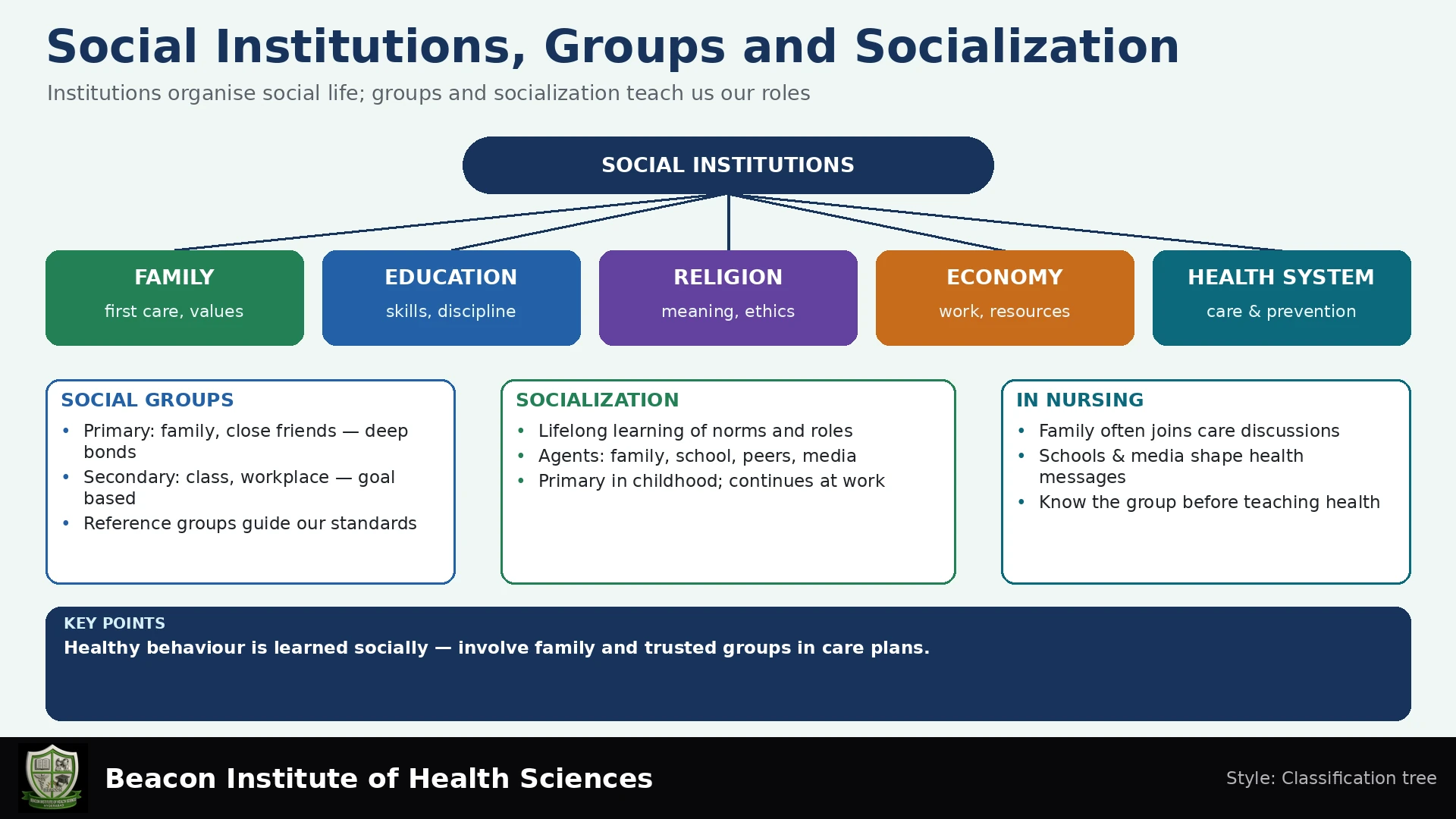
A social institution is an enduring pattern of norms, roles and relationships organized around important social needs or activities. An organization is a particular coordinated body with members and goals. Education is an institution; a named nursing college is an organization within it. A hospital building alone is not the institution of healthcare.
Major Social Institutions
| Institution | Important activities | Nursing relevance |
|---|---|---|
| Family and kinship | Care, belonging, support and learning | Assess actual caregivers and the patient's wishes |
| Education | Knowledge, skills and social expectations | Adapt teaching to understanding, language and opportunity |
| Religion | Meaning, practices, community and moral guidance | Ask about desired spiritual support without assumptions |
| Economy and work | Production, employment and resource distribution | Explore income, occupational risk and time constraints |
| Government and law | Public decisions, rights, rules and services | Know applicable referral, protection and service procedures |
| Healthcare | Prevention, treatment, rehabilitation and care | Recognize referral structures and unequal access |
Institutions interact. Employment can affect whether a person can attend a clinic; education can affect navigation of services; family support can assist recovery. They can also reproduce inequality. A rule that appears neutral may disadvantage people with disabilities, low income or limited language access.
Institutional functions are not always achieved equally. A family may provide strong support or may be absent, overwhelmed or unsafe. Nurses should assess actual relationships rather than assume that a relative is available or suitable for care.
Groups, Categories and Aggregates
A social group involves interaction and some shared identity or expectations. A social category consists of people sharing a characteristic who need not interact. An aggregate is a collection of people in one place without necessarily having a continuing relationship. Patients waiting together are an aggregate; a continuing patient-support circle may become a group.
| Group concept | Meaning | Example |
|---|---|---|
| Primary group | Close, continuing and personal relationships | A supportive family or close friendship circle |
| Secondary group | More task-oriented or impersonal relationships | A large professional association |
| Formal group | Explicit membership, roles or procedures | A hospital quality committee |
| Informal group | Relationships developing outside official structures | Colleagues who share practical support |
| Reference group | A group used as a standard for self-evaluation | Experienced nurses whom students hope to emulate |
| In-group and out-group | Groups perceived as belonging to us or outside us | Professional boundaries that may help identity or encourage exclusion |
These categories are not mutually exclusive. A formal team may develop close informal friendships. A reference group need not be a group the person currently belongs to. Avoid treating outsiders as less deserving; group identity must not justify discriminatory care.
Group Processes
Groups influence behaviour through shared norms, encouragement, information and sanctions. Support groups may improve belonging and practical coping. Peer norms can also discourage asking questions or encourage unsafe shortcuts. A norm's popularity does not establish its safety.
Conformity means adjusting behaviour to group expectations. Groupthink describes a decision process in which pressure for agreement suppresses critical evaluation. It is not simply any agreement. Clear roles, respectful challenge and active invitations to discuss concerns can improve team decisions.
Leadership may be formal or informal. Team members need psychological safety to raise concerns, while remaining accountable for professional conduct. Students should know their supervisor, scope and escalation pathway rather than imitate a risky practice to gain acceptance.
What Is Socialization?
Socialization is the continuing process through which people learn social meanings, norms, skills and roles. It begins early and continues throughout life. People participate actively: they interpret, negotiate and sometimes challenge expectations. It is broader than casual socializing.
- Primary socialization: early learning through close relationships, often within family or caregiving settings.
- Secondary socialization: learning expectations in schools, workplaces and other settings beyond early intimate relationships.
- Anticipatory socialization: preparing for a future role, such as a student rehearsing a patient handover.
- Resocialization: substantial relearning of roles and expectations during transitions, such as adapting to a new professional setting.
These processes overlap and are not rigid age stages. Entering a hospital as a patient can require learning unfamiliar routines, but care should help people understand and participate rather than strip away their identity or autonomy.
Agents of Socialization
Families, peers, schools, workplaces, media, religious communities and public institutions can all shape learning. Media may provide useful information or circulate stigma and misinformation. Digital participation varies with access, literacy and trust.
The hidden curriculum consists of unwritten lessons conveyed by routines, rewards and role models. A college may formally teach respectful communication while students observe staff dismissing patient concerns. The contradiction can influence professional learning. Educators should model the behaviour they expect and discuss problematic examples openly.
Nursing Professional Socialization
Professional socialization includes acquiring nursing knowledge, ethical responsibilities, skills and identity. Role models, simulation, supervised placement, feedback and reflective discussion support it. Professional belonging should strengthen compassionate, evidence-informed care, not require silence about errors.
Role conflict can occur between a nurse's employment and family responsibilities. Role strain can arise from competing demands within nursing. Recognizing these pressures supports realistic staffing and supervision, but does not remove accountability for safe care. Seek support and escalate unsafe workload through the appropriate process.
Fictional Worked Discharge Case
A fictional patient, Ahmed, needs help with daily activities after discharge. His adult daughter is listed as next of kin. The team initially assumes that she can provide all care. A discussion, with Ahmed's permission, reveals that she works away from home and that a neighbour can offer only occasional help.
The nurse maps the actual support network: who is willing, available and able to do each task? With Ahmed's agreement, the team clarifies essential care, teaches willing caregivers, checks their understanding and explores available community or rehabilitation services. The plan is revised if safe support cannot be arranged. Next-of-kin status alone does not prove caregiving capacity or authority to consent for an adult.
In a fictional review, 15 of 20 discharge plans record an identified willing caregiver. Documentation coverage is 15/20 × 100 = 75%. This does not establish that 75% of patients have adequate support; ability, consent, training and unmet needs also require assessment.
Nursing Applications
- Assess family and social support without assuming one household structure.
- Ask whom the patient wants involved and protect confidential information.
- Use professional interpreters or appropriate language support when needed.
- Explain institutional routines and rights in accessible language.
- Help students question unsafe informal norms and seek supervision.
- Coordinate across services so referrals and responsibilities are clear.
Practice Questions with Explained Answers
- Is a particular hospital the same as the healthcare institution?
No. It is an organization within the wider institution of healthcare.
- Are all people with diabetes a social group?
Not necessarily. They form a category; a regularly interacting support circle may be a group.
- What is anticipatory socialization?
Learning and rehearsing expectations before entering a future role.
- Why should a nurse examine informal ward norms?
Informal norms can support good care or normalize unsafe behaviour.
- What was wrong with the first discharge assumption?
Being a relative did not establish the daughter's availability, willingness or ability to provide care.
Conclusion
Institutions organize social life, groups shape participation and socialization teaches roles throughout life. Nurses use these concepts to understand support, power and learning. Care improves when actual relationships and resources are assessed, patient choices are respected and professional norms encourage safe, thoughtful practice.