
Introduction to Adult Development
Adult development is a complex, continuous, and highly individualized process that extends across the entire lifespan, far beyond the formative years of childhood and adolescence. For BSN students and nursing educators, understanding this nuanced journey is crucial for providing person-centered, respectful, and effective care. This lecture will explore the core principles, influences, and various domains of adult development, emphasizing that development is lifelong, multidimensional, and variable, encompassing gains, stability, and losses, alongside continuous adaptation. It is vital to recognize that chronological age is distinct from functional ability, and the broad categories of early, middle, and later adulthood serve as approximate learning guides rather than universal deadlines or rigid stages. Adulthood is characterized by diverse roles and life courses, making a flexible and individualized approach essential in nursing practice.
Learning Objectives
Upon completion of this lecture, BSN students and nursing educators will be able to:
- Describe the core principles of adult development, including its lifelong, multidimensional, and variable nature.
- Differentiate between chronological age and functional ability, and recognize the diversity of adult roles and life courses.
- Identify key influences on adult development, distinguishing between cohort effects and age changes, and cross-sectional versus longitudinal evidence.
- Discuss typical physical, cognitive, and psychosocial changes across early, middle, and later adulthood, highlighting the importance of individual variability and avoiding ageist assumptions.
- Apply principles of adult development to nursing care, focusing on autonomy, capacity assessment, and appropriate support for diverse patient needs.
Key Principles of Adult Development
Adult development is founded on several fundamental principles that underscore its intricate nature:
- Lifelong Process: Development does not cease at a certain age; it is an ongoing journey from birth until death, with changes and adaptations occurring at every stage of adulthood.
- Multidimensional: Development occurs across multiple interacting domains, including physical, cognitive, and psychosocial aspects. Changes in one dimension often influence others.
- Variable and Plastic: The course of development is highly individual and influenced by a myriad of factors. It is not linear or uniform; individuals experience unique patterns of gains, stability, and losses throughout their lives, demonstrating remarkable capacity for adaptation.
- Distinction Between Chronological Age and Functional Ability: An individual's actual physical, cognitive, and psychosocial capabilities (functional ability) cannot be inferred from chronological age alone. Nurses must assess functional ability directly rather than making assumptions based solely on a person's age.
- Diverse roles and life courses: Work, education, caring, relationships and community roles occur in many different sequences. Marriage, parenting, retirement and other events are not compulsory milestones or tests of successful development.
What influences development?
Biological characteristics interact with health, learning, relationships, culture, financial resources and the environments in which people live. Development includes adaptation to opportunities and constraints. Access to safe housing, education and health services can make a difference to what a person can do. A difficulty should not automatically be interpreted as poor motivation or an inevitable consequence of age.
A cohort is a group whose members share a historical period or experience, often people born around a similar time. Differences between younger and older groups may reflect schooling, nutrition, technology or other cohort experiences as well as age. For example, unfamiliarity with an electronic form may reflect limited opportunity to use it, rather than reduced ability to learn.
Reading developmental evidence
A cross-sectional study compares different age groups at one time. It cannot by itself show how the same individuals changed as they grew older. A longitudinal study follows people over time and can describe individual change, but may be affected by dropout, repeated-test practice and historical events. Neither design justifies treating one group average as a prediction about a particular patient.
Physical development across adulthood
Many adults experience gradual changes in sensory function, muscle strength, body composition or recovery from exertion. The timing and extent vary. Illness, medicines, activity, working conditions and access to care also matter. Reproductive transitions may affect some aspects of health and identity, but do not determine a person’s worth or end their need for relationships, privacy or respectful sexual-health care.
Nursing assessment should establish the person’s usual function and recent changes. Ask what they can do, what support they use and what they would like to maintain. Do not dismiss pain, marked weight change, sleep disruption or reduced function as “just age.” Such problems may need assessment and support. An abrupt change deserves particular attention.
Cognitive development and learning
Cognitive abilities do not all change in the same way. Speed on unfamiliar tasks and some aspects of working memory may change with age, while accumulated knowledge, vocabulary and experience can remain important strengths. Adults can continue learning. Hearing, vision, fatigue, pain, anxiety and unfamiliar instructions may affect performance without indicating loss of reasoning ability.
Offer a clear explanation, a manageable pace, accessible written material and opportunities to practise. Check understanding rather than guessing from age or appearance. Dementia is not an inevitable or normal part of ageing. New confusion or a sudden change in attention requires prompt clinical assessment and appropriate escalation; it must not simply be attributed to growing older.
Psychosocial development
Adult lives may involve building relationships, developing skills, supporting others, reviewing identity, adapting to disability or finding new purpose. Caregiving can bring meaning and strain. Retirement may be welcome, unwanted or irrelevant to the person’s situation. Bereavement, unemployment and changes in social roles can occur at many ages. Ask about the meaning of an event to the individual.
Erikson as an interpretive framework
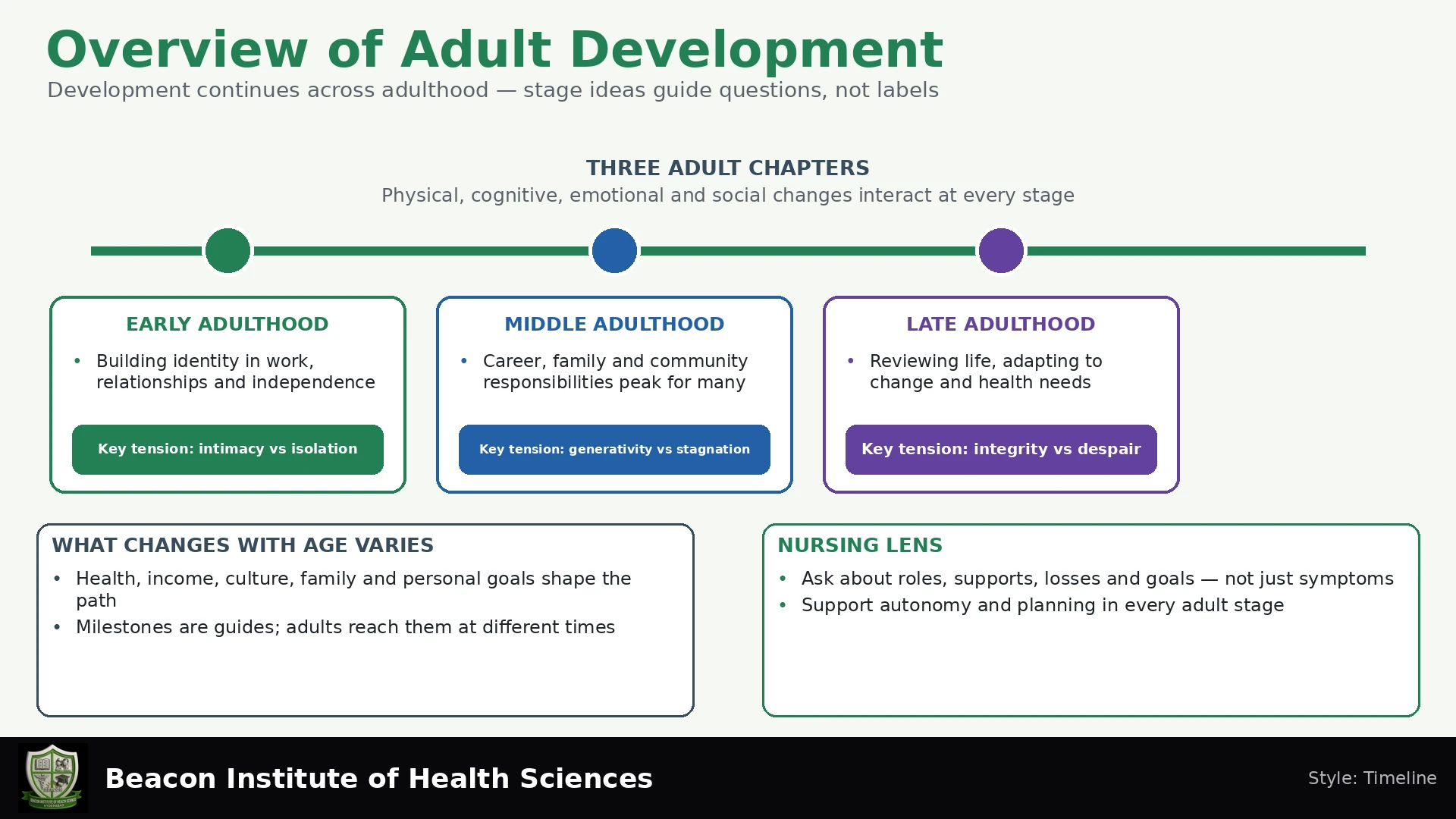
Erikson associated early adulthood with intimacy versus isolation, middle adulthood with generativity versus stagnation, and later adulthood with integrity versus despair. Intimacy concerns meaningful connection; generativity concerns contributing to others or future generations; integrity concerns making sense of one’s life.
These are historical theoretical themes, not diagnostic categories or universal deadlines. Meaningful connection does not require marriage, and contribution does not require parenting. People may revisit these concerns throughout life. The framework can prompt questions about relationships and meaning, but should not be used to declare that a patient has failed a stage.
Comparing broad periods without rigid expectations
| Broad period | Possible strengths and challenges | Individual nursing question |
|---|---|---|
| Early adulthood | Developing independence and skills; balancing education, employment, relationships and resources. | “Which responsibilities and supports matter most to you now?” |
| Middle adulthood | Experience and contribution; possible competing work, health and caregiving demands. | “How does the proposed care plan fit with your everyday responsibilities?” |
| Later adulthood | Experience, continuing learning and community roles; possible sensory, health or social transitions. | “What activities would you like to continue, and what would make them easier?” |
The periods above are approximate descriptive groupings. Their boundaries vary across texts and cultures. There is no single age at which every person should take on a role or experience a change.
Autonomy and nursing support
Address the adult directly, ask permission before involving others and clarify who they wish to include. Age alone does not establish lack of decision-making capacity. Capacity concerns the specific decision and circumstances; assessment and any required support should follow the applicable professional procedures. A hearing difficulty or slow answer does not automatically indicate inability to decide.
Ask about preferred language, access needs, transport, social support and health literacy. Use teach-back to check the clarity of your explanation. Offer choices that are realistic in the person’s circumstances and review whether adaptations help. Assessment should include strengths and goals, not only deficits.
Fictional worked case
An older adult enrols in a community course after retirement. They request written instructions and a quieter room. A student initially wonders whether this indicates poor memory. The nurse asks what makes learning easier and learns that background noise makes spoken instructions difficult to hear.
The plan is to provide clear written steps, arrange a quieter discussion and allow practice with feedback. The adult chooses the goals and whether to involve a support person. Evaluation considers their explanation of the task, observed performance and feedback about the arrangement. The request for an adaptation is not a diagnosis, and the plan does not guarantee a particular outcome.
Self-check with explained answers
1. Does being older establish lack of capacity to consent?
Answer: No. Consider the particular decision, assess and support understanding through the appropriate process, and avoid substituting age for assessment.
2. A survey finds different technology skills in younger and older groups. Does it prove that ageing caused the difference?
Answer: No. Cohort experiences, education and opportunities may contribute. Cross-sectional differences do not demonstrate change within the same individuals.
3. Is sudden disorientation an expected developmental milestone?
Answer: No. It needs prompt clinical assessment. Developmental knowledge must not become a reason to overlook a new symptom.
Glossary and conclusion
Chronological age: time since birth. Functional ability: what a person can do in their circumstances. Cohort: people sharing a historical period or experience. Adaptation: adjustment to demands or opportunities. Generativity: contribution to others or future generations.
Adult development includes continuing strengths and learning alongside possible changes and losses. Good nursing care starts with the individual’s goals, usual function and current needs, uses developmental theories cautiously and supports autonomy without ageist assumptions.