
Learning Objectives
- Distinguish screening from diagnosis and symptom assessment.
- Explain the requirements of an effective screening programme.
- Calculate sensitivity, specificity and predictive values.
- Recognize screening harms, biases and nursing follow-up responsibilities.
What Is Screening?
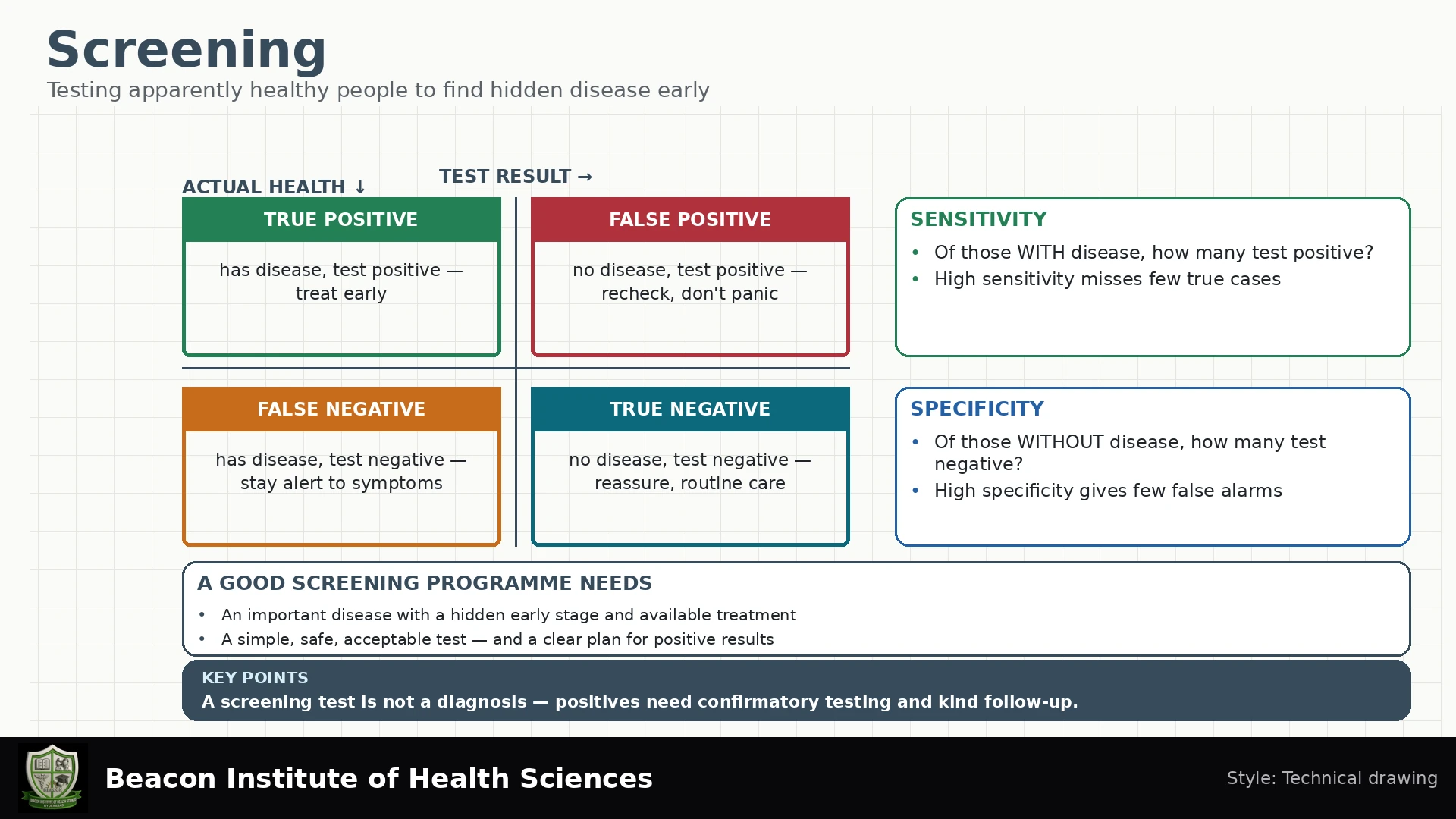
Screening uses a test, examination or structured assessment to identify apparently well people who may have an unrecognized condition or increased risk. It separates people who need further assessment from those who do not currently meet the referral threshold. A screening result is not automatically a confirmed diagnosis.
Screening differs from investigating symptoms. A person with a new breast lump, rectal bleeding or another concerning symptom needs clinical assessment according to the presentation; they should not be told to wait for a routine screening invitation. Some tests are used in both screening and diagnosis, but their purpose, population and interpretation differ.
The Whole Screening Pathway
A programme includes identifying eligible people, giving balanced information, obtaining appropriate consent, delivering a quality-assured test, communicating results, arranging diagnostic assessment and providing effective care when indicated. A test offered without reliable follow-up may cause anxiety and delay without producing its intended benefit.
- Define the condition, eligible population and intended health benefit.
- Explain the likely benefits, harms, limitations and choices.
- Perform and document the test correctly.
- Communicate positive, negative, inadequate or uncertain results clearly.
- Arrange further assessment for results meeting referral criteria.
- Track completion of diagnostic work and care, then evaluate the programme.
When Is a Programme Appropriate?
The condition should be important, its natural history sufficiently understood, and an early-detection opportunity should exist. There should be an acceptable test, an agreed pathway after each possible result and evidence that the programme improves meaningful outcomes. Effective care and adequate capacity must be available. The expected benefits should outweigh harms and costs across the full pathway.
Finding more abnormalities is not itself proof of success. Suitable evaluation may examine disease-specific mortality, severe morbidity, incidence where precursor treatment prevents disease, quality of life, complications, equity and resource use. The appropriate outcomes depend on the programme. Eligibility ages, intervals and test choices are disease-specific and change with evidence; use current guidance relevant to Pakistan and the clinical setting rather than assuming another country's schedule applies.
Types of Screening
| Approach | Description | Important consideration |
|---|---|---|
| Population-based | Systematically offers screening to a defined eligible population | Needs organized invitations, quality assurance and follow-up |
| Targeted or high-risk | Focuses on people with specified risk characteristics | Risk criteria must be evidence-based and access must be fair |
| Opportunistic | Offered during contact with health services for another reason | May miss people who seldom attend care |
| Multiphasic | Uses several tests during one encounter | Adding tests increases the chance of incidental findings and false positives |
A healthy-looking person may still decline screening after informed discussion. Respect informed choice and follow the applicable consent process. Explain information in the person's preferred language, check understanding and address practical barriers without pressure.
Test Accuracy: A Two-by-Two Table
To assess accuracy, compare screening results with an appropriate reference standard. The reference classification also has limitations and must be applied carefully. The following dataset is entirely fictional and assumes reference disease status is known for all 1000 participants.
| Screen result | Disease present | Disease absent | Total |
|---|---|---|---|
| Positive | 90 true positives | 45 false positives | 135 |
| Negative | 10 false negatives | 855 true negatives | 865 |
| Total | 100 | 900 | 1000 |
Sensitivity and Specificity
Sensitivity is the proportion of people with the condition who test positive: TP/(TP + FN). Here it is 90/(90 + 10) = 90%. Ten of 100 people with the condition were missed by the test.
Specificity is the proportion without the condition who test negative: TN/(TN + FP). Here it is 855/(855 + 45) = 95%. Forty-five of 900 people without the condition tested positive.
For many continuous tests, lowering the threshold increases sensitivity but reduces specificity. The direction depends on how the test is coded. Threshold selection balances the consequences of missed disease against unnecessary assessment and treatment. Sensitivity and specificity also depend on the test procedure, disease spectrum and study setting; they are not unchangeable properties in every population.
Positive and Negative Predictive Values
Positive predictive value is the proportion of positive results that are true disease: TP/(TP + FP). Here PPV = 90/135 = 66.7%. About one-third of positive results are false positives in this example. A positive result therefore requires the defined confirmatory pathway.
Negative predictive value is the proportion of negative results without disease: TN/(TN + FN). Here NPV = 855/865 = 98.8%. A negative screen reduces concern under these assumptions but does not guarantee absence of disease or protection against future disease.
The fictional disease prevalence is 100/1000 = 10%. Positivity is 135/1000 = 13.5%; positivity and prevalence are not the same quantity.
Why Prevalence Matters
Assume the same sensitivity of 90% and specificity of 95% in a second fictional population of 10,000 people where 1% have the condition. Among 100 people with disease, there are 90 true positives and 10 false negatives. Among 9900 without disease, there are 495 false positives and 9405 true negatives.
PPV = 90/(90 + 495) = 15.4%. Most positive screens are false positives in this lower-prevalence setting, even though sensitivity and specificity are unchanged by assumption. With those values fixed, lower prevalence lowers PPV and raises NPV. This illustrates why programmes target suitable populations and why indiscriminate testing may cause harm.
Harms and Biases
| Issue | Meaning | Implication |
|---|---|---|
| False positive | Test positive when the target condition is absent | May cause anxiety, extra procedures and cost |
| False negative | Test negative when the condition is present | May delay diagnosis through false reassurance |
| Overdiagnosis | Detection of a real abnormality that would never cause symptoms or harm during the person's lifetime | Can lead to unnecessary treatment; differs from a false positive |
| Lead-time bias | Earlier diagnosis increases measured survival from diagnosis without delaying death | Longer survival alone does not prove benefit |
| Length-time bias | Periodic screening tends to find slower-progressing disease more readily | Screen-detected cases may appear to have better outcomes because of disease behaviour |
In a fictional lead-time example, two otherwise comparable patients die at age 70. One is diagnosed after symptoms at age 68, giving two years of measured survival. The other is screen-detected at age 65, giving five years. The three-year difference in measured survival does not show that screening prolonged life. Real programme evaluation requires suitable comparison evidence.
Nursing Applications
- Check eligibility and the current programme protocol before offering screening.
- Assess symptoms separately and escalate clinical concerns promptly.
- Explain the test, possible results, uncertainty and follow-up requirements using teach-back.
- Use correct technique, equipment checks, specimen identification and documentation.
- Communicate that a positive screen is not necessarily disease and a negative result is not a guarantee.
- Track referrals, contact people through approved channels and address cost, transport or language barriers.
- Protect confidentiality and avoid labelling people with a diagnosis before confirmation.
Monitor uptake among eligible people, result completeness, turnaround time, diagnostic follow-up and harms. Distinguish programme coverage from test accuracy. A highly accurate test cannot benefit people who never receive their results or cannot access necessary care.
Practice Questions with Explained Answers
- What is sensitivity in the first example?
90/100 = 90%, using all people with the condition as the denominator.
- What is PPV?
90/135 = 66.7%, using all positive screens as the denominator. This differs from sensitivity.
- Does a positive result confirm disease?
Not by itself. Follow the defined diagnostic pathway.
- Is overdiagnosis the same as a false positive?
No. Overdiagnosis detects a real abnormality that would not have caused harm; a false positive incorrectly indicates the condition.
- What should a nurse do when symptoms appear after a negative screen?
Arrange appropriate clinical assessment. A previous negative screen should not dismiss new symptoms.
Conclusion
Screening can improve health when the whole programme provides more benefit than harm. Understanding test accuracy, predictive values, biases and follow-up helps nurses explain results honestly and support informed choices. The goal is better health outcomes through appropriate care, rather than simply performing more tests.