
1. Learning objectives
Reading comprehension means constructing meaning from written language. BSN students need it to understand textbooks, assignments, academic discussions and professional information. This lesson teaches English reading skills rather than clinical interpretation. By the end, you should be able to identify a main idea, locate details, trace references, infer cautiously from textual clues and distinguish evidence from unsupported assumptions. You should also be able to summarize a passage and explain the reasons for your answers.
2. Reading beyond word recognition
Recognizing words is necessary, but understanding also depends on grammar, organization, context and relevant prior knowledge. A reader connects information across sentences and checks whether the resulting meaning is coherent. Translating every word separately may still leave the relationships between ideas unclear.
Three useful levels are literal understanding, supported inference and critical evaluation. Literal understanding identifies what the passage states. Inference combines clues to reach a reasonable implication. Critical evaluation considers the purpose, evidence and limits of a claim. These levels work together. An inference should not be presented as an explicitly stated fact.
3. Set a purpose and preview
Decide why you are reading. Finding a meeting time, learning a concept and evaluating an argument need different attention. Preview the title, headings, introduction, diagrams and conclusion where relevant. This creates an initial map of the material and helps you form useful questions.
Predictions are provisional. A heading may suggest the topic, but the details may change your expectations. Revise predictions as you read instead of forcing the text to match them. For example, a passage titled Study Spaces may discuss access and scheduling rather than study techniques. Let the actual text determine its meaning.
4. Skimming, scanning and close reading
Skimming is quick reading for overall meaning. Notice the major sections and ideas without treating every detail equally. Scanning searches for a particular item, such as a name, date or room number. Close reading examines wording and relationships carefully. Extensive reading involves sustained reading of suitable material to develop familiarity and practice.
Use these methods according to purpose. Scan a notice to locate the start time, then read the surrounding sentence to check whether it refers to registration or the main session. Skimming is not sufficient for a safety-critical instruction. When precise conditions, exceptions or sequence matter, read carefully and seek appropriate clarification if anything remains unclear.
5. Topic, main idea and supporting details
The topic is the general subject. The main idea is what the writer says about that subject. Supporting details explain, illustrate or justify it. A passage about a study room may have the main idea that a trial booking system improved access during one particular week.
A topic sentence can appear at different positions or be implied. Do not assume that the first sentence always contains the complete main idea. Ask which statement connects the important details and fits the whole paragraph. A number or example may be memorable without being the main point. Avoid summaries that select one striking detail and omit the larger message.
6. Organization and signal words
Texts can follow sequence, comparison, cause and effect, problem and solution, or definition and example. Recognizing the pattern helps you connect details. First and afterward often signal sequence; however can mark contrast; because can introduce a reason. These words guide interpretation but do not replace reading the whole sentence.
Check which ideas are connected and in what direction. Because the room was unavailable, the group changed its plan identifies unavailability as the reason for the change. Reversing the relationship would change the meaning. Some texts mix structures, so a paragraph may explain a problem and then compare possible responses.
7. Vocabulary, reference and qualifying words
For an unfamiliar word, examine nearby definitions, examples or contrasts. Identify its grammatical role and propose a meaning that fits the passage. Check a reliable dictionary when clues are insufficient. Contextual guessing is not enough when an exact technical meaning matters.
Trace pronouns and reference expressions. Ask what it, they or this change refers to. Pay special attention to negatives, quantities and conditions. Some students requested more time differs from all students requested more time. May indicates possibility rather than certainty; unless introduces an exception or condition. Missing one small word can reverse a conclusion.
8. Inference and critical evaluation
An inference must be supported by the text. If a room trial occurs only in one week, the passage cannot establish that its result will continue indefinitely. Separate what is stated, what is reasonably implied and what is unknown. Prior knowledge can help understanding, but it must not silently replace textual evidence.
Evaluate the writer's purpose, source, date and supporting evidence. A statement of preference is not the same as an observed result. A reported number needs a clear group and denominator. Publication alone does not make every claim reliable. Clinical information also requires professional source evaluation and appropriate guidance beyond this general English lesson.
9. Annotation, recall and summary
Annotate selectively. Mark key terms, note the purpose of a paragraph and record genuine questions. Highlighting nearly everything removes the distinction between central and supporting information. After a section, close the text and explain its main idea briefly from memory, then reopen it to check.
A paraphrase restates a selected idea in new wording while preserving meaning. A summary condenses the main points of a larger text. Neither should add unsupported claims or omit important qualifications. Acknowledge the source in academic work according to the assigned style. Changing a few words in copied sentences is not an adequate substitute for understanding and proper attribution.
10. Original reading passage
Fictional teaching passage: A first-year student group wanted a quieter place to prepare for an English discussion. The main library area became busy after afternoon classes, and some members found it difficult to concentrate there. Before suggesting a permanent change, the group asked the librarian whether an unused seminar room could be available for a short trial.
The librarian allowed the group to use the room from three to four o'clock on two afternoons during one week. Students had to book a place in advance and leave the room ready for the next activity. The group assigned one member to record attendance and collect brief comments about the trial. These comments were informal feedback rather than a research survey.
Most participants said that the quieter setting helped them follow the discussion. However, two students could not attend because the session overlapped with their travel arrangements. At the end of the week, the group suggested trying a different time before requesting regular access. The librarian agreed to review room availability, but no permanent arrangement was made. The experience showed the value of checking both the study environment and students' practical needs before proposing a longer-term plan.
11. Passage questions and explained answers
- What is the topic? A student group's trial use of a quieter study room.
- What is the main idea? A short trial helped the group evaluate a study space and scheduling needs before proposing a longer-term arrangement.
- Why did the group seek another room? The main library became busy, and some members struggled to concentrate.
- When was the trial room available? From three to four on two afternoons during one week.
- What does there in the first paragraph refer to? The main library area.
- What does overlapped suggest? The session conflicted in time with the students' travel arrangements.
- Why did the group suggest a different time? Two students could not attend, so access depended on scheduling as well as quietness.
- Was the feedback a research survey? No. The passage explicitly identifies it as informal feedback.
- Did the librarian approve permanent access? No. Availability would be reviewed, but no permanent arrangement was made.
- Does the passage prove that the room benefits every student? No. It describes a limited fictional trial and participant comments, not evidence about all students.
12. Worked summary comparison
Inaccurate summary: All students learned better in the new room, so the library permanently changed its rules.
Improved summary: A fictional student group tried a quieter room for two afternoons. Participant feedback was generally positive, but travel conflicts led the group to suggest another trial time before seeking regular access.
The improved version preserves the limited duration, identifies the feedback accurately and retains the unresolved scheduling issue. The inaccurate version changes most participants into all students, invents a learning outcome and adds a permanent policy change. These are meaning errors, not merely differences in wording.
13. Scanning practice and common errors
Fictional notice: English discussion workshop, Tuesday 13 October 2026. Registration opens at 9:15 a.m. The workshop starts at 9:30 a.m. in Room B and ends at 10:30 a.m. Students should bring their own notes. Questions about access should be directed to the organizer.
To find the workshop start, scan for starts rather than selecting the first time you see. The correct answer is 9:30, not 9:15, because the earlier time belongs to registration. Room B is the location; bringing notes is a separate instruction. Read beyond the matching keyword to confirm its role.
Common errors include importing assumptions, confusing one detail with the main idea, ignoring negative words and copying sentences instead of summarizing. Another error is answering from general knowledge when the task asks what a particular passage says. Support your answer with the relevant wording or relationship in that text.
14. A reading routine and revision checklist
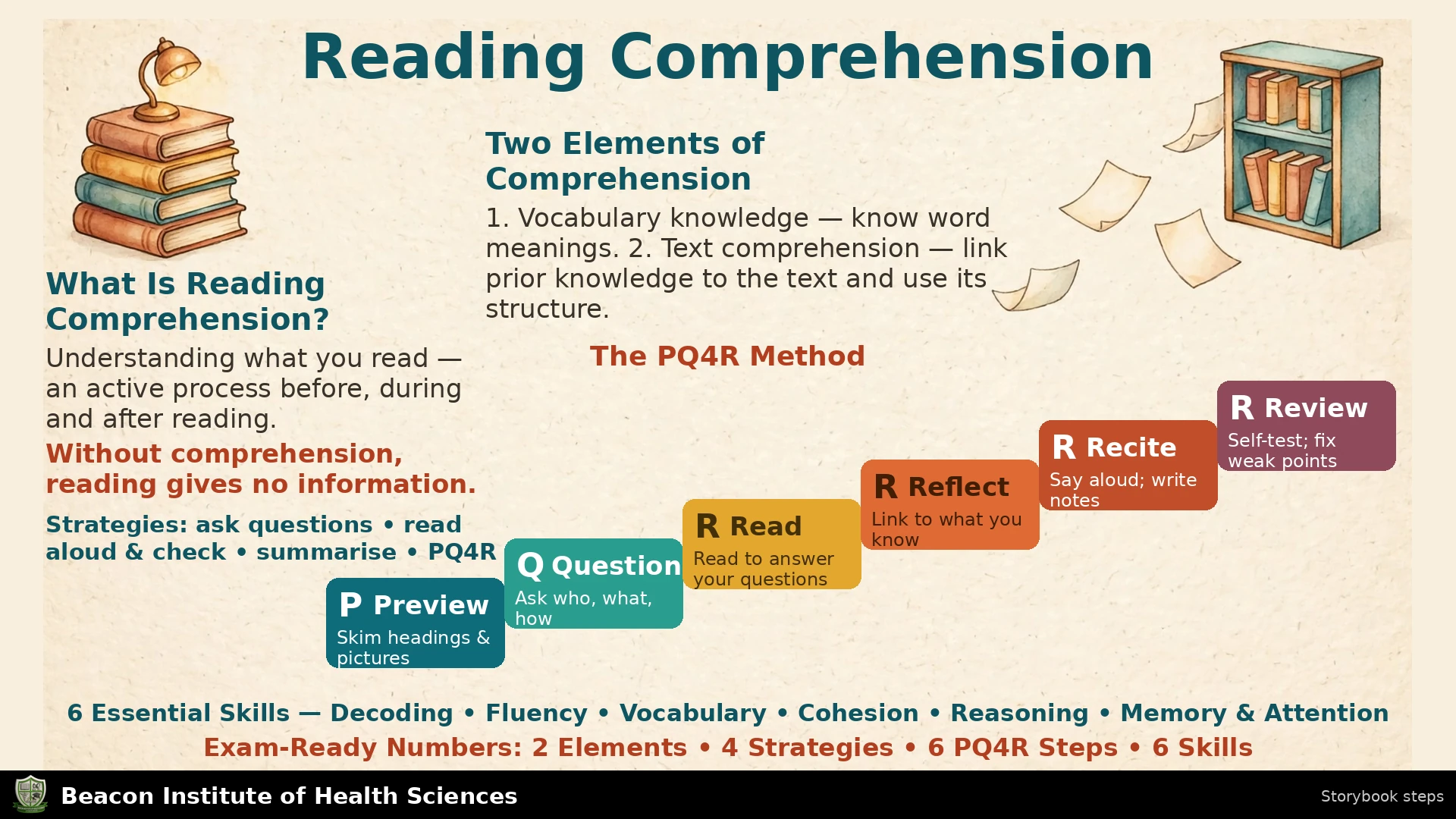
A practical routine is purpose, preview, questions, careful reading, recall, checking and summary. Use your questions to guide attention, but remain open to unexpected information. Divide a long reading into manageable sections and revisit passages that remain unclear. Choose suitable material for additional reading practice, gradually increasing difficulty.
Before submitting an answer, check the topic, main idea, supporting evidence, reference words, qualifications and inference limits. Ask whether the text actually supports your conclusion. For self-assessment, judge accuracy, explanation and source use rather than speed alone. The goal is a faithful, usable understanding of the writer's meaning.