
Introduction to Psychopharmacodynamics
For Bachelor of Science in Nursing (BSN) students and nursing educators, a comprehensive understanding of psychopharmacodynamics is fundamental to providing safe and effective care in mental health. This lesson delves into how psychotropic medications exert their effects at a cellular level, distinguishing these actions from how the body processes drugs, and outlines critical nursing considerations for patient monitoring and education.
Understanding Pharmacodynamics and Pharmacokinetics
The journey of a medication within the body involves two primary scientific disciplines: pharmacodynamics and pharmacokinetics. While often discussed together, they represent distinct aspects of drug action and processing.
Pharmacodynamics: Drug Action at Receptors
Pharmacodynamics refers to the study of what the drug does to the body. Specifically, it focuses on the molecular, biochemical, and physiological effects of drugs on cellular targets, primarily receptors. Psychotropic medications exert their therapeutic and adverse effects by interacting with specific receptors in the brain and nervous system. Understanding these interactions is crucial for comprehending drug mechanisms.
- Agonist: An agonist is a drug that binds to a receptor and produces a pharmacological response, mimicking the effect of an endogenous ligand (e.g., a neurotransmitter). It activates the receptor.
- Antagonist: An antagonist binds to a receptor but does not activate it. Instead, it blocks the action of agonists or endogenous ligands, preventing them from binding and eliciting a response.
- Partial Agonist: A partial agonist binds to a receptor and produces a sub-maximal response, even when all receptors are occupied. It acts as an agonist but with lower intrinsic activity than a full agonist.
Pharmacokinetics: What the Body Does to the Drug
In contrast to pharmacodynamics, pharmacokinetics describes what the body does to the drug. This involves the processes by which the body handles a medication from the moment it is administered until it is completely eliminated. The four main processes are:
- Absorption: The movement of the drug from its site of administration into the bloodstream.
- Distribution: The reversible transfer of a drug from the bloodstream into the interstitial and intracellular fluids.
- Metabolism: The biotransformation of the drug by the body, typically into more water-soluble compounds for easier excretion. The liver is the primary site of drug metabolism.
- Excretion: The elimination of the drug or its metabolites from the body, primarily through the kidneys in urine, but also via bile, feces, sweat, or breath.
Neurotransmitters and the Complexity of Mental Health
Neurotransmitters play a pivotal role in brain function and mood regulation. Many psychotropic medications target neurotransmitter systems. However, it is important to understand that mental health conditions, such as depression or anxiety, are not reducible to single chemical imbalance. Mental disorders involve interacting biological, psychological and social processes. A medicine can be helpful without proving that a particular neurotransmitter deficiency caused the illness.
Learning Objectives
- Distinguish drug action from drug handling.
- Explain receptor activation, blocking and partial activation.
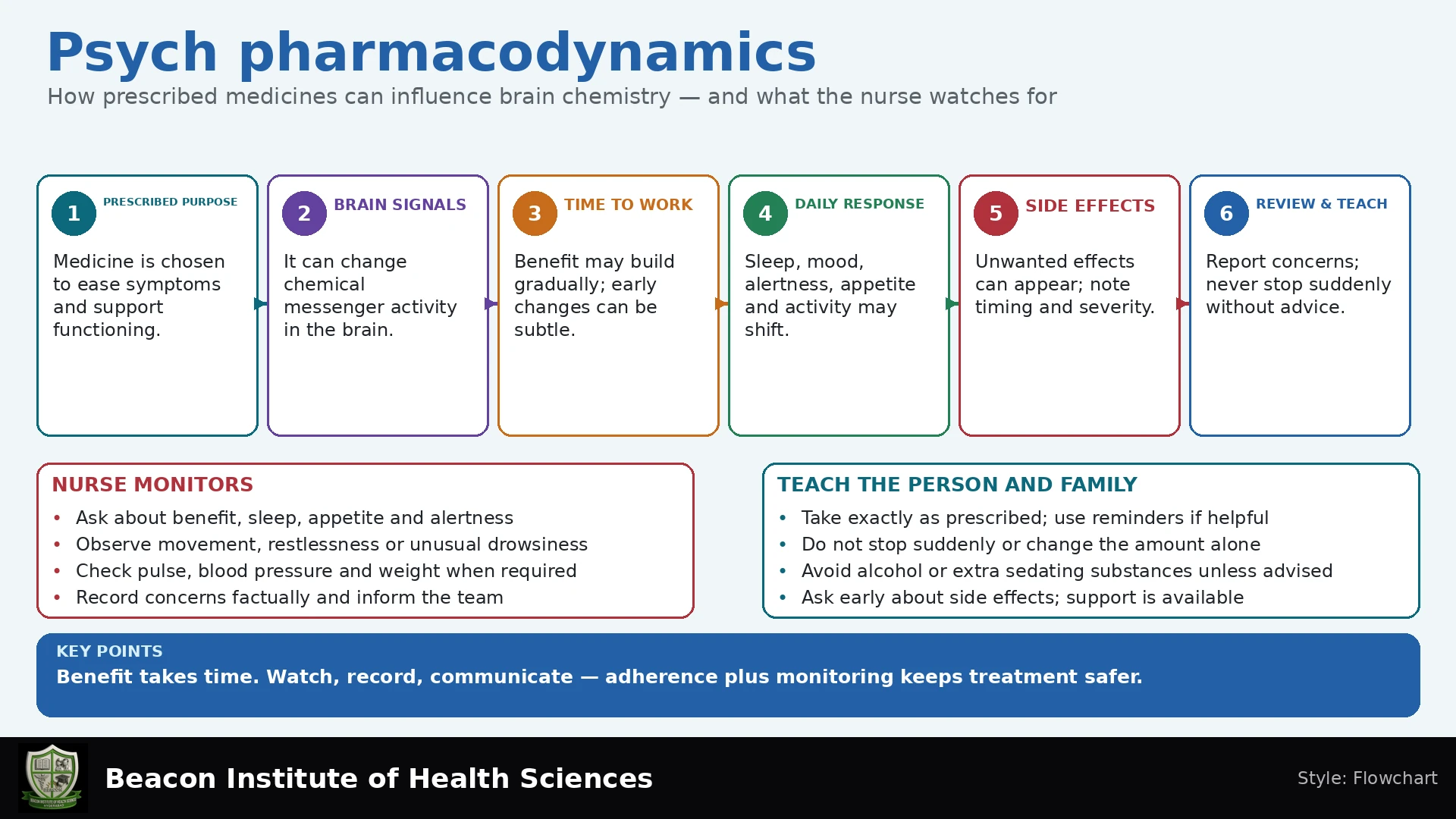
- Connect common psychotropic classes with nursing monitoring.
Actions and Clinical Monitoring
Not all targets are receptors: drugs may also act on transporters, enzymes and ion channels. Affinity describes binding; efficacy describes the response after binding. Potency refers to the amount needed for a specified effect and does not mean a medicine is clinically better. Dose-response relationships include both desired and unwanted effects. These concepts inform monitoring but do not replace an individualized prescription.
| Class | Broad action | Nursing focus |
|---|---|---|
| Antidepressants | Many alter serotonin or noradrenaline signaling, often through reuptake inhibition; mechanisms vary. | Monitor mood, sleep, activation, tolerability and safety, particularly after starting or changing treatment. Benefit commonly develops over weeks. |
| Antipsychotics | Many block dopamine receptors; some partially activate them. Other receptor actions vary by medicine. | Observe movement effects, restlessness, sedation and metabolic changes; follow the specific medicine's monitoring plan. |
| Benzodiazepines | Enhance GABA-A mediated inhibition. | Monitor sedation, coordination, respiratory risk and dependence. Alcohol or other sedatives can increase harm. |
| Mood stabilizers | Include medicines with different cellular actions, such as lithium and some anticonvulsants. | Follow drug-specific laboratory and clinical monitoring. Lithium has a narrow therapeutic margin and requires prescribed level, renal and thyroid monitoring. |
| Stimulants | Alter dopamine and noradrenaline signaling; drug mechanisms differ. | Monitor appetite, sleep, cardiovascular observations and growth in children as indicated. |
Safe Nursing Practice
Check the correct person, medicine, prescription, route, timing, allergies and relevant observations. Review other prescriptions, over-the-counter products and supplements with the team. Renal or hepatic changes can alter drug exposure; this is a pharmacokinetic issue that changes the clinical effect. Medication decisions in pregnancy, older age and childhood require individual review.
Teach the purpose of treatment, expected timing, common adverse effects, monitoring appointments and how to obtain advice. Use teach-back. Discuss concerns and barriers rather than describing a person as noncompliant. Do not advise abrupt stopping: withdrawal or relapse can follow, and changes should be planned with the prescriber. Benzodiazepine reduction in particular requires an individualized supervised plan.
Seek urgent clinical assessment for severe new reactions. Fever with rigidity and altered consciousness during antipsychotic treatment may indicate neuroleptic malignant syndrome. Agitation with fever, tremor or clonus after serotonergic medicines may indicate serotonin toxicity. New vomiting, marked tremor, confusion or unsteady walking during lithium treatment can raise concern about toxicity. These are warning presentations, not diagnoses from a checklist; activate the local urgent-response pathway and inform the team promptly.
Fictional Case and Explained Answers
Sara, 27, recently began a prescribed antidepressant. She reports nausea, disrupted sleep and disappointment that her mood has not improved after several days. She asks whether she should double the dose.
- How should the nurse respond? Explain that some adverse effects appear before benefits and that she should not change the prescription herself. Assess symptom severity, current mental state, safety and other medicines, and communicate concerns to the prescriber.
- What explains the delay? Immediate effects on signaling do not necessarily produce immediate clinical improvement. Ongoing adaptation and individual differences contribute to the treatment timeline.
- What needs urgent review? Severe agitation, emerging self-harm concerns or symptoms of a serious adverse reaction warrant prompt assessment. Arrange appropriate follow-up and agree on whom she will contact if concerns worsen.
Related Practice Quiz
The gallery quiz for Psych pharmacodynamics is currently unavailable. For related practice on combined treatment approaches, use the working Biopsychosocial Interventions Quiz. This is a related quiz, rather than a dedicated psychopharmacodynamics assessment.