
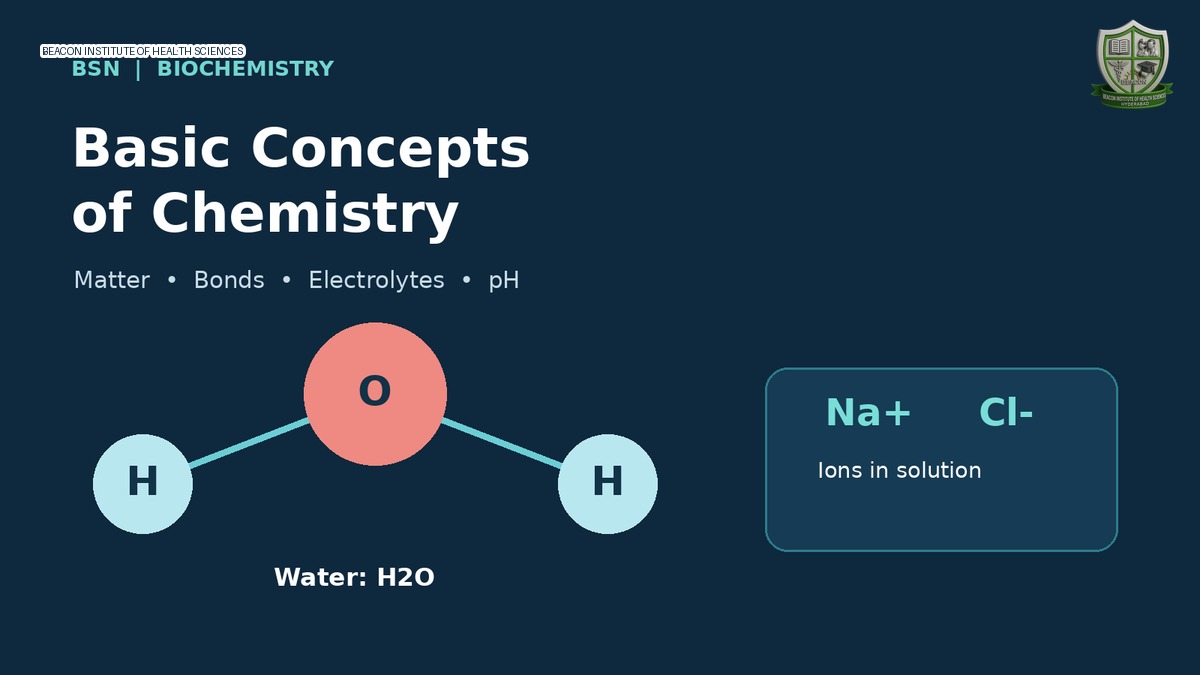
1. Chemistry and its place in nursing
Chemistry studies the composition, structure, properties and changes of matter, together with the energy involved in those changes. Biochemistry applies these principles to living systems. In a BSN program, chemistry provides the foundation for understanding body fluids, cellular activity, nutrition, metabolism, medicines and laboratory results.
A nurse encounters chemistry when reading a sodium or potassium result, checking an intravenous solution, observing changes in breathing associated with an acid-base disturbance, or explaining why glucose is an energy source. Understanding the underlying concepts makes these observations meaningful. A laboratory number represents the concentration or activity of a particular substance; it must be interpreted with its units, the laboratory reference interval and the patient's condition.
Properties and changes of matter
A physical property can be observed or measured without changing a substance into a different substance. Examples include colour, density, temperature, melting point, boiling point and solubility. A chemical property describes how a substance participates in reactions, such as its ability to burn, react with an acid or undergo oxidation.
A physical change alters the state, shape or size of matter while retaining its chemical identity. Melting ice produces liquid water; both are H2O. A chemical change produces different substances through changes in bonding. Rusting, combustion and the chemical reactions of digestion are examples. A change in colour, gas production, a precipitate or energy release can suggest a chemical reaction, but observations should be interpreted in context: boiling water produces bubbles through a physical change.
2. Matter, elements, atoms and compounds
Matter has mass and occupies space. Body tissues, blood, an oxygen cylinder and the air in a room contain matter. Mass is the amount of matter in an object. Weight is the gravitational force acting on that mass. Volume is the space occupied. Density relates mass to volume: density = mass / volume.
States of matter
- Solid: particles remain close together and have restricted movement. A solid generally retains its shape and volume.
- Liquid: particles remain close but can move past one another. A liquid retains its volume while taking the shape of its container.
- Gas: particles are widely separated and move freely. A gas expands to occupy its container and is much more compressible than a liquid or solid.
Heating generally increases particle motion. Cooling reduces it. Melting, freezing, evaporation and condensation are changes of state. Temperature, pressure and intermolecular attraction influence which state is present. Medical oxygen is stored under pressure because gases can be compressed; this does not make oxygen a different element.
Elements and chemical symbols
An element is a pure substance that cannot be separated into simpler substances by ordinary chemical reactions. Its identity is determined by the number of protons in its atoms. Symbols use an uppercase first letter and, where present, a lowercase second letter: C is carbon, Ca is calcium, Na is sodium and Cl is chlorine. Capitalisation matters.
Oxygen, carbon, hydrogen and nitrogen are major constituents of the human body. Calcium and phosphorus contribute to mineralised tissues. Sodium, potassium, chloride and magnesium have important physiological functions. Iron is a component of haemoglobin. The body's need for an element does not mean its pure elemental form is safe to administer; the chemical form and dose matter.
Atomic structure
- Proton: positively charged particle in the nucleus.
- Neutron: electrically neutral particle in the nucleus.
- Electron: negatively charged particle occupying regions around the nucleus.
A neutral atom has equal numbers of protons and electrons. Atomic number equals the number of protons. Mass number equals protons plus neutrons for a particular isotope. Electrons contribute very little to atomic mass. Atoms are not indivisible: they contain these smaller particles.
Isotopes are atoms of the same element with different numbers of neutrons. Carbon-12 and carbon-14 both have six protons, but different neutron numbers. An isotope may be stable or radioactive. Radioactive isotopes undergo nuclear decay and have medical uses in selected imaging and treatment procedures. Nuclear change is distinct from an ordinary chemical reaction, which primarily rearranges electrons and bonds.
Electron shells and valence
Electron shells represent energy levels, rather than literal circular tracks. The outermost occupied shell is the valence shell. Its electrons participate in bonding. For introductory examples, the first shell holds up to two electrons and the second up to eight. The familiar octet rule describes the tendency of many main-group atoms to achieve eight valence electrons, but it has exceptions and is not a rule that every shell can hold only eight.
Sodium has the simplified arrangement 2,8,1. Losing its outer electron gives a stable Na+ ion. Chlorine has 2,8,7; gaining an electron gives Cl-. Oxygen commonly forms two covalent bonds, hydrogen one and carbon four in basic biological examples. Valence describes combining capacity; it should not be confused with atomic number or the total number of electrons.
Molecules, compounds and formulas
A molecule consists of bonded atoms. O2 is a molecule of an element because both atoms are oxygen. H2O is a molecular compound because it contains hydrogen and oxygen. A compound contains two or more different elements chemically combined in a definite composition. Some compounds, including sodium chloride, form ionic lattices rather than separate molecules.
A subscript shows the number of atoms within a formula unit or molecule: H2O contains two hydrogen atoms and one oxygen atom; C6H12O6 contains six carbon, twelve hydrogen and six oxygen atoms. A coefficient counts complete units. Thus, 2H2O represents two water molecules, containing four hydrogen atoms and two oxygen atoms in total. Changing a subscript changes the substance; changing a coefficient changes its amount.
3. Mixtures, solutions, colloids and suspensions
A mixture contains substances physically combined without requiring a new chemical compound to form. Its composition can vary. Air is a mixture of gases. A homogeneous mixture is uniform at the scale being considered; a heterogeneous mixture contains distinguishable regions or dispersed particles.
Solutions and their components
A solution is a homogeneous mixture. The solvent is the dissolving medium and is usually the component present in the larger amount. The solute is the dissolved substance. In a salt solution, water is the solvent and salt supplies dissolved solute. An aqueous solution uses water as its solvent. Solutes can be solids, liquids or gases: dissolved salts, a water-alcohol mixture and dissolved oxygen illustrate these possibilities.
Water dissolves many ionic and polar substances because of its polarity. It is often called a universal solvent, but this does not mean that it dissolves everything. Nonpolar oils have poor solubility in water. Solubility is the amount that can dissolve under specified conditions. Concentration describes how much solute is present in a given amount of solution or solvent.
Comparing dispersed mixtures
- True solution: dissolved particles are individual ions or molecules. They do not settle under gravity, and ordinary filtration does not separate them. Examples include sodium chloride and glucose dissolved in water.
- Colloid: dispersed particles are larger than those in a true solution but small enough to remain distributed for a substantial time. Colloids scatter light, called the Tyndall effect. Their behaviour depends on particle properties and the surrounding medium.
- Suspension: larger particles are dispersed in another medium and may settle on standing. Many liquid medicines require shaking because settling can make the delivered dose uneven.
- Emulsion: droplets of one liquid are dispersed in another liquid with which it does not readily mix. Milk contains fat droplets dispersed in an aqueous phase. Emulsifiers can help stabilise these droplets.
Common introductory size bands are below about 1 nm for true solutions, about 1-1000 nm for colloids, and larger than about 1000 nm for suspensions. These are approximate teaching ranges, rather than universal diagnostic cutoffs. Whether particles cross a membrane depends on pore size, charge, chemical properties and the transport mechanisms of that membrane.
Blood illustrates why one biological material can display more than one mixture type. Plasma contains dissolved electrolytes and small molecules, proteins with colloidal behaviour, and suspended blood cells. Blood is therefore not adequately described as only a true solution. Separation by centrifugation depends on the components' physical properties.
Concentration and units
Mass/volume percentage expresses grams of solute per 100 mL of solution. A 0.9% w/v sodium chloride solution contains 0.9 g per 100 mL, equivalent to 9 g per litre. A 5% w/v glucose solution contains 5 g per 100 mL. These statements describe composition and do not, by themselves, determine whether a solution is appropriate for a particular patient.
Molarity is moles of solute per litre of solution. A mole is a standard amount of substance containing approximately 6.022 x 10^23 entities. Clinical results commonly use mmol/L. Milliequivalents incorporate ionic charge: mEq = mmol x absolute value of charge. Therefore, 1 mmol of Na+ equals 1 mEq, whereas 1 mmol of Ca2+ equals 2 mEq. Do not exchange mmol/L, mg/dL and mEq/L without the appropriate conversion.
4. Chemical bonds and intermolecular forces
Ionic bonding
An ion is an atom or group of atoms with a net electrical charge. Loss of electrons produces a positive ion, a cation. Gain of electrons produces a negative ion, an anion. The nucleus does not gain a proton simply because an atom loses an electron.
In the sodium chloride example, sodium transfers an electron to chlorine. The resulting Na+ and Cl- ions attract through electrostatic forces and form an ionic lattice. When sodium chloride dissolves in water, the ions become hydrated and dispersed. Dissolution is not a conversion of the sodium ion into the reactive sodium metal.
Covalent bonding
A covalent bond involves sharing an electron pair between atoms. One shared pair produces a single bond, two pairs a double bond and three pairs a triple bond. H2 has a single bond, O2 a double bond and N2 a triple bond. Sharing can stabilise both atoms without complete electron transfer.
Electronegativity is an atom's tendency to attract bonding electrons. In a nonpolar covalent bond, sharing is equal or nearly equal. In a polar covalent bond, unequal sharing creates partial charges. These partial charges are different from the full charges of separate ions. Water has polar O-H bonds and a bent molecular arrangement, producing an overall molecular dipole. HCl in its molecular form has a polar covalent bond; in water it ionises as a strong acid. It should not be used as the standard example of an ionic bond.
Bond polarity and overall molecular polarity are related but different. A molecule can contain polar bonds whose dipoles cancel because of its symmetrical arrangement. Numerical electronegativity cutoffs are useful introductory guides, not universal boundaries separating every ionic and covalent substance.
Intramolecular versus intermolecular attraction
Intramolecular bonds hold atoms together within a molecule. Intermolecular forces act between molecules and influence properties such as boiling point, viscosity, surface tension and solubility. Boiling water primarily separates water molecules from one another; it does not normally break each water molecule into hydrogen and oxygen.
- Hydrogen bonding: attraction involving hydrogen covalently bonded to a strongly electronegative atom, commonly oxygen, nitrogen or fluorine, and an electron-rich site. It occurs between water molecules and also helps stabilise biological structures.
- Dipole-dipole attraction: attraction between the partially positive region of one polar molecule and the partially negative region of another.
- London dispersion forces: attractions associated with temporary fluctuations in electron distribution. They occur in all atoms and molecules and are particularly important for nonpolar substances.
Hydrogen bonds help explain water's cohesion and thermal properties. They also contribute to protein structure and to pairing between complementary bases in DNA. A single interaction may be relatively weak, but many interactions together can provide substantial stability while still allowing reversible molecular changes.
5. Water, membranes and fluid movement
Water provides a medium for chemical reactions, transports dissolved substances and participates directly in reactions such as hydrolysis. Its heat capacity helps reduce rapid changes in body temperature. Evaporation of sweat transfers heat away from the body.
Intracellular fluid is inside cells. Extracellular fluid is outside cells and includes interstitial fluid and plasma. Sodium is the principal extracellular cation, while potassium is the principal intracellular cation. These are distributions, not statements that either ion is entirely absent from the other compartment.
Diffusion, osmosis and active transport
Diffusion is the net movement of particles down a concentration gradient. Oxygen and carbon dioxide move by diffusion across suitable biological barriers. Osmosis is the net movement of water through a selectively permeable membrane toward the side with the higher effective concentration of osmotically active solutes.
Active transport uses energy directly or indirectly to move substances against an electrochemical gradient. The sodium-potassium pump uses ATP to move three sodium ions out of a cell and two potassium ions into it during each cycle. Maintaining these gradients supports cellular electrical activity.
Osmolarity measures osmoles of particles per litre of solution; osmolality measures osmoles per kilogram of solvent. Tonicity describes a solution's effect on cell volume and depends especially on solutes that do not readily cross the relevant cell membrane. An isotonic environment causes no sustained net change in cell size. A hypotonic environment encourages water entry and swelling; a hypertonic environment encourages water exit and shrinkage. Equal measured osmolarity does not always mean equal tonicity if solutes can cross the membrane or are metabolised.
6. Electrolytes and physiological function
An electrolyte forms ions in solution, allowing electrical conduction. Sodium chloride separates into sodium and chloride ions. Glucose can dissolve without forming comparable quantities of ions and is a nonelectrolyte. A solution's electrical conductivity is therefore different from its total dissolved-solute concentration.
- Sodium, Na+: important in extracellular fluid balance and electrical signalling.
- Potassium, K+: important in membrane potential, nerve activity and skeletal and cardiac muscle function.
- Calcium, Ca2+: contributes to bone structure, muscle contraction, cellular signalling and blood clotting.
- Magnesium, Mg2+: supports many enzyme reactions and normal neuromuscular activity.
- Chloride, Cl-: a major extracellular anion involved in fluid and acid-base balance.
- Bicarbonate, HCO3-: central to extracellular acid-base buffering.
- Phosphate: occurs in several ionic forms and participates in buffering, energy metabolism and mineralised tissues.
Ion concentrations affect the electrical difference across cell membranes. Changes in this membrane potential support nerve impulses and muscle contraction. Potassium imbalance can disturb cardiac electrical activity even though only a small proportion of total body potassium is extracellular. Serum concentration and total body stores are related but are not interchangeable concepts.
Nursing assessment connects electrolyte results with intake, fluid losses, medicines, renal function and symptoms. Vomiting, diarrhoea and diuretic therapy can alter fluid or electrolyte balance. Changes in mental status, muscle strength or heart rhythm may be important cues. Blood pressure cannot be predicted from a sodium result alone: circulating volume, vascular resistance, cardiac function and other factors also influence it.
7. Acids, bases and pH
In the Brønsted-Lowry model, an acid donates a proton and a base accepts one. In aqueous chemistry, H+ is commonly used as shorthand for hydrated hydrogen ions. An Arrhenius acid increases hydrogen ion concentration in water, while an Arrhenius base increases hydroxide ion concentration. Hydroxide, OH-, can accept H+ to form water: H+ + OH- produces H2O.
An alkali is a water-soluble base. Sodium hydroxide, NaOH, and potassium hydroxide, KOH, are familiar examples. Not every base must contain an OH group: ammonia accepts a proton to form ammonium. Alkali and alkali metal are different terms; a metal in a periodic-table group is not itself the same thing as its hydroxide solution.
Strong, weak, concentrated and dilute
Acid strength describes the extent of ionisation, not simply how fast an acid appears to react. A strong acid such as HCl ionises essentially completely in dilute aqueous solution. A weak acid such as carbonic acid, H2CO3, ionises partially and establishes an equilibrium. Strong bases dissociate or react essentially completely under the relevant aqueous conditions; weak bases accept protons only partially.
Concentration describes the amount present. A dilute strong acid and a concentrated weak acid are possible. The terms strong and concentrated are therefore not synonyms. A conjugate base is the species left after an acid loses a proton. H2CO3 and HCO3- form an acid-conjugate-base pair.
The pH scale
For introductory calculations, pH = -log10[H+], where hydrogen ion concentration is expressed in mol/L. More precisely, pH is defined using hydrogen ion activity. The relationship is logarithmic: a decrease of one pH unit represents approximately a tenfold increase in hydrogen ion activity. A solution at pH 3 is about ten times more acidic in this sense than one at pH 4, and about one hundred times more than one at pH 5.
At 25 degrees Celsius, neutral pure water has pH 7. Solutions below 7 are acidic and those above 7 are alkaline at this temperature. Neutral pH changes with temperature. The common 0-14 scale is useful for introductory aqueous examples, but it is not an absolute limit for all solutions.
8. Buffers and acid-base homeostasis
A buffer resists a large pH change when a limited quantity of acid or base is added. It usually contains a weak acid and its conjugate base. The base component accepts added H+, while the acid component can provide H+ when base is added. Buffering does not eliminate the need to remove acid from the body, and a buffer's capacity is finite.
The bicarbonate system can be represented as: CO2 + H2O <=> H2CO3 <=> H+ + HCO3-. The lungs influence carbon dioxide through alveolar ventilation. The kidneys regulate hydrogen ion excretion and bicarbonate handling. This coordinated system is more informative than treating bicarbonate or carbon dioxide as an isolated number.
Phosphate buffering involves the H2PO4- / HPO4(2-) pair. Proteins also act as buffers because ionisable groups can accept or release protons. Haemoglobin provides important buffering in red blood cells. Chemical buffers respond promptly; respiratory changes can act relatively quickly, whereas full renal adaptation takes longer.
Arterial blood gas terminology and ranges
- Arterial pH: commonly 7.35-7.45.
- PaCO2: commonly 35-45 mmHg; the respiratory component.
- HCO3-: commonly about 22-26 mEq/L in introductory ABG interpretation; the metabolic component. Use the reporting laboratory's reference interval.
Acidaemia means the measured blood pH is below 7.35; alkalaemia means it is above 7.45. Acidosis and alkalosis describe processes that tend to lower or raise pH. Compensation or simultaneous processes can leave pH within the reference range even when an acid-base disorder exists.
Primary disturbances and compensation
- Respiratory acidosis: a primary increase in PaCO2 tends to lower pH. Renal compensation increases bicarbonate retention.
- Respiratory alkalosis: a primary decrease in PaCO2 tends to raise pH. Renal compensation reduces bicarbonate.
- Metabolic acidosis: a primary decrease in bicarbonate tends to lower pH. Respiratory compensation lowers PaCO2 through increased ventilation.
- Metabolic alkalosis: a primary increase in bicarbonate tends to raise pH. Respiratory compensation tends to increase PaCO2, within physiological limits.
Compensation opposes the pH disturbance; it does not mean the underlying cause has been corrected. Mixed disorders require assessment of whether compensation is appropriate. A normal pH alone cannot exclude a mixed disorder.
Worked introductory interpretations
Example 1: pH 7.28, PaCO2 55 mmHg and HCO3- 25 mEq/L. The pH shows acidaemia. The increased PaCO2 explains the direction of the pH change, supporting a primary respiratory acidosis. Clinical assessment must determine why ventilation is inadequate.
Example 2: pH 7.30, PaCO2 32 mmHg and HCO3- 16 mEq/L. The reduced bicarbonate supports metabolic acidosis. The lower PaCO2 moves pH toward normal and suggests respiratory compensation. Formal expected-compensation calculations and clinical context are needed before excluding an additional disturbance.
Example 3: pH 7.50, PaCO2 40 mmHg and HCO3- 30 mEq/L. The pH shows alkalaemia and elevated bicarbonate supports metabolic alkalosis. A patient history, including gastrointestinal losses and medicines, helps identify the cause. These examples teach interpretation; they do not determine a treatment from three numbers alone.
9. Chemical reactions and energy
A chemical reaction rearranges atoms through the breaking and formation of bonds. Reactants are the starting substances and products are the substances formed. An equation uses an arrow to show direction. In an ordinary reaction, atoms are conserved, so a balanced equation has the same number of each type of atom on both sides.
To balance an equation, identify the formulas, count each element on both sides, adjust coefficients and recount. Do not change subscripts to force a balance. For hydrogen reacting with oxygen, 2H2 + O2 produces 2H2O: four hydrogen and two oxygen atoms are present on each side.
Common reaction classes
- Synthesis: smaller components combine. General form: A + B produces AB. Protein synthesis joins amino acids into polypeptides. A simple balanced inorganic example is 2Na + Cl2 producing 2NaCl.
- Decomposition: a substance separates into simpler products. General form: AB produces A + B. For example, 2H2O2 produces 2H2O + O2.
- Single displacement: one element replaces another in a compound. General form: A + BC produces AC + B. Whether this occurs depends on chemical reactivity.
- Double displacement: components of two compounds exchange partners. General form: AB + CD produces AD + CB. Precipitation and many neutralisation reactions can fit this pattern.
- Neutralisation: an acid and a base react. HCl + NaOH produces NaCl + H2O. The net reaction between hydrogen and hydroxide ions forms water.
- Combustion: reaction with oxygen releases energy. Complete combustion of methane is CH4 + 2O2 producing CO2 + 2H2O. Not every oxidation reaction is combustion.
Digestion commonly uses hydrolysis: water participates in splitting a bond. Building larger biological molecules may involve condensation reactions. Metabolism includes catabolism, which breaks down molecules, and anabolism, which builds them. Enzymes allow these reactions to proceed under the body's conditions.
Reversibility and reaction rate
A reversible reaction proceeds in both directions and can be shown with opposing arrows. At dynamic equilibrium, forward and reverse rates are equal; reactions have not stopped and the concentrations need not be equal. Changes in concentration, temperature or other conditions may shift the equilibrium.
Reaction rate depends on factors including temperature, reactant concentration, accessible surface area and catalysts. Enzymes are biological catalysts that reduce the activation-energy barrier. They do not change the equilibrium position or turn an energetically unfavourable overall reaction into a favourable one merely by being present. Enzyme function also depends on conditions such as pH and temperature.
Energy changes
Kinetic energy is associated with motion; potential energy is associated with position or arrangement. Cells convert chemical energy into movement, electrical activity and heat. Breaking a chemical bond requires energy, while forming a bond releases energy. The net energy change depends on all bonds broken and formed, not on bond breaking alone.
Exergonic reactions have a favourable net free-energy change; endergonic reactions require energy input. Exothermic and endothermic refer specifically to heat release and absorption. ATP helps couple energy-releasing processes to energy-requiring cellular work. Energy is transformed rather than created from nothing.
10. Oxidation, reduction and biological electron transfer
Oxidation is loss of electrons; reduction is gain of electrons. The mnemonic OIL RIG means Oxidation Is Loss, Reduction Is Gain. These processes occur together because an electron donor must have an electron acceptor. A substance that causes another to be oxidised is an oxidising agent and is itself reduced. A reducing agent donates electrons, reduces another substance and is itself oxidised.
For example, Zn + Cu2+ produces Zn2+ + Cu. Zinc loses two electrons and is oxidised; copper ions gain those electrons and are reduced. Zinc is the reducing agent and Cu2+ the oxidising agent. In biochemical contexts, oxidation often corresponds to loss of hydrogen or gain of oxygen, but electron accounting is the general definition.
Oxidation number is a formal bookkeeping value used to track electron redistribution. It is not always a real ionic charge: atoms in covalent compounds can have oxidation numbers without existing as isolated ions. An increase in oxidation number indicates oxidation, and a decrease indicates reduction.
Cellular respiration transfers electrons from nutrients through a sequence of reactions. NAD+ accepts reducing equivalents to form NADH; NADH can subsequently be oxidised back to NAD+. Related carriers link nutrient metabolism with ATP production. The overall aerobic oxidation of glucose can be written as C6H12O6 + 6O2 producing 6CO2 + 6H2O, with energy transferred to ATP and released as heat. This overall equation represents many enzyme-controlled steps rather than glucose burning in one flame inside a cell.
11. Free radicals and antioxidants
A free radical contains one or more unpaired electrons. Radicals can arise during normal metabolism and from exposures such as ionising radiation or tobacco smoke. Some participate in normal cell signalling and immune defence. Excess production or inadequate control can damage DNA, proteins and membranes.
Reactive oxygen species include radical and nonradical reactive oxygen-containing substances; not every reactive oxygen species is a free radical. Oxidative stress describes an imbalance between oxidant production and protective systems. It should not be described as the sole cause of every cancer or degenerative disease.
Antioxidants limit harmful oxidation through several mechanisms. Vitamins C and E have antioxidant functions, while the body also uses enzyme systems such as superoxide dismutase and catalase. Antioxidant activity in a chemical system does not prove that high-dose supplements prevent disease. Cancer-prevention trials have not established a general benefit from antioxidant supplements, and some supplements can interfere with cancer treatment. Nurses should document supplement use and communicate it to the treating team.
12. Applying chemistry during nursing study and assessment
Connecting observations with mechanisms
A suspension medicine: particles may settle while the bottle stands. Following the product's mixing instructions helps distribute the drug before measuring the prescribed dose. The chemical classification explains why an apparently uniform liquid can become uneven.
Fluid loss: vomiting or diarrhoea can change both water and electrolyte balance. The nurse connects the history with fluid intake and output, vital signs, weight trends and ordered laboratory results. The chemical mechanism helps explain why replacing water alone does not always correct the problem.
An altered respiratory pattern: changes in alveolar ventilation alter carbon dioxide and can affect pH. Breathing assessment and ABG interpretation therefore belong together. The direction of a compensatory respiratory change should be distinguished from the original cause of the disturbance.
A potassium result: the ion's role in membrane potential explains why a substantial abnormality can have electrical and muscular consequences. Interpretation also considers renal function, medicines, trends and whether the specimen is reliable. A concentration result is not a direct measurement of total body potassium.
A systematic approach to laboratory information
- Identify the substance measured and whether the specimen is arterial blood, venous blood, serum, plasma or urine.
- Read the unit and the reference interval printed with the result.
- Compare the value with previous results and the patient's symptoms and assessment findings.
- Consider related measurements: interpret pH with PaCO2 and bicarbonate, and fluid status with intake, output and other clinical observations.
- Recognise significant abnormalities and communicate findings through the clinical escalation process.
- Use the prescribed care plan and institutional procedures for interventions and monitoring.