
Learning Objectives
Upon completion of this lecture, BSN students and nursing educators will be able to:
- Explain the distinct characteristics of primordial, primary, secondary, tertiary, and quaternary prevention.
- Distinguish between health promotion and specific protection within primary prevention.
- Differentiate between screening and diagnosis in the context of secondary prevention.
- Describe and compare population-based and high-risk strategies for prevention.
- Analyze the role of social determinants of health, equity, and informed consent in preventive healthcare.
- Apply the levels of prevention to both communicable and noncommunicable disease examples.
- Discuss nursing applications across all levels of prevention.
- Evaluate basic components of a prevention program using provided metrics.
Understanding the Levels of Prevention
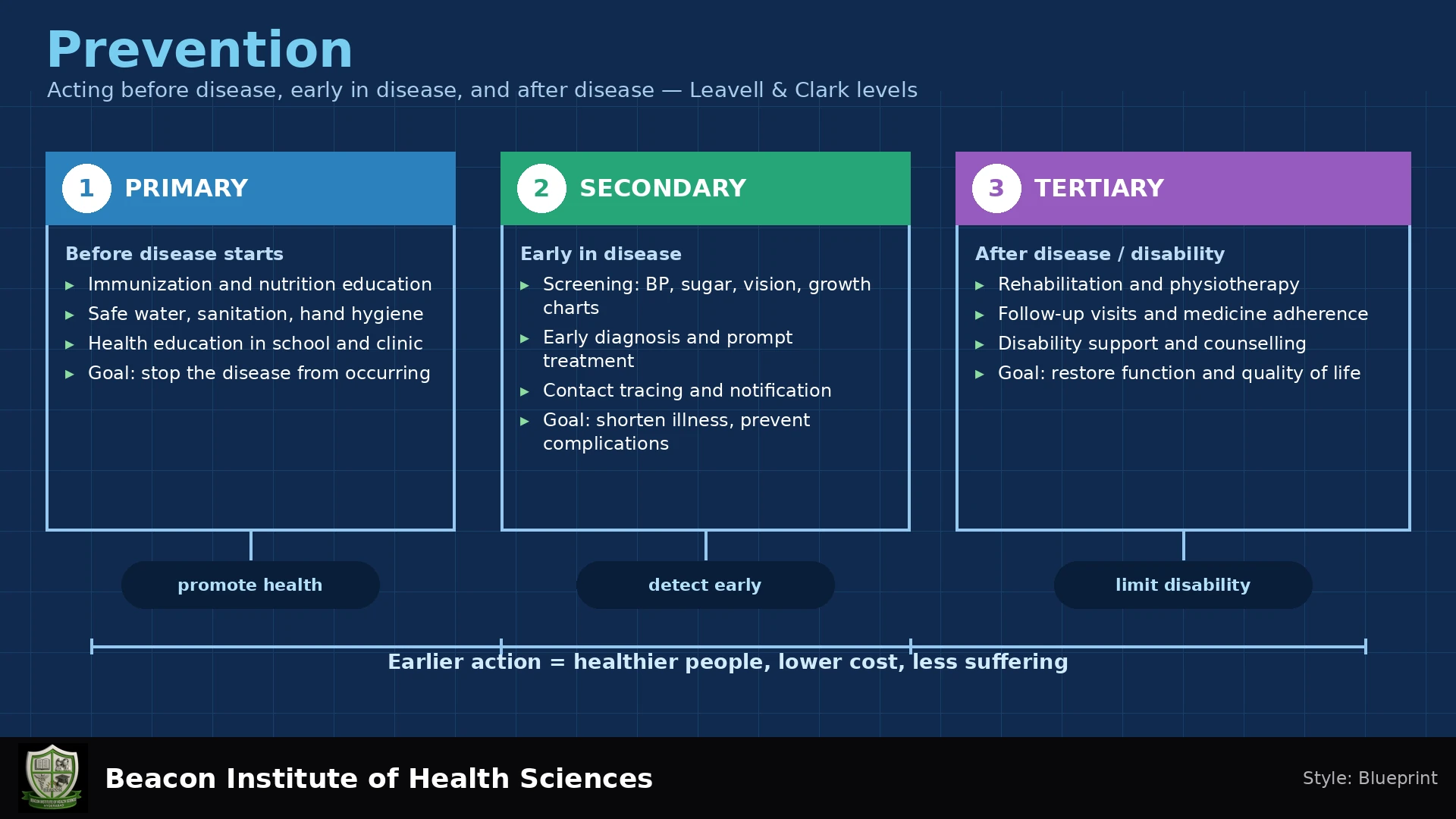
Prevention is a cornerstone of public health and nursing practice, aiming to minimize the burden of diseases and associated risk factors. It encompasses a spectrum of activities categorized into distinct levels based on the stage at which intervention occurs relative to disease development.
Primordial Prevention
Primordial prevention represents the earliest stage of prevention, focusing on preventing the emergence and establishment of environmental, economic, social, and behavioral conditions and policies that are known to increase the risk of disease. The target for primordial prevention is not a specific disease or a risk factor, but rather the underlying conditions that lead to the development of risk factors. This approach operates at a population level, often through public policy and legislation.
Primary Prevention
Primary prevention aims to reduce the incidence of disease by preventing its onset in healthy individuals. It targets individuals or populations who are susceptible to a disease but have not yet developed it. The goal is to avoid the initial occurrence of disease by eliminating causative agents or increasing resistance to disease.
Health Promotion
Health promotion supports overall health and well-being. It contributes to primary prevention but also applies to people living with disease and disability. It involves educating and empowering individuals and communities to increase control over their health and its determinants. Activities include health education, lifestyle modification counseling, and advocating for policies that support healthy environments.
Specific Protection
Specific protection involves targeted interventions designed to protect against particular diseases or health problems. These measures are often direct and involve specific actions to avert a disease. Examples include immunizations against infectious diseases, water fluoridation to prevent dental caries, and the use of seatbelts to prevent injuries from accidents.
Secondary Prevention
Secondary prevention focuses on early detection and prompt treatment of existing diseases to halt their progression, prevent complications, or shorten their duration. The goal is to minimize the impact of a disease once it has occurred. This level of prevention is applied to individuals who have developed a disease but may be asymptomatic or in the early stages.
Screening vs. Diagnosis
Within secondary prevention, screening refers to the presumptive identification of unrecognized disease or defects by applying tests, examinations, or other procedures that can be applied rapidly. Screening is typically performed on apparently healthy, asymptomatic individuals to identify those who may have the disease, prompting further diagnostic tests. In contrast, diagnosis is the process of identifying a disease or condition by its signs and symptoms, typically performed on individuals presenting with symptoms or following a positive screening result. It involves detailed investigations to confirm the presence of disease and specify its nature. It is important to note that while screening is a key component of secondary prevention, in clinical cardiology, preventing recurrent events in patients with established cardiovascular disease is also often classified as secondary prevention, distinct from initial screening efforts.
Tertiary Prevention
Tertiary prevention occurs after a disease is well-established and aims to reduce the impact of the disease, minimize disability, prevent further complications, and improve the patient's quality of life. It focuses on rehabilitation and management of the disease to restore optimal function and reduce dependency. This level of prevention helps individuals live as fully as possible with their chronic conditions.
Quaternary Prevention
Quaternary prevention is a relatively newer concept focused on identifying patients at risk of over-medicalization, protecting them from new medical interventions that are unnecessary or harmful, and suggesting ethically acceptable alternatives. It emphasizes avoiding iatrogenic harm, advocating for appropriate care, and recognizing the limits of medical intervention.
Comparison of Prevention Levels
| Prevention Level | Goal | Target Group | Key Activities/Examples |
|---|---|---|---|
| Primordial | Prevent emergence of risk factors | Entire population/generations | Public policies (e.g., healthy food environment, reducing pollution) |
| Primary | Prevent disease onset | Healthy, susceptible individuals/population | Health education, vaccinations, specific safety measures |
| Secondary | Early detection and prompt treatment | Individuals with unrecognized or early-stage disease | Screening programs (e.g., blood pressure, mammography), early intervention |
| Tertiary | Reduce impact, minimize disability | Individuals with established disease | Rehabilitation, chronic disease management, pain control |
| Quaternary | Protect from over-medicalization | Patients at risk of unnecessary or harmful interventions | Ethical practice, shared decision-making, avoiding iatrogenesis |
Strategies for Prevention
Two main strategies are employed in preventive healthcare:
Population-Based Strategy
The population-based strategy targets the entire population or large segments of it. It aims to shift the average risk of a population by implementing measures that result in a small reduction in risk for many people. This approach is often cost-effective for common diseases, even if the individual benefit is small, because the cumulative effect across a large population is substantial.
High-Risk Strategy
The high-risk strategy focuses on identifying individuals who are at a high risk of developing a particular disease and then offering them targeted interventions. This approach is more individualized and can be highly effective for the specific individuals identified. However, it may miss many individuals who are not classified as high-risk but still contribute significantly to the overall disease burden within the population.
Contextual Factors in Prevention
Effective prevention is not merely about medical interventions; it is deeply intertwined with broader societal and ethical considerations.
Social Determinants of Health
Social determinants of health are the non-medical factors that influence health outcomes. These include conditions in which people are born, grow, live, work, and age, and the wider set of forces and systems shaping the conditions of daily life. Factors such as socioeconomic status, education, housing, access to healthy food, and safe environments profoundly impact individuals' ability to engage in preventive behaviors and access preventive services.
Equity in Prevention
Equity in prevention means striving for fair and just distribution of preventive resources and opportunities across all population groups. It involves addressing health disparities that arise from social, economic, environmental, and structural disadvantages, ensuring that vulnerable populations have equitable access to effective preventive interventions, not just equal access.
Informed Consent in Preventive Measures
For individual preventive care, informed consent is an essential ethical requirement; legal requirements depend on the intervention and jurisdiction. It requires that individuals understand the purpose, benefits, risks, and alternatives of a preventive intervention and voluntarily agree to participate without coercion. This is particularly crucial for screening programs or vaccinations, where patient autonomy must be respected.
Examples of Prevention in Communicable and Noncommunicable Diseases
Communicable Disease Examples
- Primordial: Implementing policies for universal access to clean water and sanitation to prevent conditions conducive to waterborne diseases.
- Primary: Routine childhood immunization programs (e.g., measles, polio) and promoting hand hygiene to prevent the spread of infections.
- Secondary: Offering appropriate testing and follow-up to contacts of a diagnosed infection under the relevant programme. Testing and management depend on the disease and current guidance.
- Tertiary: Rehabilitation for individuals recovering from severe infections, such as physical therapy after a stroke caused by meningitis, or managing chronic symptoms of HIV/AIDS.
- Quaternary: Avoiding unnecessary antibiotic prescriptions for viral infections to prevent antibiotic resistance, thus protecting the patient and population from potential future harm.
Noncommunicable Disease Examples
- Primordial: Urban planning that promotes active transport (walking, cycling) to prevent sedentary lifestyles, or policies regulating marketing of unhealthy foods to children.
- Primary: Public health campaigns encouraging healthy diets and regular physical activity to prevent obesity and type 2 diabetes; smoking cessation programs.
- Secondary: Regular blood pressure screenings for hypertension or mammography screenings for breast cancer among asymptomatic individuals. In cardiology, managing lipid levels and blood pressure aggressively in a patient with a history of myocardial infarction to prevent a second event is secondary prevention.
- Tertiary: Cardiac rehabilitation programs for patients post-myocardial infarction, physical therapy for individuals with osteoarthritis, or diabetes education to prevent complications.
- Quaternary: Advocating against aggressive and potentially harmful screening or treatment for prostate cancer in elderly men with limited life expectancy, where the intervention's harms may outweigh its benefits.
Nursing Applications in Prevention
Nurses are frontline healthcare providers and play a crucial role across all levels of prevention:
- Primordial: Nurses advocate for policies that promote healthy environments and social equity, participating in community health needs assessments to identify underlying risk conditions.
- Primary: Nurses provide health education on nutrition, exercise, and safety; administer immunizations; counsel on lifestyle modifications; and promote protective behaviors.
- Secondary: Nurses conduct health screenings (e.g., blood pressure, glucose, vision); perform detailed assessments to identify early signs of disease; provide patient education on adherence to early treatment regimens; and facilitate referrals for diagnostic evaluations.
- Tertiary: Nurses manage chronic conditions, provide rehabilitation support, educate patients and families on self-care, coordinate care with multidisciplinary teams, and support patients in adapting to chronic illness.
- Quaternary: Nurses engage in shared decision-making with patients, question the necessity of certain medical interventions, advocate for patient-centered care, and promote ethical considerations in treatment planning to prevent iatrogenic harm.
Fictional Worked Programme Evaluation
Consider a community health program aimed at improving vaccination rates and early disease detection:
- Vaccination Coverage Metric: Out of 100 eligible children in a target community, 80 received their age-appropriate vaccinations. The vaccination coverage rate is calculated as (80 vaccinated / 100 eligible) * 100% = 80%.
- Screening Follow-up Metric: Out of 20 individuals who had a positive result on a preliminary health screening (e.g., for hypertension), 15 received follow-up diagnostic evaluations. The follow-up rate is (15 followed up / 20 positive screens) * 100% = 75%.
These metrics provide an indication of program reach and process efficiency. This evaluation presents process measures but makes no causal effectiveness claim regarding disease incidence reduction from these specific figures.
Practice Questions
A community nurse is involved in a program that promotes active transport (walking, cycling) through urban planning initiatives. Which level of prevention is this activity primarily addressing?
Answer: This is an example of Primordial Prevention. By preventing the establishment of sedentary lifestyles, the program aims to avert the emergence of risk factors for noncommunicable diseases like obesity and cardiovascular disease, even before specific risk factors appear.
A 55-year-old patient with a history of hypertension and hyperlipidemia is enrolled in a cardiac rehabilitation program after experiencing a myocardial infarction. This program includes supervised exercise, dietary counseling, and medication management. Which level of prevention does this represent?
Answer: This represents Tertiary Prevention. The patient already has an established disease (history of myocardial infarction) and chronic conditions (hypertension, hyperlipidemia). The cardiac rehabilitation program aims to minimize the impact of the disease, prevent further complications, and improve quality of life and functional ability.
What is the key difference between 'health promotion' and 'specific protection' within primary prevention?
Answer: Health promotion involves broad strategies to enhance overall health and well-being, such as general health education about healthy lifestyles. Specific protection involves targeted interventions against particular diseases or health problems, such as immunizations or wearing seatbelts. Health promotion is general wellness, specific protection is targeted defense.
A mass screening program is implemented to identify individuals with elevated blood glucose levels in an apparently healthy adult population. Those with positive results are referred for definitive diagnostic testing. This screening activity falls under which level of prevention?
Answer: This activity falls under Secondary Prevention. The goal of screening is early detection of a possible disease or elevated risk (an abnormal glucose result may indicate diabetes or an intermediate high-risk state) in asymptomatic individuals, allowing for prompt intervention to prevent its progression or complications.
A physician consciously decides against prescribing a broad-spectrum antibiotic for a patient presenting with symptoms highly suggestive of a viral infection, citing concerns about antibiotic resistance and potential side effects for the patient. This decision aligns with which level of prevention?
Answer: This decision aligns with Quaternary Prevention. The physician is protecting the patient from potentially unnecessary or harmful medical intervention (antibiotic in a viral infection) and considering broader public health implications (antibiotic resistance), thereby avoiding over-medicalization.
Conclusion
Understanding the distinct levels of prevention – primordial, primary, secondary, tertiary, and quaternary – is fundamental for BSN students and nursing educators. These levels provide a structured framework for conceptualizing how health interventions can be applied across the disease continuum, from preventing the very emergence of risk factors to managing established conditions and guarding against iatrogenic harm. Nurses are integral to implementing these prevention strategies, applying them through health promotion, specific protection, screening, rehabilitation, and advocating for patient safety and appropriate care. Recognizing the influence of social determinants of health, promoting equity, and upholding informed consent are crucial for the ethical and effective delivery of preventive healthcare services, ultimately contributing to healthier individuals and communities.